
Count the logins at a typical mid-market PE firm. A CRM for relationships. A pipeline tracker for deals. A data room provider, sometimes two. A CIM screening tool someone on the deal team found last year. A portfolio monitoring platform. An LP reporting portal. A meeting-notes app. Two or three AI assistants that different partners pay for on their own cards.
Each one was bought for a good reason. Together, they describe the state of private equity technology in 2026: more capable than ever, and less connected than it should be. Every tool solves its own problem. None of them solves the firm’s.
The private equity technology decision most firms face this year is not which tool to add next. It is whether to keep buying point tools or to run the firm on one operating system. This piece lays out the difference, where each approach makes sense, and how to tell whether a vendor is AI-native or just AI-washed.
Key Takeaways
- Most PE firm stacks are a set of point tools joined by manual handoffs, and the handoffs, not the licenses, are the real cost.
- Deloitte’s 2026 Pulse Study found fewer than one-third of M&A organizations have fully integrated their AI tools, and advises fixing architecture before adding point solutions.
- An operating system differs on three properties: standardized outputs, memory across deals and companies, and supervised autonomous execution.
- Keep specialist systems of record such as fund accounting and the data room, and connect them to one operating layer for everything else.
What Does the Typical PE Tech Stack Look Like in 2026?
Private equity technology is the software a firm uses to run itself, and it breaks into five workflows: sourcing and screening, diligence, portfolio oversight, LP reporting, and the firm’s own internal knowledge. Most firms have at least one product in each, and often several.
The problem is not any single product. It is what happens at the seams. A CIM screened in one tool gets retyped into the deal database. Diligence findings live in a data room export that never reaches the value-creation plan. Portfolio KPIs arrive in a different format from every company, and an associate normalizes them in a spreadsheet before they reach portfolio reporting. The LP report is assembled by hand from all of the above, every quarter.
The subscription line is the smallest part of the cost. The larger part is analyst time spent moving data between tools, the errors introduced every time a figure is retyped, and the partner hours lost when two systems disagree and nobody knows which one is right. Those costs rarely show up in a technology budget. They show up as slower screening, later LP reports, and deal teams that spend Sunday night reconciling spreadsheets.
Each handoff is small. Together they are where a firm’s analysts actually spend their time, and they are why ad-hoc AI costs more at the deal-ops level than the subscription line suggests.
Why Do Point Tools Stop Compounding?
Point tools deliver a quick win and then flatten out. There are three reasons.
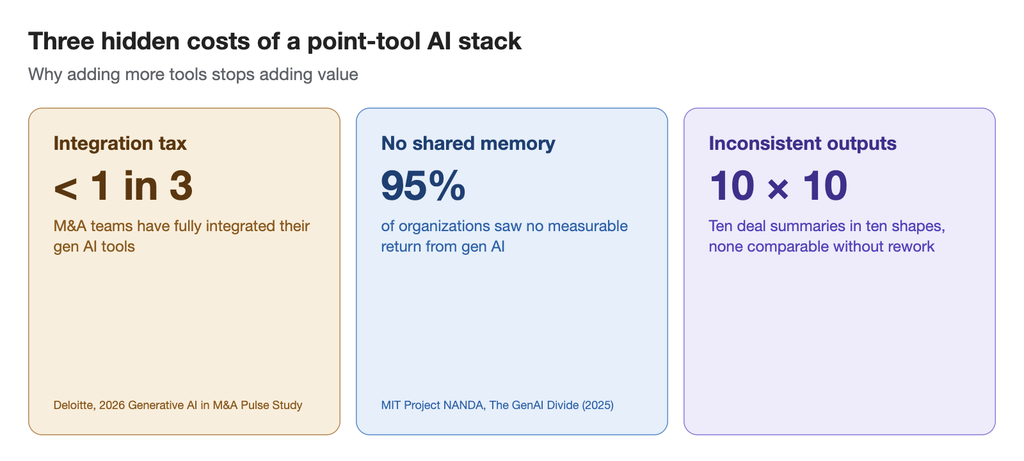
The result is a private equity technology stack that costs more every year and gets no smarter.
Most PE AI Tools Are Wrappers. That Is Not the Real Problem
Much of the new private equity software on the market is a thin interface over the same few large language models, a point we made at length in Private Equity Software Is Crowded. Most of It Is a Wrapper. That is true, but it is easy to draw the wrong conclusion.
Using a foundation model is not a flaw. Everyone serious builds on one. The flaw is that each wrapper holds its own slice of context, produces its own outputs, and forgets everything between sessions. Buying five wrappers does not give a firm five times the intelligence. It gives the firm five places where the same deal is described five different ways.
So the useful question is not whether a product is a wrapper. It is what the product connects to, what it remembers, and what it does without being asked.
What Makes an Operating System Different?
An operating system is a different category of private equity technology: one environment where the firm’s workflows run on shared records. Three properties define it.
Standardized outputs. Every CIM screen, diligence tracker, portfolio update, and LP report follows the same structure. Comparisons are instant because the formats already match.
Memory. The system carries context across deals, companies, and time. What the firm learned in one diligence informs the next screen. What a board agreed sits next to the KPIs it was meant to move.
Supervised autonomous execution. Agents do the recurring work (screening, extraction, reconciliation, report assembly, follow-up) on a schedule or a trigger, and a senior operator reviews and owns the result. The firm stops asking a tool for help and starts reviewing work that is already done.
| Dimension | Point Tools | Operating System |
| Data | Separate store per tool | Shared records across workflows |
| Outputs | Different format per tool | Standardized across deals and companies |
| Memory | Resets per session or per tool | Accumulates across the firm |
| Execution | Waits for a prompt | Runs recurring work under human supervision |
| Integration | Custom connectors or manual handoffs | Native |
| Value over time | Flat after adoption | Compounds with use |
This is the model behind Growth OS, the AI-native operating platform Azarian Growth Agency runs for PE firms: more than 150 specialized agents and 50-plus connectors, each agent supervised by a senior operator who owns the outcome, running the firm’s workflows on one set of records from CIM screening to one commercial view across every portfolio company.
Map your stack against one system. We will walk through your current tools, workflow by workflow, and show where handoffs cost your team time.
Compare your current stack
When Does Buying Point Tools Still Make Sense?
Not every private equity technology decision should end in a platform. A credible answer includes the cases where point tools are the right call.
Regulated systems of record. Fund accounting, fund administration, and the data room itself carry audit, compliance, and counterparty requirements. These are usually best bought from specialists and connected to, not rebuilt.
Narrow, stable tasks. If a workflow is well defined and rarely changes, a mature tool that does one thing reliably may be all you need.
Very small teams. A firm with a handful of deal professionals and a single fund may not feel the integration tax yet. The case for an operating system strengthens with every added fund, portfolio company, and workflow.
There is also a sequencing argument. A firm that has not yet standardized how it screens deals or reports on its portfolio may get real value from a good point tool first, simply because it forces a process where none existed. The mistake is treating that tool as the end state rather than a step toward shared records.
The practical model for most firms is a hybrid. Keep specialist systems of record where regulation or counterparties require them. Run everything that touches the firm’s own judgment and knowledge (screening, diligence analysis, portfolio oversight, reporting) on one system that connects to them.
How Should a PE Firm Decide? Five Questions to Ask
Before the next private equity technology purchase, run it through five questions.
- Does it remove a handoff or add one? If someone has to move its output into another system, it adds a seam.
- Where does its memory live? If context disappears when the session ends, the firm is renting speed, not building an asset.
- Will its outputs match the rest of the firm’s? A new format is a new reconciliation job.
- Who supervises the work? Autonomous execution without a named human owner is a risk, not a feature.
- What does year three look like? Point tools tend to look best in month one. Systems should look better every quarter.
Bain’s Global Private Equity Report 2026 frames the moment well: today’s deals demand faster EBITDA growth, and winning firms will build systems, not slogans. That applies to the firm’s own operations as much as to its portfolio.
AI-Native vs. AI-Washed: How Can You Tell the Difference?
Every vendor now describes itself as AI-powered. A few tests cut through the language.
Ask what it does when nobody is logged in. AI-native systems run recurring work on their own schedule. AI-washed tools wait for a prompt.
Ask to see yesterday’s output next to last quarter’s. If the formats differ, there is no standardization underneath.
Ask what it learned from the last deal. If the answer is nothing unless you re-upload the files, there is no memory.
Ask who is accountable for the result. A serious system names the human who reviews and owns each output. A demo names the model.
The same tests apply inside the portfolio, where companies face their own version of this choice. Our AI marketing work and our look at content automation beyond writing assistants cover how it plays out at the company level, and the autonomy line sets out where tools end and agents begin. For private equity firms weighing the firm-level decision, the question is the one this piece started with: keep adding logins, or run the firm on one system.
See the unified commercial view live at SF Tech Week and LA Tech Week, October 2026
Hamlet Azarian will demo Growth OS with real portfolio-level commercial data, from CIM screening to unified portfolio reporting, on one system. This is not a slide deck. If you’re a GP, operating partner, or deal team lead evaluating what AI-native operations infrastructure actually looks like at PE quality, this is the session to attend.
Reserve your seat: SF Tech Week (Oct 5–11, San Francisco)
Reserve your seat: LA Tech Week (October, Los Angeles)
About the Author: Hamlet Azarian is the founder of Azarian Growth Agency. He advises PE operating partners and deal principals on commercial diligence, growth infrastructure, and revenue system design for PE-backed platforms.
Resources
- Deloitte. 2026 Generative AI in M&A Pulse Study. 2026.
- MIT Project NANDA. The GenAI Divide: State of AI in Business 2025. July 2025.
- Bain & Company. Global Private Equity Report 2026. 2026.