
Every deal team has lived this cycle.
A CIM lands in the inbox at 9 AM. An associate blocks off three hours, reads through 80 pages of management presentation, financial projections, and market positioning. They build a summary. They flag the deal-killers. They run it up the chain.
The deal dies at first review.
And every single piece of that work, the pattern recognition, the sector insight, the exact reason you passed, evaporates. Not because your team isn’t talented, but because the system was never built to retain it.
Multiply that across 300 CIMs a year and you begin to see the real problem: private equity firms have a structural memory deficit at the top of the funnel. It is the same pattern we see across the firms we work with in private markets, where world-class intake sits on top of a broken retention system.
The Anatomy of a Wasted CIM Review
Let’s break down what actually happens when a CIM enters your pipeline.
Step 1, Sourcing. The deal hits your inbox from a banker, a founder, or a portfolio referral. It looks interesting enough to review.
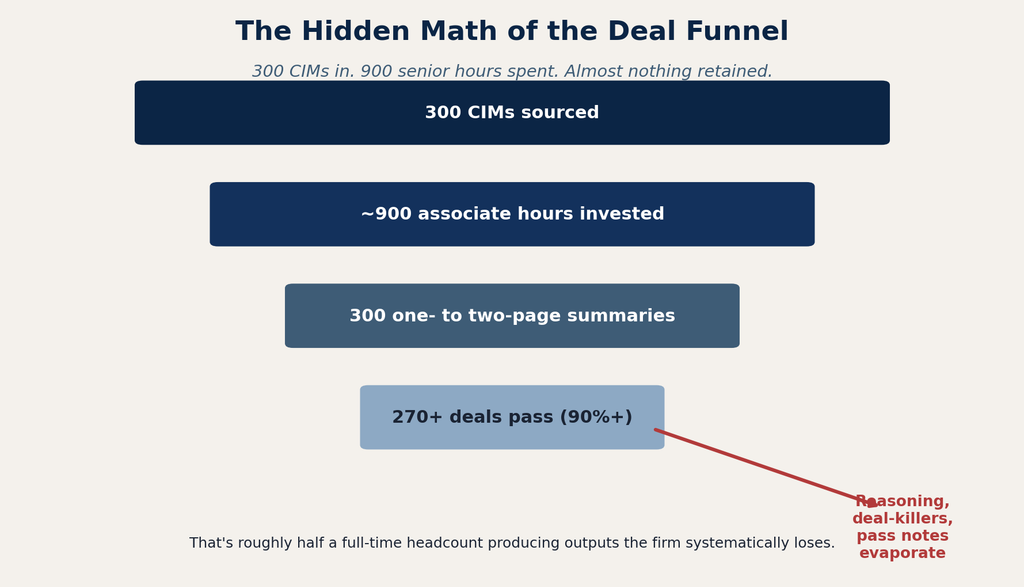
Step 2, Initial Read. An associate (or two) invests two to four hours reading the document, cross-referencing comparable transactions, and assessing fit against your investment thesis.
Step 3, The Summary. That analysis gets distilled into a one- to two-page deal memo or a slide. It’s presented internally. Questions get asked. A decision gets made.
Step 4, The Pass. For more than 90% of CIMs, the answer is no. The deal dies. The memo gets filed. And within 90 days, almost nobody remembers why.
Here’s the brutal math: if your team reviews 300 CIMs a year at an average of three hours per CIM, that’s 900 hours of senior associate time annually, roughly half a full-time headcount, producing outputs that are systematically lost. Firms that treat this as a marketing analytics and reporting problem, measuring the waste before fixing it, are the ones that build a real case for change.
What Gets Lost When the Deal Dies
This isn’t just about efficiency. It’s about compounding institutional knowledge that never compounds.
When a deal dies without proper documentation, you lose:
- The exact deal-killers flagged (customer concentration, margin compression, key-man risk)
- The sector context built during the review
- The comparable transactions identified
- The management team assessment, which may resurface in a future deal
- The banker relationship signal (who brought this, how they positioned it, what quality looks like from this source)
- The pattern that would have told you: we’ve seen this before, and here’s why we passed
Each of these is a data point. Isolated, it’s just one deal. Aggregated across 300 deals and three years, it’s a proprietary deal intelligence layer that most firms simply do not have, because they never built the infrastructure to capture it.
The Memory Problem Is Structural, Not Personal
The instinct is to blame process. We need better templates. Associates should write better memos. We should have a deal log.
But the root cause isn’t discipline. It’s architecture.
Most deal teams use a patchwork of tools: email for deal flow, Excel for pipeline tracking, shared drives for memos, and some combination of Slack, Salesforce, or a purpose-built DealCloud instance for CRM. None of these systems talk to each other in a meaningful way. None of them surface relevant prior deals when a new CIM arrives. None of them tell you: you looked at a business in this sector with this profile 18 months ago, and here’s why you passed.
The result is that your team’s institutional knowledge lives in the heads of your most senior people, and walks out the door when they leave.
Why Ad-Hoc AI Made the Inconsistency Worse
The obvious reaction is to point associates at ChatGPT and call it a solution. In practice, ad-hoc AI use does not close the bottleneck. It widens it.
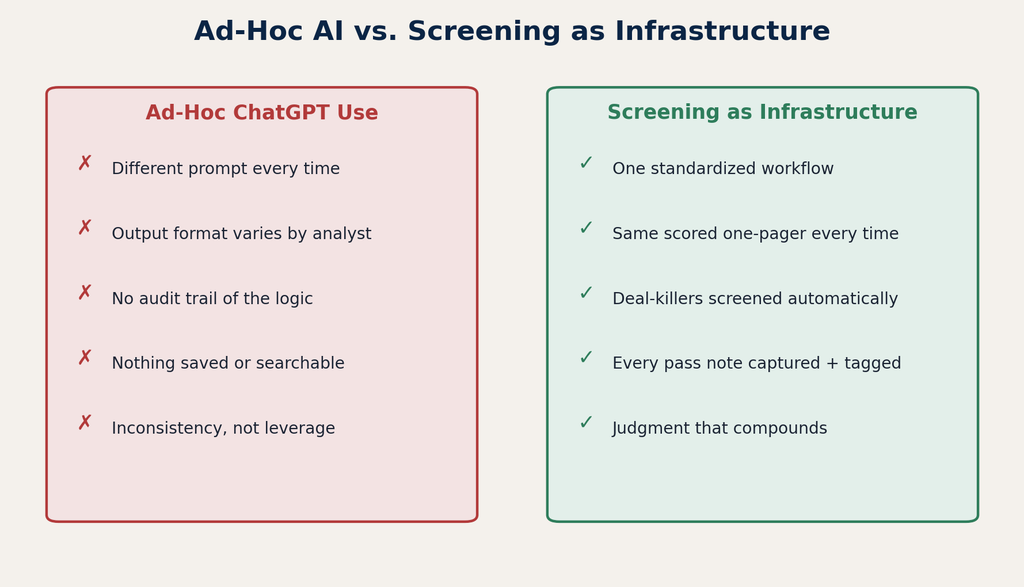
Every analyst writes a different prompt. Every output lands in a different format. There is no audit trail behind the scoring logic, no shared definition of a deal-killer, and nothing gets saved anywhere the firm can search later. You trade one kind of inconsistency for a faster, more confident-looking version of the same problem.
The fix is not more prompting. It is treating screening as infrastructure rather than improvisation, the same discipline we bring to AI marketing systems: one workflow, one format, one source of truth.
What Screening Looks Like When It Is Infrastructure
Imagine a different workflow.
A CIM arrives. Before your associate opens the document, your deal intelligence system has already:
- Matched the company against your historical deal database
- Surfaced the three most comparable transactions you’ve reviewed
- Flagged recurring deal-killers in the sector
- Pulled the banker’s historical conversion rate from pitch to LOI
- Noted that a portfolio company is already competing in this space
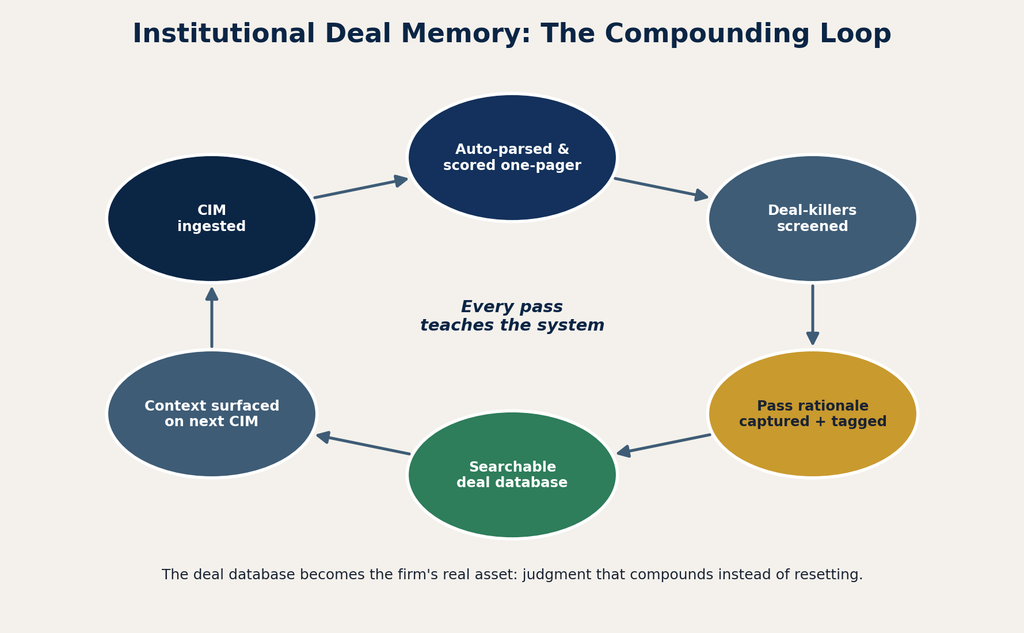
Your associate still does the work, but they start with context instead of a blank page. Their review is sharper. Their summary is denser. And when the deal dies, the system captures not just the outcome but the reasoning.
In practice this means the same output every time: a CIM to a scored one-pager in the same format, deal-killers screened automatically, and every pass note written in plain English so it can be found again. This is what institutional deal memory looks like. It’s not a dream, it’s an architecture problem with a solvable answer.
How AI Is Closing the CIM Bottleneck
The firms closing this gap are doing it with AI-assisted deal review workflows. Here’s what that looks like in practice.
Automated CIM Parsing. AI reads the CIM on ingestion and extracts structured data: financials, sector, business model, management team, deal size, geographic footprint. This happens in minutes, not hours.
Pattern Matching Against Historical Deals. The system compares the incoming deal against your firm’s proprietary deal database, surfacing relevant prior reviews, passed deals, and portfolio adjacencies.
Dynamic Deal Scoring. Based on your investment criteria, the system generates a preliminary fit score with flagged risks and opportunities, giving associates a starting point rather than a blank slate.
Decision Capture. When you pass (or proceed), the system prompts for a structured rationale. Not a paragraph buried in an email, but a tagged, searchable record: sector, deal size, deal-killer category, and source quality.
Longitudinal Learning. Over time, the system learns from your decisions. It gets better at predicting which deals will make it to IC and which will die at first review, not because it’s replacing judgment, but because it’s operationalizing it.
Institutional Memory: The Deal Database as the Firm’s Real Asset
Deal flow is not the constraint. Attention is.
The top quartile of PE firms don’t just see more deals, they process them faster, with higher signal-to-noise, and they retain what they learn. That compounding effect shows up not just in sourcing efficiency but in sector expertise, banker relationships, and ultimately, return profile. It is the same logic that makes thought leadership and signal-based outreach compound: captured judgment, applied again and again.
When you build institutional deal memory:
- Associates spend less time on rote summarization and more time on actual analysis
- Senior partners get sharper, faster inputs with relevant historical context baked in
- Passed deals become a proprietary dataset, not a graveyard
- Pattern recognition accelerates across vintage years and sector cycles
- Onboarding new team members is faster because the knowledge base is documented, not tribal
This is a durable competitive moat. And right now, most mid-market firms don’t have it.
What Changes When the Whole Thing Runs the Same Way Every Time
You don’t need to overhaul your entire tech stack to start closing the CIM bottleneck. Here’s a practical framework.
Step 1, Standardize the Pass Rationale. Create a structured template for deal passes that captures sector, deal size, stage, deal-killer category (financial, strategic, management, market), and banker source. Even a simple spreadsheet is better than nothing.
Step 2, Build a Searchable Deal Database. Every deal reviewed should be logged in a searchable format. At minimum: company name, sector, deal size, date reviewed, outcome, and primary reason for pass or proceed.
Step 3, Tag and Categorize Deal-Killers. Create a taxonomy of your most common pass reasons. Customer concentration. Single-product risk. EBITDA normalization concerns. Geographic limitations. This vocabulary becomes the foundation of your pattern recognition layer.
Step 4, Surface Historical Context at Ingestion. When a new CIM arrives, the first question should be: have we seen this before? Build or buy a system that answers that question automatically.
Step 5, Invest in AI-Assisted Review. The tools exist. Whether you’re building internally or deploying a purpose-built solution, the ROI on associate time recapture alone, let alone the compounding intelligence value, is significant.
The Bottom Line
The CIM bottleneck isn’t a talent problem. Your associates are smart. The bottleneck is architectural: you have a world-class intake process and a broken retention system.
Every deal that dies should leave a footprint. Every pass should teach the system something. Every sector review should make the next one faster.
The firms that build this infrastructure now won’t just be more efficient, they’ll be smarter, faster, and compounding institutional knowledge while their competitors start from scratch every Monday morning.
The question isn’t whether AI will change deal review. It already is. The question is whether your firm is building the memory layer, or burning it down with every pass.
| See It Live at SF Tech Week This is exactly what we will be showing live at SF Tech Week. We are running Growth OS on a real CIM in real time, from screening to a scored one-pager to searching years of pass notes in plain English.If your firm reads hundreds of deals a year and remembers none of them, come see what the alternative looks like. We will talk more about it during SF Tech Week. |
Want to see how AGA builds AI-assisted growth systems for PE-backed companies and investment firms? Explore our work with private equity firms or get in touch.