
A portfolio board meeting ends with a dozen commitments. The CEO will revisit the pricing test. The CFO will rebuild the cash forecast under the new debt terms. The operating partner will introduce a candidate for the VP Sales search. Everyone nods. Three months later, the next board pack arrives, and the first twenty minutes of the meeting go to working out which of those commitments actually happened.
That gap between what a board decides and what gets done is one of the quietest leaks in private equity portfolio operations. It never appears as a line item. It appears as a hold period running a quarter behind plan because decisions made in March were still open in June.
Board meeting intelligence turns a board meeting into draft minutes, a decisions log, and owner-attributed action items tracked until they close. The meeting goes in. Minutes, decisions, and action items come out, each item attributed to an owner, dated, tied to the moment it was agreed, and tracked until it is closed. This piece covers how it works, where it helps, where it should stop, and how it fits into how a firm runs its portfolio.
Key Takeaways
- Board action items get lost because minutes are written for governance, not for tracking execution between meetings.
- Board meeting intelligence returns draft minutes, a decisions log, and action items with a named owner, a due date, and the moment each was agreed.
- Tracked across every portfolio board, those items give the private equity portfolio operations team an early read on slippage before it shows up in the numbers.
- Legal minutes, board consent, and owner confirmation of every item stay non-negotiable.
Why Do Action Items Die Between Board Meetings?
Not because anyone is careless. Because the process that captures them was built for a different job.
Traditional minutes record decisions for governance purposes. They are careful, formal, and often deliberately brief. They are not a task list, and nobody should want them to be. The action items live somewhere else: the operating partner’s notebook, a follow-up email half the board reads, a slide someone adds to the next pack. When the owner of that follow-up changes roles or goes on leave, the thread breaks.
Volume makes it worse. Do the math for one operating partner: six boards, four meetings a year each, roughly a dozen items per meeting. That is close to 300 commitments a year, tracked by memory and email. It is the same capacity problem deal teams hit upstream in the CIM bottleneck: too much text, too few hours, and no system holding the thread. Harvard Business Review found executives spend nearly 23 hours a week in meetings, up from under 10 in the 1960s. Time in the room keeps rising. The system for carrying decisions out of the room has barely changed.
And the cost compounds. One missed item in a portfolio company is rarely dramatic. It is the pricing test that runs a quarter late, the hire that starts a quarter after the model assumed, the add-on integration issue nobody raised again. Over a hold period, those quarters add up to value the plan counted on, and the portfolio never delivered. That is why action tracking belongs inside private equity portfolio operations, not in someone’s inbox.
What Is Board Meeting Intelligence?
Board meeting intelligence is a system that turns a board meeting into structured, trackable output. It is easiest to describe by what goes in and what comes out.
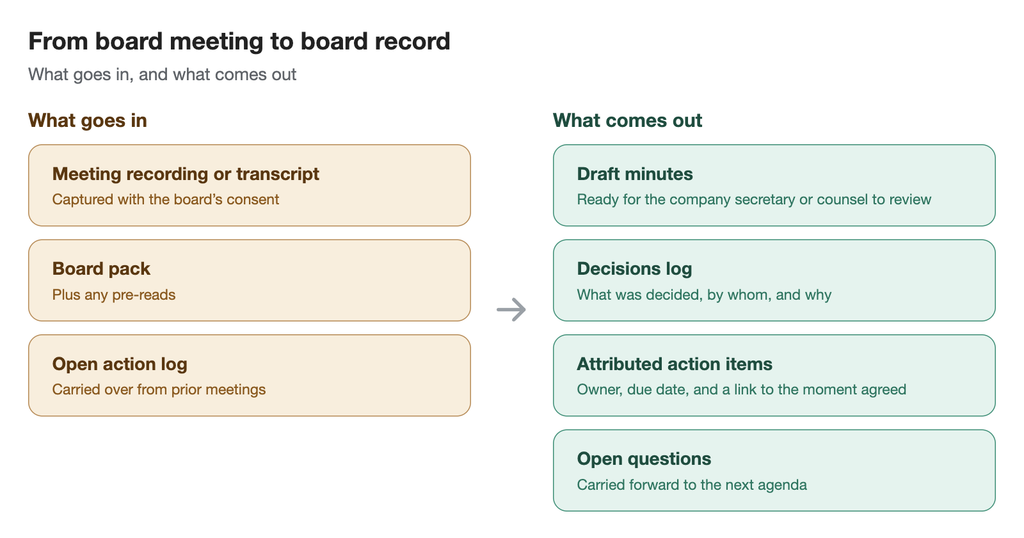
For private equity portfolio operations, the value sits in the second list, and specifically in the attribution. “Revisit pricing” is a note. “CEO to present results of the mid-market pricing test before the June board, agreed at 41:12” is an accountable commitment. Nobody has to reconstruct who said what, because the record shows it.
How Does Attribution Change Board Accountability?
Boards already know they have an accountability problem. PwC’s 2025 Annual Corporate Directors Survey is built around that theme, and found that more than half of directors think at least one fellow director should be replaced. That is a statement about people. Attribution fixes the process underneath it.
When every action item has a named owner and a source moment, three things change. Follow-up stops being awkward, because the record does the reminding instead of the operating partner. Slippage shows up early, because an item nearing its due date with no update is flagged before the next meeting, not during it. And board reporting gets shorter, because the first section of every pack can be a generated status of last quarter’s commitments rather than a manual recap.
This is portfolio company governance with less friction. The board spends its time on the decisions in front of it, not on reconstructing the last ones.
What did your last board meeting leave open? We will run board meeting intelligence on your next board cycle and hand back attributed minutes, a decisions log, and a tracked action register.
How Do You Track Board Actions to Close Across the Whole Portfolio?
A single company’s action log is useful. The portfolio view is where private equity portfolio operations teams get leverage, especially at private equity firms where each operating partner covers several boards.
Once every board produces the same structured output, the firm can see across all of them at once: how many commitments are open by company, which are overdue, which owners carry the most, and which themes recur. If four portfolio companies have an open item on pricing, that is a pattern worth a portfolio-wide playbook. If one company’s list keeps growing while closures stall, that is an early signal an operating partner can act on before the numbers show it.
In a buy-and-build, the value is sharper. Each add-on brings its own management cadence, diligence open issues, and integration commitments. Tracking those in one register is what keeps a platform strategy from becoming a set of disconnected integration projects.
The mechanics are simple:
- Every meeting’s action items land in one tracked register, tagged by company, owner, theme, and due date.
- Owners get reminders ahead of due dates, and updates are logged against the item.
- Overdue items automatically escalate to the operating partner.
- Each board pack opens with a generated status of prior commitments.
- The portfolio team reviews cross-company patterns every month.
None of this is new as management practice. What is new is that it no longer depends on someone maintaining it by hand. In most private equity portfolio operations functions today, the register exists only as long as one diligent person keeps it current. When that person is on a deal, in diligence, or out for a week, it stops. A system that updates itself from every meeting removes that single point of failure.
What Should Board Meeting Intelligence Not Do?
Private equity portfolio operations teams should ask this first, so here are the limits.
It does not replace legal minutes. Formal minutes are a governance record with legal weight. The system drafts; the company secretary or counsel decides what the official record says. Some boards will keep formal minutes deliberately brief while the action register carries the operational detail. That separation is healthy.
It does not record without consent. Capture should be agreed at the board level, with clear rules on retention and access, and with executive sessions and privileged legal discussions excluded entirely.
It does not remove human review. Attribution is only as good as its accuracy. Each action item should be confirmed by its owner before it becomes a tracked commitment. Deloitte’s 2026 Generative AI in M&A Pulse Study found human review remains the top requirement for high-stakes generative AI use in deals, and board governance deserves the same standard.
It does not fix a board that does not decide. If a meeting ends without clear decisions, the system will faithfully record that it ended without clear decisions. That is useful information. It is not a cure.
Where Does Board Meeting Intelligence Fit in Private Equity Portfolio Operations?
Board meeting intelligence works best as part of private equity portfolio operations, not as a standalone tool. A firm that adds a meeting-notes app gets better notes, plus one more point tool that does not talk to the others. A firm that runs board actions through the same system as its portfolio reporting gets something more useful: commitments tied to the KPIs they were meant to move.
That is the difference between a transcript and an operating record. The action item to rebuild the sales comp plan sits next to the pipeline numbers it was meant to change. The pricing test sits next to gross margin by segment. An operating partner reviewing a company sees what was promised, what was done, and what the numbers did, in one commercial view across every portfolio company.
It changes the value-creation plan too. Most plans are written once and reviewed occasionally. When you track board commitments against the plan’s initiatives, the plan becomes a living operating document instead of a deck that goes stale the quarter it lands. This is the thinking behind Growth OS, the AI-native operating platform Azarian Growth Agency runs for PE firms: meeting capture, action tracking, and portfolio-level reporting on one set of records, with specialized agents supervised by senior operators who own the outcome.
For teams stretched across more boards than anyone can personally track, the change is easy to state. Nothing agreed in the room gets dropped between meetings, and nobody has to be the person who remembers. Where commercial execution is the recurring gap in those action logs, a Fractional CMO can own the items management cannot. Firms fitting this into a broader AI program can compare approaches along the autonomy line between AI tools and autonomous agents, and what ad-hoc AI costs at the firm level.
See the unified commercial view live at SF Tech Week and LA Tech Week, October 2026
Hamlet Azarian will demo Growth OS with real portfolio-level commercial data, from CIM screening to unified portfolio reporting, on one system. This is not a slide deck. If you’re a GP, operating partner, or deal team lead evaluating what AI-native operations infrastructure actually looks like at PE quality, this is the session to attend.
Reserve your seat: SF Tech Week (Oct 5–11, San Francisco)
Reserve your seat: LA Tech Week (October, Los Angeles)
About the Author: Hamlet Azarian is the founder of Azarian Growth Agency. He advises PE operating partners and deal principals on commercial diligence, growth infrastructure, and revenue system design for PE-backed platforms.
Resources
- Harvard Business Review. Stop the Meeting Madness. July 2017.
- PwC Governance Insights Center. 2025 Annual Corporate Directors Survey. October 2025.
- Deloitte. 2026 Generative AI in M&A Pulse Study. 2026.