
The investment thesis gets written once, in the IC memo. Then it gets retold: in the 100-day plan, the value-creation plan, the board deck, the lender update, the add-on screening criteria, and finally the exit materials. Each retelling happens in a different tool, by different people, on a different timeline. By year three, the thesis the firm is executing is not quite the one it underwrote, and nobody can say exactly when it changed.
A private equity investment thesis is the specific argument for why an asset will be worth more at exit than at entry: which value levers, how much each is worth, and what evidence supports them. Running it on one system means the thesis, the roll-up strategy built on it, and the execution that follows all share the same records. Every screen, board update, and add-on decision is then measured against the original argument, not a memory of it.
This piece covers what a thesis should contain, where it gets lost between the memo and the exit, and what changes when thesis, strategy, and execution run on one operating system.
Key Takeaways
- A private equity investment thesis rarely fails in the memo. It drifts in the handoffs between deal team, operating team, management, and each add-on.
- Roll-ups multiply that drift, because every add-on brings a new data room, new systems, and a new chance for the thesis to get lost.
- Deloitte found fewer than one-third of M&A organizations have fully integrated their generative AI tools across the deal lifecycle, and advises fixing architecture before adding point solutions.
- On one system, the thesis becomes a live scorecard that screening, the value-creation plan, board reporting, and the exit story all draw from.
What Should a Private Equity Investment Thesis Contain?
A thesis that can be executed is more than a narrative about a good market. It is a set of testable claims. Five components make a private equity investment thesis usable after close.
Value levers with quantified impact. Pricing, commercial productivity, cross-sell, add-on acquisitions, margin programs. Each one with the EBITDA contribution the model assumes.
Evidence and confidence. What supports each lever, and how strong that support is. A lever backed by customer data or an outside-in commercial diagnostic differs from one backed by a management presentation.
Risks and kill criteria. The conditions under which the thesis is wrong, stated in advance. This is what lets a board recognize a failing lever in quarter three rather than year three.
Add-on criteria. For a roll-up, the thesis defines what a good add-on looks like: segment, geography, capability, size, and integration fit.
The exit story. Who buys this business, and what they will need to see. Writing it at entry forces the plan to produce that evidence during the hold.
Where Does the Thesis Get Lost?
In the handoffs. The memo behind a private equity investment thesis is usually sound. What breaks is the chain of custody.
Screening to IC. The reasoning that made a deal attractive lives in notes, emails, and a deal team’s heads. Firms still struggling with the CIM bottleneck lose context before they even write the memo.
IC to the first 100 days. The deal team moves to the next deal. The operating partner inherits a memo without the conversations behind it, and the plan gets rebuilt in slides.
Plan to board. Board packs are assembled from company reports in whatever format each one uses. Levers are discussed in narrative, not measured against the thesis numbers.
Platform to add-ons. Each add-on gets its own screening, diligence, and integration plan, often in its own tools. The platform thesis is referenced, not enforced.
Management changes. AlixPartners’ 2026 leadership survey found 65% of PE firms replace portfolio company CEOs during the hold. A new CEO inherits the thesis secondhand.
Underneath all five is the same problem: each stage holds its fragment of the thesis in a different place. That is the cost of a stack of point tools, a pattern we covered in why most private equity software is a wrapper and in what ad-hoc AI costs a PE firm.
How Does One System Connect Thesis, Strategy, and Execution?
[INFOGRAPHIC SECTION: this section is flagged for the design team to turn into an infographic. Remove this note before publishing.]
On one system, the thesis is not a document that gets retold. It is the reference point every later step reads from and writes back to. Six stages share the same records.
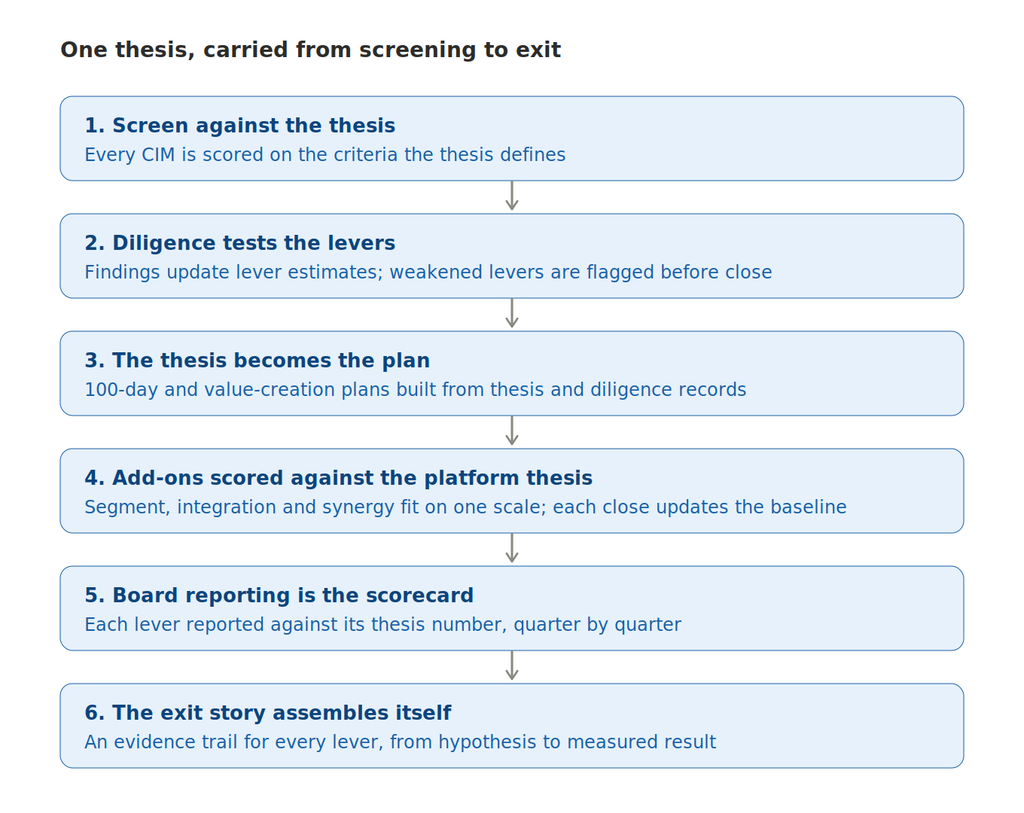
What Changes at Each Stage?
The difference between point tools and one system shows up at every step of the hold.
| Stage | On Point Tools | On One System |
|---|---|---|
| Screening | CIMs reviewed in one tool, notes in email | Every CIM scored against thesis criteria |
| Diligence | Findings sit in a data room export | Findings update lever estimates directly |
| First 100 days | Plan rebuilt in slides | Plan generated from thesis and diligence records |
| Add-on acquisitions | Each target assessed ad hoc | Each target scored against the platform thesis |
| Board reporting | Manual consolidation each quarter | Lever-by-lever scorecard from shared records |
| Exit | Story reconstructed from old decks | Evidence trail already assembled |
The right-hand column is not about working faster. It is about the private equity investment thesis staying the same argument from the first screen to the last buyer meeting.
Test your thesis on the commercial side before you close. Our Strategic Growth Diagnostic maps a target’s attribution, CAC, pipeline, and positioning, and shows which levers the commercial engine can actually support. See how the diagnostic works
What Does One System Actually Require?
Calling something an operating system does not make it one. Four requirements separate a real private equity operating model from a set of connected tools.
Shared records. The thesis, the deal database, diligence findings, portfolio metrics, and board commitments live in one place, not in exports passed between applications.
Standardized outputs. Every CIM screen, diligence summary, add-on assessment, and board report follows the same structure, so results are comparable across deals and over time.
Memory. The system carries context across deals and years. What the firm learned on one add-on informs the next screen.
Supervised execution. Agents run the recurring work, and a named senior operator reviews and owns each result.
The architecture question matters more than any single feature. Deloitte’s 2026 Generative AI in M&A Pulse Study found that while more than half of M&A organizations have partially integrated their AI tools across the deal lifecycle, fewer than one-third have reached full integration, and it recommends prioritizing architecture and approved-data connectivity before adding more point solutions. Specialist systems of record such as fund accounting and the data room stay where they are, connected to the operating layer rather than rebuilt.
This is the design behind Growth OS, the AI-native operating platform Azarian Growth Agency runs for PE firms: more than 150 specialized agents and 50-plus connectors, each agent supervised by a senior operator who owns the outcome, running from CIM screening to one commercial view across every portfolio company.
How Does This Change the Roll-Up Strategy Itself?
A roll-up strategy on one system becomes a rule set rather than a presentation. The thesis defines add-on criteria, and every target is measured against them. Bain’s buy-and-build research frames the gating question for each add-on: what value are you capturing by making this particular acquisition with this particular platform? On one system, that question gets answered the same way every time, with the answer recorded.
Integration stops being improvised. Each add-on runs the same playbook, lands in the same records, and shows up in the same portfolio-level reporting. Synergies are tracked against the thesis by add-on. The value-creation plan updates as each acquisition closes, rather than drifting from the business it describes.
For private equity firms running a platform strategy, that is the practical payoff: the tenth add-on is easier to integrate than the second, and the exit story is built as the platform is.
Where Should a Firm Start?
Not with a full migration. Start where the thesis leaks most.
For most firms, that is one of two places. The first is screening, where scoring every CIM against written thesis criteria improves the pipeline immediately and creates the first shared records. The second is board reporting, where a lever-by-lever scorecard replaces the quarterly consolidation exercise and makes drift visible.
Prove the time savings and the decision quality on one workflow, then extend. Moving one stage at a time avoids disrupting live deals and gives the team confidence in supervised automation, the same line between tools and agents we set out in the autonomy line. The goal is a private equity investment thesis that stays intact from entry to exit. The system is how you get there.
See the unified commercial view live at SF Tech Week and LA Tech Week, October 2026
Hamlet Azarian will demo Growth OS with real portfolio-level commercial data, from CIM screening to unified portfolio reporting, on one system. This is not a slide deck. If you’re a GP, operating partner, or deal team lead evaluating what AI-native operations infrastructure actually looks like at PE quality, this is the session to attend.
About the Author: Hamlet Azarian is the founder of Azarian Growth Agency. He advises PE operating partners and deal principals on commercial diligence, growth infrastructure, and revenue system design for PE-backed platforms.
Resources
- Deloitte. 2026 Generative AI in M&A Pulse Study. 2026.
- AlixPartners. 11th Annual Private Equity Leadership Survey. March 25, 2026.
- Bain & Company. Building a Stronger Buy-and-Build. Global Private Equity Report 2024.