

The pitch fits on one slide. Buy a business with $3 million of EBITDA at 6x, fold it into a platform the market values at 10x, and $12 million of equity value appears the day the deal closes. Repeat five times, and the model looks spectacular. That is multiple arbitrage, and it is real. It is also the most over-assumed number in private equity roll-up models.
Multiple arbitrage is the value created when a sponsor buys smaller companies at lower EBITDA multiples and combines them into a larger business that buyers value at a higher multiple. The gap exists because the market pays more for scale and quality. The catch is in the title: the market re-rates the platform, not the tuck-in. An acquired company’s earnings only earn the platform’s multiple once they are indistinguishable from the platform’s own.
This piece walks through the math, explains why platforms re-rate and tuck-ins do not, and covers what makes multiple arbitrage hold up when a buyer’s diligence team arrives.
Key Takeaways
- The size premium is real. GF Data’s Q3 2025 figures showed business services companies in the $100 million to $250 million tier trading at 11.0x EBITDA, versus 7.4x for the $25 million to $50 million tier.
- In Bain’s study of 44 buy-and-build deals, those relying on multiple arbitrage alone returned 1.4x MOIC, while those with a strategy driving organic growth or margins returned 2.2x.
- Buyers re-rate what they can verify: integrated systems, organic growth, and clean combined data. A tuck-in that stays separate gets valued as such.
- With typical deals now needing 10% to 12% annual EBITDA growth, arbitrage cannot carry the return on its own.
How Does Multiple Arbitrage Work?
Start with a simple platform and five tuck-ins. The figures are illustrative and ignore debt, fees, and integration costs.
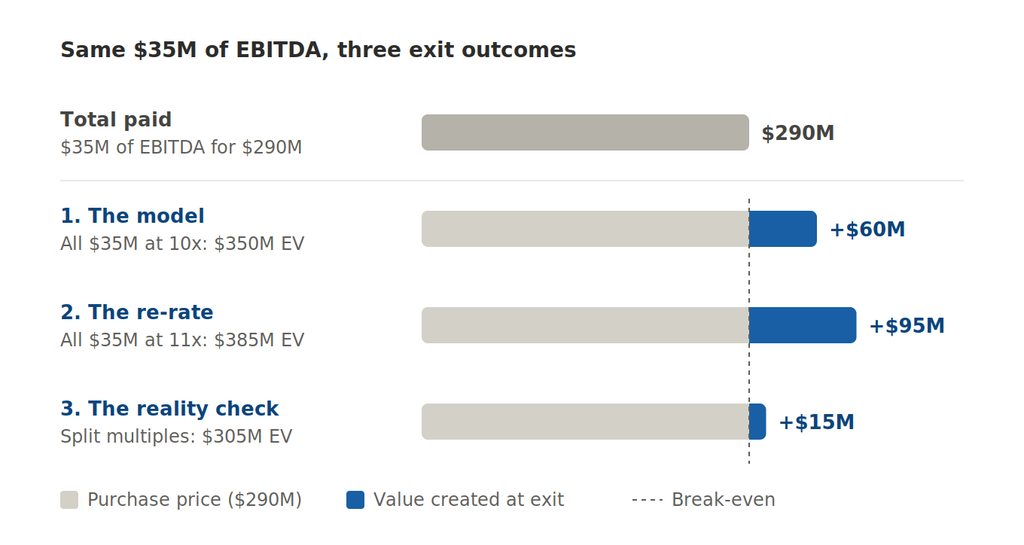
Same companies, same EBITDA, and an $80 million swing in outcome. The difference between scenario 2 and scenario 3 is not the market. It is whether the tuck-ins became part of the platform.
Why Do Platforms Re-Rate?
Larger companies command higher multiples because they carry less risk and attract more buyers. GF Data’s size premium analysis of Q3 2025 middle-market deals showed the spread clearly: business services companies in the $100 million to $250 million tier traded at 11.0x EBITDA, while the $25 million to $50 million tier traded at 7.4x. GF Data also noted that lenders were asking smaller companies for more equity and more conservative capital structures, which widens the gap further.
The re-rate reflects specific qualities buyers pay for:
| What Buyers Pay For | Integrated Platform | Stand-Alone Tuck-In |
|---|---|---|
| Revenue scale | Large and diversified | Small, often concentrated |
| Management | Institutional team with depth | Founder-dependent |
| Customer concentration | Spread across the combined base | A few key accounts |
| Systems and data | One reporting model | Separate tools and spreadsheets |
| Growth evidence | Organic growth documented | Hard to separate from founder effort |
| Buyer universe | Larger sponsors and strategics | Smaller buyers |
Every row is something the platform has to earn. None of it comes with the purchase agreement.
Why Don’t Tuck-Ins Re-Rate on Their Own?
Because the multiple belongs to the whole business, and a buyer will test whether the tuck-in is actually part of it.
A tuck-in acquisition that keeps its own CRM, pricing, brand, and a founder who holds every key customer relationship is still a small company with a new owner. Quality of earnings and commercial diligence will isolate its earnings and ask the obvious questions. Would these customers stay if the founder left? Is the revenue growing, or is it being carried by the platform’s sales team without clear attribution? Can the numbers be verified without a month of reconciliation?
If the answers are weak, the buyer prices those earnings closer to what a small company is worth. A bolt-on acquisition that stays bolted on gets valued like one. The arbitrage that looked locked in at close turns out to have been a forecast.
There is a second-order effect too. A platform carrying several unintegrated tuck-ins can pull down its own multiple, because a buyer sees complexity, duplicated cost, and integration work it will have to finish itself. The discount does not always stay confined to the tuck-ins. It can spread to the whole business.
Before the next tuck-in closes, know whether it will re-rate. Our Strategic Growth Diagnostic examines a target’s commercial engine from the outside: attribution, CAC, pipeline, founder dependence signals, and fit with your platform’s go-to-market. See how the diagnostic works
What Makes Multiple Arbitrage Hold Up at Exit?
Five practices turn the model’s arbitrage into a buyer’s valuation.
Screen for integration fit, not just price. A cheap multiple on a business that cannot be integrated is not cheap. Add-on screening should score each target against the platform’s systems, customers, and go-to-market, which is easier when the firm has solved the CIM bottleneck and can review targets consistently. An outside-in commercial diagnostic on the target adds the commercial view the CIM leaves out.
Integrate the commercial engine. One CRM, one pipeline definition, harmonized pricing, and a coordinated sales motion. This is what makes the tuck-in’s revenue part of the platform’s revenue in the buyer’s eyes.
Reduce founder and customer dependence. Transition key relationships to the platform team during the first year, and document them. Dependence that is still visible at exit gets priced.
Decide brand architecture early. Buyers, customers, and increasingly AI engines that recommend vendors need to understand what the combined company is. Several competing brands for the same offering read as a collection, not a platform.
Prove organic growth separately. Report same-company growth for each tuck-in after its first year, alongside total growth, from one data model. One commercial view across every portfolio company, fed by consistent portfolio-level reporting, is what lets a buyer verify the story instead of discounting it. Someone has to own that growth at the platform level, full-time or through a Fractional CMO while the role is scoped.
How Should You Underwrite Multiple Arbitrage?
Conservatively, and per tuck-in rather than in aggregate. Four habits keep the model honest.
Price each tuck-in at its own exit multiple first. Model what the business would be worth at exit if it stayed separate, then treat the uplift to the platform multiple as a result of specific integration milestones, not an assumption.
Put scenario 3 in the IC memo. Show what happens to returns if a buyer values unintegrated earnings at a discount. If the deal only works when every tuck-in re-rates, the thesis depends on integration execution, and the plan should say so.
Tie the re-rate to evidence you will be able to show. Shared CRM adoption, same-company growth, reduced founder concentration, and combined reporting. Each is measurable during the hold, and each is something a buyer will check.
Watch the exit multiple, not just the entry multiple. Arbitrage assumes the platform’s multiple holds. Rising rates, sector sentiment, or a narrower buyer universe can compress it, which makes the operating return even more important.
Firms that already track add-ons in separate tools tend to discover the gap between modeled and earned arbitrage late, a cost we covered in what ad-hoc AI costs a PE firm.
Is Multiple Arbitrage Still a Valid Strategy?
Yes, as a result rather than a thesis. The strategy is more common than ever. PitchBook data reported by Marquette Associates shows add-ons made up 77% of US buyout transactions in 2022, up from 50% in 2008. What has changed is how much of the return arbitrage can carry.
Bain’s buy-and-build research found that higher interest rates made it much harder for platforms leaning on arbitrage to drive returns, and that across 44 deals, arbitrage alone produced 1.4x MOIC against 2.2x for deals with a strategic rationale. Bain’s 2026 Global Private Equity Report added that typical deals now need 10% to 12% annual EBITDA growth to reach a 2.5x return over five years.
The practical conclusion for private equity firms: underwrite multiple arbitrage conservatively, and build the platform so it is earned. That means treating every tuck-in as an integration project with a thesis, a playbook, and a measured outcome, which is the core of a strong platform strategy and the reason integration discipline belongs in the value-creation plan from the first add-on. It is also the model behind Growth OS, the AI-native operating platform Azarian Growth Agency runs for PE firms, where every add-on plugs into shared records and shared reporting from day one.
See the unified commercial view live at SF Tech Week and LA Tech Week, October 2026
Hamlet Azarian will demo Growth OS with real portfolio-level commercial data, from CIM screening to unified portfolio reporting, on one system. This is not a slide deck. If you’re a GP, operating partner, or deal team lead evaluating what AI-native operations infrastructure actually looks like at PE quality, this is the session to attend.
About the Author: Hamlet Azarian is the founder of Azarian Growth Agency. He advises PE operating partners and deal principals on commercial diligence, growth infrastructure, and revenue system design for PE-backed platforms.
Resources
- GF Data. The Size Premium Returns to 2.8x. January 27, 2026.
- Bain & Company. Building a Stronger Buy-and-Build. Global Private Equity Report 2024.
- Bain & Company via PR Newswire. Private Equity Resurgence Gathers Steam as New Era Challenges Firms to Enhance Value Creation. February 23, 2026.
- Marquette Associates, citing PitchBook data. If They Build It, Buyers Will Come. June 2023.