
A competitive mid-market process runs on a schedule the seller controls. Once exclusivity is granted, the clock starts, and an associate spends most of a week opening folders, cross-checking a customer list against a revenue schedule, and building a request tracker by hand. None of that is judgment. All of it sits between your deal team and the questions that move the IC vote.
AI due diligence uses language models and document intelligence to read, index, and cross-check a virtual data room so the deal team starts with a verified workpaper instead of a folder tree. It is not e-discovery, which is built for litigation, and it is not contract-only review, which never compares one document against another. Done properly, it compresses first-pass VDR review from the 40-plus associate hours a mid-market room can absorb into a few hours of structured output. It does not replace judgment. It changes what judgment is spent on.
This piece covers what AI due diligence does inside a data room, how to structure an AI-assisted workflow, where partner judgment stays essential, and the layer most deal teams skip: an external commercial diagnostic on the target before you close.
Key Takeaways
- AI due diligence handles the reconciliation work in a data room (indexing, missing-item tracking, and cross-document checks), which is where most first-pass review hours go.
- Automate the tasks where errors are cheap to catch, and every output cites its source. The deal team keeps quality of earnings, management assessment, and valuation.
- Deloitte’s 2026 Pulse Study found 90% of organizations already use generative AI in M&A, and human review remains the top requirement for high-stakes use.
- An external commercial-maturity diagnostic shows the go-to-market gap the CIM cannot and maps your first 90 days before you close.
Why Does VDR Review Still Take 40+ Hours Per Deal?
Because most of the work is reconciliation, and reconciliation does not compress by adding people. A mid-market data room holds financial statements, contracts, cap tables, customer and vendor lists, HR files, IP schedules, and board minutes, uploaded in whatever structure the seller’s banker chose. The first job is not analysis. It is finding out what is there.
Then comes cross-referencing. Does customer concentration in the CIM match revenue by customer in the financials? Do the top ten contracts carry the renewal terms management described? Does the model ignore change-of-control clauses? Each check is simple. There are hundreds, and they repeat on every deal and every add-on in a platform strategy.
The cost is attention as much as hours. Under a deadline, reviewers triage: they read closely what looks unusual and skim what looks standard. The anomaly buried in a routine-looking schedule is exactly what that triage misses. It is the same capacity problem we described at the top of the funnel in the CIM bottleneck.
What Does AI Due Diligence Actually Do Inside a Data Room?
Strip away the vendor language, and you’re left with four jobs.
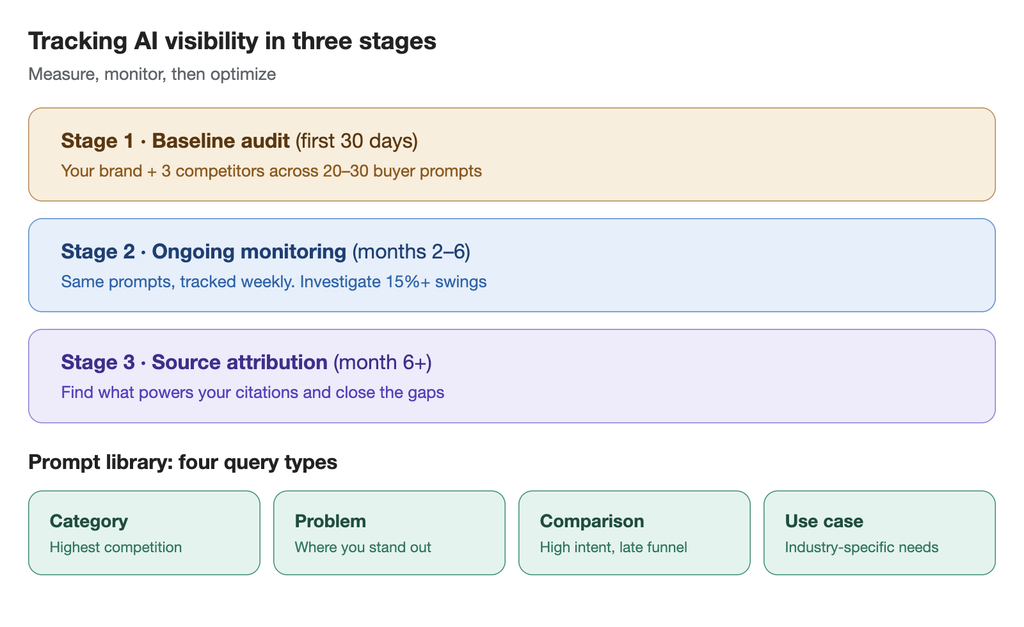
What comes out is not a verdict. It is a workpaper: what is in the room, what is not, what does not agree, and where to look.
The CIM shows you the financials. It does not show you the commercial gap. Our Strategic Growth Diagnostic examines a target from the outside and returns board-ready findings on attribution, CAC, pipeline, and positioning before you close. See how the diagnostic works
Which Diligence Tasks Should You Automate and Which Stay With the Partner?
Due diligence automation is the narrower, rules-based part of the discipline: tasks you can define, run, and check. It works worst on anything that needs context the documents do not contain. A practical split for an AI due diligence program:
| Diligence Task | Automate? | Why |
| Document indexing and classification | Yes | Pure volume; errors are easy to spot |
| Clause extraction (change of control, exclusivity, termination) | Yes, with review | Fast and consistent; a human confirms material clauses |
| Missing-item tracking against the request list | Yes | Mechanical matching |
| Cross-document reconciliation | Yes, with review | Highest payoff; every flag links to its source |
| Seller Q&A drafting | Yes, with review | Draft only; a deal lead sends it |
| Quality of earnings judgment | No | Needs accounting judgment and management context |
| Management assessment | No | Depends on relationships and a read of the room |
| Valuation and IC recommendation | No | This is the job |
The line is not about what the technology can attempt. It is about where an error is cheap to catch. Deloitte’s 2026 Generative AI in M&A Pulse Study found that 90% of corporate and PE organizations now use generative AI in M&A, but human review remains the top requirement for high-stakes use. Any setup worth running should make review easy, with every extracted field and flag traceable to a page.
For private equity firms running buy-side due diligence, the payoff is speed to a confident first view. A team that completes reconciliation by day two spends the remaining weeks on the questions that change price.
What Can AI Due Diligence Not Replace?
The deal teams that get the most from these tools are the clearest about their limits.
Founder and management judgment. No document pass tells you how a management team behaves under pressure or whether it fits the platform. That takes time in the room and structured reference checks.
Market sensing. Customer calls, channel partner interviews, and competitive checks are primary research. AI can analyze what has been written about a market. It cannot hear what a distributor leaves unsaid.
Legal interpretation and negotiation. AI flags deviations from standard terms. Counsel decides which deviations are acceptable and how to negotiate them given the deal structure.
How Do You Structure an AI-Assisted Diligence Workflow?
AI due diligence does not replace the traditional workflow. It shifts analyst time from retrieval and cross-referencing to exceptions and judgment across five phases.
Phase 1: Before the VDR opens. Load the CIM and teaser. Build a preliminary question list from disclosed financials, stated growth drivers, and add-backs, and define the document categories you expect to see.
Phase 2: VDR open (days 1–3). The full room is ingested, indexed, and matched against the request list. Output: a missing-item report, an inconsistency report, and a document map.
Phase 3: Management Q&A prep (days 4–5). The system drafts management questions from the flags. Analysts prioritize, so the session covers material issues, not background.
Phase 4: Commercial assessment (parallel track). An outside-in review of the target’s go-to-market runs alongside document review. Where the timeline allows, the full diagnostic starts at exclusivity so findings land before signing.
Phase 5: Synthesis. Findings are summarized by workstream (financial, legal, commercial, operational) against the thesis. The deal team validates and decides: proceed, re-price, or pass.
| Step | Traditional Timeline | AI-Assisted Timeline |
| Document ingestion and gap report | Weeks 1–2 | Days 1–2 |
| Cross-document consistency review | Weeks 2–3 | Days 2–3, analyst validates |
| Management Q&A prep | Week 3 | Days 4–5 |
| Commercial assessment | Often skipped, or post-close | Parallel track from exclusivity |
| Synthesis and IC memo | Weeks 5–6 | Week 3 |
| Total elapsed | 5–6 weeks | 2–3 weeks |
Timelines are illustrative. Actual compression depends on VDR quality, document volume, and how quickly the seller answers requests.
The Diligence Weapon: Running a Commercial-Maturity Diagnostic Before You Close
The CIM is a marketing document. The data room confirms the financials and surfaces contract risk. Neither was designed to show commercial health: whether the business can keep growing under new ownership.
Is marketing spend tied to revenue, or is it funding activity? What is CAC by channel, and does anyone at the company know? Is the pipeline real below the top three accounts? Does the company show up when a buyer asks an AI engine for a vendor in its category? A revenue schedule answers none of these.
An external commercial-maturity diagnostic answers them from the outside, before you own the problem. It examines what you can observe without management’s slides: search and AI visibility, paid media footprint, website conversion architecture, positioning against named competitors, and whether attribution exists at all. The diagnostic tells you the commercial gap. The VDR confirms the financials. You need both.
Two things follow. First, you price the gap. Second, you walk in on Day 1 with the first 90 days mapped. Bain’s Global Private Equity Report 2026 argues that today’s deals demand faster EBITDA growth and that winning firms will move from full-potential diligence to execution on Day 1. The diagnostic feeds straight into a value-creation plan that does not go stale, and if it shows nobody owns the growth number, a Fractional CMO can cover while you recruit.
Bain noted in 2024 that leading firms were building scorecard-based protocols to assess generative AI in every diligence, aiming to make it as routine as legal or commercial review. Commercial maturity deserves the same treatment: a standard workstream, not a favor you ask of a consultant after close.
How Do You Evaluate AI Due Diligence Tools Without Getting Burned?
The market is crowded, and much of it is a thin layer over the same underlying models, a pattern we unpacked in why most private equity software is a wrapper. Five questions separate useful tools from demos.
Does every output cite its source? An extracted term without a page reference is a liability.
Where does the data go? Ask about training use, retention, access logging, and what happens to documents after the deal closes, before anything is uploaded.
Have you tested it on your documents? Run it against a known document set from a closed deal before using it on a live one. An invented figure in a financial review is not acceptable.
Does it connect to your approved deal data? Deloitte found integration with approved deal data sources is the capability respondents rated most important in an M&A technology solution.
Does it remember? A tool that starts from zero on every deal is a faster associate. A system that learns which issues recurred and which flags mattered is an institutional asset.
What Changes When Diligence Runs on One Operating System?
Most firms adopt AI due diligence as one more tool beside the CIM screener, the CRM, and the portfolio reporting stack. Run instead as one workflow inside a single system, diligence flags become Day 1 priorities, the commercial diagnostic becomes the baseline for the hold period, and the same records flow into one commercial view across every portfolio company without being retyped. That is the approach behind Growth OS, the AI-native operating platform Azarian Growth Agency runs for PE firms: specialized agents, each supervised by a senior operator who owns the outcome. For cost, see what ad-hoc AI actually costs a PE firm. For what happens after close, see our marketing analytics and reporting practice.
See the unified commercial view live at SF Tech Week and LA Tech Week, October 2026
Hamlet Azarian will demo Growth OS with real portfolio-level commercial data, from CIM screening to unified portfolio reporting, on one system. This is not a slide deck. If you’re a GP, operating partner, or deal team lead evaluating what AI-native operations infrastructure actually looks like at PE quality, this is the session to attend.
Reserve your seat: SF Tech Week (Oct 5–11, San Francisco)
Reserve your seat: LA Tech Week (October, Los Angeles)
About the Author: Hamlet Azarian is the founder of Azarian Growth Agency. He advises PE operating partners and deal principals on commercial diligence, growth infrastructure, and revenue system design for PE-backed platforms.
Resources
- Deloitte. 2026 Generative AI in M&A Pulse Study. 2026.
- Bain & Company. Global Private Equity Report 2026. 2026.
- Bain & Company. Harnessing Generative AI in Private Equity. Global Private Equity Report 2024.