
Every deal closes with a 100-day plan. Most of them look the same: a slide with five workstreams, sixty initiatives, a Gantt chart, and a column of owners that is mostly the CEO. By day 40, no one has opened the slide since the kickoff. By day 100, the team is reporting activity instead of progress, and nobody can say with confidence whether the thesis is holding.
A 100-day plan in private equity is the sequenced set of decisions, owners, and measures a sponsor and management commit to in the first 100 days after close. Its job is to validate the investment thesis against real data, stabilize the business through the ownership change, and launch the few levers that justify the price. The 100-day plan private equity firms actually need is shorter than the one they usually write, and it breaks in predictable places.
This piece covers what the plan should do, the five places it usually fails, how to sequence the first 100 days, and what “done” should look like on day 100.
Key Takeaways
- A strong private equity 100-day plan does three things: establishes a trusted baseline, stabilizes people and cash, and launches the two or three levers behind the thesis.
- Most plans break at the handoff from deal team to operating team, on missing baseline data, and on misaligned expectations with management.
- AlixPartners’ 2026 leadership survey found 65% of PE firms replace portfolio company CEOs during the hold, and 83% of PE executives say unplanned CEO turnover lengthens the hold.
- Day 100 should end with a measured baseline, funded and owned initiatives, a running operating cadence, and a draft value-creation plan.
What Should a Private Equity 100-Day Plan Actually Do?
It should do three jobs, and only three.
Validate the thesis with real numbers. Diligence runs on management’s figures and the CIM. The first 100 days are when the sponsor finds out which of those figures hold up once you can see the underlying systems. That means building a baseline: revenue by segment and customer, gross margin by product, cash conversion, and on the commercial side, CAC by channel and pipeline that can be traced to real opportunities.
Stabilize the business through the ownership change. Key people, key customers, and cash. The team just survived a sale process. Customers are wondering what changes. Lenders want covenant reporting on a new cadence. None of this creates value, but getting it wrong destroys it quickly.
Launch the two or three levers that justify the price. Not twenty. The investment committee approved the deal on a small number of value drivers: a pricing opportunity, a sales capacity gap, an add-on pipeline, a margin program. The plan exists to start those, staffed and funded, with a way to measure them.
The plan should not be a complete list of everything that could improve. A post-acquisition integration plan that tries to fix everything in 100 days fixes nothing, because management capacity is the scarcest resource in the building.
Where Does the 100-Day Plan Usually Break?
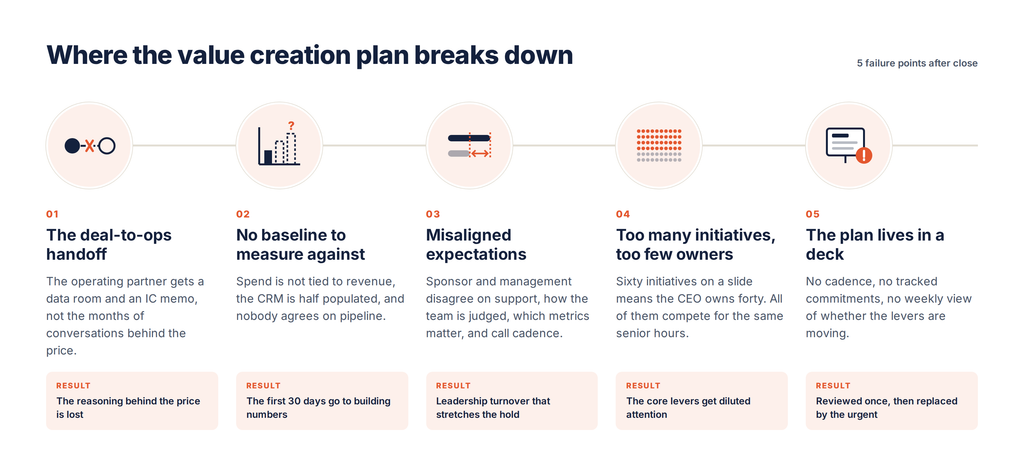
A 100-day plan private equity teams write can fail in many ways, but the failure points repeat across sectors and deal sizes. Five account for most of the damage.
Start day 1 with the baseline most plans spend a month building. Our Strategic Growth Diagnostic maps attribution, CAC by channel, pipeline quality, and positioning, and returns board-ready findings with a prioritized 90-day action plan. See how the diagnostic works
How Should the First 100 Days Be Sequenced?
The 100-day plan private equity sponsors can actually run follows four phases. The dates flex. The order does not.
| Phase | Focus | Outputs |
| Signing to close | Handoff and readiness | Thesis handoff document, Day 1 communications, key-person retention plan |
| Days 1–30 | Listen and baseline | Trusted baseline for revenue, margin, cash, CAC, and pipeline; management assessment |
| Days 31–60 | Decide and staff | Two or three priority levers confirmed, owners named, budget released, talent gaps addressed |
| Days 61–100 | Launch and measure | Levers live, weekly metrics running, first results reviewed, value-creation plan drafted |
Signing to close is the most underused window. Write the thesis handoff here: each value lever, the quantified impact assumed in the model, the evidence behind it, and how confident the deal team is in that evidence. The operating partner should own this document before close, not receive it after. Deal context leaks at every handoff, from the CIM bottleneck at screening to the IC memo at close, and this document is what stops the leak.
Days 1–30 are for listening and measurement. Management should hear the thesis directly from the sponsor, and the sponsor should hear management’s view of what the thesis missed. In parallel, build the baseline. If the numbers cannot be trusted by day 30, that is the first finding, and it goes to the board.
This is also the window where misalignment is fixed or starts. AlixPartners’ 2018 leadership survey called the first 100 days ripe for misalignment on support, assessment, metrics, and contact frequency. Its 2026 survey found 65% of PE firms replace portfolio company CEOs during the hold, and earlier AlixPartners research found 83% of PE executives say unplanned CEO turnover lengthens holding periods.
Days 31–60 are for decisions. Which levers survived contact with the baseline? Who owns each one? What budget and headcount do they need? This is also when leadership gaps get addressed deliberately, rather than a year later as an unplanned replacement.
Days 61–100 are for launch and measurement. Each lever runs with a weekly metric the board will recognize. The value-creation plan for the full hold gets drafted from what the first 100 days actually proved.
What Belongs in the Commercial Workstream?
The commercial workstream is where most private equity 100-day plans are weakest, because it depends on data that mid-market companies rarely have in usable shape. Four items belong in it.
A revenue-connected baseline. CAC by channel, conversion rates by stage, and marketing spend tied to closed revenue, not to leads. That depends on attribution that connects spend to revenue across every channel, including AI search.
Pipeline truth. Pipeline built on opportunities that exist, with stage definitions everyone uses the same way. Coverage ratios that looked healthy under old assumptions often do not survive this test, a pattern we covered in why 3x pipeline coverage no longer hits plan.
Positioning and visibility. How the company shows up against named competitors, in search, and increasingly when buyers ask AI engines for a vendor in its category.
Commercial ownership. Someone has to own the growth number. If the company has no senior marketing leader, a Fractional CMO can hold the workstream through the first 100 days while the permanent hire is recruited.
An outside-in commercial diagnostic can start this work before close, so the commercial baseline exists on day 1 rather than day 45.
How Do You Know the First 100 Days Worked?
Judge day 100 against exit criteria, not activity. By day 100, a 100-day plan private equity sponsors can call successful has delivered five things:
- A baseline the board trusts, for financial and commercial metrics alike.
- Two or three priority levers with named owners, released budget, and a weekly metric.
- Leadership decisions made on purpose: who stays, who is added, and where interim support is needed.
- An operating cadence that runs without the operating partner chasing it.
- A draft value-creation plan grounded in what the baseline showed, not in what the model assumed.
If any of those five is missing, the next 30 days should go to closing that gap before anything new starts.
How Does the 100-Day Plan Connect to the Full Hold?
A private equity 100-day plan is a starting line, not a separate project. Bain’s Global Private Equity Report 2026 argues that today’s deals demand faster EBITDA growth and that winning firms will move from full-potential diligence to execution on Day 1. A 100-day plan that ends in a deck makes that impossible. One that ends in a running operating system makes it routine.
That is why the output of day 100 should flow straight into a value-creation plan that stays live for the rest of the hold, with the same metrics feeding portfolio-level reporting and one commercial view across every portfolio company. In a buy-and-build, each add-on gets its own compressed version of the same plan, which is how a platform strategy avoids becoming a stack of disconnected integrations.
This is the thinking behind Growth OS, the AI-native operating platform Azarian Growth Agency runs for private equity firms: baseline, commitments, and reporting on one set of records, with specialized agents supervised by senior operators who own the outcome.
Start your next 100 days with a baseline, not a guess. Our Strategic Growth Diagnostic tells you where growth is leaking, whether attribution exists, and which two or three levers deserve the first 100 days. It is a paid, system-deep review with board-ready findings you keep regardless of what comes next.
See the unified commercial view live at SF Tech Week and LA Tech Week, October 2026
Hamlet Azarian will demo Growth OS with real portfolio-level commercial data, from CIM screening to unified portfolio reporting, on one system. This is not a slide deck. If you’re a GP, operating partner, or deal team lead evaluating what AI-native operations infrastructure actually looks like at PE quality, this is the session to attend.
Reserve your seat: SF Tech Week (Oct 5–11, San Francisco)
Reserve your seat: LA Tech Week (October, Los Angeles)
About the Author: Hamlet Azarian is the founder of Azarian Growth Agency. He advises PE operating partners and deal principals on commercial diligence, growth infrastructure, and revenue system design for PE-backed platforms.
Resources
- AlixPartners. 11th Annual Private Equity Leadership Survey. March 25, 2026.
- AlixPartners. Third Annual Private Equity Leadership Survey. March 2018.
- Bain & Company. Global Private Equity Report 2026. 2026.