
Buying companies is the easy part of a roll-up. Sourcing add-ons, negotiating price, and closing are skills most sponsors have in depth. The hard part starts after the fifth acquisition, when the “platform” becomes five CRMs, four pricing models, three brands competing for the same customers, and a board pack that takes an analyst two weeks to assemble.
A roll-up strategy is a private equity approach in which a sponsor acquires a platform company and then adds smaller companies in the same or adjacent markets, aiming to build one business worth more than the sum of its parts. Bain defines the stricter version, buy-and-build, as a platform making at least four repeated add-on acquisitions. The difference between a roll-up strategy that compounds and one that stalls is whether those acquisitions become one operating business or stay a collection of companies with a shared owner.
This piece covers why multiple arbitrage no longer works, what separates a platform from a collection, where a private equity roll-up usually breaks, and how to build one that gets stronger with every add-on.
Key Takeaways
- A roll-up strategy creates durable value only when add-ons are integrated into one commercial and operating engine, not just consolidated on a balance sheet.
- In Bain’s study of 44 buy-and-build deals, those relying on multiple arbitrage alone returned 1.4x MOIC, while those with a strategy driving organic growth or margin improvement returned 2.2x.
- Roll-ups usually break on integration debt, unmerged commercial systems, slow combined reporting, and management overload.
- The platforms that compound build the integration playbook, shared data definitions, and organic growth engine before the add-on count climbs.
Why Is Multiple Arbitrage No Longer Enough?
For years, the math of a roll-up strategy was simple. Buy small companies at low multiples, combine them into a larger business, and sell the whole at the higher multiple the market assigns to scale. Add cheap debt and the returns took care of themselves.
That math has weakened. Bain’s 2024 buy-and-build research found that higher interest rates made it much harder to drive returns for platforms that leaned on multiple arbitrage, and its look back at 44 buy-and-build deals from 2010 to 2019 showed the gap clearly: 1.4x MOIC for deals depending on arbitrage alone versus 2.2x for deals with a strategic rationale driving organic growth or margin improvement. Bain’s Global Private Equity Report 2026 went further, arguing that “12 is the new 5”: today’s deals demand faster EBITDA growth.
The strategy is not going away. PitchBook data reported by Marquette Associates shows add-ons made up 77% of US buyout transactions in 2022, up from 50% in 2008. What has changed is where the return comes from. It now has to come from operating the combined business better than its parts could operate alone.
In practice, that means the plan for a private equity roll-up has to name the organic levers up front: which cross-sell motions, which pricing moves, and which operating improvements the combination makes possible. If those are vague at the first add-on, they tend to stay vague until exit.
What Separates a Platform From a Collection of Companies?
A collection shares an owner. A platform shares an operating model. The difference shows up in a handful of places.
| Dimension | Collection of Companies | Integrated Platform |
| Commercial engine | Separate CRMs, pipelines, and sales motions | One CRM, one pipeline definition, coordinated go-to-market |
| Brand | Each add-on markets itself | Deliberate brand architecture decided early |
| Pricing | Legacy price books per company | Harmonized pricing and discount rules |
| Data and reporting | Manual consolidation each quarter | Shared metric definitions and one reporting model |
| Integration | Improvised per deal | Repeatable playbook run on every add-on |
| Exit story | Sum of acquisitions | Evidence of organic growth at the platform level |
Buyers at exit pay for the right-hand column. They want proof that the combined business grows on its own, not a list of companies it bought. Our earlier piece on private equity platform strategy covers the shared-resources side of this model. This piece focuses on what makes the roll-up itself compound.
Where Do Private Equity Roll-Ups Usually Break?
Most roll-ups do not fail on a single bad acquisition. They fail slowly, as unresolved integration work piles up.
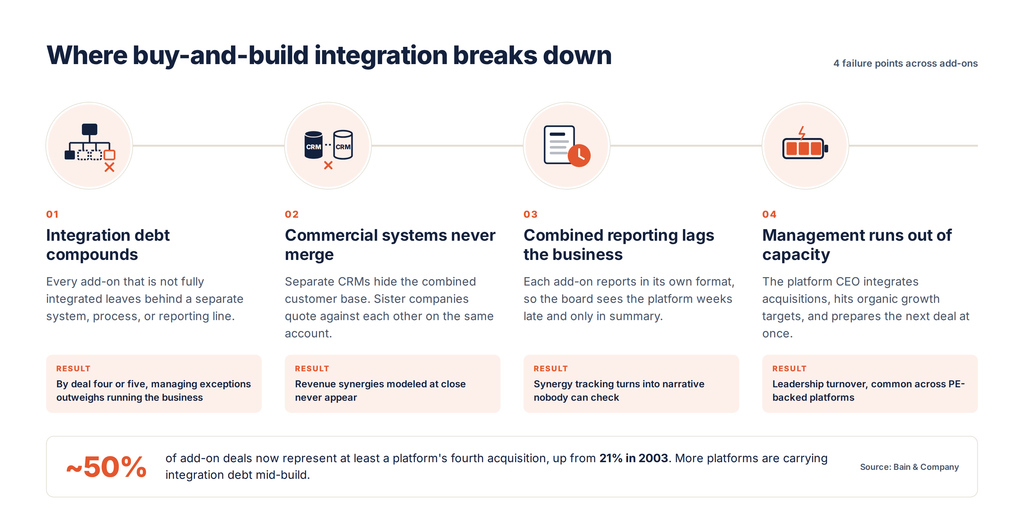
The exit story is never built. Without clean combined data, the sponsor arrives at exit with a collection of acquisitions and no proof of organic growth. That is the story buyers discount most.
[MID-ARTICLE CTA BOX, format in WordPress:] Know what an add-on will add before you buy it. Our Strategic Growth Diagnostic examines a target’s commercial engine from the outside: attribution, CAC, pipeline, positioning, and fit with your platform’s go-to-market.
How Do You Build a Roll-Up Strategy That Compounds?
Six practices separate platforms that get stronger with scale from ones that get heavier.
1. Write a thesis for every add-on acquisition. Bain frames the gating question well: what value are you capturing by making this particular acquisition with this particular platform? New segment, new geography, new capability, or scale in the core. If the answer is only “it was available at a good multiple,” the add-on is adding integration debt.
2. Build the integration playbook before add-on number two. The first add-on is where you write the playbook: systems migration, pricing harmonization, customer communication, team integration. Every later deal runs the same playbook faster.
3. Standardize commercial data from day one. One definition of a qualified opportunity, one pipeline stage model, one attribution approach. This is unglamorous work, and it underpins every revenue synergy in the model.
4. Decide brand architecture early. Keep acquired brands, migrate them to a master brand, or run a house of brands. Any of the three can work. Leaving it undecided does not, because customers, search engines, and increasingly AI engines that recommend vendors end up seeing several competing versions of the same company.
5. Track synergies against the model every quarter. Modeled synergies, captured synergies, and the variance, by add-on. If the board cannot see this, nobody is managing it.
6. Build the organic growth engine at the platform level. Demand generation, sales enablement, pricing, and customer success run centrally so every add-on plugs into them. This creates the organic growth evidence buyers pay for, and it takes weight off a platform CEO already carrying integration. That matters: AlixPartners’ 2026 leadership survey found 65% of PE firms replace portfolio company CEOs during the hold. It often calls for a senior commercial leader at the platform, full-time or through a Fractional CMO while the role is scoped.
What Should Commercial Integration of an Add-On Look Like?
Each add-on deserves its own compressed first 100 days, focused on the commercial engine:
- Map customer overlap between the add-on and the platform, and assign account ownership before anyone quotes.
- Move the add-on into the shared CRM and pipeline definitions within the first quarter.
- Harmonize pricing where the same customers see both price books.
- Launch cross-sell into the combined base with a clear offer and a named owner.
- Fold the add-on into platform reporting so the board sees it in the same view as everything else.
The best time to start is before the add-on closes. An outside-in commercial diagnostic on the target shows how its customers, positioning, and pipeline will fit the platform’s go-to-market, so the first 100 days start from a plan rather than a discovery exercise. It also flags the add-ons whose commercial engine will cost more to integrate than it adds, and before signing is the cheapest time to find that out.
That work should feed the platform’s value-creation plan directly, so each acquisition updates the plan instead of sitting beside it.
How Does Technology Change the Math of a Roll-Up?
The integration problem in a roll-up strategy is largely a data problem. Each add-on arrives with its own systems, and the cost of connecting them rises with every deal. That is why sponsors who add a new point tool for each problem find the stack getting heavier alongside the platform, a pattern we covered in why most private equity software is a wrapper and in what ad-hoc AI actually costs a PE firm.
The alternative is to run the platform on one operating system from the first add-on. Each acquisition plugs into shared records, shared definitions, and shared reporting, so the board sees one commercial view across every portfolio company and reporting that does not need a two-week consolidation. That is the model behind Growth OS, the AI-native operating platform Azarian Growth Agency runs for private equity firms: specialized agents supervised by senior operators, running on one set of records. Each add-on then gets easier to integrate than the last, which is what a roll-up strategy is supposed to do.
See the unified commercial view live at SF Tech Week and LA Tech Week, October 2026
Hamlet Azarian will demo Growth OS with real portfolio-level commercial data, from CIM screening to unified portfolio reporting, on one system. This is not a slide deck. If you’re a GP, operating partner, or deal team lead evaluating what AI-native operations infrastructure actually looks like at PE quality, this is the session to attend.
Reserve your seat: SF Tech Week (Oct 5–11, San Francisco)
Reserve your seat: LA Tech Week (October, Los Angeles)
Resources
- Bain & Company. Building a Stronger Buy-and-Build. Global Private Equity Report 2024.
- Bain & Company. Global Private Equity Report 2026. 2026.
- AlixPartners. 11th Annual Private Equity Leadership Survey. March 25, 2026.
- Marquette Associates, citing PitchBook data. If They Build It, Buyers Will Come. June 2023.