

Two portfolio companies arrive at exit with the same EBITDA. One sells at a full multiple. The other gets a haircut, and nobody on the sell side can point to a single reason. The financials were clean. The quality of earnings held up. The buyer couldn’t find proof that revenue would keep coming without the people and habits that produced it.
That missing proof is the commercial infrastructure gap. It is the distance between the revenue a private equity portfolio company reports and the systems it would need to show that revenue is repeatable: attribution, pipeline definitions, CRM discipline, pricing governance, and a demand engine that works without the founder. Buyers price that gap into the exit multiple, usually without saying so.
This piece covers what commercial infrastructure is, where the gap quietly costs sponsors multiple turns, how to measure it, and how to close it before a buyer’s diligence team does the measuring for you.
Key Takeaways
- Buyers pay for revenue they can believe will continue. Commercial infrastructure is the evidence that makes revenue believable.
- Bain’s 2026 analysis found typical deals now need 10% to 12% annual EBITDA growth to reach a 2.5x return over five years, putting more weight on organic growth that must be proven at exit.
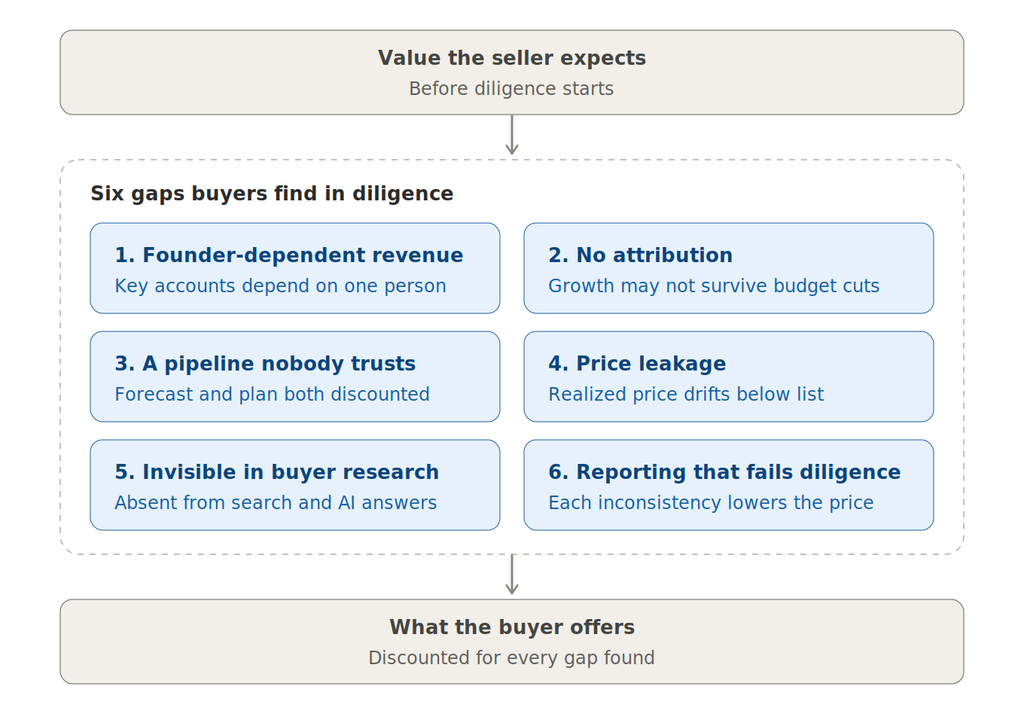
- The gap usually shows up in six areas: founder-dependent revenue, missing attribution, an untrusted pipeline, price leakage, weak visibility to self-directed buyers, and reporting that cannot survive diligence.
- Closing the gap takes several quarters of clean data, so the work has to start well before the exit process.
What Is Commercial Infrastructure in a Portfolio Company?
Commercial infrastructure is the set of systems, data, and routines that turn sales and marketing activity into predictable revenue. It is sales and marketing infrastructure in the fullest sense, not just the tools. Six components matter most:
- A CRM that reflects reality, with every opportunity, stage, and owner recorded the same way across teams.
- Pipeline definitions everyone uses, so a qualified opportunity means the same thing in the board pack as it does on the sales floor.
- Attribution that ties spend to revenue, not to leads or clicks.
- Pricing governance, with realized price, discount levels, and approvals tracked by customer and rep.
- A demand engine that runs without the founder, including search, paid, content, and visibility in AI answers.
- Reporting from one data model, so leadership, the board, and eventually a buyer see the same numbers.
Most mid-market companies have some of these. Very few have all six working together, and that is where the gap opens.
Why Does the Gap Hit the Exit Multiple, Not Just Revenue?
Because a buyer is not paying for last year’s revenue. It is paying for the next five years of it. The exit multiple is the buyer’s estimate of how durable and scalable the earnings are, and commercial infrastructure is the evidence behind that estimate.
The market has made this sharper. Deloitte’s analysis of private equity alpha creation notes that leverage and multiple expansion drove over half of buyout value creation between the global financial crisis and the pandemic, and that revenue growth has since become the largest driver, at 65% to 70% in recent years. Bain’s 2026 Global Private Equity Report adds that typical deals now need 10% to 12% annual EBITDA growth to reach a 2.5x return over five years, compared with about 5% in the 2010s.
When growth carries the return, the buyer’s diligence focuses on whether the growth is real, repeatable, and transferable. A company that can show it with clean data keeps its multiple. A company that can only describe it loses turns, and the loss rarely shows up as a line in the negotiation. It shows up as a lower bid, a longer earn-out, or a buyer who walks.
How Much Can the Gap Cost?
The math is simple and uncomfortable. Take a private equity portfolio company with $10 million of EBITDA. If commercial diligence moves the exit multiple from 10x to 9x, the sponsor gives up $10 million of enterprise value, a full year of earnings, without EBITDA changing at all. A two-turn discount doubles it. The figures are illustrative, but the mechanism is not: small doubts about repeatability, applied to the whole earnings base, add up to large numbers.
Leverage makes it worse. Debt is fixed, so a lower exit multiple comes almost entirely out of equity. In the same example, with $50 million of debt, a one-turn discount cuts enterprise value by 10% but cuts equity proceeds by 20%. That is why the commercial infrastructure gap deserves as much attention in the value-creation plan as any cost program.
Find the leaks before a buyer does. Our Strategic Growth Diagnostic maps attribution, CAC by channel, pipeline quality, pricing, and positioning, and returns board-ready findings with a prioritized 90-day action plan. See how the diagnostic works →
Where Do Multiples Quietly Leak?
Six leak points account for most of the discount. None of them appear on the income statement.
How Do You Measure the Commercial Infrastructure Gap?
The simplest test is to ask the questions a buyer’s commercial diligence team will ask, and see whether the answers come from data or from people.
| Area | What a Buyer Asks | Gap Signal | Infrastructure That Closes It |
|---|---|---|---|
| Revenue concentration | Who owns the top 20 accounts? | Founder or one executive | Documented account plans and shared ownership |
| Attribution | Which programs produce revenue? | Answer is leads, not revenue | Spend tied to closed revenue by channel |
| Pipeline | How accurate was last year’s forecast? | Large manual adjustments | Shared stage definitions and CRM discipline |
| Pricing | What is realized price versus list? | Nobody tracks it | Discount governance by customer and rep |
| Visibility | Where do buyers find you? | Referrals and outbound only | Search, content, and AI answer presence |
| Reporting | Can we see this by month for three years? | Rebuilt for diligence | One data model feeding board reporting |
Each row where the answer comes from a person rather than a system is a place the buyer will apply a discount. An outside-in commercial diagnostic runs the same test from the buyer’s side of the table.
How Do You Close the Gap Before Exit?
In order, starting with the pieces everything else depends on.
Fix the data foundation first. One CRM, one set of pipeline definitions, and one reporting model across the company. Without this, every other improvement is unmeasurable.
Connect spend to revenue. Build attribution that ties marketing spend to closed revenue across every channel, including AI search. This is what turns marketing from a cost line into evidence of repeatable growth.
Rebuild the pipeline on real opportunities. Coverage ratios that looked healthy under old assumptions often do not survive this kind of cleanup. Better to find out during the hold than during diligence.
Transfer founder relationships. Move key accounts to documented, shared ownership over several quarters, and show the buyer that retention held through the transition.
Build visibility where buyers research. Gartner research found B2B buyers spend only 17% of their buying time meeting with potential suppliers, split across every vendor they are considering. The rest happens in independent research, which is why visibility in AI-generated answers now belongs in the commercial plan.
Name an owner. Someone has to own the growth number and the infrastructure behind it. If the company lacks a senior marketing leader, a Fractional CMO can build the system while the permanent role is scoped.
When Should a Sponsor Start Closing the Gap?
At entry. A buyer will want several quarters of consistent data showing that the infrastructure works, not a system switched on in the final year before a private equity exit. Infrastructure built late looks like preparation for sale, and experienced buyers discount it.
The practical approach is to treat commercial infrastructure as a workstream in the value-creation plan from the first 100 days, measured every quarter alongside revenue and EBITDA. For private equity firms running a platform strategy, the same standard applies to every add-on, so the combined business can be reported as one.
That reporting is where the gap finally closes. One commercial view across every portfolio company, fed by consistent portfolio-level reporting, lets a sponsor show a buyer the same evidence the board has seen every quarter. It is also the approach behind Growth OS, the AI-native operating platform Azarian Growth Agency runs for PE firms: commercial data, pipeline, and reporting on one set of records, with specialized agents supervised by senior operators who own the outcome. A company that can prove its growth keeps its exit multiple. One that can only describe it gives some of it back.
See the unified commercial view live at SF Tech Week and LA Tech Week, October 2026
Hamlet Azarian will demo Growth OS with real portfolio-level commercial data, from CIM screening to unified portfolio reporting, on one system. This is not a slide deck. If you’re a GP, operating partner, or deal team lead evaluating what AI-native operations infrastructure actually looks like at PE quality, this is the session to attend.
About the Author: Hamlet Azarian is the founder of Azarian Growth Agency. He advises PE operating partners and deal principals on commercial diligence, growth infrastructure, and revenue system design for PE-backed platforms.
Resources
- Bain & Company via PR Newswire. Private Equity Resurgence Gathers Steam as New Era Challenges Firms to Enhance Value Creation. February 23, 2026.
- Deloitte. Private Equity Alpha Creation. 2026.
- Gartner. B2B Sales Reps: Maximize Customer Interactions. Smarter With Gartner.