

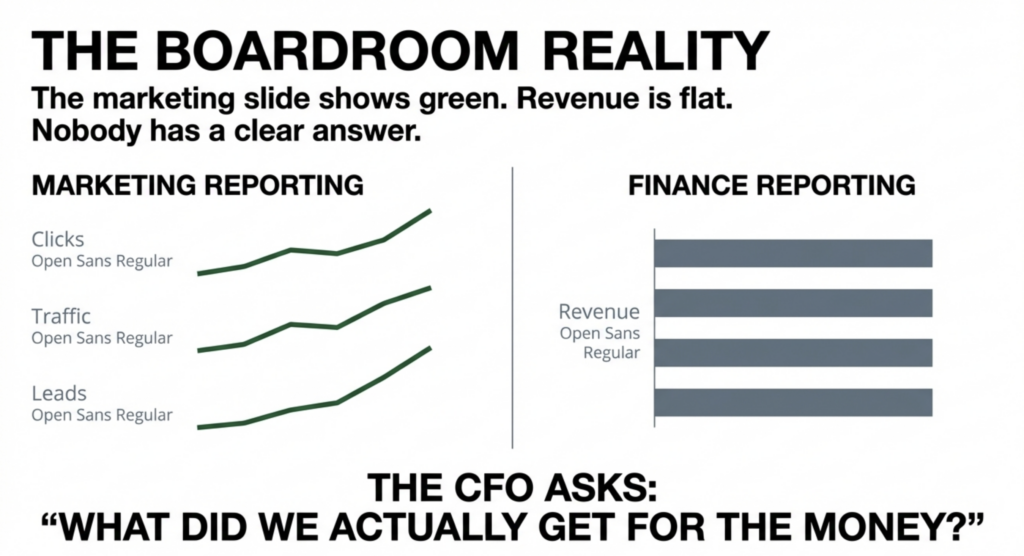
I have sat in enough board meetings to know what happens when the marketing slide comes up.
The CEO reads the headline number. The CFO asks what it means. The marketing lead explains it in terms of impressions, leads, or website traffic. The CFO asks a different version of the same question: what did we actually get for the money? And nobody has a clear answer.
The instinct, almost every time, is to blame the team. The marketing director is not strategic enough. The agency is underperforming. The content is not resonating. Maybe we need a new hire. Maybe we need a new agency. Maybe we need to cut the budget and see what survives.
I have run diagnostics on enough growth-stage companies to tell you with confidence: the team is usually not the problem. The people executing campaigns, writing content, and managing ad accounts are often doing competent work within the scope they have been given.
The problem is that nobody gave them the scope that connects to revenue.
The Structural Disconnect Between Marketing Activity and Revenue Accountability
Here is the pattern we see at nearly every company between $20M and $200M in revenue that engages us for a Strategic Growth Diagnostic.
The marketing team exists. The budget is real. There are two to four external agencies managing paid media, SEO, email, or creative. Every month, each agency sends a report showing their channel is performing. Google Ads shows a strong click-through rate. The SEO agency reports improved rankings. The email platform shows solid open rates.
And revenue is flat.
McKinsey published research in 2025showing that 70% of CEOs measure marketing’s effectiveness based on year-over-year revenue growth and margin. But only 35% of CMOs track the same metric as a top priority. That is not a performance gap. That is a measurement gap. The CEO and the marketing function are literally using different scorecards.
The same McKinsey research found that 20% fewer CEOs now believe marketing’s role is clearly defined and understood by the C-suite, compared to just two years ago. The role is getting less clear, not more.
According to IBM’s 2025 CMO Study, 64% of CMOs are now held accountable for company profitability. That is a significant increase from historical expectations. But here is the disconnect: most marketing teams still operate with tools, KPIs, and reporting structures designed to measure activity, not revenue contribution.
The board wants revenue accountability. The team was built for activity reporting. And nobody built the bridge between the two.
This Is a System Problem, Not a People Problem
When we run a diagnostic at a PE-backed portfolio company, we almost never find a team that is incompetent. What we find, consistently, are five structural failures that prevent marketing from connecting to revenue.
Failure 1: Nobody Owns the Connection Between Spend and Outcomes
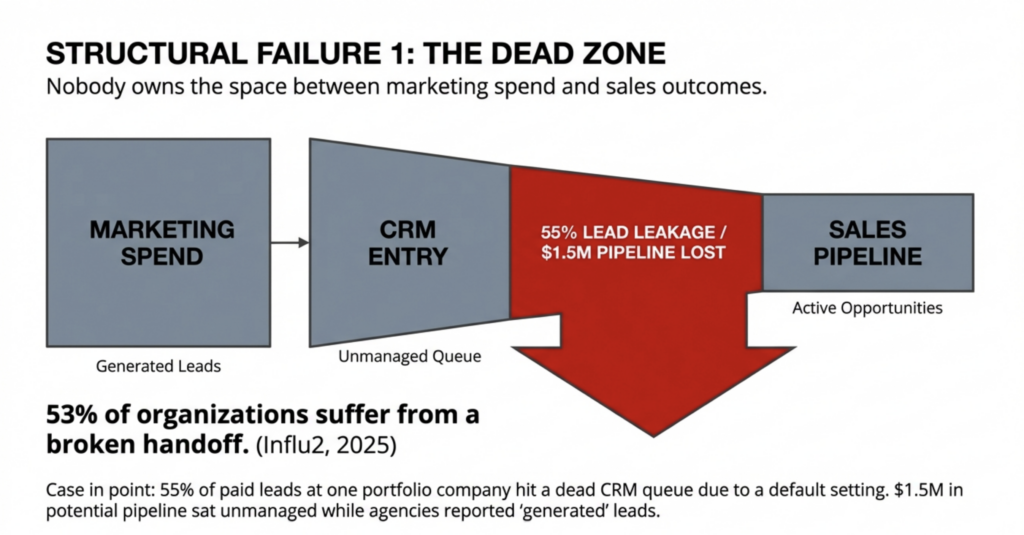
The marketing team is responsible for campaigns. The sales team is responsible for closing. Finance is responsible for reporting revenue. But the space between “leads generated” and “revenue produced” belongs to nobody.
A 2025 study by Influ2 found that 53% of organizations have a broken handoff between marketing and sales. That is not a people problem. That is an infrastructure problem. The leads come in, they enter the CRM, and then they fall into a gap that nobody is watching.
At one financial services company, we assessed that roughly 55% of paid leads were entering a dead queue in the CRM due to a field default that had been set incorrectly during a platform migration.
No one on the team, and none of their agencies, had caught it. The leads appeared in marketing’s reports as “generated.” They never appeared in the sales pipeline. Over $1.5 million in potential pipeline was sitting in a queue that nobody checked.
Failure 2: Agencies Report on Themselves, Not on Revenue
This is the most consistent finding in every diagnostic we run: agencies are held accountable to their channel’s metrics, not to business outcomes.
The Google Ads agency reports click-through rate and cost per lead. The SEO agency reports keyword rankings and organic traffic. The email agency reports open rates and send volume. Every single one of those reports can look healthy while revenue stays flat or declines.
MarketingSherpa data shows that 79% of marketing leads never convert into sales. That number has not improved meaningfully in years. And the reason is structural: nobody is measuring what happens to a lead after it enters the CRM. The agency’s job ends at the lead. The sales team’s job starts in the pipeline. The middle is unmanaged.
We frequently find companies paying $250K or more per year in combined agency fees with zero strategic oversight connecting that spend to revenue outcomes. Every agency reports great metrics. Nobody reports on whether the money produced customers.
Failure 3: Attribution Is Broken and Nobody Knows It
Here is a finding that shows up in six out of ten diagnostics we run: the ad platform reports one number of conversions, the CRM reports a different number, and GA4 reports a third. The discrepancy is often 50% to 200%.
The root cause is almost always attribution window misalignment. Meta uses a 7-day click window. The CRM uses a 30-day window. Google uses its own methodology. Nobody reconciled them.
The business consequence is severe: channels that are actually performing get killed because the data says they are failing. At the same financial services company, the Meta channel was running at under 3% cost of acquisition, making it the best-performing channel in the portfolio. But the attribution was so broken that internal reporting showed Meta as a loss.
The team was about to shut it down. A 20-minute data reconciliation saved the channel and over a million dollars in the future pipeline.
Read Also
Failure 4: Unit Economics Are a Single Blended Number
Most marketing teams report customer acquisition cost as a single average across all channels and segments. This is dangerously misleading.
We regularly find that unit economics vary dramatically by customer segment. At one company, Segment A had a lifetime value of +$800 per customer. Segment B had a lifetime value of -$150 per customer.
The blended average looked acceptable. But the company was spending equally across both segments, meaning they were actively losing money on a significant portion of new customer acquisitions without knowing it.
This is not a team failure. This is a failure to build the analytical infrastructure that connects marketing data to customer financial data. Nobody told the team to calculate CAC by segment because nobody owned that connection.
Failure 5: There Are 150 Things To Do and Nobody Who Prioritizes Them
Growth-stage companies accumulate marketing tasks at an extraordinary rate. New campaigns, website updates, landing page builds, email sequences, agency reviews, competitive analysis, and reporting improvements. The list grows every week.
Without a strategic layer that can evaluate each item by dollar impact and implementation complexity, the team defaults to either doing what is most urgent or doing what is most familiar.
Neither approach connects to revenue. The result is a marketing function that is busy, that is producing output, and that cannot explain what any of it accomplished.
What Revenue-Connected Marketing Accountability Actually Looks Like
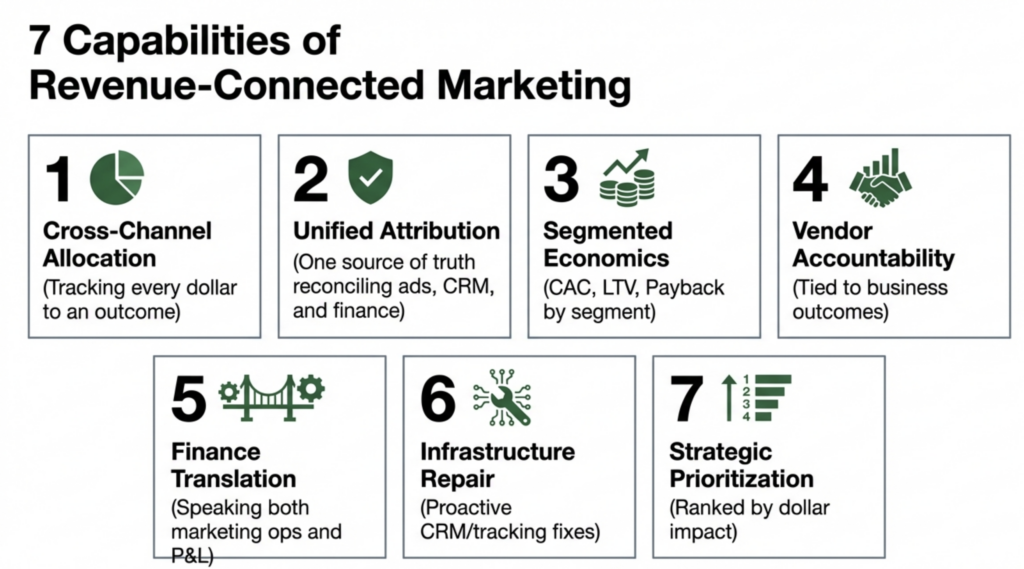
Revenue-connected accountability is not about adding more dashboards or buying a new analytics tool. It is about building seven specific capabilities into the marketing function:
Cross-channel budget allocation based on revenue contribution, not channel metrics. Every dollar should be tracked to a revenue outcome, and budget should flow to the channels that produce customers, not the channels that produce the most leads.
Unified attribution infrastructure. One source of truth that reconciles ad platform data, CRM data, and financial data so the business can trust its numbers. Forrester reports that 74% of B2B marketing organizations now have pipeline or revenue as their primary metric, up from 54% in 2022. The shift is happening. But the infrastructure to support it is lagging behind.
Segmented unit economics. CAC, LTV, and payback period calculated by channel, segment, and product line. Not a single blended average.
Vendor accountability tied to business outcomes. Agency contracts should include revenue-connected KPIs, not just channel performance targets.
Marketing-to-finance translation. The CMO Survey reportsthat board pressure on marketing rose 21% between 2023 and 2025, and CFO pressure rose 52%. Someone needs to speak both languages: marketing operations and financial outcomes. That capability must live inside the organization, not be delegated to an agency.
Infrastructure diagnosis and repair. Proactive identification of CRM misconfigurations, broken automation sequences, and tracking failures before they compound into six- or seven-figure losses.
Strategic prioritization. A roadmap that ranks every marketing initiative by dollar impact and implementation complexity, so the team executes in the order that produces the most revenue the fastest.
This is what we refer to as the missing strategic layer. When it exists, marketing connects to revenue. When it does not exist, marketing stays busy but disconnected. For a deeper look at what this layer involves, read our breakdown of the strategic layer gap and how it affects portfolio company performance.
How To Build Revenue Accountability Without a Full-Time CMO
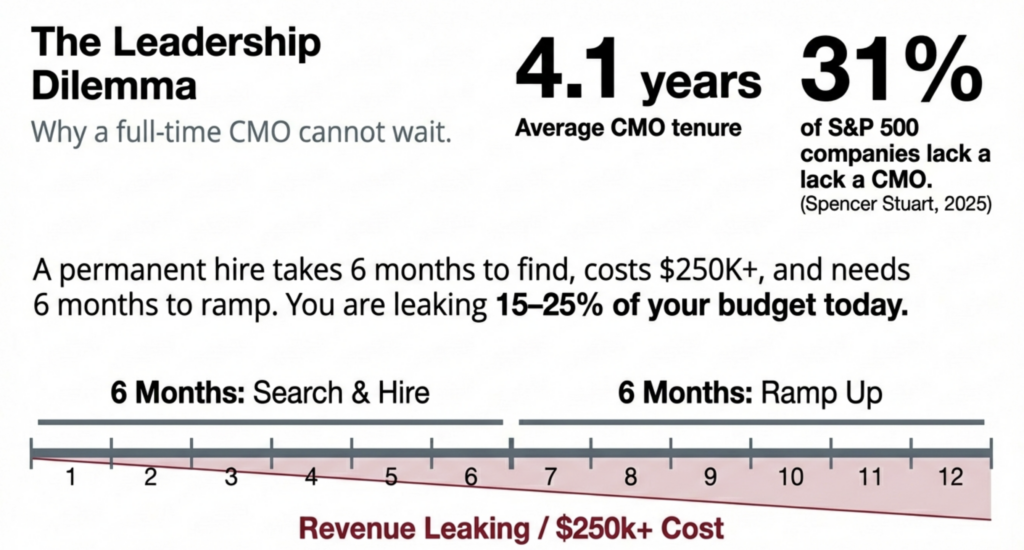
Here is the reality for most growth-stage companies: the person who should own this function is a CMO. But CMO tenure sits at 4.1 years at S&P 500 companies, according to Spencer Stuart’s 2025 data. That is down from 4.3 years in 2024 and well below the C-suite average of 5 years.
At mid-market PE-backed companies, the situation is worse. A full-time CMO hire takes 4 to 6 months to find, costs $250K or more in salary and benefits, and takes another 6 months to ramp up. That is a 12-month timeline before the function is fully operational. And 31% of S&P 500 companies do not even have a CMO in the seat right now.
The gap cannot wait 12 months to fill. Revenue is leaking today. Board questions are being asked today. Agency contracts are being renewed today.
There are three practical approaches to closing this gap:
Option 1: Run an Independent Diagnostic First
Before you hire a CMO, a Fractional CMO, or a new agency, you need to understand what is actually broken. A Strategic Growth Diagnostic goes system-deep: CRM configurations, attribution chains, unit economics, email automation logic, competitive positioning, and organizational capability. It produces a prioritized roadmap of 150 to 200 specific findings with dollar impact and implementation timelines.
The diagnostic also tells you what kind of CMO you actually need to hire, whether your current agencies should be kept or replaced, and which infrastructure investments will produce the highest return. Without it, you are hiring blind.
Option 2: Engage a Fractional CMO for the Strategic Layer
A Fractional CMO provides the seven capabilities listed above without the cost, timeline, or fit risk of a full-time hire. They can start within weeks, they work from the diagnostic findings, and they embed with the team to build the accountability framework from the inside.
Gartner’s 2025 data shows that marketing budgets have been flat at 7.7% of company revenue. Growth has to come from efficiency, not from spending more. The strategic layer is the highest-leverage investment in marketing efficiency because it redirects existing spend from waste to revenue.
Option 3: Diagnostic, Then Fractional, Then Hire
The most effective path we have seen is sequential: run the diagnostic (4 to 8 weeks), engage a Fractional CMO to implement the roadmap and build the accountability framework (12+ months), then use the diagnostic and the Fractional CMO’s institutional knowledge to write the job description for the permanent hire.
This path eliminates the 12-month gap, produces visible results within the first 30 days, and ensures the permanent hire walks into a functioning system instead of inheriting the same problems that existed before they arrived.
The Board Meeting Test
Here is the simplest way to know if your marketing function has revenue accountability: can your marketing leader answer these four questions at the next board meeting, without caveats or follow-up?
- What is our cost to acquire a customer, by channel and segment?
- Which channels produce customers (not leads, not traffic) and what does each customer cost us?
- How long does it take us to recover the cost of acquiring a customer, and how does that vary by segment?
- If we increase marketing spend by 20%, where should that money go to produce the most revenue?
If the answers require caveats, asterisks, or follow-up, the marketing function does not have revenue accountability. It has activity reporting. And the gap between the two is where companies lose 15 to 25% of their marketing budget every year to spend that cannot be connected to any business outcome.
That is not a team problem. That is a system problem. And system problems require structural solutions: an independent diagnosis of what is broken, a strategic layer that connects execution to outcomes, and investor-ready growth reporting that gives the board the confidence it needs to keep investing.
The team is doing the work. The question is whether anyone has built the infrastructure to make that work count.
How Azarian Growth Agency Builds the Bridge
At Azarian Growth Agency, this is the exact problem we solve. We run paid, independent Strategic Growth Diagnostics that go system-deep into CRM configurations, attribution chains, unit economics, and vendor accountability. We find the things nobody else is looking for because nobody else has been asked to look.
If your marketing team is busy, your agencies are reporting strong metrics, and your revenue is not growing the way it should, the answer is probably not a new hire or a new agency.
The answer is an independent diagnosis of what is actually broken and a strategic layer that connects what your team is doing to what your business needs.
See How the Strategic Growth Diagnostic Works
Sources and Further Reading
- McKinsey & Company, “The CMO’s Comeback: Aligning the C-Suite to Drive Customer-Centric Growth” (2025) → https://www.mckinsey.com/capabilities/growth-marketing-and-sales/our-insights/the-cmos-comeback-aligning-the-c-suite-to-drive-customer-centric-growth
- Gartner, “2025 CMO Spend Survey: Marketing Budgets Have Flatlined at 7.7% of Overall Company Revenue” (2025) → https://www.gartner.com/en/newsroom/press-releases/2025-05-12-gartner-2025-cmo-spend-survey-reveals-marketing-budgets-have-flatlined-at-seven-percent-of-overall-company-revenue
- Spencer Stuart, “CMO Tenure Study 2025: The Evolution of Marketing Leadership” (2025), via Adweek → https://www.adweek.com/brand-marketing/why-cmo-tenure-remains-stubbornly-short/
- IBM, “2025 CMO Study: 64% of CMOs Now Held Accountable for Profitability,” via emfluence → https://emfluence.com/blog/what-cmos-are-prioritizing-in-the-second-half-of-2025
- Forrester, “74% of B2B Marketing Organizations Now Have Pipeline or Revenue as Primary Metric,” via Pedowitz Group Revenue Marketing Index (2025) → https://www.pedowitzgroup.com/revenue-marketing-index
- Influ2, “The State of Sales & Marketing Alignment in 2025” → https://www.influ2.com/reports/sales-marketing-alignment-statistics
- MarketingSherpa, “79% of Marketing Leads Never Convert Into Sales,” via HubSpot → https://blog.hubspot.com/blog/tabid/6307/bid/30901/30-thought-provoking-lead-nurturing-stats-you-can-t-ignore.aspx
- The CMO Survey, Spring 2025: “Board Pressure on Marketing Rose 21%, CFO Pressure Rose 52%,” via Funnel.io → https://funnel.io/blog/roi-of-marketing