
Local SEO AI search has fundamentally transformed how customers discover businesses across multiple locations in 2025 and 2026. Traditional local ranking factors like keyword density and backlinks now compete with AI-powered entity recognition, semantic understanding, and conversational query processing.
Multi-location businesses face unprecedented challenges as search engines prioritize contextual relevance over simple geographic proximity.
The global local SEO market is projected to reach $122.11 billion by 2028, with AI-driven optimization accounting for a significant portion of this growth. Google’s Search Generative Experience (SGE) and other AI search platforms now interpret local intent through natural language understanding rather than exact-match keywords.
This shift demands new strategies for franchise SEO in the AI era.
In this guide, you’ll discover how AI search engines process local queries, what multi-location businesses must optimize differently, and proven frameworks for maintaining visibility across dozens or hundreds of locations simultaneously.
Understanding AI Local Discovery and Search Behavior
AI local discovery operates fundamentally differently from traditional local search algorithms. Instead of matching keywords to business listings, AI systems understand user intent through conversational context. When someone asks, “find me the best coffee near downtown with outdoor seating,” AI interprets multiple intent layers simultaneously.
The system recognizes “best” as a quality signal requiring review and analysis. “Near downtown” triggers geographic understanding with flexible radius interpretation. “Outdoor seating” becomes an amenity filter that AI matches against structured and unstructured business data.
Multi-location businesses must optimize for entity recognition at scale. Each location needs distinct entity signals that help AI differentiate between your Chicago, Miami, and Seattle operations. This goes beyond simple NAP (Name, Address, Phone) consistency into deeper entity attributes.
AI search engines build knowledge graphs connecting your business entities to related concepts. Your restaurant locations connect to cuisine types, chef credentials, dietary accommodations, and neighborhood characteristics. These entity relationships determine visibility in AI-generated responses.
Google Business Profile GEO Optimization for AI Visibility
Google Business Profile GEO (Generative Engine Optimization) represents the new frontier of local visibility. Your GBP listings now feed directly into AI-generated search responses. Optimizing for this requires understanding what data AI systems prioritize when generating local recommendations.
Complete every GBP field with detailed, specific information. AI systems favor comprehensive profiles over sparse listings. Include business descriptions that naturally incorporate entity relationships rather than keyword stuffing. Describe what makes each location unique within your brand framework.
Critical GBP Elements for AI Search:
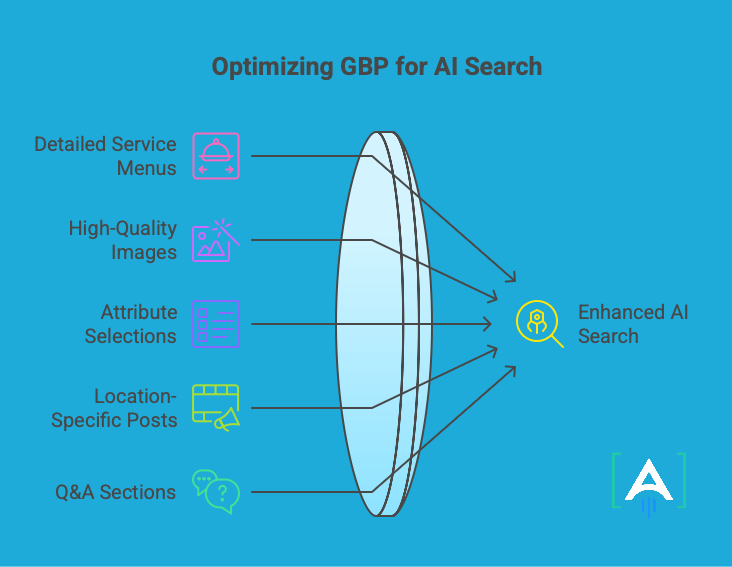
- Detailed service menus with descriptions
- High-quality images with descriptive file names
- Attribute selections covering all relevant categories
- Posts announcing location-specific events and offers
- Q&A sections addressing common local queries
Update each location’s GBP weekly with fresh content. AI systems interpret update frequency as a relevance signal. Post about seasonal menu changes, staff achievements, community involvement, or location improvements. This activity signals to AI that your business remains actively engaged.
Leverage GBP features like appointment booking, messaging, and product catalogs. These structured data points give AI concrete information to reference in generated responses. The more structured data you provide, the more confidently AI systems recommend your locations.
Multi-Location AI Optimization at Scale
Managing multi-location AI optimization requires systematic approaches that maintain consistency while preserving location uniqueness. Standardized templates help, but each location needs customized elements that reflect its specific market context and customer base.
Create location-specific content hubs on your main website. Each location deserves a dedicated page with unique, substantial content beyond address and hours. Include neighborhood descriptions, local team bios, location-specific services, and community involvement stories.
Build entity relationships through structured data markup at every location level. Implement LocalBusiness schema with complete property specifications. Add the Organization schema, connecting all locations to your parent brand. Use the FAQ schema for common location-specific questions.
Multi-Location Content Strategy Framework:
- Core brand content maintained centrally
- Location pages with unique local elements
- Neighborhood and city guides demonstrating local expertise
- Location-specific blog content addressing local trends
- Community involvement documentation per location
Develop location-specific authority through local backlinks and citations. Partner with local businesses, sponsor community events, and engage with local media. AI systems recognize these local connections as entity relationship signals that boost relevance.
For franchise SEO in the AI era, balance brand consistency with franchisee autonomy. Provide templates and guidelines while allowing location owners to add authentic local touches. AI rewards genuine local engagement over corporate-generated content pushed to all locations.
Review Management for AI Citations and Recommendations
Review management has evolved beyond reputation monitoring into an active AI citation strategy. AI search engines reference reviews when generating recommendations, making your review content and response strategy critical visibility factors.
93% of consumers read online reviews before making a purchase decision, and AI systems now synthesize these reviews to generate recommendation summaries. Your reviews become the raw material AI uses to describe your business to potential customers. Quality and quantity both matter significantly.
Encourage detailed reviews that mention specific services, menu items, staff members, and location features. General “great service” reviews provide less value than specific descriptions AI can extract and reference. Train staff to politely request reviews that mention what customers specifically appreciated.
Respond to every review promptly and authentically. AI systems analyze response patterns as customer service indicators. Generic template responses score lower than personalized replies addressing specific review content. Demonstrate that you read and care about each customer’s experience.
Review Response Best Practices for AI:
- Address reviewers by name when provided
- Reference specific details from their review
- Provide relevant additional information
- Include location-specific context naturally
- Maintain consistent brand voice across locations
Monitor review sentiment across all locations systematically. AI systems compare locations within multi-location brands. Consistently negative sentiment at specific locations damages your entire brand’s AI visibility. Address operational issues preventing positive reviews rather than just managing reviews reactively.
Leverage review insights for location improvements. When multiple reviews mention the same issues or praise the same features, AI systems weigh these patterns heavily. Addressing common complaints and emphasizing frequently praised elements improves how AI describes your locations.
Local Search 2026: Preparing for Voice and Visual AI
Local search in 2026 increasingly happens through voice assistants and visual search tools. Multi-location businesses must optimize for these AI interfaces that present results differently from traditional search results pages.
Voice search prioritizes singular recommendations over lists of options. When someone asks Alexa or Siri for “a good Italian restaurant nearby,” they typically receive one or two suggestions, not ten. Your optimization must target featured positions in AI responses.
Optimize for conversational, question-based queries. People speak differently than they type. “Where can I get my oil changed quickly near me” represents natural voice search syntax. Create content addressing these natural language patterns explicitly.
Voice Search Optimization Priorities:
- FAQ content matching conversational queries
- Natural language in business descriptions
- Clear, concise service descriptions AI can quote
- Strong review signals supporting recommendations
- Fast, mobile-optimized website experience
Visual search through Google Lens and similar tools matches images to business locations. Ensure your business exterior, signage, and interior are well-photographed across all locations. Use consistent branding elements AI can recognize across locations.
Implement image schema markup describing photos on location pages. Include geographical coordinates, business names, and image descriptions. This structured data helps AI systems connect visual searches to your locations accurately.
Location-Specific Content Strategies for AI Visibility
Location-specific content strategies for AI visibility require depth over breadth. Instead of thin pages for every location, create comprehensive resources that establish genuine local expertise and authority. This content feeds AI systems the context they need to recommend your locations confidently.
Develop neighborhood guides demonstrating local knowledge. Write about nearby attractions, complementary businesses, parking options, and local events. AI systems recognize this content as genuine local engagement rather than corporate marketing.
Create location-specific blog content addressing local trends and issues. A coffee shop in Portland might discuss local roasters and sustainability initiatives. The same brand’s Boston location could cover historical coffeehouses and university culture. These distinctions help AI understand each location’s unique context.
Content Types That Strengthen Local AI Signals:
- Neighborhood history and characteristics
- Local partnership announcements
- Community event participation recaps
- Location-specific how-to guides
- Local customer success stories
Interview local team members and feature their expertise. AI systems recognize authentic local voices and expertise markers. A gym location’s content featuring local trainers and their specializations provides stronger entity signals than corporate fitness content.
Document community involvement authentically. Sponsorships, charity partnerships, and local initiatives create entity relationships that AI systems recognize. These connections position your locations as integral community members rather than external corporate presences.
Professional content marketing agencies understand how to create location-specific content at scale while maintaining quality and authenticity. They balance efficiency with the customization of AI systems’ rewards.
Entity Optimization at Scale for Multi-Location Brands
Entity optimization at scale requires understanding how AI systems build knowledge graphs connecting your locations to relevant concepts, services, and geographic areas. Each location needs distinct entity recognition while maintaining a connection to your parent brand entity.
Implement consistent structured data across all locations using Schema.org markup. LocalBusiness schema should include complete attributes: opening hours, price range, accepted payments, accessibility features, and service areas. Connect each location to your parent Organization schema.
Build citations systematically across authoritative local directories. Ensure NAP consistency across all platforms, but include detailed descriptions that establish entity attributes. These citations help AI systems verify your locations and understand what you offer.
Create separate social media profiles for locations when scale permits. This isn’t necessary for every franchise with hundreds of locations, but regional or flagship locations benefit from dedicated social presence. These profiles strengthen individual location entities in AI knowledge graphs.
Entity Attribute Optimization Checklist:
- Complete Schema markup implementation
- Consistent NAP across all directories
- Unique location descriptions with entity relationships
- Service-specific pages for each location
- Local backlinks from authoritative sources
Manage entity disambiguation carefully for similar location names. If you have multiple locations in the same city, AI systems must clearly distinguish between them. Use Monitor how AI systems currently describe your locations. Search for your business name plus location, then analyze how AI-generated summaries present your information. Identify gaps or inaccuracies in AI understanding, then optimize content and structured data addressing these issues. This is a crucial part of Local SEO for franchises.
Franchise Local SEO in the AI Era: Balancing Consistency and Local Authenticity
Franchise SEO in the AI era demands new frameworks balancing brand consistency with location authenticity. Traditional franchise marketing emphasized uniform messaging across all locations. AI rewards genuine local engagement that template content cannot provide. Implementing Local SEO principles ensures that each location ranks well for nearby searches while maintaining brand cohesion.
Develop tiered content strategies with brand-level, regional, and location-specific layers. Core brand content lives on your main domain. Regional content addresses multi-state or metro area contexts. Location content provides granular local relevance, a key factor in effective Local SEO.
Provide franchisees with content frameworks rather than finished templates. Give them structures for creating location-specific content while maintaining brand voice and quality standards. This approach yields authentic local content AI systems recognize and reward.
Franchise AI Optimization Framework:
- Centralized technical SEO and structured data
- Regional content addressing shared market characteristics
- Location-specific content created with local input
- Review management systems with local response capability
- Centralized monitoring with location-specific interventions
Implement centralized monitoring systems tracking all locations’ AI visibility. Monitor how AI search engines present each location in generated responses. Identify locations underperforming in AI search, then diagnose and address specific issues.
Train franchisees on AI search fundamentals and their role in optimization. They need to understand how their Google Business Profile management, review responses, and local engagement affect AI visibility. Create simple processes they can execute consistently.
Balance franchisee autonomy with quality control. Allow local customization while preventing brand-damaging content or tactics. Regular audits ensure compliance with brand standards and AI best practices across all locations.
Measuring Multi-Location AI Search Performance
Measuring multi-location AI search performance requires tracking metrics beyond traditional local SEO KPIs. Monitor not just rankings but how AI systems present your locations in generated responses and recommendations.
Track GBP insights for each location systematically. Monitor search queries triggering your business profile, actions taken, and how customers find your listing. Compare performance across locations, identifying consistently high and low performers.
Key Metrics for Multi-Location AI Performance:
- AI-generated response appearances by location
- GBP search query volume and diversity
- Review acquisition rate and sentiment by location
- Direction requests and phone calls by location
- Website traffic from AI search by location
Use conversation monitoring tools tracking how voice assistants and chatbots reference your locations. These AI-generated recommendations represent future search behavior. Understanding current patterns helps you optimize proactively.
Monitor competitor visibility across locations. AI search democratizes some aspects of local discovery while creating new competitive advantages. Understand which competitors appear in AI-generated recommendations and analyze why.
Implement location-specific conversion tracking. Know which locations generate the most customers from AI search channels. This data justifies optimization investment and identifies successful strategies worth replicating across locations.
Professional data analytics services provide comprehensive visibility into multi-location performance. They identify patterns across locations and recommend data-driven optimization priorities.
The Strategic Advantage of Expert Local SEO Guidance
Local SEO AI search represents complex challenges for multi-location businesses managing dozens or hundreds of locations simultaneously. The shift from traditional local ranking factors to AI-powered entity recognition and semantic understanding requires expertise most in-house teams lack.
Successful multi-location AI optimization demands systematic approaches balancing automation with customization. You need frameworks that maintain efficiency while delivering the location-specific authenticity AI systems reward. Understanding how to implement structured data at scale, manage review strategies across locations, and create authentic local content requires specialized knowledge.
The competitive advantages go to businesses that treat local AI optimization as a strategic priority rather than a tactical checklist. Your locations need more than basic GBP management. They require comprehensive entity optimization, sophisticated content strategies, and continuous adaptation to AI search evolution.
Azarian Growth Agency specializes in multi-location AI optimization for businesses operating across cities, states, and countries. Our local SEO agency services combine technical expertise with strategic frameworks that scale across any number of locations. We understand how AI search engines process local queries and what optimization delivers measurable visibility improvements.
Our approach integrates multiple disciplines that strengthen local AI presence. We combine social media marketing for location-specific engagement, branding that differentiates each location while maintaining consistency, and AI content optimization that speaks AI systems’ language. This integrated strategy delivers results individual tactics cannot achieve.
Whether you operate five locations or five hundred, we develop customized frameworks that fit your operational reality. We balance centralized control with location autonomy, automation with authenticity, and efficiency with effectiveness. Our systems scale with your growth without losing the local authenticity AI rewards.
Partner with us to transform your multi-location local visibility in the AI search era. We’ll audit your current performance, identify immediate opportunities, and implement systematic optimization that delivers measurable improvements across every location.