

GEO first-mover advantage represents the single greatest positioning opportunity since early SEO adoption in the 2000s. Business owners and CEOs face a rapidly closing window: implement Generative Engine Optimization now while competition remains minimal, or fight for scraps when saturation hits later in 2026.
The GEO market, valued at $886M in 2024, projects to reach $7.3B by 2031, with 75% of digital agencies launching GEO services in 2025. Additionally, only 11% of B2B marketers have AI-ready content, creating a massive opportunity for prepared brands while competitors delay.
In this guide, we’ll reveal why early GEO adoption matters, analyze current low adoption creating temporary advantages, and provide your 90-day implementation plan for capturing category leadership before Q1 2026 ends.
Understanding GEO First-Mover Advantage
GEO first-mover advantage works similarly to early SEO: brands optimizing before market saturation capture disproportionate visibility that compounds over time. The difference? GEO’s opportunity window is compressing faster.
Furthermore, AI platforms like ChatGPT, Perplexity, and Google AI Overviews prioritize established, frequently-cited sources. Early positioning builds citation history that strengthens recommendation algorithms over time.
GEO agency expertise accelerates implementation dramatically. Brands attempting solo optimization waste precious months learning principles agencies already mastered.
Why Early Adopters Win Disproportionately
AI recommendation algorithms learn from interaction patterns. Brands earning early citations establish authority signals that reinforce future recommendations. This creates self-perpetuating cycles favoring first movers.
Consequently, late adopters face higher barriers. When AI platforms already cite established sources consistently, displacing them requires dramatically superior content rather than merely good optimization.
The window for easy wins is shrinking. AI keyword competition rose 60% year-over-year, with projections showing 150% above 2024 levels by decade’s end in competitive niches.
The Historical Parallel: Early SEO Adoption
Early SEO adopters in the 2000s captured dominant positions that persisted for years. Basic optimization delivered outsized results before the competition understood the game.
Moreover, 71% of Americans now use AI search to research purchases, mirroring early search engine adoption curves. The parallel is unmistakable: we’re witnessing GEO’s equivalent of Google’s early growth phase.
Brands delaying action repeat history’s mistake. Those who dismissed early SEO importance later spent millions fighting entrenched competitors for visibility.
Competitive Analysis: Current Low Adoption
Current GEO adoption remains surprisingly low despite growing awareness. This gap between importance and implementation creates temporary first-mover windows smart brands exploit immediately.
Additionally, only 11% of B2B content is AI-ready, meaning 89% of competitors lack proper optimization. This massive unpreparedness creates unusual opportunities for brands implementing systematic GEO strategies.
Content marketing teams overwhelmed by AI transformation often postpone GEO, prioritizing familiar tactics over emerging channels. This delay hands advantages to decisive competitors.
Why Competitors Aren’t Moving Yet
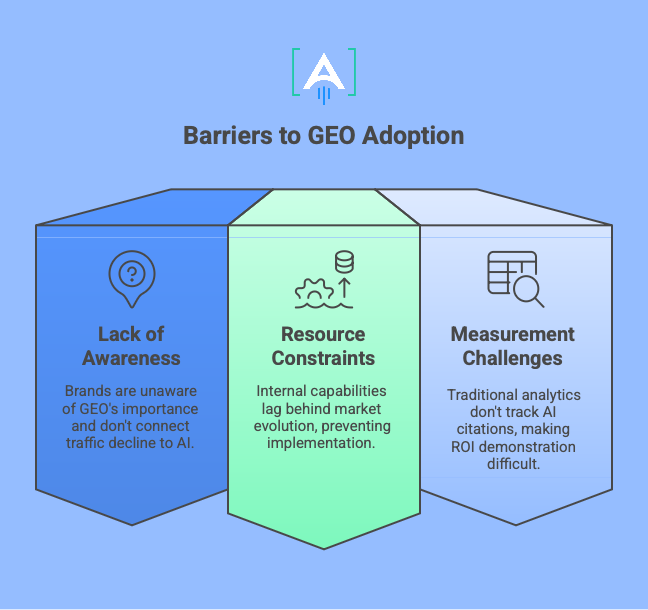
Lack of awareness keeps many brands ignorant of GEO’s importance. They notice declining organic traffic but don’t connect it to AI-powered search displacement.
Resource constraints prevent implementation even when teams understand the GEO value. Internal capabilities lag behind market evolution, creating paralysis.
Measurement challenges deter adoption. Traditional analytics don’t track AI citations, making ROI demonstration difficult for conservative marketers requiring proof before investment.
Furthermore, AI marketing agency partnerships solve these barriers systematically. Professional implementation eliminates common obstacles preventing in-house GEO execution.
The Saturation Timeline
Market saturation accelerates as awareness spreads. 75% of agencies now offer GEO services, signaling mainstream recognition. This professionalization drives rapid client adoption.
Q1 2026 represents the transition point. Early adopters securing positions now benefit from minimal competition. By Q2 2026, market saturation begins as delayed competitors rush to catch up.
Q3-Q4 2026 becomes highly competitive. Brands starting then face established competitors with citation history, making displacement exponentially harder than Q1 implementation.
The math is simple: earlier action means easier wins and lower costs. Every quarter delayed multiplies difficulty and expense.
Generative Search Early Adoption Benefits
Generative search early adoption delivers compounding advantages that late movers cannot replicate. These benefits accumulate over time, creating widening gaps between leaders and laggards.
Consequently, content cited by AI platforms sees 38% boosts in organic clicks according to 2025 research. Early visibility generates traffic while competitors remain invisible.
Social media marketing amplifies GEO success. Cited brands gain authority signals that improve performance across all channels, not just AI platforms.
Building Citation Authority
Original research generates proprietary insights AI platforms must cite directly. This unique content can’t be synthesized from existing sources, forcing AI to reference you specifically.
Comprehensive guides covering complete topics earn repeated citations. When users ask related questions, AI platforms return to authoritative resources rather than seeking new sources.
Consistent publication signals active expertise. AI systems favor brands demonstrating sustained thought leadership over sporadic contributors.
Moreover, AI content optimization ensures content speaks effectively to both AI systems and human audiences. This dual optimization maximizes visibility across discovery channels.
The Compound Effect
Early citations create momentum that accelerates over time. Each mention increases authority signals, improving recommendation likelihood for future queries.
Brand recognition grows as AI platforms repeatedly cite your content. Users encountering your brand across multiple AI interactions develop familiarity that influences purchase decisions.
Category association strengthens when AI consistently mentions your brand for specific topics. You become synonymous with the category itself in AI recommendation hierarchies.
Additionally, data analytics and reporting platforms track these compounding effects. Measuring citation growth over time quantifies first-mover ROI.
AI Search Competition 2026
The AI search competition 2026 will intensify dramatically as delayed brands recognize GEO’s importance and scramble to recover lost ground. Understanding this competitive trajectory informs strategic timing.
Furthermore, 60% of searches now end without clicks, with users satisfied by AI-generated answers. This zero-click reality makes AI visibility essential for brand discovery.
Projected Market Dynamics
Early Q1 2026: Minimal competition. Brands implementing now capture easy wins with basic optimization. Citation acquisition happens quickly.
Mid Q1 2026: Growing awareness. More brands begin implementation, but execution lags recognition. First movers maintain advantages.
Q2 2026: Accelerating competition. Professional implementation becomes standard. Differentiation requires sophisticated strategies beyond the basics.
Q3-Q4 2026: Market maturity. GEO becomes table stakes like SEO. Competitive advantages come from execution excellence rather than participation itself.
The transition from Q1 to Q2 2026 represents the inflection point. Brands positioned before this shift capture lasting advantages.
Cost Implications
Early adoption costs less than late catch-up efforts. Basic optimization during low competition delivers results that sophisticated strategies barely match during saturation.
Citation acquisition becomes expensive as competition intensifies. Early movers earn citations through quality content. Late entrants must outspend established players.
Content production requirements increase. Standing out amid GEO-optimized competitors demands higher volume and better quality than current standards.
Moreover, AI marketing agency partnerships provide cost-effective implementation. Agency expertise delivers faster results at lower total costs than trial-and-error internal efforts.
Your 90-Day GEO Implementation Plan
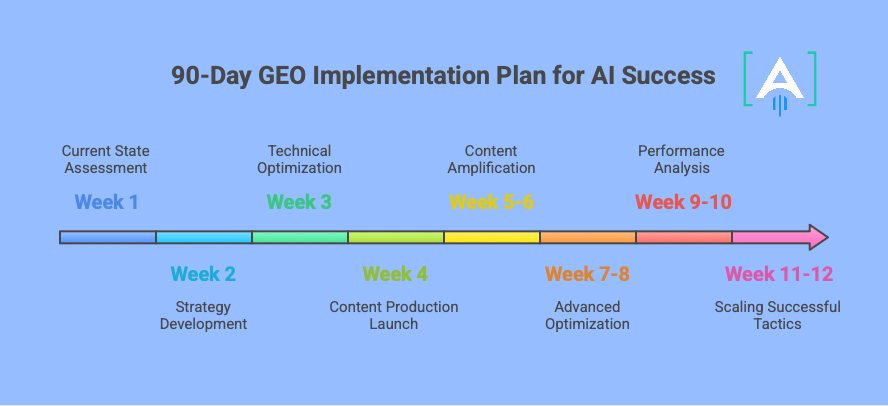
Systematic 90-day implementation captures first-mover advantages before Q1 2026 ends. This phased approach balances speed with quality, ensuring proper foundation for long-term success.
Consequently, focus on high-impact activities first. Perfect execution of basics beats mediocre attempts at advanced tactics. Build momentum through quick wins.
Content marketing strategies must prioritize GEO-optimized formats. Redirect resources from low-performing channels toward AI discovery optimization.
Days 1-30: Foundation and Audit
1 Week: Current State Assessment
- Audit existing content for AI readability
- Test brand visibility across ChatGPT, Perplexity, AI Overviews
- Identify competitor citation frequency
- Document baseline metrics
2 Week: Strategy Development
- Define target keywords and topics
- Identify content gaps AI platforms favor
- Create citation-worthy content roadmap
- Establish measurement frameworks
3 Week: Technical Optimization
- Implement schema markup
- Optimize site architecture for AI crawlers
- Ensure mobile performance and speed
- Configure analytics for AI traffic tracking
4 Week: Content Production Launch
- Create first batch of GEO-optimized content
- Publish original research or data
- Develop comprehensive topic guides
- Initiate outreach for authoritative backlinks
Days 31-60: Content Scale and Distribution
5-6 Week: Content Amplification
- Syndicate content across industry publications
- Secure podcast and interview placements
- Develop social amplification campaigns
- Build relationships with journalists covering your industry
7-8 Week: Advanced Optimization
- Test content variations for citation performance
- Refine messaging based on initial AI visibility
- Expand content coverage to adjacent topics
- Develop FAQ and Q&A content AI platforms favor
Key focus areas:
- Natural language optimization over keyword stuffing
- Question-answer formats AI extracts directly
- Structured data enabling easy AI synthesis
- Comprehensive coverage establishing authority
Days 61-90: Measurement and Optimization
Week 9-10: Performance Analysis
- Measure citation frequency growth
- Track competitive displacement rate
- Analyze which content types perform best
- Identify optimization opportunities
Week 11-12: Scaling Successful Tactics
- Double down on high-performing content formats
- Expand topics earning consistent citations
- Refine distribution channels based on results
- Document learnings for ongoing optimization
Strategic priorities:
- Consistency matters more than perfection
- Regular publication signals active expertise
- Original insights outperform aggregated content
- Authority builds through sustained effort
Why Professional Implementation Matters
Professional GEO implementation accelerates results while avoiding the costly mistakes amateur efforts make repeatedly. The complexity exceeds typical marketing team capabilities.
Consequently, GEO agencies provide specialized expertise that most organizations lack internally. This knowledge gap makes professional partnerships essential for competitive execution.
Technical requirements, content strategies, and measurement frameworks each demand dedicated proficiency. Few brands possess comprehensive GEO capabilities in-house.
The Expertise Gap
Content optimization for AI differs fundamentally from SEO writing. Natural language patterns, structured data implementation, and citation-worthy formats require specialized skills.
Technical infrastructure enabling AI visibility involves schema markup, crawl optimization, and architecture decisions most developers haven’t encountered.
Competitive intelligence tracking citation frequency and AI visibility across platforms demands tools and methodologies that agencies develop through client work.
Additionally, AI marketing agency specialists maintain cutting-edge knowledge as platforms evolve. Internal teams struggle to keep pace with monthly changes.
Time-to-Market Advantages
Agency implementation compresses timelines dramatically. What takes in-house teams 6+ months to figure out happens in 90 days with professional guidance.
Proven frameworks eliminate trial-and-error waste. Agencies apply learned principles from dozens of implementations rather than discovering patterns slowly.
Vendor relationships provide access to tools and platforms that individual brands can’t justify. Agencies amortize costs across clients, delivering capabilities at fractional prices.
Execution velocity matters enormously during opportunity windows. Every month’s delay hands advantages to decisive competitors.
Conclusion
GEO’s first-mover advantage represents the greatest positioning opportunity since early SEO, with Q1 2026 being your last easy window before market saturation. The GEO market is growing from $886M to $7.3B by 2031, and 75% of agencies launching services signals rapid professionalization, driving client adoption.
Azarian Growth Agency combines over 20 years of growth marketing expertise with cutting-edge GEO capabilities. We’ve helped clients secure over $4 billion in funding and generate more than $500 million in revenue through systematic strategies capturing first-mover advantages.
Our GEO agency services implement comprehensive optimization, earning AI citations before competitors recognize the opportunity. We build citation authority, technical infrastructure, and content strategies that compound over time. Our AI content optimization ensures messaging performs across AI platforms and traditional search simultaneously.
Partner with us to capture the GEO first-mover advantage in Q1 2026. We combine strategic guidance with rapid implementation, helping you secure category leadership while competition remains minimal and costs stay low.