
Data strategy is very important, because third-party cookies are dead and tracking across websites is broken, and traditional marketing tactics are losing effectiveness.
Privacy regulations like GDPR, CCPA, iOS updates, and Google’s Privacy Sandbox have created data scarcity. Consumers demand transparency, consent, and personalization. Brands that fail to adapt risk losing both visibility and trust.
Implementing a first-party data strategy is now essential. This strategy allows businesses to collect, unify, and activate customer data across owned channels. Companies that do this can predict behavior, personalize experiences, and optimize campaigns with accuracy. First-party data turns insights into a strategic moat, providing defensibility against rising ad costs and platform volatility.
For business owners and CEOs, acting now ensures long-term growth and customer loyalty.
This guide covers the full ecosystem of first-party data in 2026. You will learn about zero-party data, customer data platforms, server-side tagging, data clean rooms, progressive profiling, AI-driven personalization, and privacy-first marketing. By the end, you will know how to build a first-party data ecosystem that drives ROI, ensures compliance, and creates sustainable competitive advantage.
The Cookie Apocalypse: What Actually Happened
The decline of third-party cookies began with GDPR in 2018, followed by iOS privacy updates and Google’s plan to phase out cookies in Chrome by 2024. Consumers increasingly demand transparency and control over personal data. Third-party data accuracy has dropped significantly. According to Salesforce, the ability to rely on third-party audience targeting has fallen by over 61%.
Only 48 % of marketers track Customer Lifetime Value, 59 % lack real-time data for key tasks, and even with live data, 59 % still require IT support to activate it effectively, highlighting a significant gap in accessible tools and skills.
Implications for marketers include attribution collapse, retargeting inefficiency, and diminished ROAS. Brands that rely solely on third-party data struggle to measure campaigns accurately and target the right audiences.
Data dependency has not disappeared; it has evolved. Businesses now need a first-party data strategy to regain control and optimize growth.
First-Party vs Zero-Party Data: Critical Distinctions
First-party data comes from channels you own, such as websites, apps, email lists, or loyalty programs. Zero-party data is voluntarily shared by customers, such as preferences, product interests, or survey responses. Zero-party data enables highly personalized experiences while respecting privacy.
Examples include quizzes, preference forms, gated content, or product finders. The benefits are clear: transparency builds trust, voluntary sharing drives engagement, and ownership ensures compliance. For marketers, combining first-party and zero-party data forms a foundation for privacy-first marketing while unlocking rich insights for personalization and campaign optimization.
The 49% ROAS Lift: Why First-Party Data Wins
Brands using first-party data report higher returns. Facebook internal studies show campaigns using first-party data achieve 49 % higher ROAS compared to campaigns reliant on third-party data. This happens because first-party data provides higher signal quality, improves audience targeting, and enables smarter optimization.
Key levers for success include integrating CRM data with ad campaigns, using engagement data to create predictive audiences, and applying AI personalization for retargeting. This allows businesses to own their feedback loops, rather than renting insights from platforms. Companies that adopt these practices see measurable improvements in both efficiency and revenue.
Customer Data Platforms: Build vs Buy Decision
A Customer Data Platform (CDP) consolidates all customer data into a unified source of truth. It connects multiple touchpoints, including websites, apps, email, CRM, and offline interactions. By centralizing data, businesses can deliver consistent personalization, optimize campaigns, and gain better insights into customer behavior.
Brands face a strategic choice: build a custom CDP or buy a commercial solution.
Build Option
- Offers complete control over data architecture, integrations, and features.
- Allows customization to fit unique business needs and compliance requirements.
- Requires technical expertise, internal development resources, and ongoing maintenance.
- Suitable for companies with large data teams and long-term infrastructure plans.
Buy Option
- Provides pre-built platforms with support, updates, and integration options.
- Speeds up implementation and reduces internal resource strain.
- Popular vendors include Segment, Salesforce CDP, and Bloomreach.
- Best for businesses seeking rapid activation without building infrastructure from scratch.
Key Considerations
- Scalability – Can the CDP grow with your audience and data complexity?
- Integration – Will it seamlessly connect to existing tools, ad networks, and analytics platforms?
- Compliance – Does the platform support GDPR, CCPA, and other privacy requirements?
- Cost vs Benefit – Evaluate build costs versus subscription fees and potential ROI.
Aligning the CDP approach with a long-term first-party data strategy ensures sustainable marketing advantages and stronger privacy compliance.
Collection Strategies That Don’t Creep People Out
Effective data collection focuses on consent, transparency, and clear value for the customer. Brands must respect privacy while gathering meaningful insights.
Techniques That Work
- Interactive quizzes – Collect data while providing helpful insights or recommendations, followed by email follow-ups.
- Loyalty programs – Reward engagement and purchases while capturing behavioral and preference data.
- Preference centers – Allow users to manage content, product, and communication preferences over time.
Checklist for Effective Data Collection
- Clearly communicate why the data is collected.
- Offer tangible value in exchange, such as discounts or personalized experiences.
- Ensure opt-in processes are seamless and frictionless.
- Respect user choices and provide easy opt-out mechanisms.
- Leverage zero-party data collection for voluntary sharing and trust-building.
By focusing on consent and value, brands encourage higher participation and richer insights without alienating users.
Server-Side Tagging: The Technical Solution
Server-side tagging shifts tracking from the browser to the server, improving both accuracy and privacy. Instead of relying on cookies and client-side scripts, all event data passes through a secure server first.
Benefits of Server-Side Tagging
- More accurate measurement of website and app activity.
- Reduced reliance on third-party cookies.
- Better tracking across multiple devices and platforms.
- Enhanced compliance with privacy regulations.
Implementation Basics
- Route analytics events from your website or app to a server endpoint.
- From the server, forward data to platforms like Google Analytics, ad networks, or CDPs.
- Monitor data quality and ensure proper configuration of tags.
This approach ensures clean, reliable datasets for marketing optimization and attribution while respecting user privacy.
Data Clean Rooms: Privacy-Safe Collaboration
Data clean rooms enable brands to analyze data alongside partners without exposing personal information. Platforms like Google Ads Data Hub and Amazon Marketing Cloud allow aggregated analysis while preserving privacy.
Benefits of Clean Rooms
- Collaboration without sharing raw customer identifiers.
- Ability to generate insights from combined datasets.
- Compliance with GDPR, CCPA, and other privacy regulations.
Implementation Considerations
- Define clearly what data enters the clean room.
- Establish rules for analysis and outputs to avoid data leaks.
- Monitor compliance and maintain security protocols.
Data clean rooms allow safe monetization of insights, enhance targeting, and enable cooperative campaigns with partners or publishers.
Progressive Profiling: The Gradual Approach
Progressive profiling collects customer data incrementally, rather than asking for all information up front.
Implementation Steps
- Start with minimal essential information, such as an email address.
- Gradually request additional details like preferences, purchase intent, and behavior.
- Reward ongoing engagement to encourage completion, such as discounts or content access.
Benefits
- Higher form completion rates due to reduced friction.
- Stronger privacy compliance and trust.
- Richer customer intelligence for segmentation, personalization, and predictive analytics.
This method ensures a continuous flow of high-quality data without overwhelming users.
Value Exchange Framework: What to Offer
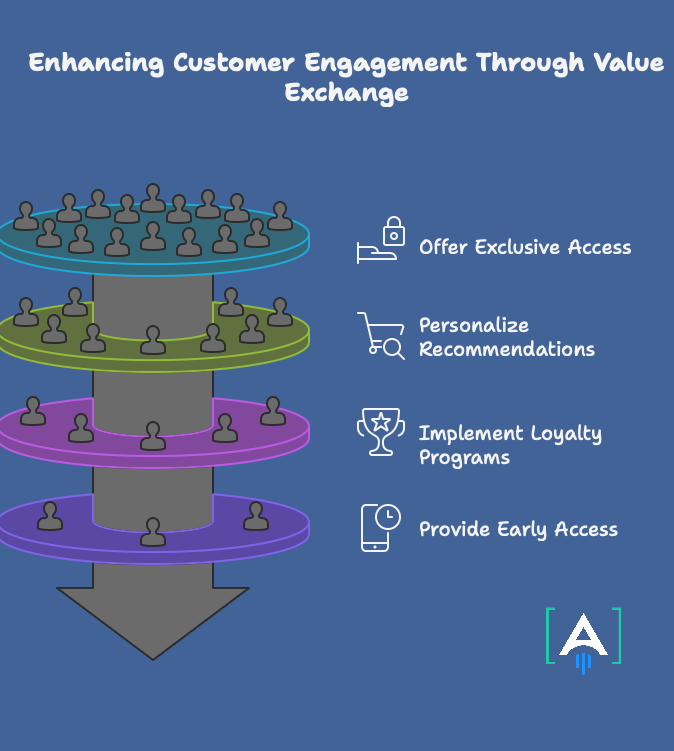
The value exchange framework ensures customers perceive tangible benefits for sharing their data. This encourages voluntary participation and enhances data quality.
What Brands Can Offer
- Exclusive access to content or early releases.
- Personalized product recommendations.
- Loyalty points, rewards, or gamified incentives.
- Early access to promotions, sales, or beta products.
Benefits
- Supports privacy-first marketing by making participation voluntary.
- Drives higher opt-in rates and more accurate data collection.
- Strengthens engagement and loyalty while enabling personalization.
A well-executed value exchange framework turns data collection into a mutually beneficial relationship between brands and customers.
Email, Loyalty, And Community: Data Collection Vehicles
Owned channels, such as email newsletters, loyalty programs, and private communities, provide long-term, sustainable sources of first-party data.
Examples include:
- Starbucks Rewards for behavioral insights
- Nike Run Club for community-driven data
- Online communities fostering engagement and feedback
Actionable strategies:
- Convert transactional data into customer lifetime value insights
- Gamify participation to enhance engagement
- Connect analytics with predictive modeling
These channels are essential for data monetization and maintaining a long-term competitive advantage.
AI And First-Party Data: The Amplification Effect
AI transforms raw first-party data into predictive intelligence, allowing brands to make smarter, faster marketing decisions. Machine learning models analyze engagement patterns, purchase behavior, and customer preferences to uncover insights that humans alone cannot detect.
Applications for Brands
- Audience Segmentation – Automatically group customers based on behavior, demographics, and engagement.
- Churn Prediction – Identify customers at risk of leaving and trigger retention campaigns.
- Personalized Campaigns at Scale – Serve content, offers, and recommendations tailored to individual preferences.
- Predictive Lifetime Value – Forecast which customers are likely to generate the most revenue over time.
- Automated Retargeting – Trigger campaigns based on customer actions without manual intervention.
Benefits of Integrating AI
- Increases campaign efficiency and ROI.
- Accelerates decision-making by identifying actionable insights quickly.
- Enables data-driven marketing 2025 strategies to be proactive rather than reactive.
- Enhances customer experience through relevant, timely messaging.
Agentic AI SaaS tools amplify these benefits by automating repetitive processes and continuously learning from updated first-party data. Brands that integrate AI into their first-party strategy gain a significant competitive advantage.
Compliance Without Compromise: GDPR, CCPA, And Beyond
Privacy compliance is no longer optional. Brands must balance personalization with strict adherence to privacy laws. Key practices ensure legal protection and build customer trust.
Essential Compliance Practices
- Consent Banners – Clearly explain what data is collected and why. Obtain explicit opt-in.
- Data Deletion Requests – Provide customers with an easy way to remove their data.
- Partner Compliance – Work only with vendors that meet GDPR, CCPA, and other privacy standards.
- Ongoing Updates – Monitor privacy regulations in 2025 and beyond to maintain compliance.
Privacy-First Marketing Practices
- Implement consent management systems to track user permissions.
- Leverage anonymized or aggregated data where possible to reduce risk.
- Enable personalization without storing unnecessary personal identifiers.
By combining these practices with a first-party data strategy, businesses can maximize data value while maintaining ethical and legal standards. Compliance becomes a growth enabler rather than a limitation.
The Competitive Moat: Why Data Equals Defensibility
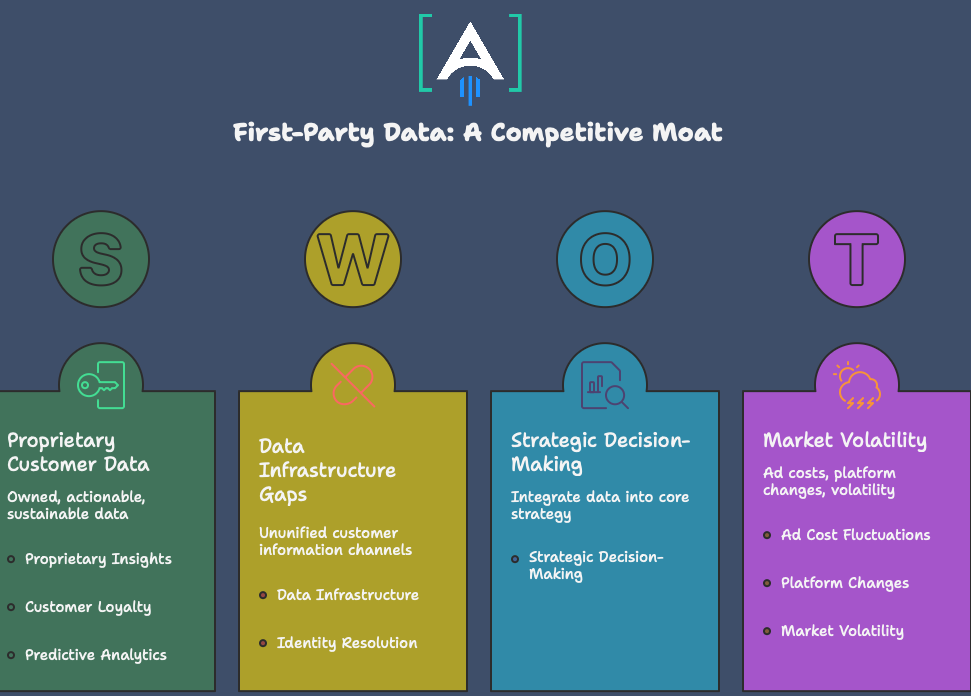
First-party data is a strategic asset that provides a defensive advantage in a volatile marketing environment. Unlike rented data or third-party lists, proprietary customer data is owned, actionable, and sustainable.
Why First-Party Data is a Moat
- Proprietary Insights – Understand customers better than competitors who rely on external data.
- Customer Loyalty – Deliver personalized experiences that increase retention and lifetime value.
- Predictive Analytics – Forecast trends, churn, and opportunities faster than market benchmarks.
Building Defensibility
- Develop a robust data infrastructure to unify customer information across channels.
- Implement identity resolution to track users across touchpoints accurately.
- Treat data as a core business asset, integrating it into strategic decision-making.
Brands that view first-party data as a moat reduce vulnerability to ad cost fluctuations, platform changes, and market volatility while creating a long-term competitive edge.
Implementation Roadmap: 90-Day First-Party Data Build
A tactical roadmap helps brands systematically implement a first-party data strategy. Breaking the process into phases ensures measurable progress.
Phase 1: Audit and Align (Days 1–30)
- Inventory all existing customer data sources.
- Identify gaps, redundancies, and quality issues.
- Establish a compliance baseline with GDPR, CCPA, and privacy-first marketing practices.
Unify and Activate: Phase 2 (Days 31–60)
- Integrate a Customer Data Platform to centralize all first-party data.
- Clean and standardize datasets for accuracy.
- Implement server-side tagging to restore measurement accuracy and attribution.
Phase 3: Scale and Optimize (Days 61–90)
- Activate AI insights to generate predictive analytics.
- Automate segmentation, retargeting, and personalization.
- Track key performance indicators such as opt-in rates, data quality, and attribution recovery.
Following this roadmap establishes a solid foundation for long-term growth, enabling data-driven decision-making and consistent personalization.
ROI Calculator For CDP Investment
A CDP ROI calculator helps brands quantify the financial impact of investing in a Customer Data Platform or first-party data strategy.
Key Inputs
- Audience size and engagement metrics.
- Campaign spend and expected performance lift.
- Predicted conversion improvement and retention rates.
How ROI Scales
- Automation reduces manual campaign work, saving time and resources.
- Predictive analytics improves targeting and personalization.
- Each interaction with the brand increases the value of stored data, making first-party data a self-appreciating asset.
By calculating potential ROI, brands can justify CDP investment, plan budgets efficiently, and visualize long-term growth from their data ecosystem.
Conclusion
Third-party data may be gone, but the first-party data strategy has emerged as the foundation for sustainable, long-term growth.
Brands that collect, unify, and activate their own customer data gain unparalleled insight into behavior, preferences, and intent. This enables personalized experiences that drive engagement, increase loyalty, and maximize customer lifetime value.
Beyond personalization, a robust first-party strategy ensures full privacy compliance, builds customer trust, and protects against rising ad costs and platform volatility.
The integration of AI and predictive analytics amplifies the power of first-party data, allowing brands to forecast trends, automate segmentation, and deliver highly targeted campaigns at scale.
Techniques like progressive profiling, value exchange frameworks, loyalty programs, and community-driven data collection further strengthen competitive advantage and deepen customer relationships. Every interaction becomes an opportunity to refine targeting, improve messaging, and make data-driven business decisions that accelerate growth.
At [A] Growth Agency, we specialize in helping businesses transform first-party data into a true marketing moat.
Our services include Customer Data Platform integration, AI-powered personalization, privacy-first marketing, and omnichannel strategy implementation. We work with business owners, CEOs, and growth-focused teams to design tailored, compliant, and scalable data ecosystems that generate measurable results.
If you are ready to turn your data into a strategic asset, future-proof your marketing, and lead in a cookieless world, partner with Azarian Growth Agency to build your first-party data ecosystem today.
Let us help you leverage your data for smarter campaigns, better customer experiences, and sustainable competitive advantage.