
A few months ago, I sat in on a Monday standup with a Series B SaaS team. The SDR lead pulled up his pipeline tracker, the team walked through their account list, and one of the reps mentioned she had spent most of Friday afternoon trying to find the right person at a target account. She had three names, two probably-correct emails, and no idea which one of them actually owned the buying decision. She was going to send it to all three.
I have watched some version of that conversation happen at almost every B2B company we work with. The rep is doing what she was told to do. The list she is working from looks fine on paper. The tools she is using are the tools everyone uses. And the work she is doing, the actual hours of clicking through Sales Navigator and cross-referencing LinkedIn profiles and guessing at email patterns, is the single highest-cost, lowest-yield activity in the entire pipeline.
That is the work the Decision Maker Finder replaces. Not the calls. Not the discovery. The research.
Check the webinar: the autonomous agents pipeline demo at Tech Week Boston.
Contact research is not a sourcing problem
Most teams treat prospecting as a sourcing problem. Get more contacts. Buy a bigger database. Hire another SDR to build more lists. The premise is that there is a contact out there somewhere, and the task is finding them.
That premise was probably right ten years ago. It is wrong now. The contacts are not hiding. Apollo has 230 million of them. ZoomInfo has built an entire public company on the premise that the contacts are knowable. The problem in 2026 is not finding a person at a target account. It is knowing which person actually matters, whether the contact information you have is still true, and whether your timing has anything to do with what is happening inside that account this week.
The shift, when you see it clearly, is from sourcing to verification. From who do I email to which of these contacts is the right one to email right now and how do I know.
The Decision Maker Finder is built around that shift. It is the second agent in our autonomous GTM chain at Azarian Growth Agency, and its job is not to add contacts to a list. Its job is to answer four questions about every account on your target list, continuously, faster than any human can, and to refuse to ship a contact into your sequencer if any of those four answers come back wrong.
The four questions worth answering
Anyone can hand you a list of names. The question is whether the names are useful, and useful turns out to mean something specific.
Who actually controls this decision? A title is a clue, not an answer. The CMO at a 200-person company is making the buying decision. The CMO at a 2,000-person company has handed it to a VP of Demand Gen, who has handed it to a Director of Operations, who has the actual budget. The agent’s job is to read the org chart against the deal type and figure out where the decision lives, not just where the title sits.
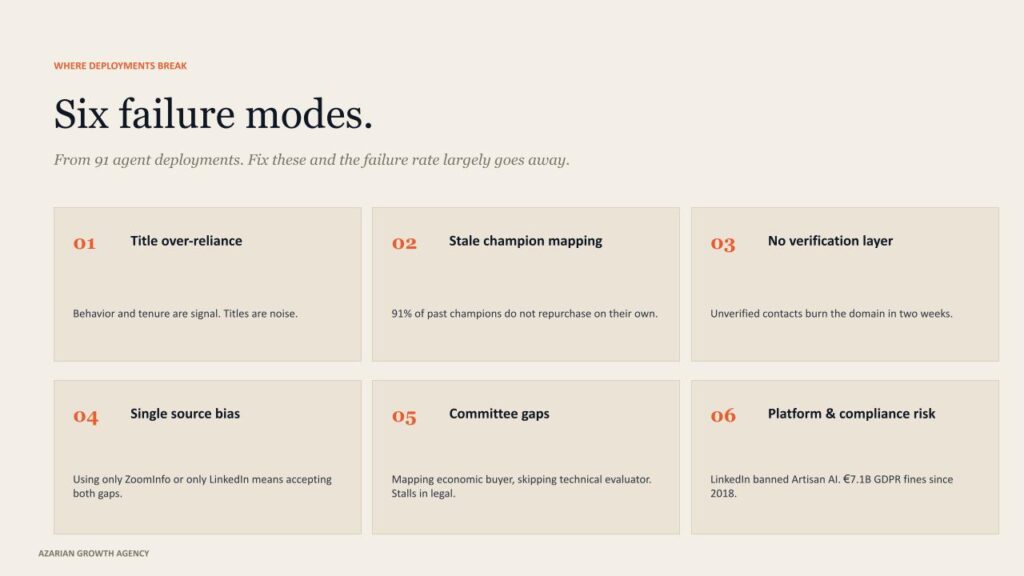
Are these contacts still real? Email and phone data decays continuously. People change jobs, get promoted, switch teams. Independent testing by Cleanlist in early 2026 found Apollo bouncing at around 20% and ZoomInfo at around 15% in real deliverability conditions. Those bounce rates are not just lost emails. They damage your sender reputation, and once it is damaged, the new Yahoo and Google bulk-sender enforcement can keep your domain in the penalty box for weeks. The agent verifies before it ships.
Who else is in the room? This is the question SDR work usually skips, and it is the most expensive miss. The person you found is rarely making the decision alone. The technical evaluator who will run the POC, the procurement lead who will negotiate the contract, the finance partner who will ask about ROI, and the skeptic who will say it is too early. They are all in the room, whether you know about them or not. The agent maps the full committee, not just the loudest voice.
Is anything happening right now that should change how I reach out? A new VP of Sales started last week. The CRO who championed your competitor’s product just left. Your target company shipped a layoff yesterday or closed a Series C the day before. None of this shows up in a static list. The agent watches signal feeds across job boards, funding databases, social platforms, and hiring announcements, and it routes the trigger to whoever owns the account before the news is even public on LinkedIn.
Four questions. The agent answers them in seconds. The SDR cannot answer them at all unless she gives up the rest of her day.
The most expensive thing about manual contact research is not the time. It is the contacts you never find at all.
The shadow committee problem
Here is the part most operators underestimate. When you only have time to map two or three people per account, the contacts you pick are usually the wrong ones. Not because the people you found are not real. Because the people you missed are the ones who decide.
Forrester’s research on B2B buying committees has been showing this for years. The committee is bigger than the team’s plan around. It is also more distributed. A typical mid-market software purchase pulls in someone from the line-of-business team, someone from IT or security, someone from finance, and someone from procurement, and that is before the end users get a vote. The single contact your SDR found is, statistically, working against four to nine people she has never heard of.
I call this the shadow committee. It is the set of stakeholders who shape the decision but do not show up in your CRM until very late. By the time they do show up, they have already formed opinions, usually based on whatever vendor’s content their internal champion shared with them. If that internal champion was not your champion, you lost the deal six weeks before you knew it was a deal.
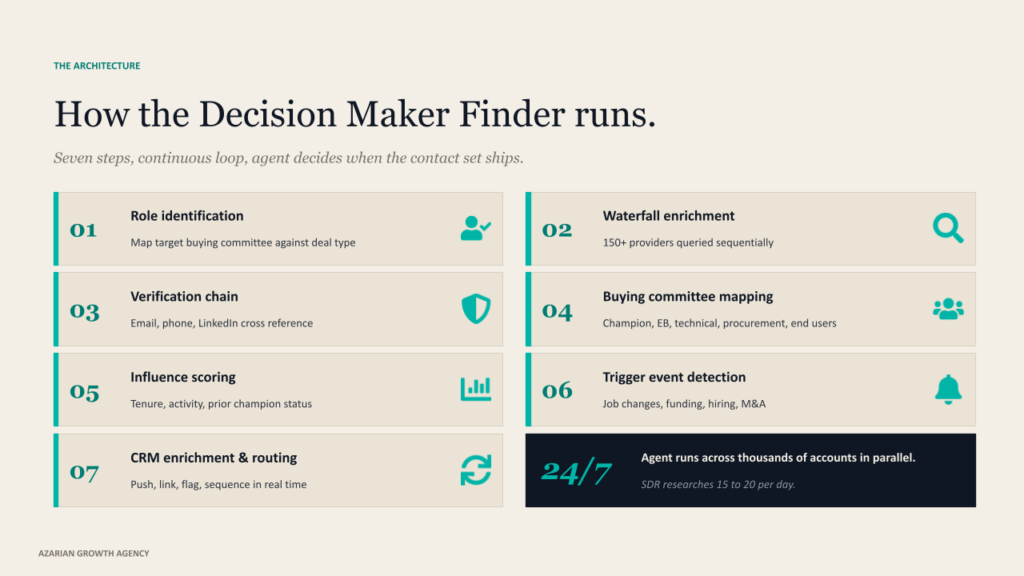
The Decision Maker Finder treats every account as a committee mapping exercise from day one. It identifies the likely roles by deal type, finds the actual humans in those roles using waterfall enrichment across multiple data sources, verifies them, scores who is most likely to be the real buyer versus the title-holder, and watches all of them rather than just the one you reached out to first. That last part is what changes the math. You are not single-threaded into one contact and hoping. You are multi-threaded into a committee and learning.
Why job changes matter more than they should
The single most useful signal a Decision Maker Finder agent watches is also the most overlooked one. It is the job change.
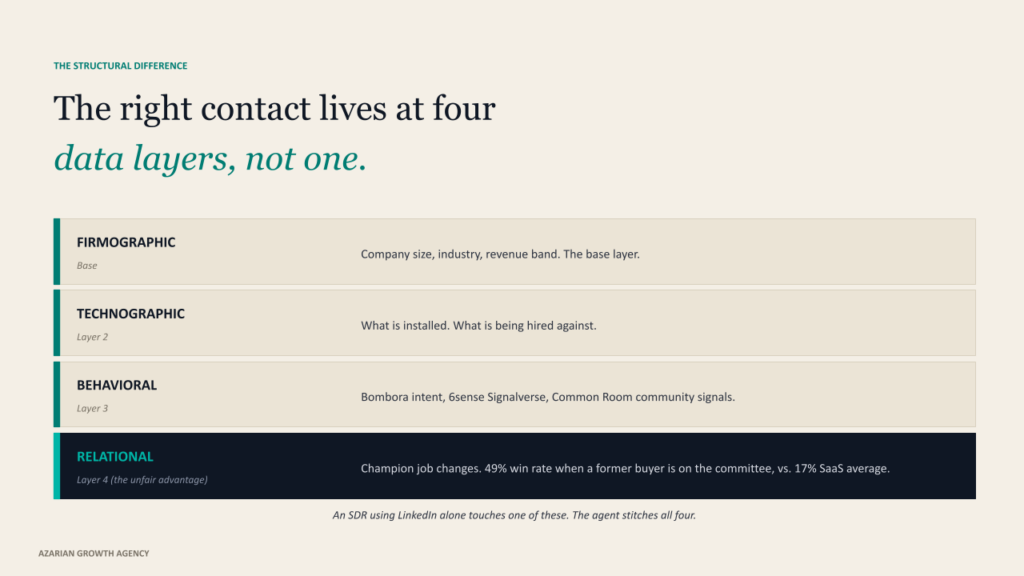
Every quarter, a meaningful percentage of the people on your target list move. Some get promoted. Some change companies. Some get fired. UserGems has built a whole product category around tracking these moves, and the data they have published is the kind of thing that quietly changes how you think about pipeline.
Past customers and former champions, when they show up at a new company, are dramatically more likely to buy your product again than a cold prospect at the same account. Their published research on champion tracking puts the gap between champion-led deals and average cold-outbound deals at multiple times the win rate.
I have watched this play out at our own clients more times than I can count. A VP of Marketing leaves a company that was a customer, lands at a new company that has never heard of the product, and within 90 days, that new company is a sales-qualified lead. Not because the rep was clever. Because the agent saw the move and routed the lead.
The flip side matters too. When your champion at an active opportunity leaves, your deal is in trouble, and you usually find out way too late. The agent flags it the day the LinkedIn change happens, which gives the AE a week or two to multi-thread before the new person comes in and restarts the evaluation. Without that visibility, the deal slips, and you do not know why.
This is also why Champify and similar tools have built defensible businesses around what looks, on the surface, like a thin product category. The signal is small. The pipeline implication is enormous. An agent that watches it across every account in your CRM, continuously, surfaces opportunities a human researcher could not find if she worked weekends.
What we got wrong the first time
When we first started building Decision Maker Finder agents for clients, we made a mistake that I think most teams make. We optimized for coverage. The brief was: find more contacts, faster. The agent did exactly that, and the results were worse than the manual SDR process it replaced.
Reply rates dropped. Bounce rates climbed. One client got their domain throttled by a major email provider for two weeks because the agent had cheerfully shipped 800 contacts into a sequencer with a 14% bounce rate. The agent had done what it was told. We had told it the wrong thing.
The fix was to flip the optimization target. Instead of building agents that maximized contacts found per account, we started building agents that maximized contacts shipped per account, where shipped meant cleared a verification gate. ZeroBounce, NeverBounce, and MillionVerifier all do this kind of validation well at the email layer. The harder part is title accuracy and committee role assignment, which is where the agent has to actually reason rather than just check a database.
The lesson, which sounds obvious in retrospect, is that an agent that adds five verified contacts per account is more valuable than an agent that adds twenty contacts of unknown quality. Volume is the wrong metric. Confidence is the right one.
The other thing we got wrong was thinking the agent could replace human judgment on the high-stakes touches. It cannot. For the first outreach to a CRO at a Fortune 500 account, you still want a human looking at the message and the timing. The agent is excellent at doing the research, mapping the committee, watching for the trigger event, and drafting the first version. The human still has to decide whether to send it.
Anthropic’s framework for agents calls this the difference between autonomy and oversight. Both matter. Most teams either trust the agent too much or not enough. The right answer is to trust it on the work where the failure mode is acceptable, and to keep human review on the work where it is not.
How to know if you actually need a Decision Maker Finder
Not every team needs an autonomous agent for this. Some teams genuinely have a sourcing problem, and a database subscription will solve it. The Decision Maker Finder solves a different kind of problem. Here are the signals I look for when a client asks whether they need one.
Your reply rates have been flat or declining for two or more quarters, even though your team is sending more. This usually means the contacts you are reaching are the wrong ones, not that the messages are bad. More volume in the same flawed list does not fix it.
Your AEs are losing late-stage deals to internal politics. When a deal that looked locked in stage three falls apart in stage five because someone you never engaged with raised an objection, you have a shadow committee problem. The agent’s value is exactly here.
Your SDRs are spending more than a third of their time on research. Inside a typical 60% non-selling block (the number Salesforce reported in State of Sales 2026), if research is the dominant slice, an agent will produce real cost compression. If your reps are mostly tied up in admin and CRM hygiene, you have a different problem and a different agent.
You are starting to see the pattern 6sense documented in their 2026 State of BDR report: more touches per contact, less correlation between activity and pipeline. That is the signal that the system has stopped working at the contact-quality layer, not the messaging layer.
If three or four of those describe your team, the math on a Decision Maker Finder works out. If only one of them does, fix the underlying issue first. Agents amplify the system you already have. They do not substitute for one you have not built.
A quick note on the tool stack
I am not going to walk you through every vendor in this category because the right stack depends on your motion, your buyer, and your existing infrastructure. But the shape of a working stack is consistent.
You need a signal layer. Common Room is what we usually reach for when a client has a product-led motion, since it pulls signals across community surfaces, product analytics, and CRM all in one place. 6sense or Bombora for intent data, especially in larger enterprise deals.
You need an enrichment and orchestration layer. Clay is the most flexible tool here, and the one that works best when you have RevOps capacity to build with it. It will run waterfall enrichment across dozens of providers, score contacts against custom criteria, and feed the rest of your stack.
You need a relational layer. UserGems for champion and job-change tracking. This is the unglamorous part of the stack and also the one that produces the most outsized pipeline lift, in our experience.
If you sell into Europe, you need a compliance-first contact source. Cognism has built their position around GDPR posture and is the safest choice for EMEA buyers. Inside the US, the regulatory picture is more fragmented, and the right answer depends on which states you are selling into.
And you need a verification chain at the end. Email, phone, and LinkedIn currency, with the agent throwing out anything that does not clear all three. This is where most cheap stacks fail and where most expensive stacks over-spend. We have written about the broader AI research tool landscape for teams that want to go deeper on the category.
The honest answer
If you are running an outbound motion in 2026 and a meaningful share of your team’s time still goes into manual contact research, you are paying for the wrong work. Not because SDRs are not valuable. They are.
They are valuable when they are talking to people, qualifying intent, and moving deals through stages. They are not valuable when they are clicking through LinkedIn at 4 pm on a Friday, trying to figure out which Director of Marketing is the actual one.
The Decision Maker Finder gets that hour back, and the eight others around it. It does the research that the SDR was doing badly because nobody can do it well at human speed across a thousand accounts simultaneously. And it does it continuously, which means the contacts in your CRM are real today, not whenever the last list pull happened.
The teams that win in the next few years will not be the ones that send the most emails. The 95-to-5 rule from Ehrenberg-Bass has been reminding everyone for years that only a small fraction of any market is in buying mode at a given moment. Reaching that fraction with the right contact, mapped to the right committee, at the right trigger moment is what produces a pipeline. Reaching everyone else is what produces noise.
The agent is how you stop producing noise.
About Azarian Growth Agency
Azarian Growth Agency is an AI native growth marketing agency working with VC-backed founders, PE operating partners, and growth-stage B2B leadership teams. We build full funnel growth systems anchored on agent infrastructure, with 91 agents in production across client engagements as of 2026.
Our work spans pipeline diagnostics, intent signal architecture, decision maker mapping, and the broader stack of AI content marketing, AI-driven customer insights, and generative AI systems. The Strategic Growth Diagnostic is the entry point for most engagements: a structured assessment of pipeline, CAC, signal infrastructure, and agent readiness, framed against the metrics PE and VC institutional buyers actually use.
I run a recurring live demo of the autonomous agent system that the agency builds for B2B clients. The session walks through the full agent handoff in real time. The TAM and signal scoring agent. The Decision Maker Finder.
The persona and outreach agent. Attendees see the prompts, the data flows, the verification checkpoints, and the metrics framework that ties the motion back to the pipeline and CAC payback. The session is built for VC-backed founders, VPs of Sales, and operating partners evaluating GTM efficiency at the portfolio level.
Check it here: Tech Week Boston autonomous agents pipeline session.