
Clari’s January 2026 research surveyed 400 CIOs, CROs, and RevOps leaders and found that 87 percent of enterprises missed their 2025 revenue targets. These were companies that spent record amounts on AI. They had more contact data than at any point in B2B history. They had bigger tech stacks, more tools, and more dashboards than the generation of sales leaders before them. And 87 percent of them still missed.
If you run a VC-backed B2B company at Series A or B, or you sit inside a portfolio company reporting to a PE operating partner, this number should not surprise you. You are probably living it. The pipeline is not where it needs to be. CAC has crept up. The SDR team is sending more touches than ever and getting fewer replies.
Here is the argument, made directly: B2B outbound in 2026 is not failing because teams have too little data. It is failing because they have too much of the wrong kind, interpreted too shallowly, and executed too autonomously. The fix is not another contact database. The fix is a system that reads b2b buying signals and acts on them. That is the entire game now.
Check This System Run Live: Watch the Tech Week Boston Autonomous Agents Pipeline Demo
The Response Rate Collapse Nobody on Your Board Wants to Hear About
Cold email reply rates have been falling for five years, and the drop has accelerated sharply. In 2019, the average B2B cold email response rate sat at 8.5 percent. Belkins analyzed 16.5 million B2B cold emails sent across 93 domains in 2024 and clocked the full-year average at 5.8 percent.
The 2026 Instantly platform benchmark, which aggregates across thousands of senders, is now 3.43 percent. In seven years, the cold email reply rate has fallen by more than half.
The underlying metrics are worse than the headline. Martal’s 2026 benchmark report found that about 17 percent of cold emails never reach any inbox, and another 20 percent get filtered to spam. The sequences your SDR team built three years ago do not work the way they used to, and they will work less next quarter than they do this quarter.
The cost structure has not adjusted. Gong and 30MPC analyzed 85 million cold emails in 2025 and found that the average rep sends 344 cold emails to land a single meeting. Layer in the fully loaded cost of an SDR, which SalesHive puts between $110,000 and $160,000 per year, and the unit economics of manual outbound have broken in a way most teams have not modeled on a spreadsheet.
At Azarian Growth Agency, we see this every week. A founder tells us their outbound is not producing a pipeline. We ask for the last 90 days of reply data. We are routinely shown a 0.8 to 2 percent reply rate across thousands of sends, a meeting show rate under 50 percent, and a CAC that has quietly doubled in twelve months.
Meanwhile, the pipeline coverage ratio is running at 1.5 to 2x when the 19 percent 2025 win rate that Ebsta and Pavilion measured across 655,000 opportunities mathematically demands closer to 5x coverage. This is not a problem you fix by sending more emails.
The 95-5 Rule: Why Your Contact Database Is Mostly Not Buying
Apollo claims 275 million contacts. ZoomInfo claims more than 300 million. The major contact databases have never been larger, and they have never been cheaper on a per-record basis. If contact volume were the problem, B2B outbound in 2026 would be the golden age. It is not.
The reason sits in a piece of research every revenue leader should have memorized. The LinkedIn B2B Institute and Professor John Dawes at the Ehrenberg-Bass Institute published work showing that up to 95 percent of business clients are not in the market for a given product at any given time.
Only about 5 percent of B2B buyers are in-market in any given quarter. Bombora, which runs one of the largest buyer intent data B2B co-ops in the world, publishes a similar number: only around 15 percent of your ICP is in-market at any given time, and that is generous because it includes early research as well as active buyers.
Think about what this does to the math. If you have a 100,000-contact Apollo list and you send to all of it, you are by definition pitching 95,000 people who are not buying. You are not just wasting their time. You are burning your domain reputation, which takes three to six months to recover. You are giving Gmail’s AI spam filter more material to train against your infrastructure.
You are also operating in a new deliverability regime. Google and Yahoo’s February 2024 bulk sender requirements imposed SPF, DKIM, and DMARC as mandatory, with spam complaint rates that must stay below 0.1 percent. Microsoft followed in May 2025. Google escalated to permanent rejections in November 2025.
Single-domain operations now cap out at around 200 to 300 quality sends per day before reputation degrades. The math has gotten worse at exactly the moment the infrastructure got tighter.
More data was never going to fix this. You solve it by finding the 5 percent and speaking to them specifically.
What Intent Data Actually Means, and What It Does Not
The term intent data B2B gets used so loosely that it has nearly lost its meaning. I want to pull it apart the way we pull it apart internally at Azarian Growth Agency when we are building a signal-driven pipeline system for a client.
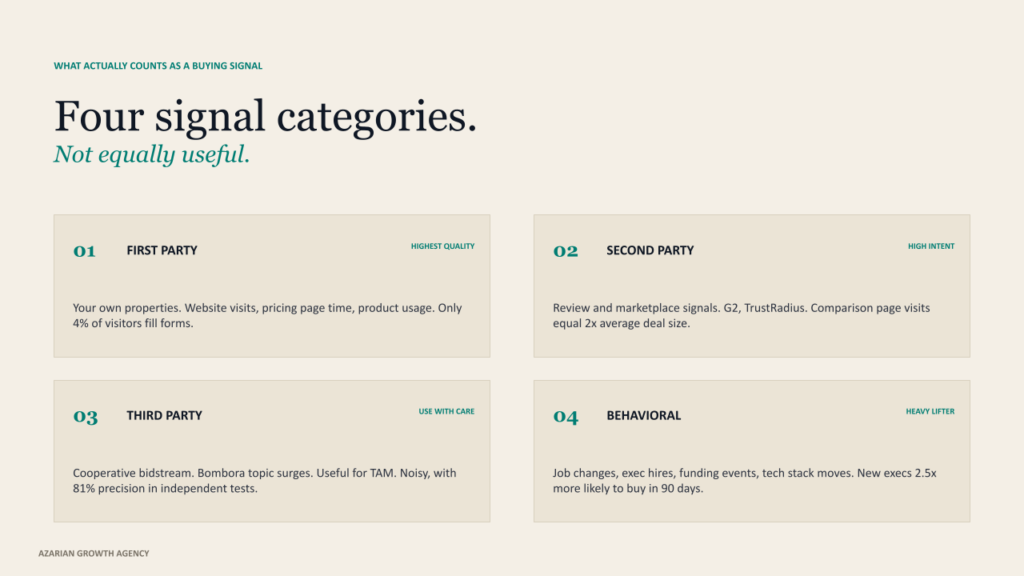
There are four categories of intent that matter, and they are not equally useful.
First-party intent
This is behavior that happens on properties you control. Website visitors, content engagement, product usage, webinar registrations, pricing page time. This is the highest-quality signal type by a large margin because the person has already self-selected by showing up.
The hard part is that only three to four percent of B2B website visitors fill out a form. Tools like RB2B, Warmly, Common Room, and HubSpot Breeze can identify a meaningful share of those anonymous visitors. The RB2B and Demandbase partnership claims to de-anonymize up to 65 percent of company-level traffic.
Second-party intent
This comes from review sites and marketplaces like G2 and TrustRadius. When someone visits your G2 comparison page, they are signaling purchase intent in a way no firmographic filter can match. Dreamdata’s benchmark study found that G2 comparison-page signals influenced around 15 percent of closed-won deals per session, and deals touched by G2 signals are twice as large as the average deal.
Third-party intent
This is cooperative bidstream data from providers like Bombora, which aggregates consumption behavior across 5,000+ B2B publisher sites. It is useful at the top of the funnel. It is also the noisiest category. Independent testing has shown Bombora’s precision at around 81 percent, which means roughly one in five surging accounts show no genuine buying behavior. Used well, third-party intent is valuable. Used as a standalone trigger for outreach, it will burn your reply rate.
Behavioral signals
This is the category that has exploded in 2025 and 2026. Job changes, executive hires, funding events, technology stack changes, leadership transitions, job postings, content downloads.
UserGems cites Forrester research showing new executives are 2.5 times more likely to buy in their first three months, and new buyers spend 70 percent of their discretionary budget in the first 100 days. When we build signal systems for clients, behavioral signals do the heaviest work because they are highly specific and time-bound.
The insight nobody wants to say out loud: a single signal is almost never enough. One intent signal in isolation produces a one to five percent reply rate. Two or three stacked signals, interpreted together, produce dramatically different results. Autobound’s 2026 benchmarks show multi-signal stacked outreach produces reply rates between 25 and 40 percent. This is the entire game.
Why Signal-Based Outreach Does Not Work By Itself
There is a failure mode I want to flag, because teams I talk to are running into it the moment they start buying intent data. They license a provider. They get a feed of accounts. They hand the feed to their SDR team and tell them to reach out. And the reply rate stays exactly where it was.
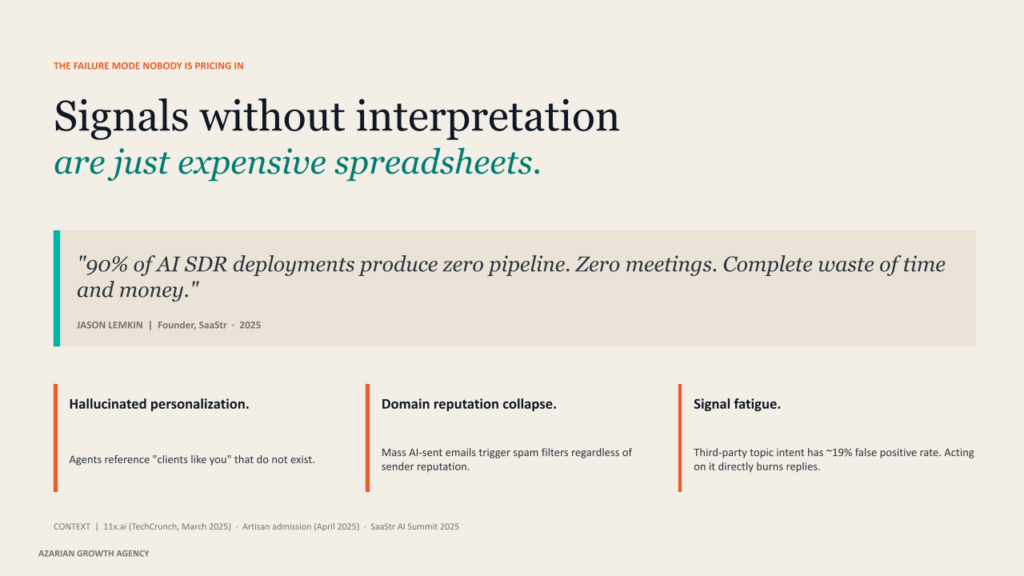
The reason is simple. A signal is a trigger, not a message. Knowing that Company X had a pricing page visit on Tuesday does not tell you what to write to the VP of Engineering at Company X on Thursday. Knowing that Company Y just raised a Series B does not tell you which problem their new CTO is trying to solve in the first 90 days. Signal data without signal interpretation is just a more expensive way to produce the same generic outreach that stopped working in 2023.
This is why the first generation of fully autonomous AI SDR tools has had such a visible failure rate. A TechCrunch investigation into 11x.ai in March 2025 documented customer retention at 70 to 80 percent churn, with ZoomInfo publicly stating that 11x’s product performed significantly worse than their own SDR employees during a pilot.
Artisan’s CEO admitted on record that first-generation AI SDRs produce low response rates and high churn. Jason Lemkin, who runs SaaStr, put the number at 90 percent of AI SDR deployments producing zero pipeline. These tools had access to the same contact data that everyone else has. What they lacked was the layer that turns signals into messages.
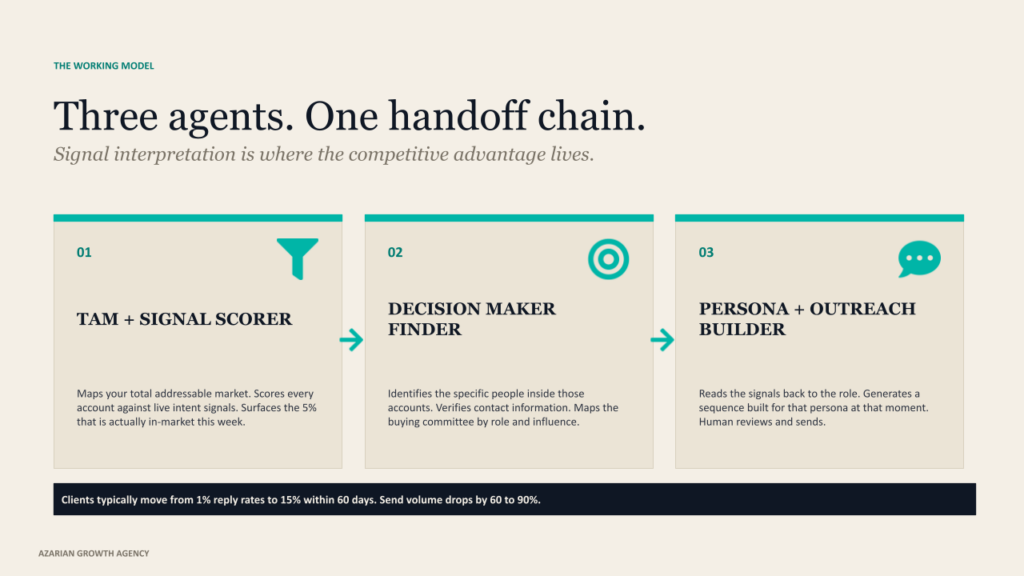
The working model, the one we built for clients at Azarian Growth Agency and the one we demoed at Tech Week Boston, is not “signal data plus email sender.” It is a three-agent system where each agent owns part of the interpretation chain.
The first agent maps the total addressable market and scores each account against live intent signals, pulling the 5 percent out of the 95 percent. The second agent identifies the specific decision makers inside those accounts, with verified contact information.
The third agent builds a full persona for each decision maker, maps the signals back to the specific problem that person is likely facing right now, and generates an outreach sequence built for that persona at that moment. The agents hand off to each other automatically. A human reviews the output before it sends.
This is the orchestration layer that the top B2B sales teams are building in 2026, and it is the layer that separates signal data that produces a pipeline from signal data that just produces expensive spreadsheets.
Want to See the Three Agent System Built Live? Watch the Full Tech Week Boston Demo
What the Signal-Based Pipeline Actually Produces
When the interpretation layer is built correctly, the performance difference is not incremental. It is categorical.
A few data points I trust. Common Room has published results from their SaaS customer cohort showing Notion booking 30 percent more meetings per rep per month and Semgrep growing its pipeline 74 percent in a single quarter after deploying a signal-first outbound motion.
UserGems’s Gem-E agent, which targets past-champion job changes, has delivered reply rates between 6 and 20 percent for customers like Sendoso and Mimecast, with pipeline ROI in the 11x to 47x range.
6sense customer Socure built what they called a “Treasure Ops” signal program and reported 3.5 times higher reply rates on signal-stacked sequences, plus 52 million dollars in sourced pipeline in year one.
These are vendor-published numbers, and they deserve the skepticism that implies. But the pattern is consistent across dozens of customer cases I have reviewed. The moment a team moves from list-based outbound to signal-interpreted outbound, meeting volume either holds or increases while send volume drops by 60 to 90 percent.
The domain reputation stabilizes. The CAC payback period stops climbing. The board starts hearing a different number at the monthly review.
Our own agency data aligns with this. Clients who moved from traditional cold outbound to a signal-interpreted system typically see their reply rates move from 1 to 2 percent into the 8 to 15 percent range within the first 60 days, and their meeting-to-opportunity conversion improves because the meetings that book are with accounts that are actually in-market. The meetings are shorter.
The cycles are tighter. The deal sizes are larger because the signals surface the buyers who have a budget allocated, not the buyers who will eventually, maybe, have a budget in two quarters.
Practitioner rule: signals do not replace judgment
The single biggest mistake teams make when they start moving to signal-based outreach is treating the signals as destinations rather than starting points. A signal says a company might be buying.
It does not say what they want to buy, or when, or from whom. That is what the interpretation layer decides. When we build signal systems for clients, we spend as much time calibrating the interpretation rules as we do building the signal feeds. The interpretation is where the competitive advantage lives.
What This Means for Your 2026 Pipeline Plan
If you are running a VC-backed Series A or B company, a PE-backed portfolio company, or a mid-market B2B team responsible for a pipeline number this year, here is the short version.
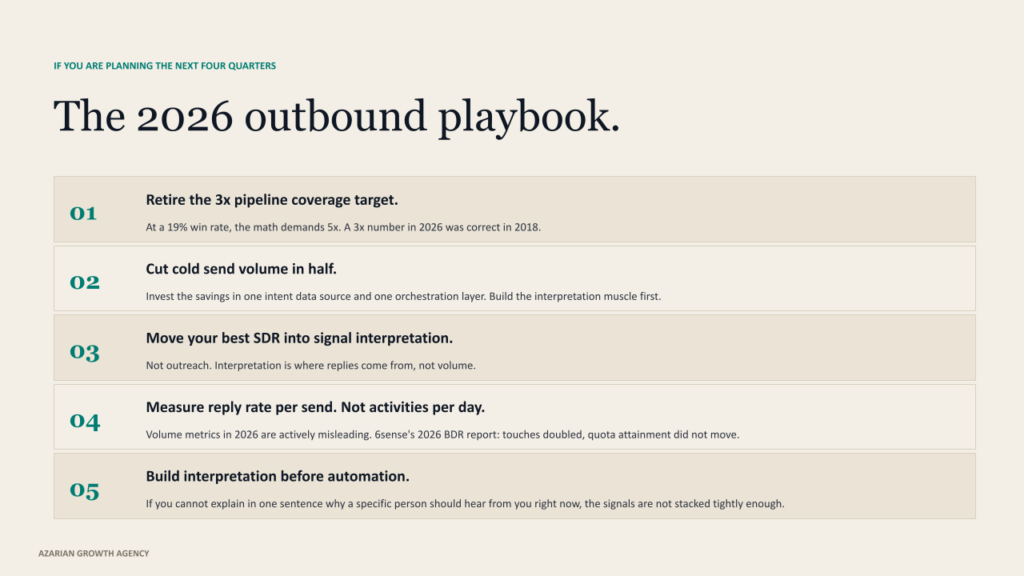
- Your 3x pipeline coverage target is not enough. At a 19 percent win rate, the math demands 5x coverage to hit the plan. Fullcast’s 2025 pipeline coverage research lays this out clearly. A 3x number in 2026 was correct in 2018.
- Your contact list is not the asset you think it is. Data decay in B2B databases runs 30 percent per year on average, up to 70 percent in tech and startup segments.
- Your SDR volume metric is destroying your deliverability. More touches per contact have no reliable correlation to quota attainment. 6sense’s 2026 State of the BDR report shows touches nearly doubled from 2024 to 2026 without moving quota attainment.
- A contact database without an intent layer is a liability, not an asset. Amplemarket’s 2026 investigative review of Apollo found user-reported email accuracy at 65 to 70 percent with bounce rates between 20 and 30 percent.
- Agents without interpretation do not work. If you are evaluating an autonomous SDR vendor, the question to ask is not “does it send emails,” but “what does it do with the signals before it sends?”
The playbook I would run if I were a founder or CRO planning the next four quarters: reduce your cold send volume by at least half. Invest the savings into one intent data source and one orchestration layer.
Move your best SDR into a signal-interpretation role. Measure reply rate per send and CAC per meeting, not activities per day. Build the interpretation layer before you buy the automation layer. This is how you turn an outbound engine that is slowly breaking into one that quietly works in the background, and how you end up with a pipeline coverage number that matches the 2026 win rate reality.
About Azarian Growth Agency & the Autonomous Pipeline Webinar
Azarian Growth Agency is a full-funnel, AI-native growth marketing firm. We operate as an embedded growth partner for B2B companies, with a heavy focus on VC-backed SaaS companies at Series A and B, PE-backed portfolio companies, and growth-stage B2B tech. Our approach is practitioner-first. We build the systems we recommend, and we run them for the companies we work with.
The autonomous pipeline generation system described in this piece is not a concept on a slide. It is a deployed system currently producing a pipeline across client engagements, and it is built on the same principle every other working part of the agency is built on: data-driven, signal-aware, and operator-grade.
We keep a standing library of AI marketing tools, AI research tools, and AI tools for email marketing that we use in our own builds, and we publish the learnings from those builds back to the community because that is how we think about the relationship with the people we work with.
The Autonomous Agents and Real Pipeline webinar at Tech Week Boston is the long-form version of the argument in this piece. In the session, I demo the three-agent system live, starting from an ICP description determined in the room and running the full build in real time.
The agents map the total addressable market, score accounts against live intent signals, identify the specific decision makers, and generate personalized outreach ready to send, all before the session ends. If you are running outbound and the numbers in this piece felt uncomfortably familiar, the webinar is where I would start. It is the fastest way to see what the working system looks like on the ground, with enough operational detail that you can decide whether to build your own version or whether it is the right conversation to have with us directly.
If you are thinking about how this applies to your own team, the first question to ask is not which vendor to buy. It is which 5 percent of your target market is in-market right now, and what you would do differently if you could see them clearly. That is the signal. Everything else is a contact list.
Check the Autonomous Agents Pipeline Demo (Tech Week Boston Full Session)