
How Multi-Agent Systems Hand Off Between Each Other: The Architecture Behind Autonomous GTM
I have had some version of this conversation maybe forty times in the last twelve months. A founder or a head of revenue sits down for a diagnostic, opens with a polite version of the same question, and waits to see what I say.
We are looking at AI SDRs. Should we use one? Which one is best?
The honest answer is that the question is the wrong question. It treats AI SDR like a single category of product when it is actually two very different categories of product wearing the same marketing label. The choice between them is not about which vendor is best. It is about which kind of system your team actually needs, and most teams have not stopped to figure that out before they start shopping.
So this is the version of the conversation I wish I could just send people. What an AI SDR tool actually is. What an autonomous agent system actually is. Why the difference matters in practice. And how to tell which one belongs in your stack right now.
Check the webinar: the live agents pipeline demo at Tech Week Boston.
Why are these two categories, not one
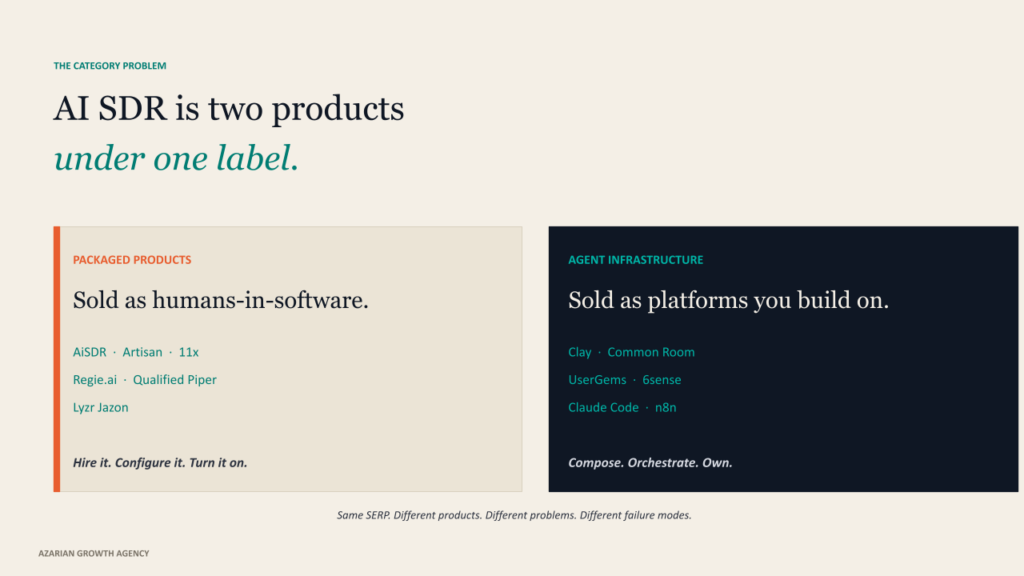
Walk through the SERP for AI SDR tools, and you will see two completely different kinds of products on the same page. AiSDR, Artisan, 11x, Regie.ai, Qualified’s Piper, Lyzr’s Jazon. They are positioned as humans-in-software. You hire them like an SDR, give them a quota, and they handle the outbound motion. Some are full replacements. Some are copilots. They are sold as products you turn on.
Then on the same page, you will find Clay, Common Room, UserGems, 6sense. These are not SDRs in any meaningful sense. They are infrastructure. They are the data pipes, the signal aggregators, the enrichment engines, and the orchestration layers your team uses to do prospecting work better. They are sold as platforms you build on.
These two product categories solve different problems and fail in different ways. Bundling them under one label is what is producing the Reddit threads where people ask whether any AI SDR actually works and get a hundred contradictory answers. The answers contradict because half the people are talking about packaged SDR replacements and the other half are talking about agent infrastructure, and nobody clarifies which one they meant.
The cleanest way to draw the line is to borrow Anthropic’s framework for what makes something an agent. Workflows follow predefined paths. Agents direct their own processes. Most products marketed as AI SDRs are workflows in disguise, very polished ones, with an LLM stitched into the parts that used to be templates. A real autonomous agent is something else. It plans, it picks tools, it adjusts based on what it observes, and it operates without the human re-running the prompt.
What an AI SDR tool actually is
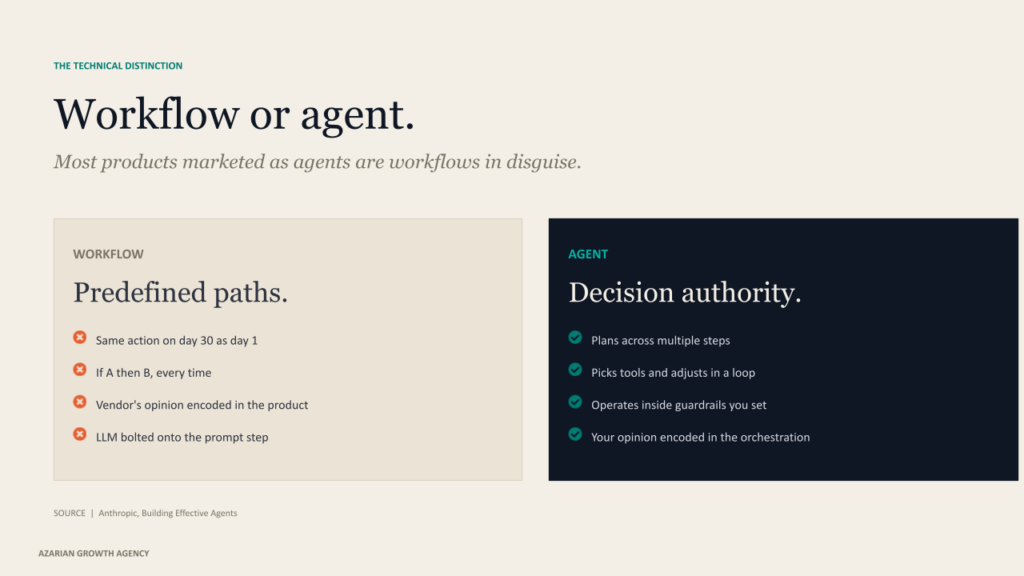
An AI SDR tool is, fundamentally, a packaged outbound motion. The vendor has decided what good looks like, encoded that opinion into a product, and your job as the buyer is to plug in your ICP and your domain and let it run. The pricing usually maps to seats or contacts or replies, just like an SDR’s salary maps to OTE.
What it actually does, under the hood, is a fairly defined set of steps. It pulls contacts from a database the vendor has licensed. It writes outreach copy using a model and the vendor’s prompt library. It schedules sends. It reads replies and routes them. Most of these tools have genuinely good copy and the cadence, and the ones that have invested seriously in their data layer can produce decent volume.
Here is the thing nobody likes saying out loud. An AI SDR tool is a great fit for a specific kind of company in a specific situation. If your motion is high volume and low ACV, your messaging is fairly templated by category, and you do not have a strong opinion about how outbound should look at your company, the packaged products will do more for you faster than any agent system you could build yourself. Jason Lemkin’s public reporting on SaaStr’s AI SDR results is one of the more honest write-ups in this category and lands roughly there. The tools work when the motion is the kind of motion the vendor designed for.
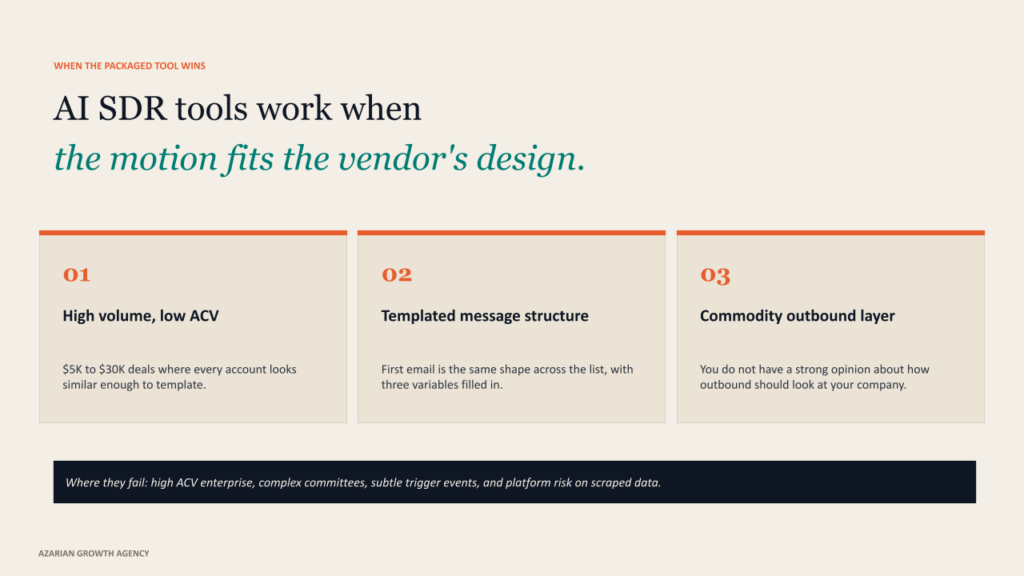
They fail when your motion is not that. If your ACV is six figures and your buyer is a CTO at a regulated enterprise, the templated outreach reads exactly like templated outreach to a CTO at a regulated enterprise, which is to say it gets deleted. If your committee is complex, the linear flow inside the tool cannot map it. If your trigger events are subtle (a former champion just took a new role, a competitor’s product just announced a price hike), the tool does not see them because seeing them was not in the product spec.
The other failure mode is platform risk, which became real in January 2026 when LinkedIn temporarily banned Artisan from the platform over data sourcing and trademark issues. Packaged AI SDR products that lean heavily on scraped data are exposed to platform enforcement decisions you do not control. That is a category-level risk, not a vendor-specific one, and it is worth pricing in.
What an autonomous agent system actually is
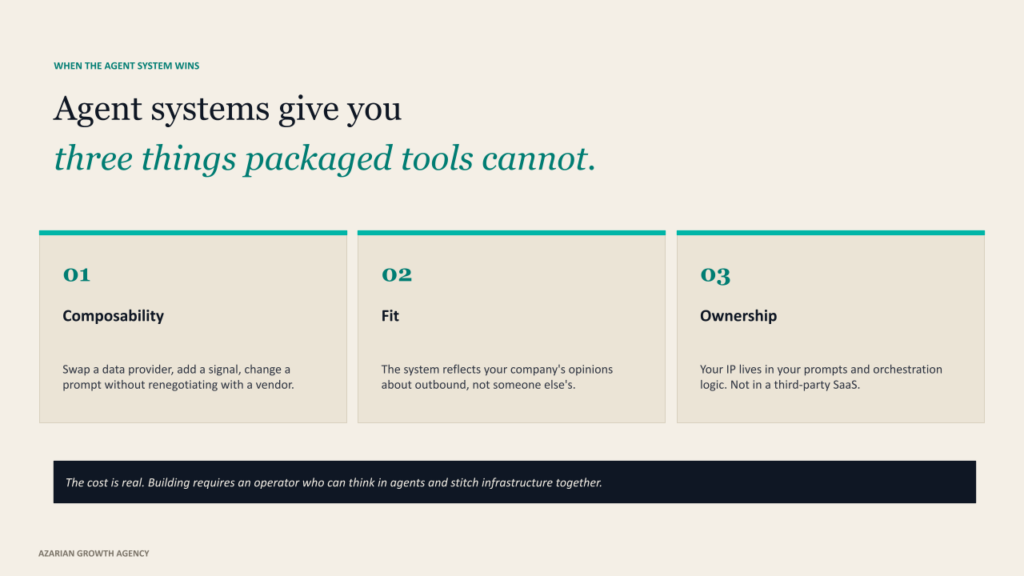
An autonomous agent system is the opposite premise. Instead of buying a packaged motion, you build one. Instead of seats, you have agents. Instead of a vendor’s opinion about good outbound, you encode your own.
Mechanically, an agent system is a set of LLM-driven processes that each handle a slice of the work and hand off to each other. One agent scores accounts and decides which ones deserve attention this week. Another finds the right contacts inside those accounts and verifies them. A third generates the outreach copy and handles the back and forth with replies.
They share state through a shared memory layer or a CRM, they call tools (databases, enrichment APIs, your CRM, your email service), and they make decisions inside guardrails you set.
The pieces are real products you can build on. Claude Code for the orchestration logic and the prompts. n8n or a similar workflow runtime for the wiring. Clay for waterfall enrichment. UserGems for the relational signals. Common Room or 6sense for the intent layer. Outreach, Salesloft, or your own sequencer for delivery. The big platforms are starting to build this layer too. HubSpot Breeze and Salesforce Agentforce are both betting hard that the future is agentic.
The work to build a system like this is real. It requires someone in your org who can think in agent terms, prompt well, debug LLM outputs, and stitch together infrastructure. It is not plug-and-play. We have written separately about the GTM stack we run with Claude Code and the considerations that go into it. The piece worth understanding here is that the agent system is the architecture, not a product, and the architecture is what gives you the things the packaged tools cannot give you.
What it gives you, in practice, is three things. The first is composability. You can change one piece without breaking the others, swap out a data provider, add a new signal, adjust a prompt without renegotiating with a vendor. The second is fit. The system reflects your company’s opinions about how outbound should look, not someone else’s. The third is ownership. Your IP lives in your prompts and your orchestration logic, not in a third-party product you pay for seats in.
The cost is also real. Building this without the right team can become a months-long project that produces a fragile system nobody wants to maintain. We have walked into client engagements where someone tried to do this themselves and ended up with three half-built agents talking to a Google Sheet. The architecture works when the team has the operating maturity to support it.
An AI SDR tool is a packaged motion. An autonomous agent system is your motion, automated. Both can work. They are not the same thing.
How Multi-Agent Systems Hand Off Between Each Other: The Architecture Behind Autonomous GTM
Five questions that tell you which one you need
When a client asks me which one to choose, I do not start with the tools. I start with five questions about their motion. The answers tell you which category fits.
How templated is your message? If a competent SDR could write the first email to almost any prospect on your list using a single template with three variables filled in, you have a packaged-motion problem, and a packaged AI SDR tool will solve it. If every first email needs to reflect a specific trigger event, a specific industry context, or a specific competitive dynamic, the templated tool will not produce the message you actually want sent.
How many signals matter? A simple motion uses one or two signals. A new account showed up in your ICP filter, or a contact downloaded a piece of content. A complex motion uses ten or fifteen signals at once and weights them differently. 6sense’s 2026 State of BDR Report makes the point that the highest-performing reps are operating with structured context, not volume, and the systems that can deliver that context are usually the ones with custom signal architecture, not the packaged ones.
Do you have someone who can build with this? The agent system requires an operator who can think in agent terms, write prompts that hold up under load, and debug LLM outputs. If your team is one founder and three SDRs, the packaged tool is probably the right call. If you have a RevOps lead with engineering instincts or a growth marketer who has been deep in vibe marketing and agent infrastructure for the last year, the agent system is in reach.
How big are your deals? There is a clean break in the data here. At low ACV ($5K-$30K) and high volume, packaged AI SDR tools win on cost-to-serve. At high ACV ($75K+) and lower volume, agent systems win because every account justifies real research and personalized handling. The middle is messy and depends on the other answers.
What is your defensibility model? If your company’s edge is the product itself and outbound is a distribution lever, the packaged tool is usually fine. If your company’s edge is your GTM motion, your data infrastructure, or the relationships you have built in a community, you do not want that motion sitting inside a third-party SaaS product where every prompt and every workflow is shared infrastructure with your competitors.
Most teams answer two of these questions one way and three the other way. That is normal. The question is which way they lean and which mistakes they can afford.
Why most teams actually need both
Here is what I have actually deployed across most of our client engagements. The honest answer is not pure agent system versus pure packaged tool. The honest answer is a hybrid where the two layers cover different parts of the motion.
The agent layer handles the work that has to be specific to the company. ICP scoring against the actual closed-won patterns, decision maker mapping against the actual buying committee, signal monitoring across the actual channels where the buyer hangs out. This is the work where the company’s IP lives, and packaging it into someone else’s product gives away the edge. We build this layer with Claude Code and a stack of infrastructure tools, and it is the part of the system that gets refined every quarter as the team learns more about its own motion.
The packaged layer handles the parts of the motion where the company’s IP does not live. Email sequencer, dialer, conversation routing, basic copy generation for low-stakes touches. Outreach or Salesloft for delivery. Regie.ai or one of the copy-focused AI tools for the templated parts of the cadence. The packaged tools are good at the commodity layer of outbound, and there is no reason to rebuild commodity layers.
The split usually looks like 70/30 or 60/40 in favor of the agent layer for the strategic work, with the packaged tools doing the operational work below it. That ratio shifts based on the answers to the five questions above. A late-stage startup with a complex enterprise motion will be 90% agent layer. A high-volume SMB outfit will be 80% packaged. The shape is the same. The mix is different.
The mistake I see teams make is assuming they have to pick a side. They do not. They have to figure out which parts of their motion are worth automating themselves and which parts are worth paying someone else to handle. Lean teams in particular benefit from this hybrid model because it lets one operator with the right tools punch above their weight without trying to replicate every commodity capability inside a homegrown system.
A short note on agent washing
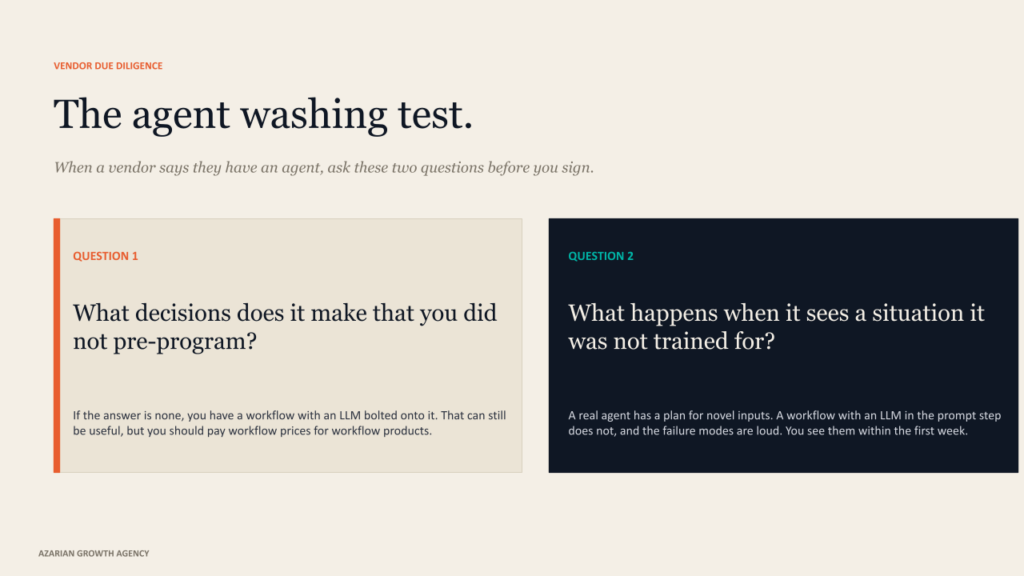
There is a separate problem you should know about before you spend a budget cycle on this. Gartner has been calling it agent washing, and it is happening across the entire category. Vendors take products that are workflows, attach the word agent to them, and ride the LLM hype into a sales conversation that should have been about whether their existing tool was good enough.
The simple test, when a vendor tells you they have an agent, is to ask what decisions the agent makes that the vendor did not pre-program. If the answer is none, you have a workflow with an LLM bolted onto it. That is fine, workflows are useful, but you should pay workflow prices for workflow products and not agent prices.
The other test is to ask what happens when the agent encounters a situation it has not seen before. A real agent has some plan for handling novel inputs. A workflow with an LLM in the prompt step does not, and the failure modes are loud. You will see them within the first week of deployment.
The real question
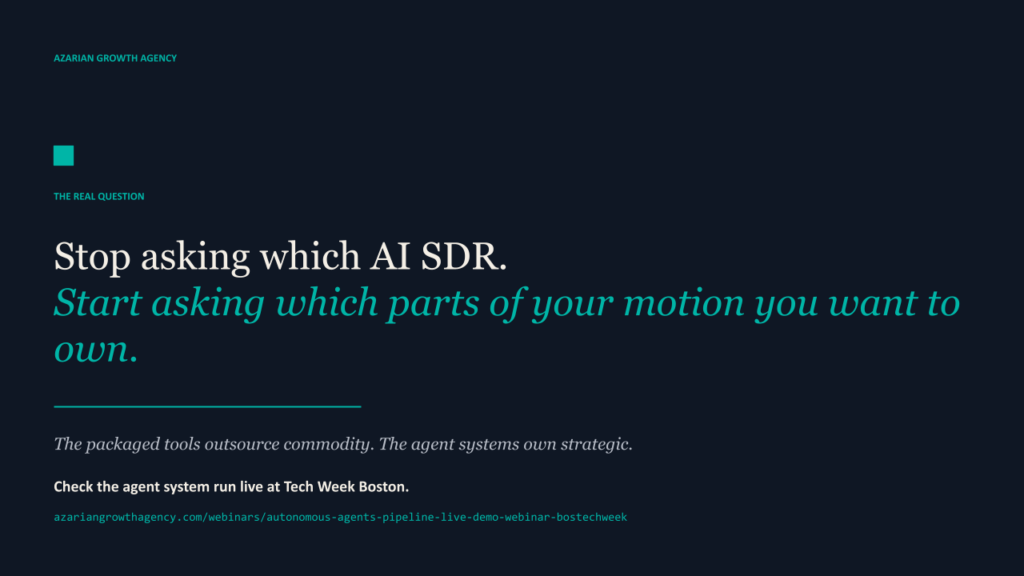
When the founder sits down for the diagnostic and asks me which AI SDR she should buy, the version of the answer I give now is this. Stop thinking of it as which AI SDR. Start thinking of it as which parts of your motion you want to own and which parts you want to outsource. The packaged AI SDR tools are excellent at outsourcing commodity parts. The autonomous agent systems are how you own the strategic parts. Most teams need both, in some ratio they have to figure out for themselves.
The teams that are getting outsized results in 2026 are not the ones that picked the best vendor. They are the ones who figured out their motion first and then chose the tools that fit it. The choice itself is downstream of a clearer question, which is what kind of outbound system you want to be running in two years and what work that requires now.
The autonomous agent system, in our experience, is what gets you there. The packaged tools fill in the gaps along the way.
About Azarian Growth Agency
Azarian Growth Agency is an AI native growth marketing agency working with VC-backed founders, PE operating partners, and growth-stage B2B leadership teams. We build full funnel growth systems anchored on agent infrastructure, with 91 agents in production across client engagements as of 2026. Our work spans pipeline diagnostics, intent signal architecture, decision maker mapping, and the broader stack of AI content marketing, AI-driven customer insights, and generative AI for marketing.
The Strategic Growth Diagnostic is the entry point for most engagements: a structured assessment of pipeline, CAC, signal infrastructure, and agent readiness, framed against the metrics PE and VC institutional buyers actually use.
Check the webinar: Tech Week Boston autonomous agents pipeline session.