
Most content about AI marketing automation describes what is theoretically possible. This post describes what actually happens on a Tuesday morning when a five-person marketing team uses it correctly.
The result is not a 10% productivity bump. The teams doing this well are running three to five times the campaign volume they ran twelve months ago with the same headcount. They are not working longer hours. They redesigned how work flows through the team.
If you want to see the live operational build, the More Output, Same Team session shows exactly how this is constructed in real time. But the workflows below are where to start.
Why the Productivity Numbers Are Real
Before getting into operational specifics, it is worth establishing the data because it is more concrete than most people expect.
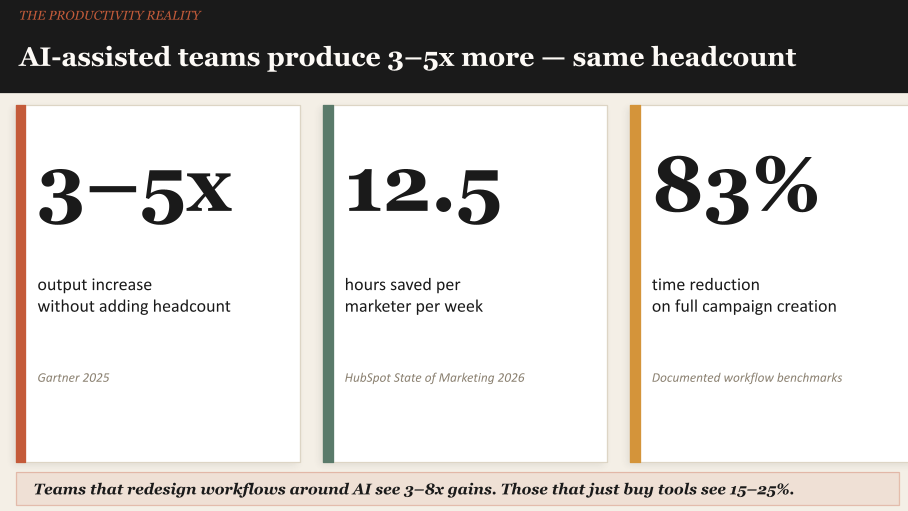
HubSpot’s 2026 State of Marketing report, covering 1,500+ marketers, found that 32.8% of respondents save 10 to 14 hours per week with AI tools, with an average of 12.5 hours per week. That is more than 26 working days per year per person, recovered. Gartner research finds that 80% of marketing leaders report AI-assisted content production has increased output by three to five times without adding headcount.
But here is the important qualifier: the teams saving 12 hours per week are not the ones who bought AI tools and kept their workflows the same. Teams that bolt AI onto existing processes see 15 to 25% productivity gains. Teams that redesign workflows around AI report three to eight times output improvements within 90 days. The difference is architecture, not software.
Marketing budgets sit at 7.7% of company revenue and are flat year over year, according to Gartner’s 2025 CMO Spend Survey. 59% of CMOs report insufficient budget to execute their strategy. The teams that are solving this are not solving it by requesting more headcount. They are solving it by changing what one person can do in a week.
What a Lean Team’s Monday Looks Like After AI Integration
Here is a composite example based on documented patterns across growth-stage B2B SaaS teams. Five people. Series A. The CMO, two content marketers, one demand gen manager, one marketing ops specialist.
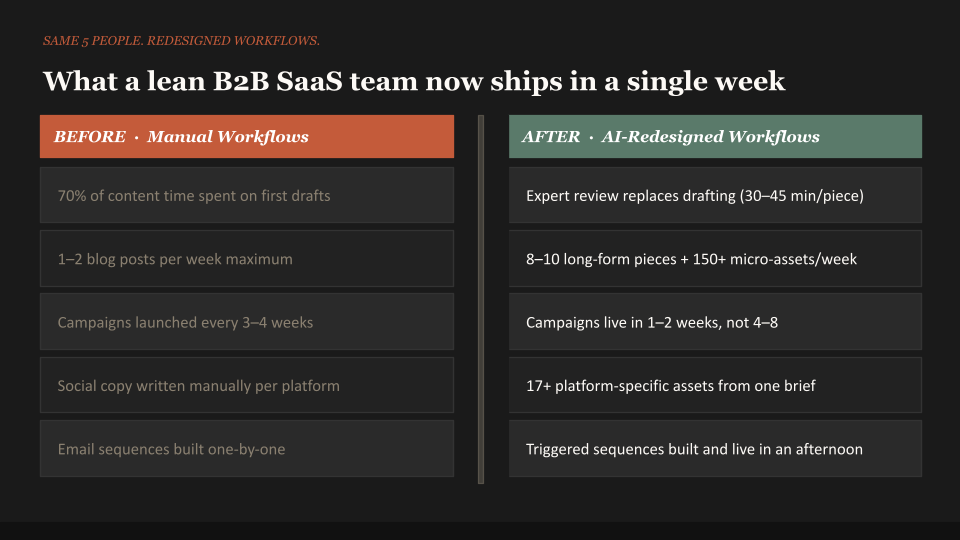
Before AI workflow redesign: both content marketers spent 70% of their time on first drafts, reformatting, social copy, and email sequences. Campaigns launched every three to four weeks. Content output was one to two pieces per week, maximum.
After: the same two content marketers produce the equivalent of what previously required seven contributors and three weeks, in a single week. A single strategic brief now generates an entire content ecosystem in one day: ten LinkedIn posts, five email newsletter sections, eight social variants, three YouTube script outlines, a whitepaper summary, and a sales enablement one-pager. Not by cutting corners. By redesigning where human judgment sits in the workflow.
The Monday morning workflow now looks like this: the content strategist reviews last week’s performance data (AI-generated summary, 15 minutes), identifies two high-priority topics for the week, generates briefs using Surfer SEO (30 minutes each), feeds those briefs to the AI drafting layer with the brand voice training active (45 to 60 minutes per first draft), and then spends the rest of the morning on expert review, adding original insights and data that AI cannot source.
By lunch, two full-length articles are in review. By the end of the day, both are through QA, and the repurposing workflow has generated 34 additional micro-assets from those two pieces. Two people. One day. Output that used to require a week and a half.
That is not a theoretical model. That is what campaign automation tools designed around human review checkpoints actually produce.
The Content Production Workflow Step by Step
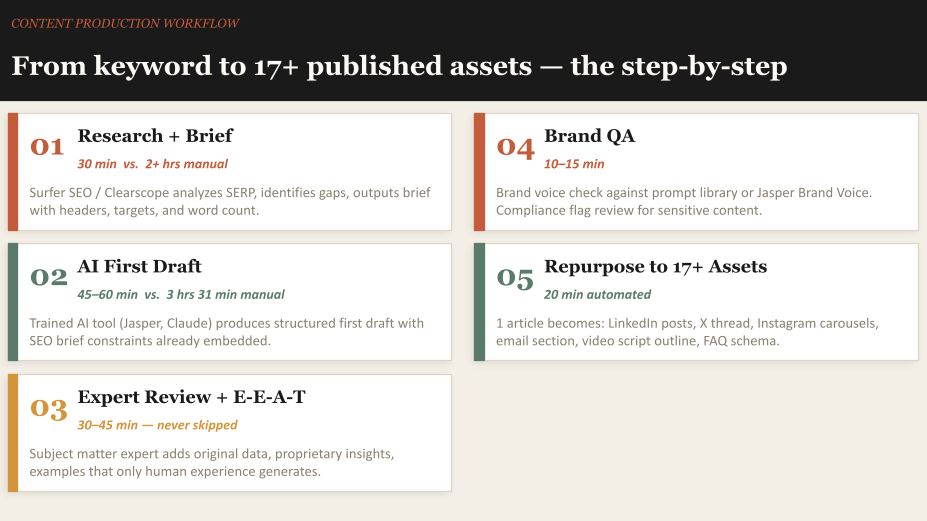
The content production workflow is where most teams see the fastest and most measurable gains. Here is the operational sequence.
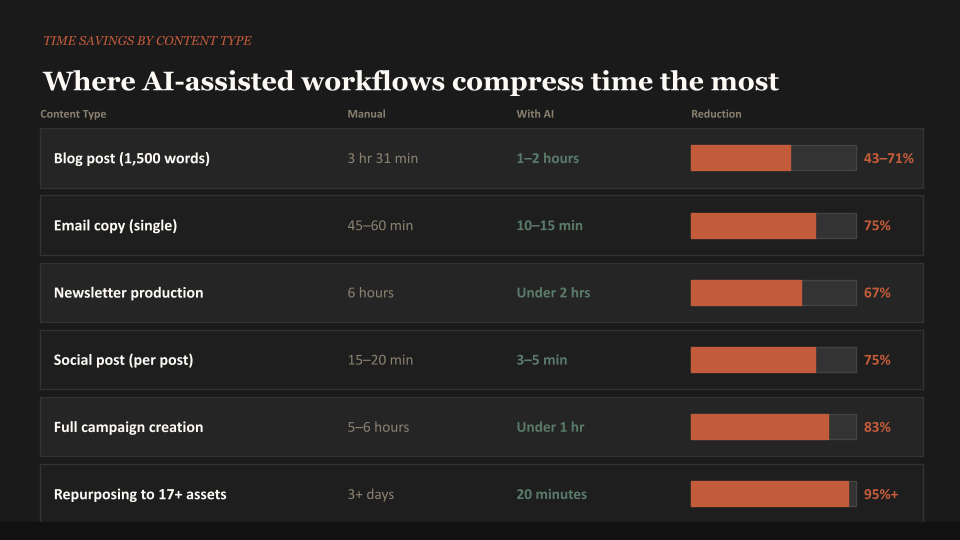
Step 1: Research and brief generation (30 minutes per piece vs. 2+ hours manually).
A tool like Surfer SEO or Clearscope analyzes the SERP, identifies competitor gaps, recommends optimal headers and word counts, and generates a content brief automatically.
What took a content manager two to three days of spreadsheet work now takes under an hour. Research time reduction of 85% is the consistent benchmark across documented implementations.
Step 2: First draft creation (45 to 60 minutes vs. 3.5 hours manually).
Orbit Media’s 2025 blogging survey puts the average blog post writing time at 3 hours 31 minutes for fully manual creation. With the SEO brief fed into a trained AI drafting tool, the first draft emerges in 45 to 60 minutes, including setup.
The critical practice here: 73% of successful marketing teams combine AI drafting with human writing, not AI-only or human-only approaches. The AI generates structure and first-pass prose. The human expert adds the layer that cannot be generated.
Step 3: Expert review and E-E-A-T enrichment (30 to 45 minutes).
This is the non-negotiable human layer. A subject matter expert reads the draft and adds original insights, proprietary data, personal experience, and the signals that search engines and readers are increasingly trained to recognize.
Google’s March 2024 update deindexed 800+ websites for mass-producing AI content without human oversight. The review step is not optional. It is also where brand voice consistency gets enforced, using trained prompt libraries or platforms like Jasper’s Brand Voice feature.
Step 4: Repurposing (20 minutes to generate 15+ assets).
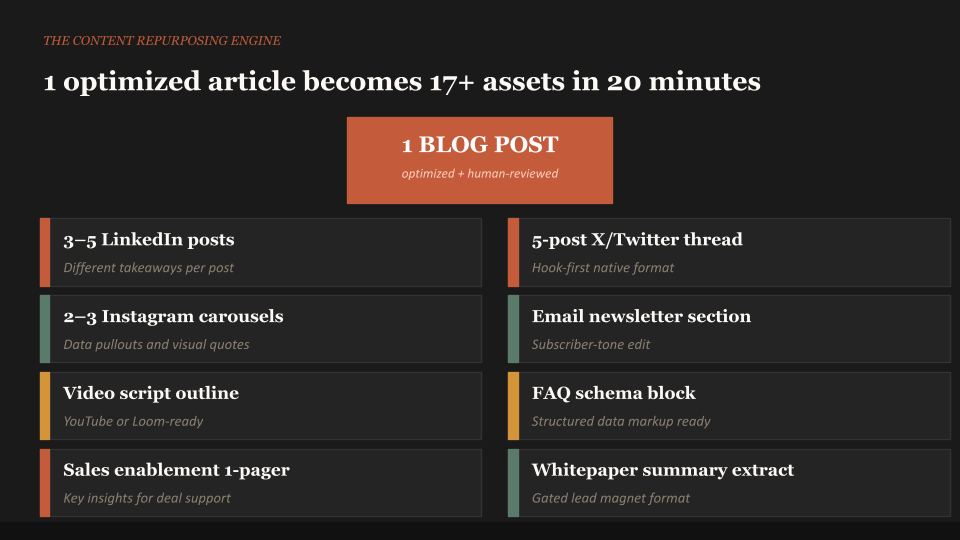
One optimized blog post becomes: three to five LinkedIn posts, a five-post thread, two to three Instagram carousel scripts, one email newsletter section, one video script outline, and two to three engagement questions.
Copy.ai users report generating three to five days of social posts from a single blog post in under 15 minutes. Hootsuite’s OwlyWriter AI generates captions from URLs and bulk-schedules 350 posts at once. The repurposing step is where lean teams multiply output non-linearly. One piece of content becomes 17+ distinct assets with a workflow that runs in the background.
The math. A two-person content team using this workflow can realistically produce eight to ten full-length optimized articles per week, plus the associated 150+ micro-assets. The same team without AI produces two to three articles per week. That is the three to five times multiplier Gartner documents.
The Paid Media Workflow: Platform AI Is Now the Default
Paid media is where AI marketing campaigns have perhaps the clearest operational documentation, because the platforms themselves publish performance data.
Google Performance Max now handles campaign delivery across YouTube, Display, Search, Discover, Gmail, and Maps from a single campaign. The AI Max for Search feature, released in 2025 delivers an average 14% lift in conversions at a similar cost per acquisition.
L’Oreal doubled their conversion rate and cut cost per conversion by 31% using the feature. PMax campaigns show benchmarks of 125% ROAS average and conversion increases of 12 to 76% when properly configured.
What this means operationally: a one-person demand gen manager can now run a multi-surface Google program that spans six ad placements simultaneously, with AI handling bidding optimization, placement decisions, audience expansion, and creative mix.
Human time concentrates on campaign strategy, asset quality, and weekly performance review. Daily bid management, which used to consume hours, is automated entirely.
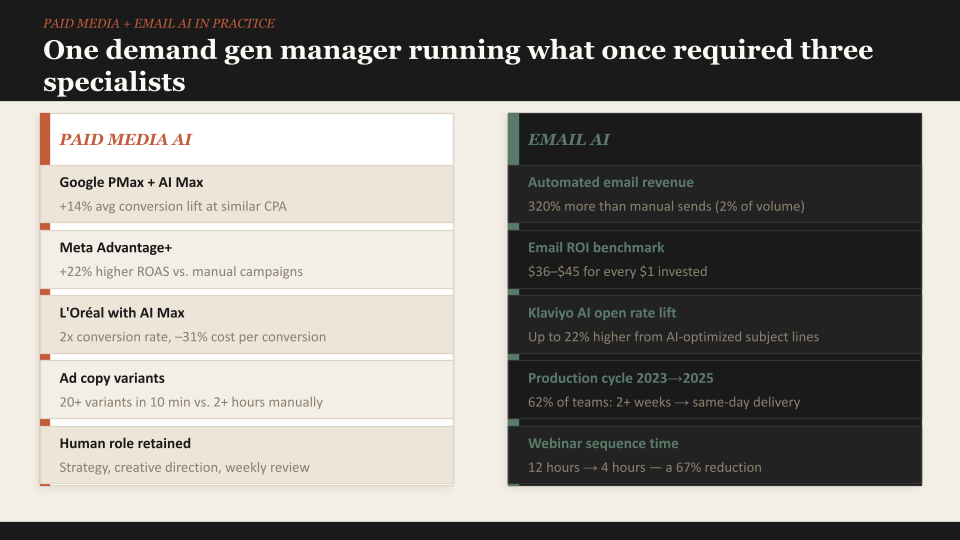
Meta Advantage+ works similarly. Benchmarks show 22% higher ROAS on average versus manually managed campaigns. In Black Friday testing, Advantage+ Shopping delivered 3.14 ROAS versus 2.70 for manual campaigns. Hawke Media reports Advantage+ now accounts for 60 to 70% of their total Meta spending.
The operational workflow for paid media on a lean team: the strategist sets objectives, audience strategy, and creative direction (human). AI generates 20+ ad copy variants from a single brief in 10 minutes versus 2+ hours manually.
AdCreative.ai or Google Asset Studio generates visual variants. Campaigns launch with AI handling bidding, targeting, and placement. The human reviews weekly, adjusts creative direction, makes strategic decisions. One person manages a multi-platform paid program that previously required two to three specialists.
The Email Workflow: Personalization at a Scale One Person Could Not Run Before
Automated emails generate 320% more revenue than manual campaigns despite being only 2% of total send volume. The email ROI benchmark sits at $36 to $45 for every $1 invested. These numbers hold precisely because automation enables personalization and timing that manual campaigns cannot replicate.
In 2023,62% of teams needed two or more weeks per email production cycle. By 2025, only 6% do. That compression happened because of AI-assisted email workflows.
Klaviyo AI (strongest for B2C and e-commerce) includes Flows AI, which lets a marketer describe a flow in natural language and receive a complete automation with filters and conditional splits. Segments AI creates audience segments from plain language descriptions.
Predictive analytics forecasts next order date, customer lifetime value, and churn risk at the individual subscriber level. AI-generated subject lines increase open rates by up to 22%, and AI-driven personalization delivers a 41% revenue increase per Klaviyo’s documentation.
HubSpot Breeze AI (strongest for B2B) generates personalized email copy from CRM data, auto-updates segmentation lists, and scores engagement predictively. The practical result: one email marketer managing a behavioral trigger program across six audience segments, running what previously required two to three specialists to configure and maintain.
The workflow: identify behavioral trigger in CRM (website visit, content download, pricing page visit). AI generates personalized email variants for each segment in three minutes versus 45 minutes manually. Human reviews for accuracy and brand voice in 10 minutes. AI-optimized send time schedules delivery.
AI monitors engagement and flags anomalies for human review. A webinar email sequence that took 12 hours now takes 4 hours. A triggered nurture program that would have required weeks to configure in traditional marketing automation now builds in an afternoon.
The Social Media Workflow: Multi-Platform Presence Without a Dedicated Social Manager
AI social media tools in 2026 have made multi-platform publishing manageable for one person without sacrificing channel-specific quality. The operational workflow is straightforward.
A blog post or campaign asset gets fed into Buffer, Hootsuite, or SocialBee. AI generates platform-specific captions: LinkedIn professional tone with data-driven framing, Instagram visual with call to engagement, X concise with a hook. In three to five minutes versus 15 to 20 minutes manual per post. Human reviews for brand voice, approves or refines. AI auto-schedules at predicted high-engagement windows. Result: engagement rate improvements of 25 to 40% from timing optimization alone, according to platform-reported data.
One person managing five platforms and 25+ weekly posts was previously a full-time role. With AI, it becomes a three-to-four-hour-per-week operational responsibility, leaving the remaining time for strategy, community engagement, and the creative direction that produces content worth sharing.
The Bottlenecks AI Does Not Solve (And the New Ones It Creates)
Operational honesty matters here. There are two categories of constraints that AI does not eliminate, and one new constraint it actively introduces.
What AI cannot replace. Original thought leadership requires genuine expertise. Brand voice and emotional resonance require human editorial judgment. Strategic positioning, customer insight, and creative intuition require context that AI cannot possess.
The tasks that remain distinctly human are also the tasks that generate the most competitive differentiation. Teams that use AI to handle production and keep humans focused on these judgment layers consistently outperform teams where humans are managing the AI’s operational tasks.
Bottleneck displacement. When AI tools land in a traditional team without structural change, they produce what practitioners call bottleneck displacement. The team generates inputs faster, but the review architecture did not change.
A content team that produces eight articles per week instead of two now requires an editorial review process that can handle eight articles per week. If the senior editor is still reviewing one piece per day, the AI speed advantage disappears at the approval checkpoint. Governance redesign is not optional.
The quality gate problem. 52% of consumers report reduced engagement with content they believe is AI-generated. 73% can correctly identify it. Teams that scale to 10x output by accepting lower standards find roughly 40% of that output needs revision or gets scrapped. The teams with the best AI-powered content outcomes are the ones where AI handles volume and humans handle craft. That requires disciplined human-in-the-loop governance, not hoping the AI gets it right unsupervised.
The Human-in-the-Loop Governance Framework
The best-in-class governance framework for marketing automation and AI workflows in 2026 follows a consistent structure: AI assists, humans approve.
Checkpoint 1 after brief: subject matter expert reviews the content brief before drafting begins. Is the angle right? Is the audience framing accurate? Does the keyword strategy align with current priorities? 10 minutes of human review prevents an entire wasted drafting cycle.
Checkpoint 2 after first draft: expert review adds original data, proprietary insights, personal examples, and the E-E-A-T signals that AI cannot generate. Brand voice consistency gets enforced here. 30 to 45 minutes of review replaces what was previously three hours of writing from scratch.
Checkpoint 3 before distribution: final editorial and brand guardian check. Compliance review for any regulated content. This gate can be tiered by content type: social posts can auto-publish after checkpoint 2; blog posts need checkpoint 3; emails to customers need all three plus a deliverability check.
Prompt libraries as infrastructure. The best teams maintain a prompt library built by the marketing ops specialist and iterated weekly. Tested, refined prompts for every content type encode brand voice, audience targeting, tone, and quality standards directly into the AI instruction. This is what makes AI output consistent at scale. Without it, every piece requires more human intervention, and the time savings erode.
Organizations using human-in-the-loop workflows report accuracy rates up to 99.9% compared to 92% for AI-only approaches. The additional 8 points of accuracy is worth preserving, because at scale, 8% of content failing quality standards is a significant operational problem.
The Tool Stack That Makes This Work
The lean-team AI stack does not require enterprise-level budgets. The growth tier, which is the right fit for most growth-stage companies, runs between $1,500 and $1,800 per month for a five-person team.
Content layer: Claude or ChatGPT ($20/month) plus Jasper at $49 to 59 per seat for brand-voice-trained content production at scale. Surfer SEO at $89 per month for brief generation and content optimization.
CRM and email layer: HubSpot Professional (approximately $1,170 per month) with Breeze AI included for CRM, email automation, and behavioral triggers. For e-commerce or mixed B2C models, Klaviyo with AI features built in.
Distribution layer: Buffer at $6 per channel or Hootsuite at $99 per month for multi-platform social scheduling with AI caption generation.
Automation layer: Zapier Pro at $20 per month for connecting tools and building the approval workflow checkpoints that make human-in-the-loop governance manageable.
The total: approximately $1,500 to $1,800 per month. Compare that to the cost of one additional marketing coordinator at $75,000 to $90,000 per year, fully loaded. At the tool spend level, the team recovers the equivalent of two to three additional FTEs worth of capacity. Marketing automation delivers an average of $5.44 for every $1 invested, according to aggregated ROI data.
How to Present This to a Board
Only 19% of content marketers track AI-specific KPIs, which means most CMOs are not reporting the capacity unlock that AI creates. The teams getting the most organizational support for AI investment are the ones presenting three specific metrics.
Efficiency metrics: content velocity (pieces per marketer per month), cost per content unit, creative velocity (concept to deployment time in days). These show the operational improvement in concrete units that the board can evaluate.
Capacity unlocked: hours saved per month per team member, documented explicitly, with a clear statement of where that capacity was reinvested. “We recovered 50 hours per week across the team. We reinvested that capacity into six new market segments and doubled our content coverage of the fintech vertical.” This converts abstract productivity gains into strategic decisions.
Revenue impact: campaigns launched faster, correlating to pipeline acceleration, external agency costs avoided, and improvement in campaign ROI from AI-optimized targeting. Gartner’s 2025 CMO Spend Survey found 49% of CMOs report improved time efficiency from generative AI, 40% report improved cost efficiency, and 22% say it has reduced reliance on external agencies. These are the board-level outcomes worth tracking and reporting.
The narrative that works: “We are not asking for more headcount. We are investing $18,000 per year in AI tools to unlock the equivalent of two additional marketing FTEs in capacity and ship four times the campaigns. Here are the output metrics, and here is the pipeline contribution.”
About Azarian Growth Agency
Azarian Growth Agency is a full-funnel, AI-native growth marketing agency founded by Hamlet Azarian. We work with growth-stage companies across SaaS, fintech, B2B tech, and e-commerce to build the operational marketing infrastructure that produces a pipeline at scale without proportional headcount growth.
The workflows described in this post are not theoretical. They are how we build programs for clients and how we run our own marketing operation. Content automation, paid media AI, signal-based email nurturing, and prompt library governance are part of our standard operating model.
The More Output, Same Team session is where we show this built live, from a blank screen. If your board is asking how you plan to hit your pipeline number with the team you have, this is the operational answer.