

AI content tools reached an inflection point. The tools you’re using today will look primitive in six months. The ones you’ll need tomorrow already exist, but most marketers haven’t discovered them yet.
The first wave of AI content tools automated execution. They helped you write faster. The second wave is automating intelligence. They help you think strategically.
According to HubSpot’s 2025 State of Marketing Report, 34.18% of marketers now use AI primarily for research and strategic planning, not just content creation. That shift from execution to intelligence represents the most important transformation in content marketing since search engines.
Most marketing teams still use AI tools the old way. They generate drafts, rewrite headlines and optimize meta descriptions. These are execution tasks. They miss the bigger opportunity.
The teams winning with AI content tools use them for intelligence tasks. Competitive analysis. Gap identification. Strategic positioning. Audience research. These intelligence tasks determine whether content succeeds before a single word gets written.
Want to see this in action? Join Webinar 16: Building a Self-Publishing Content Engine, where we demonstrate how intelligent automation transforms content production from 70 minutes to 7 minutes per article.
This evolution from execution to intelligence changes everything about how content teams operate and what results they can achieve.
What AI Execution Tools Actually Did
The first generation of AI content tools solved a specific problem. Writers spent too much time producing drafts. Tools like ChatGPT, Jasper, and Copy.ai made draft creation faster.
These execution tools delivered real value. A writer producing five articles weekly could now produce seven or eight. That 40% to 60% productivity increase mattered for teams with fixed capacity.
The execution focus made sense initially. Writing was visible, measurable, and time-consuming. Automating writing created an obvious ROI that was easy to quantify and sell to management.
But execution automation hit diminishing returns quickly. Once you automate draft creation, what’s next? Faster drafts don’t solve the fundamental challenges content teams face.
The Problems Execution Tools Didn’t Solve:
- Topics still require manual research. Someone needs to analyze competitors, identify gaps, and determine strategic angles before writing begins.
- Quality varies based on prompts. Better prompts generate better content, but writing effective prompts requires skill most writers don’t have.
- Strategic decisions remain manual. Which topics to prioritize? What angles differentiate from competitors? These judgments can’t be automated through simple prompting.
- Integration gaps persist. Content sits in Google Docs. Publishing to WordPress requires manual copy-paste. The workflow remains fragmented.
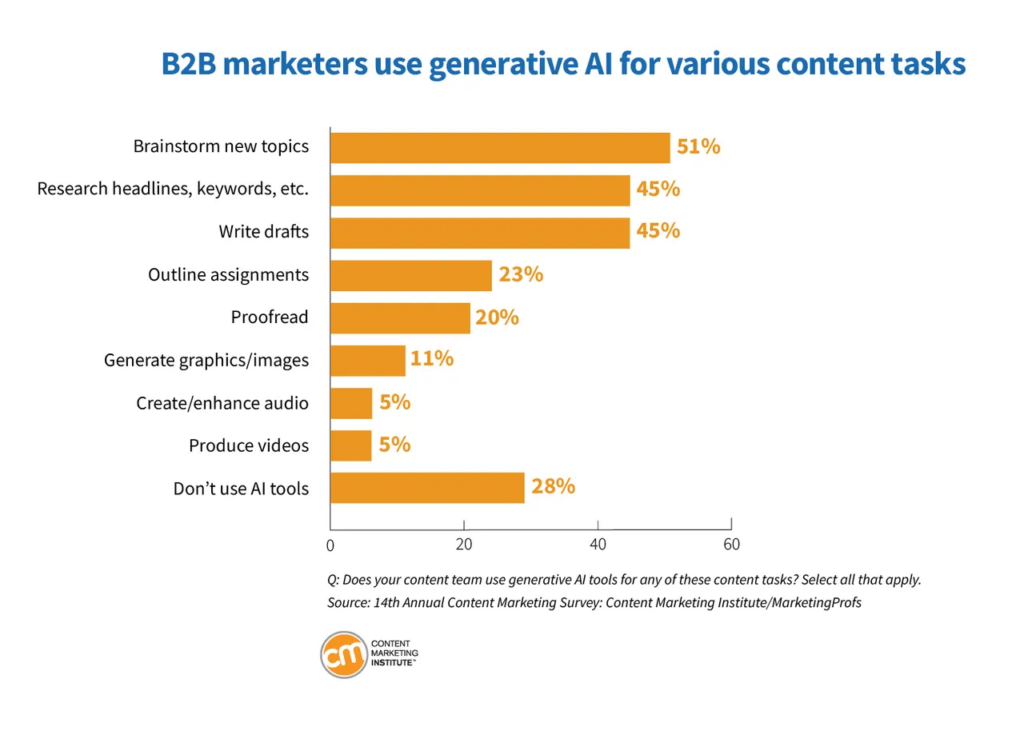
According to the Content Marketing Institute’s 2024 research, 72% of B2B marketers use generative AI, 51% brainstorm topics, but 61% report their organizations lack guidelines for its use. That gap exists because execution tools don’t provide strategic frameworks. They generate content without context.
Our AI marketing services focus on this exact problem. Execution without intelligence creates volume without value.
The Intelligence Gap That Execution Tools Missed
Real content challenges aren’t about writing speed. They’re about making smart decisions before writing begins.
Research Takes Longer Than Writing
Traditional content creation splits into two phases. Research consumes 30 to 40 minutes. Writing consumes 20 to 30 minutes. Total time per article: 50 to 70 minutes.
Execution tools only accelerate the writing phase. They reduced 20 minutes to 5 minutes. Total time drops from 50 minutes to 35 minutes. That’s a 30% improvement.
But research still takes 30 to 40 minutes manually. The bottleneck didn’t move. It just became more obvious.
Strategic Decisions Determine Success
The article succeeds or fails based on decisions made during research. Which competitors to analyze? What gaps to target? How to structure the argument? These strategic choices matter more than word choice or sentence flow.
Execution tools can’t make these strategic decisions. They generate content based on prompts. But the prompts themselves require intelligence to create. You’re just moving the strategic work from writing to prompting.
What AI Intelligence Tools Actually Do
The second generation of AI content tools automates strategic thinking, not just tactical execution. They handle the intelligence layer that determines content success.
Automated Competitive Research
Intelligence tools analyze 10 to 20 competitor articles automatically. They identify patterns in structure, depth, and positioning. They flag content gaps and differentiation opportunities.
This competitive intelligence happens in 2 minutes instead of 30 minutes. But the bigger value isn’t speed. It’s comprehensive. Manual research analyzes 3 to 5 competitors. Automated research analyzes 20 competitors with deeper pattern identification.
Strategic Gap Identification
The most valuable insight is what competitors missed. Which questions went unanswered? What objections weren’t addressed? What subtopics got ignored?
Intelligence tools systematically identify these gaps by comparing multiple sources against comprehensive topic models. They quantify the opportunity. This article’s topic has 5 significant gaps competitors missed. That topic only has 1 minor gap.
These insights enable data-driven topic prioritization, impossible with manual research.
Automated Content Strategy
Intelligence tools generate strategic recommendations before writing begins. Optimal article structure for SEO. Required depth per section. Key differentiators to emphasize. Sources to cite for authority.
This strategic blueprint guides execution. Writers know exactly what to create and why each element matters. The guessing disappears.
Workflow Integration
Intelligence tools connect research to strategy to execution to publishing. The entire workflow runs in one platform instead of jumping between 5 different tools.
Research outputs flow directly into strategic recommendations. Strategic recommendations inform the writing brief. The finished draft publishes directly to WordPress with proper formatting and metadata.
This integration eliminates the context switching that kills productivity and creates errors.
The ROI Math Changed Completely
Execution automation delivered 30% to 40% productivity gains. Intelligent automation delivers 300% to 500% productivity gains. The economics are fundamentally different.
Old Math: Execution Automation Only
A content writer producing 20 articles monthly at 50 minutes each invests 1,000 minutes monthly in content creation. That’s 16.7 hours.
With execution automation, writing time drops from 20 minutes to 5 minutes per article. But research still takes 30 minutes. Total time per article: 35 minutes. Monthly time: 700 minutes or 11.7 hours.
You saved 5 hours monthly. That’s a 30% productivity gain. Meaningful but not transformative.
New Math: Intelligence Automation Included
With intelligence automation, research drops from 30 minutes to 2 minutes. Writing stays at 5 minutes with execution automation. Total time per article: 7 minutes.
That same writer now invests 140 minutes monthly for 20 articles. That’s 2.3 hours. You saved 14.4 hours monthly compared to fully manual work. That’s an 86% time reduction.
But here’s where it gets interesting. That writer now has the capacity to produce 85 articles monthly in the same 16.7 hours previously spent on 20 articles. Output increased 4.25x without adding headcount.
The Cost Equation
Manual research and writing costs $50 to $100 per article in writer labor, depending on rates and complexity.
Execution-only AI drops costs to $35 to $70 per article. You save 30%.
Intelligence-plus-execution AI drops costs to $10 to $20 per article in labor plus $1 to $3 in API costs. You save 75% to 80% while increasing output 4x.
The ROI isn’t linear. It’s exponential.
This is exactly why our webinar marketing services emphasize intelligent automation for thought leadership content, where strategic positioning determines success.
The Shift Marketing Teams Must Make
Intelligence automation requires different processes, skills, and mindsets than execution automation. Teams can’t just swap tools and expect results.
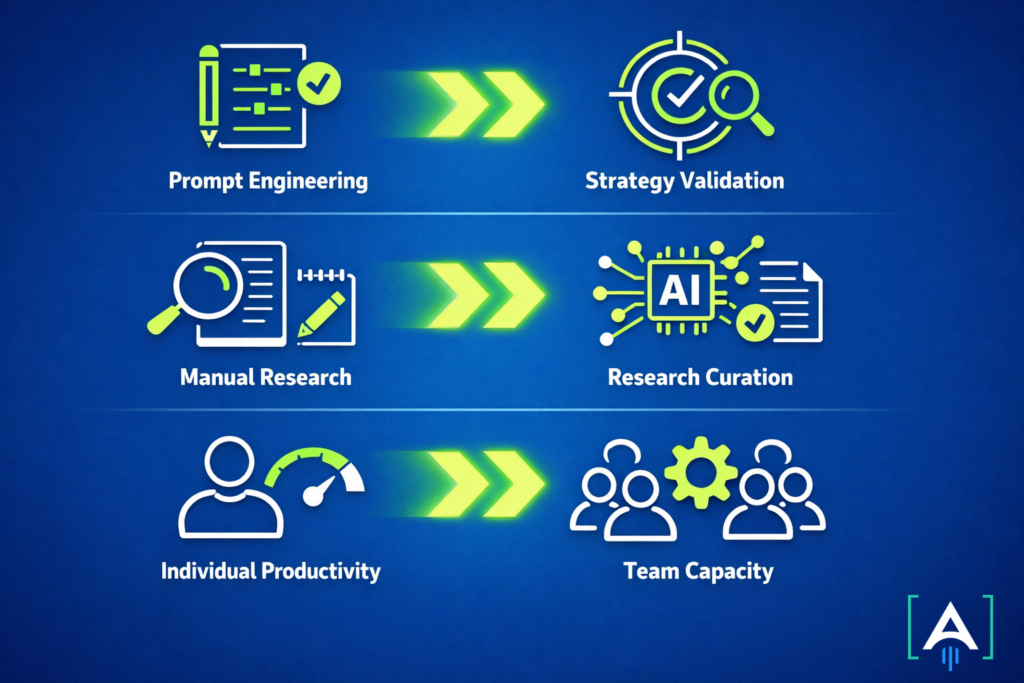
From Prompt Engineering to Strategy Validation
Execution tools require skilled prompting. You need to write detailed prompts specifying tone, structure, length, and requirements. This prompt engineering becomes a specialized skill.
Intelligence tools require strategy validation. The tool generates strategic recommendations automatically. Your job is evaluating whether those recommendations align with your audience needs and business goals.
The skill shifts from crafting good prompts to validating strategic analysis. That’s a different capability requiring different training.
From Manual Research to Research Curation
With execution tools, humans do research then use AI for writing. With intelligence tools, AI does research then humans curate the insights.
Writers need to learn how to evaluate automated competitive analysis, identify which gaps matter most to their specific audience, and enhance AI recommendations with proprietary insights the tool can’t access.
This is particularly important for signal-based outreach services where strategic intelligence about prospects drives personalization.
From Individual Productivity to Team Capacity
Execution tools improve individual writer productivity. Each person writes faster. Intelligence tools improve team capacity. The entire team produces more because strategic bottlenecks disappear.
This capacity increase enables completely different content strategies. You can dominate topic coverage in your niche., you can test 10 content angles where you previously tested 1, you can produce comprehensive content libraries that establish category authority.
From Content Creation to Content Operations
Intelligence automation shifts content from a creative function to an operational function. You’re no longer limited by how many good writers you can hire and train. You’re limited by how well you can operationalize intelligence workflows.
This operational mindset requires different skills. Process design. Quality control frameworks. Strategic oversight protocols. These capabilities matter more than writing ability.
Common Mistakes When Adopting Intelligence Tools
Teams excited about intelligence automation often implement poorly. The common mistakes are predictable and avoidable.
Mistake #1: Using Intelligence Tools Like Execution Tools
Many teams get access to intelligence tools but continue using them for execution. They use the competitive analysis feature once, manually copy insights into a brief, then use the tool like ChatGPT to generate drafts from their brief.
This defeats the purpose. Intelligence tools automate the entire workflow from research through strategy to execution. When you manual-copy insights between steps, you recreate the fragmentation problem these tools solve.
Mistake #2: Skipping Process Development
Teams assume intelligence tools work automatically without process design. They don’t establish when human review is required, how to validate AI recommendations, or which decisions humans should override.
Without clear processes, teams either blindly trust AI outputs (creating quality issues) or manually review everything (eliminating efficiency gains).
Mistake #3: Ignoring Change Management
Intelligence automation changes job responsibilities fundamentally. Writers shift from content creation to content curation. Editors shift from quality control to strategic oversight. These role changes create resistance without proper change management.
Teams that skip change management see low adoption, ongoing reliance on old workflows, and resistance to new tools regardless of their capabilities.
Mistake #4: Measuring the Wrong Metrics
Teams measure execution metrics (drafts created, time per article) instead of intelligence metrics (gaps identified, strategic recommendations validated, differentiation achieved).
You get what you measure. If you measure execution speed, teams optimize for speed. If you measure strategic value, teams optimize for insight quality.
This connects directly to our link building services where content quality and strategic positioning determine backlink acquisition success more than volume.
What This Means for Your Content Strategy Next Quarter
Intelligence automation changes what’s strategically possible. Your content strategy needs to evolve to capture these new capabilities.
Dominate Topic Coverage
With 4x to 5x capacity increases, you can publish comprehensive coverage of every topic in your niche. Instead of 1 to 2 articles per topic, you can publish 10 to 15 articles covering every subtopic, use case, and audience segment.
This comprehensive coverage creates category authority impossible for competitors still producing 1 article per topic. Search engines reward depth. You’ll rank for long-tail variations competitors don’t have content for.
Test Multiple Angles Simultaneously
Limited capacity forced you to pick one angle per topic and hope it worked. Intelligence automation lets you test 5 different angles simultaneously and see which resonates.
One angle targets beginners. Another targets advanced users. A third focuses on technical implementation. A fourth emphasizes business ROI. A fifth addresses specific industry verticals.
You learn what works through data instead of guessing.
Competitive Gap Exploitation
Manual research identifies obvious gaps occasionally. Automated intelligence research identifies gaps systematically for every topic. You can build entire content strategies around gap exploitation.
Competitors write generic how-to guides. You write comprehensive guides addressing the specific challenges they ignored. This differentiation drives traffic from searches competitors can’t satisfy.
Content as Competitive Intelligence
The research intelligence tools generate value beyond content creation. You learn competitor positioning, messaging priorities, and strategic gaps across your entire market.
This competitive intelligence informs product development, sales positioning, and marketing strategy. Content production becomes an intelligence gathering operation that pays dividends across the business.
Partner with Azarian Growth Agency for Intelligence-First Content
The evolution from execution to intelligence represents the biggest shift in content marketing capabilities since the internet made distribution free. Teams that adopt intelligence automation gain compound advantages competitors can’t close through hiring or budget increases.
At Azarian Growth Agency, we’ve built proprietary intelligence automation systems that deliver 10x productivity gains while improving content quality and strategic differentiation. We don’t use off-the-shelf execution tools. We’ve built complete intelligence platforms that automate research, strategy, and execution in integrated workflows.
We’ve proven these systems work through our own content operations. We produce 100+ strategic articles monthly with a team that previously produced 30 articles. Our content ranks consistently because intelligence automation identifies differentiation opportunities manual research misses.
We’re now helping other companies implement intelligence-first content operations that transform their capacity and results. Whether you need AI marketing services, complete content operations transformation, or strategic consulting on intelligence automation, we have the expertise and technology to deliver results.
The teams that adopt intelligence automation in 2025 will dominate their markets by 2026. The teams that continue relying on execution-only tools will fall further behind quarterly.
Ready to evolve from execution to intelligence? Join Webinar 16: Building a Self-Publishing Content Engine to see the complete system in action.
Partner with us to implement intelligence automation that transforms your content operations and market position.