
Why most marketing teams still can’t scale content despite having AI tools comes down to one fundamental mistake: they automate the wrong layer. Teams buy ChatGPT, Jasper, or Copy.ai expecting 10x productivity gains. Instead, they get 2x at best and often abandon the tools within months.
The problem isn’t the AI tools themselves. The problem is what teams try to automate with them.
Most AI writing tools automate the execution layer, the actual writing. But writing isn’t the bottleneck preventing content teams from scaling. Research, strategy, and publishing are. You can write drafts twice as fast and still hit the same capacity limits if research takes 30 minutes per article.
At Azarian Growth Agency, we cover why marketing teams can’t scale content inwebinar 16. You’ll see exactly where traditional AI tools fail and what complete workflow automation looks like in practice.
This guide explains the real barriers preventing scale and how to overcome them.
The Execution Layer vs Judgment Layer Problem
Content creation involves two distinct types of work that require fundamentally different approaches.
Execution Layer: The actual writing. Putting words on a page. Creating sentences and paragraphs. Formatting for readability. This is what most AI tools automate.
Judgment Layer: Research and strategy. Analyzing 10 competitor articles. Identifying content gaps. Deciding differentiation angles. Choosing target keywords. Planning structure and flow.
According to Content Marketing Institute research, 72% of B2B marketers use generative AI tools, yet most report minimal productivity gains. The disconnect: they automate execution but leave the judgment layer manual.
Where Time Actually Goes
Map how your content team spends time on a typical article:
Research: 30 minutes reading competitor articles, identifying gaps, gathering data
Planning: 15 minutes creating outline, deciding structure, selecting keywords
Writing: 30 minutes drafting the article
Publishing: 10 minutes formatting in WordPress, adding metadata, setting up images
Total: 85 minutes. Writing represents only 35% of the total time.
AI writing tools cut that 30 minutes to maybe 15 minutes. You save 15 minutes per article. Your total time drops from 85 to 70 minutes. That’s an 18% improvement, not the 10x scaling you need.
The real bottleneck is the 45 minutes spent on research and planning. Automate that, and your productivity transforms.
Why AI Writing Tools Don’t Solve the Scaling Problem
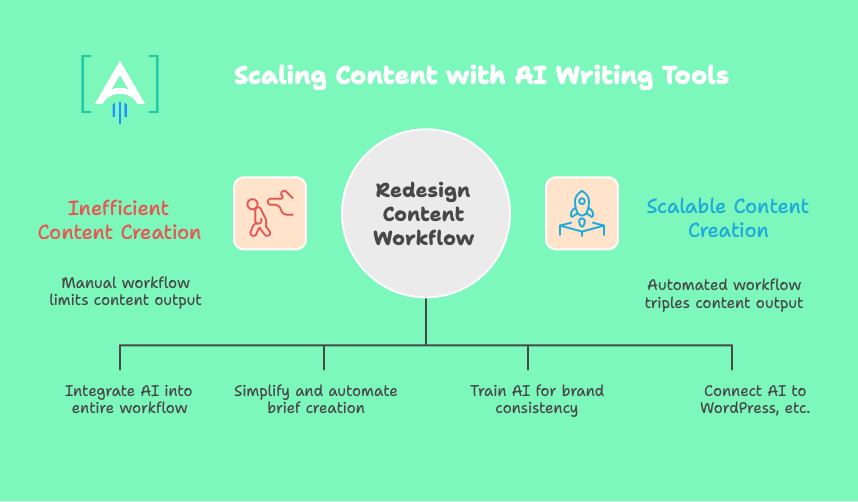
Teams adopt AI writing tools expecting to triple or 10x their content output. Here’s why it doesn’t work.
They Only Touch One Phase
ChatGPT writes drafts. It doesn’t research competitors, identify gaps, create strategic outlines, or publish to WordPress. You still manually handle four of five workflow phases.
The bottleneck doesn’t disappear. It just shifts to research and planning phases that consume more time than writing anyway.
They Require Constant Human Input
Every article needs a detailed brief. What competitors to analyze, what angle to take, what structure to use and what keywords to target.
Creating these briefs takes nearly as long as the research itself. You’ve outsourced writing but not the strategic work that enables writing.
They Create New Quality Control Work
AI drafts require extensive editing for brand voice, accuracy, and strategic positioning. Many teams spend more time editing AI output than they saved on initial drafting.
The promised productivity gain evaporates in quality control overhead.
They Don’t Integrate With Your Stack
AI writes the draft. You manually copy it to WordPress, manually add formatting, manually insert images, metadata and manually publish.
Each manual step adds friction and time. The workflow remains fundamentally manual with one automated piece.
Data from CoSchedule’s 2025 report shows 85.84% of marketing professionals plan to increase AI usage, but adoption without workflow redesign fails to deliver expected results.
The Three Missing Pieces Preventing Scale
Marketing teams can’t scale content despite AI tools because three critical pieces are missing from their implementation.
Missing Piece 1: Judgment Layer Automation
You need AI that handles research and strategy, not just writing.
Competitive Analysis Automation: AI analyzes 10 competitor articles simultaneously in 2 minutes. Identifies themes, gaps, and opportunities. Returns a structured research brief showing exactly what exists and what’s missing.
Strategic Outline Generation: AI creates SEO optimized outline incorporating research findings, target keywords, and differentiation strategy. 30 seconds instead of 15 minutes manually.
Gap Identification: AI explicitly calls out what competitors miss. These gaps become your differentiation opportunities and content angles.
This automation transforms the 45 minute research and planning bottleneck into 3 minutes of AI processing.
Missing Piece 2: Workflow Integration
You need connected systems where one step triggers the next automatically.
Research to Outline: Competitive analysis feeds directly into outline generation. No manual synthesis or copy pasting between tools.
Outline to Draft: Strategic outline triggers draft creation with proper structure, keywords, and gap coverage built in.
Draft to Publishing: Finished article publishes to WordPress automatically with formatting, metadata, categories, and featured images handled systematically.
Our Content Engine demonstrates complete workflow integration. Input topic, click start, get published article in 7 minutes. No human intervention between steps except final approval.
Missing Piece 3: Quality Without Manual Oversight
You need systematic quality control, not human review of every output.
Quality Gates: Automated checks validate completeness, accuracy, citation density, SEO optimization, and readability. Articles failing gates get flagged for human review. Articles passing gates proceed automatically.
Blind Testing: Regular validation where editors score articles without knowing production methods. This proves AI maintains quality standards objectively.
Performance Tracking: Monitor rankings, traffic, and engagement for AI assisted versus manual content. Data shows whether quality holds at scale.
We track 12 quality metrics weekly. Any metric declining 10% triggers investigation. This catches quality degradation before it impacts significant volume.
What Actual Content Scaling Looks Like
Teams successfully scaling content with AI don’t just write faster. They automate complete workflows from topic selection through publication.
Real Implementation Example
Our three person content team produced 30 articles monthly using traditional methods. Leadership wanted 100 articles monthly. Hiring six more writers would cost $288,000 annually.
We built Content Engine automating the complete workflow:
Research Phase: MCP servers scrape and analyze 10 competitors automatically. Time: 2 minutes versus 30 minutes manually.
Strategy Phase: AI generates SEO optimized outline with identified gaps incorporated. Time: 30 seconds versus 15 minutes manually.
Writing Phase: AI creates a 3,000 word draft with proper citations and structure. Time: 4 minutes versus 30 minutes manually.
Publishing Phase: WordPress integration handles formatting, metadata, and publication. Time: Instant versus 10 minutes manually.
Total: 7 minutes versus 70 minutes. That’s 10x faster, not 2x.
Results After 60 Days
Capacity: Same three person team now produces 100 plus articles monthly. Output increased 3.3x without adding headcount.
Quality: Blind testing showed AI assisted articles rated higher on research depth. They ranked 2.3 positions better and generated 64% more organic traffic.
Costs: We saved $45,000 annually compared to hiring additional writers. AI API costs run $250 monthly.
Speed: Development took 8 weeks. ROI positive in under 2 months through labor cost savings.
According to AllAboutAI research, organizations implementing AI in marketing report an average 41% increase in revenue and 32% reduction in customer acquisition costs. Complete workflow automation drives these results.
The Four Barriers Keeping Teams Stuck
Most teams recognize they need better AI implementation but can’t move forward. Four barriers keep them stuck.
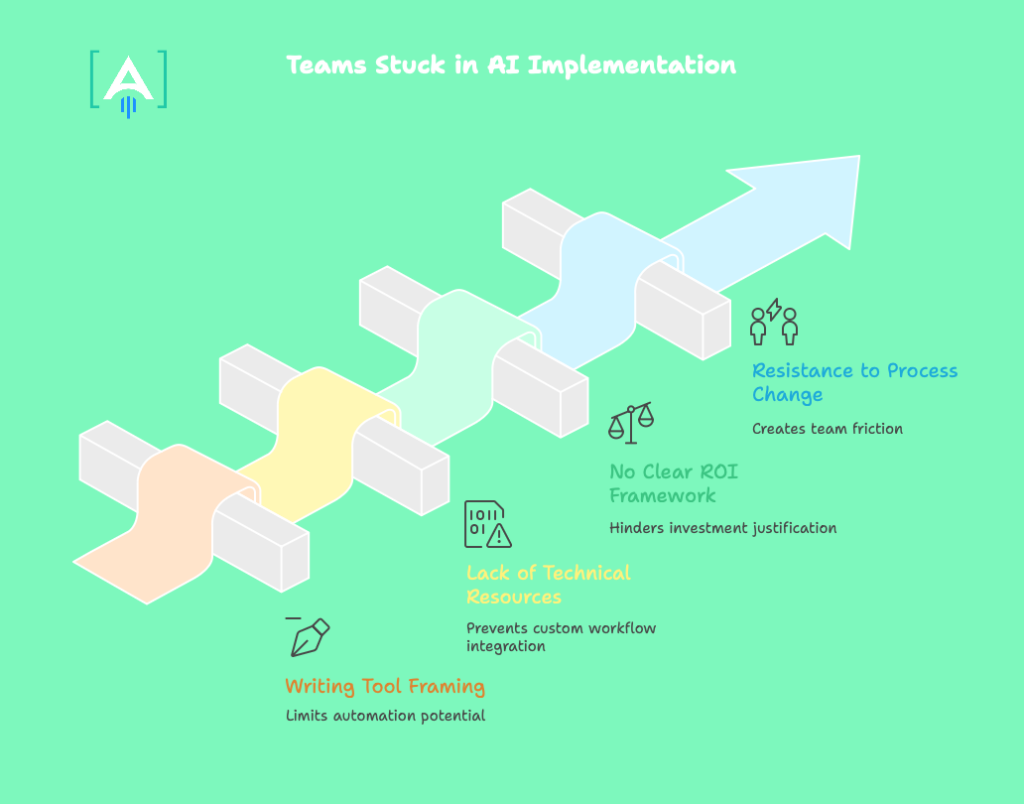
Barrier 1: Treating AI as a Writing Tool
Teams think “AI helps us write faster” instead of “AI automates workflows.” This framing limits what they build and how they measure success.
Solution: Reframe AI as workflow automation, not writing assistance. Map your complete process from topic to published article. Identify which steps AI can handle. Build automation spanning multiple phases, not just drafting.
Barrier 2: Lack of Technical Resources
Building custom automation with AI APIs requires engineering skills most marketing teams don’t have. They can’t build workflow integration themselves.
Solution: Three options exist. Partner with agencies or consultants who’ve built similar systems. Hire contractors for development then maintain internally. Use platforms abstracting technical complexity at the cost of less customization.
Barrier 3: No Clear ROI Framework
Teams can’t justify automation investment without calculating true costs and benefits. They don’t know the current cost per article or time spent per phase.
Solution: Map current workflow completely. Time track every task for two weeks. Calculate cost per article including all labor. This baseline proves whether automation delivers ROI and by how much.
Barrier 4: Resistance to Process Change
Writers resist becoming curators instead of creators. Editors worry about job security. Managers struggle to evaluate productivity differently.
Solution: Invest in change management as much as technology. Explain why changes benefit the team. Show data on time savings. Celebrate early wins. Make the transition gradual with opt in adoption initially.
Research from Social Media Examiner shows 90% of marketers use AI for text based tasks, but only teams redesigning workflows around AI achieve significant productivity gains.
Getting Unstuck and Actually Scaling
You don’t need to rebuild your entire operation overnight. Start with one workflow proving complete automation works.
Map Your Bottleneck: Document where time actually goes. Research? Planning? Writing? Publishing? Identify the phase consuming most time per article.
Automate the Bottleneck: If research takes 30 minutes, automate competitive analysis first. If planning takes 20 minutes, automate outline generation. Attack the biggest time sink.
Connect Two Phases: Link automated research to outline generation. Or outline generation to draft creation. Prove workflow integration works with one connection.
Measure Everything: Track time saved, quality scores, and actual costs. Compared to manual baseline. Let data prove the approach works.
Most teams see 40 to 60% time reductions automating just their biggest bottleneck. This success builds confidence for expanding automation.
Conclusion
Marketing teams can’t scale content despite having AI tools because they automate the wrong layer. AI writing tools help with execution, but leave the judgment layer manual. Research, strategy, and publishing remain bottlenecks limiting capacity.
We built a Content Engine automating the complete workflow using Claude API and MCP servers. Our three-person team produces 100-plus articles monthly in 7 minutes per article. Quality improved because systematic AI research catches patterns humans miss.
In webinar 16, we demonstrate what complete workflow automation looks like. You’ll see our judgment layer automation handling research and strategy, you’ll see workflow integration connecting multiple phases. You’ll see quality gates maintaining standards without manual review. We share 60 days of production data proving the approach works.
We help teams identify their specific bottlenecks, design automation architectures, and implement workflow integration. Our approach works because we built these systems for our own operation first and use them daily in production.
Ready to actually scale content instead of just writing faster?
Talk to our growth experts to discuss your workflow bottlenecks and automation opportunities.