

When to change marketing strategy isn’t always obvious. The shift happens gradually. Campaigns that generated 50 leads now generate 15. Customer acquisition costs creep higher. Sales complains about lead quality. Your team works longer hours, producing less impact.
These aren’t temporary blips. They’re signals your company outgrew its marketing approach while you were busy executing it.
According to HubSpot’s Marketing Report, only 35% of marketers report strong alignment between sales and marketing teams. More tellingly, only 26% using disconnected systems said their marketing strategy was effective compared to those with integrated approaches.
The problem compounds because signs marketing isn’t working often mask as execution issues. Your team tries harder. Tests more variations. Increases spend. But effort can’t fix strategy problems.
Smart business owners partner with experienced growth marketing agencies that recognize the difference between tactical adjustments and strategic pivots. The difference matters because it determines whether you waste months optimizing the wrong approach or transform outcomes through strategic change.
This guide shows you exactly when to pivot marketing approach, with decision frameworks business owners can use to evaluate whether your current strategy can scale or whether transformation is required.
Signs Marketing Isn’t Working: The Five Warning Signals
Recognizing when to change marketing strategy requires identifying specific warning signals. These signs appear consistently across companies that have outgrown their approach.
Sales and Marketing Misalignment Worsens
According to HubSpot, marketers with a single source of truth are 56% more likely to be strongly aligned with sales teams and 26% more likely to report effective marketing strategies. When alignment deteriorates, it signals your marketing approach doesn’t match sales needs.
Warning signs of strategic misalignment:
- Sales rejects 50%+ of marketing-qualified leads as unqualified
- Lead-to-opportunity conversion rates dropped 30%+ year-over-year
- Sales cycle length increased 40%+ without change in product complexity
- Sales uses entirely different messaging than marketing provides
- Revenue attribution to marketing channels decreases despite lead volume maintenance
This connects to our AI marketing services where we see alignment improve dramatically when strategy matches the business growth stage.
Customer Acquisition Economics Broke
Your customer acquisition costs increased while customer lifetime value stayed flat or decreased. The unit economics that justified your marketing strategy no longer work.
The math that matters:
- CAC increased 50%+ without corresponding LTV increases
- Payback period extended from 12 months to 24+ months
- Customer retention dropped 20%+ suggesting marketing attracts wrong-fit customers
- Gross margin compression makes your CAC unsustainable
- Competitors achieve 40%+ better CAC with similar ICP
According to research, only 65% of marketers report having high-quality data on their target audience, which hampers effective targeting and personalization. When acquisition economics break, it often signals your strategy targets too broadly or uses inefficient channels.
This economic analysis connects to our SEO services where we help companies rebuild efficient acquisition through organic channels that scale economics.
When to Pivot Marketing Approach: The Decision Framework
Recognizing signs marketing isn’t working is step one. Determining whether to adjust tactics or pivot strategy entirely is step two. Most business owners struggle here because tactical fixes feel safer than strategic pivots.
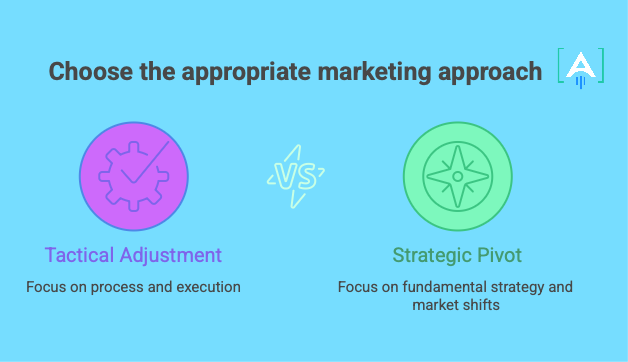
The Tactical vs. Strategic Decision Matrix
Use this framework to determine whether your situation requires tactical adjustments or strategic pivot:
Tactical Adjustment Indicators:
- Metrics declined less than 20% year-over-year
- Core strategy still generates positive ROI, just lower than historical
- Primary channels remain effective for competitors in your space
- Sales and marketing alignment issues stem from process, not strategy
- Customer feedback suggests execution gaps, not fundamental approach problems
Strategic Pivot Indicators:
- Metrics declined 30%+ year-over-year despite increased effort and spend
- ROI turned negative or payback periods extended beyond sustainable thresholds
- Your primary channels lost effectiveness industry-wide, not just for you
- Fundamental misalignment between marketing outputs and sales needs
- Market shifted to different channels, content types, or buyer behaviors
HubSpot’s data shows marketers save a significant amount of time daily by implementing AI tools, with 84% reporting faster content production. But efficiency tools can’t fix strategic misdirection.
Marketing Strategy Evaluation: What to Measure
Evaluating whether to change marketing strategy requires measuring the right metrics. Most companies track activity metrics instead of strategic health indicators.
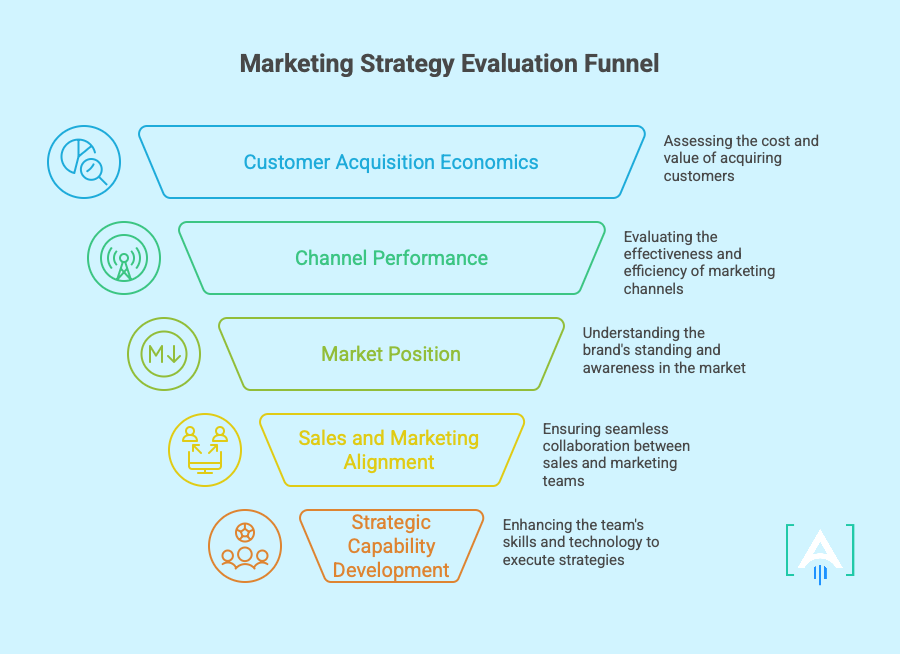
Strategic Health Metrics That Matter
Track these metrics quarterly to evaluate marketing strategy effectiveness:
1. Customer Acquisition Economics
- Customer Acquisition Cost (CAC) by channel
- Customer Lifetime Value (LTV) by acquisition source
- LTV:CAC ratio (target 3:1 minimum)
- CAC payback period (target under 12 months)
- Month-over-month trend on all acquisition metrics
2. Channel Performance and Saturation
- Revenue contribution by channel (actual revenue, not just leads)
- Cost efficiency trends by channel (improving or degrading?)
- Channel saturation indicators (diminishing returns on increased spend?)
- Competitive channel share (are you winning or losing share?)
- New customer percentage by channel
3. Market Position and Brand Strength
- Share of voice in your category
- Brand awareness and consideration metrics
- Competitive win/loss rates
- Customer acquisition from brand search vs. generic search
- Inbound inquiry quality and volume trends
4. Sales and Marketing Alignment
- Lead acceptance rate (sales agrees leads are qualified)
- Lead-to-opportunity conversion rate
- Opportunity-to-close conversion rate
- Sales cycle length by lead source
- Revenue attribution accuracy and sales agreement
HubSpot reports that marketing teams using CRMs are 128% more likely to report having an effective marketing strategy. Measurement infrastructure matters as much as the metrics themselves.
5. Strategic Capability Development
- First-party data collection and quality
- Marketing automation adoption and effectiveness
- Team capability development (can a team execute modern strategies?)
- Technology stack alignment with strategy
- Innovation capacity (ability to test new approaches)
This measurement rigor connects to our link building services where we track domain authority and backlink quality as strategic health indicators, not just activity metrics.
Partner with Azarian Growth Agency for Strategic Marketing Transformation
Knowing when to change marketing strategy is critical. Executing that change successfully determines whether you break through growth plateaus or waste months pursuing the wrong approach.
At Azarian Growth Agency, we’ve helped dozens of companies navigate strategic marketing pivots that delivered breakthrough results. We don’t optimize broken strategies. We help business owners recognize when strategy change is required, then build and execute the right new approach.
As a leading growth marketing agency, we focus on outcomes business owners actually measure:
- Revenue growth through scalable, predictable customer acquisition
- Improved acquisition economics with sustainable CAC and LTV ratios
- Sales and marketing alignment that accelerates pipeline conversion
- Strategic positioning that creates defendable competitive advantages
- Marketing infrastructure that scales with your business growth
We’ve built proven frameworks that determine whether tactical optimization or strategic pivot is required. Our clients see improved marketing efficiency within 60 to 90 days and breakthrough growth within 6 to 12 months.
Whether you need AI marketing services, complete marketing strategy transformation, or assessment of whether your current approach can scale, we have the expertise and track record to deliver results.
The companies that pivot strategically when needed will dominate their markets. The companies that persist with outgrown strategies will watch competitors pull away permanently.
Ready to determine whether your marketing strategy needs evolution or revolution?
Partner with us to build a marketing approach that scales with your business ambitions.