![The Founder's Guide To Knowing When It's Time To Outsource Marketing Knowing when to outsource marketing separates founders who scale from those stuck doing everything themselves. Building a full marketing team costs $60,000 to $180,000 annually, making the build-versus-buy decision critical for resource allocation. Many founders handle marketing themselves initially, but continuing to do so for too long limits growth while burning valuable time on tasks others could handle better. The challenge isn't whether to eventually outsource marketing. Every successful company reaches that point. The real question is recognizing the right timing. Outsource too early, and you waste money on tasks you could handle. Wait too long, and you miss growth opportunities while spreading yourself too thin across areas where you lack expertise. To help you navigate this pivotal decision, this guide highlights clear signals that indicate when it's time to outsource marketing to growth marketing agencies. Understanding these signs makes the transition smoother and ensures your efforts align with your company’s stage and resources. When DIY Marketing Starts Holding You Back Even if you enjoy marketing, there comes a point where doing it yourself becomes a bottleneck. Founders who try to juggle every channel often notice slower growth, inconsistent messaging, or missed opportunities. Key campaigns may get delayed, analytics may be underutilized, and scaling efforts stall; not because the founder lacks talent, but because time and bandwidth are finite. Outsourcing doesn’t mean giving up control; it means leveraging specialized expertise to amplify your impact. By bringing in a growth marketing agency, you gain access to professionals who can execute campaigns efficiently, provide data-driven insights, and implement strategies that would take months to manage alone. This frees you to focus on what drives the business forward, while ensuring your marketing engine keeps running at full speed. Signal 1: Marketing Takes More Than 10 Hours Weekly Track how much time you actually spend on marketing tasks each week. The Opportunity Cost Calculation Founders spend time on email, social media, content creation, advertising management, and analytics review. Add up these hours honestly. If marketing takes more than 10 hours per week, calculate the opportunity cost by multiplying those hours by your effective hourly value, which is determined by dividing your annual revenue goal by the number of working hours in a year. For example, a founder targeting $1M in annual revenue (assuming 2,000 working hours per year) should value their time at roughly $500 per hour ($1,000,000 ÷ 2,000 hours). Ten hours weekly on marketing costs $5,000 in opportunity cost. That's $20,000 per month or $240,000 per year in founder time that could be redirected to higher-value activities like product development, sales, or fundraising. What Founders Should Focus On Instead Your unique value as a founder lies in the areas where only you can do it effectively. Highest Value Founder Activities: Product vision and development Key customer relationships Fundraising and investor relations Strategic partnerships Company culture and team building Marketing agencies can handle execution. They can't replace you in these founder-specific areas. Signal 2: Marketing Results Have Plateaued Growth stalls when you've maxed out your personal marketing capacity and expertise. Recognizing The Plateau Review your marketing metrics over the past six months. Flat or declining lead generation, stable customer acquisition despite increased effort, inability to scale beyond the current level, and missing growth targets consistently all indicate a plateau. Plateaus happen when you've optimized what you know but lack the knowledge to reach the next level. Fresh expertise breaks through these ceilings. The Expertise Founders usually excel at only one or two marketing channels, lacking full-spectrum depth. You might be great at content but weak at paid advertising. You understand SEO but know nothing about email automation. You cYou can create social content, but can't run effective paid campaigns. Agencies fill these gaps, providing specialized expertise across all channels. Final 3: You're Missing Strategic Opportunities Reactive marketing, focused on daily tasks, prevents strategic thinking. Common Missed Opportunities Founders who are buried in execution miss bigger-picture opportunities. Strategic Gaps Include: Failing to test new channels Ignoring marketing automation possibilities Missing seasonal opportunities Not leveraging customer data effectively. Overlooking partnership opportunities These misses compound over time, creating competitive disadvantages that become harder to overcome. The Strategic Versus Tactical Trap Marketing requires both strategic thinking and tactical execution. Founders doing everything themselves default to tactical work because it feels productive. Strategic work, such as market positioning, customer segmentation, channel strategy, and competitive differentiation, gets pushed aside for urgent tasks like posting on social media or responding to comments. Outsourcing tactical execution frees you for strategic work that actually moves the business forward. Signal 4: Customer Acquisition Costs Keep Rising Increasing CAC without corresponding improvements indicates efficiency problems. Tracking CAC Trends Calculate the monthly customer acquisition cost by dividing all marketing and sales expenses by the number of new customers acquired. Rising CAC suggests you're working harder for each customer. This happens when you've exhausted the easy wins in your current approach but lack the knowledge to find new sources of efficiency. When Agencies Drive CAC Down Experienced agencies have optimized campaigns across dozens of companies. They know which tactics work and which waste money. They bring proven frameworks for targeting, messaging, creative, and conversion optimization. This accumulated knowledge typically reduces CAC by 20% to 40% compared to founder DIY efforts. Signal 5: Revenue Exceeds $500K Annually Business stage and revenue determine when outsourcing makes financial sense. The Revenue Threshold For annual revenue below $500K, most founders should handle marketing themselves. The cost of outsourcing consumes too large a percentage of revenue. Between $500K and $2M, hybrid models work well. Founders provide strategy while agencies handle execution. Above $2M, full outsourcing or building internal teams becomes justified by revenue scale. Budget Allocation Math Marketing typically requires 7% to 10% of revenue. At $500K revenue, that's $35,000 to $50,000 annually. Marketing agencies charge $5,000 to $15,000 per month, or $60,000 to $180,000 per year. This fits the budget at $600K to $2M revenue, but stretches too thin below that threshold. Signal 6: You Need Multiple Channel Expertise Modern marketing requires capabilities across numerous channels simultaneously. The Multi-Channel Reality Effective marketing today demands presence across SEO and organic content, paid search advertising, social media organic and paid, email marketing, conversion optimization, and analytics. No founder possesses deep expertise across all these areas. Attempting to learn everything yourself delays results and delivers mediocre performance. Specialist Versus Generalist Founders are generalists by necessity. Marketing increasingly rewards deep specialist knowledge in specific channels. Growth marketing agencies employ specialists in each channel. Their SEO expert focuses only on SEO. Their paid media specialist runs ads all day. This specialization delivers superior results. Signal 7: Competitors Are Outpacing You If competitors are growing faster with similar products, marketing likely explains the gap. Competitive Intelligence Monitor competitor marketing activity across website updates and content production, social media presence and engagement, paid advertising, and content marketing volume. Growing competitors usually invest more in marketing or execute more effectively. Either way, you need to match or exceed their efforts to compete. Catching Up Versus Staying Ahead Founders who do their own marketing while competitors use agencies face an uphill battle. The expertise-execution gap widens over time. Closing that gap requires either matching their investment in professional marketing or accepting a permanent competitive disadvantage in customer acquisition. Making The Transition: What To Expect Understanding the outsourcing process helps founders make successful transitions. Initial Investment Period Expect three to six months before seeing significant results from agency partnerships. Agencies need time to learn your business, audience, and market before they can optimize effectively. Budget for this ramp period without expecting immediate transformation. Set realistic goals focused on learning and foundation building in the early months. Founder Role After Outsourcing Outsourcing execution doesn't mean being completely hands-off. A successful growth marketing agency relationships require ongoing founder involvement in specific areas. Provide strategic direction and priorities. Share customer insights and market knowledge. Approve major initiatives and budget allocation. Review performance and provide feedback. Think of your role as CEO of marketing strategy, while the marketing agency serves as the execution team. Conclusion: Recognizing Your Timing Knowing when to outsource marketing comes down to recognizing clear signals: marketing consuming over 10 hours weekly, results plateauing despite effort, strategic opportunities being missed, customer acquisition costs rising, revenue exceeding $500K, needing multi-channel expertise, and competitors outpacing you. Most founders wait too long to outsource, trying to handle everything themselves well past the point where it makes sense to do so. With [A] Growth Agency, you can rest assured that your marketing analysis, calculations and strategy will be perfectly scheduled as per algorithms. We always treat our clients individually and consider all risk factors when determining a content marketing strategy for each business separately. The right timing maximizes your highest-value activities while ensuring marketing execution aligns with your growth ambitions. Recognize the signals, make the decision, and focus your time where only you can create value. Seeing these signals in your business? Talk to growth marketing experts who understand founder challenges and deliver results without the overhead of building internal teams. Main Keyword: when to outsource marketing Additional Keywords: outsource marketing services founder marketing decisions marketing delegation Meta Title: When To Outsource Marketing: Founder's Guide Meta Description: When to outsource marketing as a founder doing it all. Learn seven clear signals showing it's time to delegate marketing to growth agencies for better results. Short Slug: when-outsource-marketing-founders Frequently Asked Questions 1. When should founders start outsourcing marketing? Outsource marketing when it takes over 10 hours weekly, annual revenue exceeds $500K, results have plateaued despite effort, or customer acquisition costs keep rising. Calculate your effective hourly value based on revenue targets—a founder aiming for $1M annually should value their time at about $500 per hour, making 10 hours of marketing work worth $5,000 weekly in opportunity cost. Beyond the time calculation, consider whether you’re missing strategic opportunities because you’re buried in tactical execution. If competitors are outpacing you in content production or market presence, the gap often reflects their use of specialized resources you’re trying to replicate alone. Founders who wait too long to outsource often sacrifice 6 to 12 months of potential growth. Key takeaway: Delaying outsourcing can cause you to fall behind faster-growing competitors. 2. How much does it cost to outsource marketing? Marketing agencies typically charge $5,000 to $15,000 per month, translating to $60,000 to $180,000 annually. This costs significantly less than building an internal team at $300,000 to $500,000 annually when you account for salaries, benefits, tools, and overhead. Most agencies offer tiered packages, allowing you to start with core services and expand as results justify increased investment. Pricing varies based on what you’re outsourcing. Basic packages covering content and social media start at around $5,000 per month. Comprehensive programs, including paid advertising, SEO, content production, and analytics, range from $10,000 to $15,000 monthly. Compare the fully loaded cost of three internal marketers at $300,000 annually versus an agency delivering broader expertise for $120,000 to $180,000. 3. What revenue level justifies outsourcing marketing? For annual revenue below $500K, most founders should handle marketing themselves or use fractional specialists for specific projects. Between $500K and $2M, hybrid models work well, with founders providing strategic direction and agencies handling execution. Above $2M, full outsourcing or building dedicated internal teams becomes financially justified because marketing budgets of 7 to 10 percent of revenue can support professional resources. The threshold also depends on your growth stage and funding. Venture-backed companies often outsource earlier because they’re optimizing for growth speed rather than profitability. Bootstrapped companies need to be more conservative, waiting until marketing budgets can sustain agency costs without straining cash flow. Evaluate whether the agency investment will accelerate revenue growth enough to justify the cost. 4. Can I outsource marketing and still stay involved? Yes, successful outsourcing requires ongoing founder involvement in setting strategic priorities, sharing customer insights, approving major initiatives, and reviewing performance against business objectives. Think of your role as the CEO of marketing strategy, with the agency serving as your execution team, much as you might work with a product development partner. Define clear boundaries between what requires your input and what the agency handles independently. Reserve your involvement for decisions that leverage your unique knowledge of the business and customers. Avoid micromanaging tactical choices about ad copy or posting schedules. Schedule regular strategic reviews monthly or quarterly rather than getting pulled into daily operations. 5. What if I can’t afford to outsource yet? Focus your limited marketing time exclusively on the highest ROI activities and ruthlessly cut everything else. If SEO drives most leads, invest your hours there and ignore social media. Consider fractional specialists or project-based help for specific, high-impact needs, such as initial SEO setup or website optimization, that create lasting value. Many agencies offer consulting arrangements or limited-scope engagements designed for earlier-stage companies. A $2,000 monthly strategic consulting retainer might provide the guidance you need to execute more effectively on your own. Some agencies provide done-for-you execution on specific channels starting around $3,000 monthly, allowing you to outsource your biggest bottleneck while handling other channels internally. 6. How long before outsourced marketing shows results? Expect three to six months before seeing significant, measurable results. The first 30 to 45 days involve onboarding and learning your business. Months two and three focus on implementing strategies and launching campaigns. Meaningful performance improvements typically appear in months four through six as campaigns mature and optimization compounds. Key takeaway: Significant results from outsourcing usually take 3–6 months. Immediate transformation is unrealistic because marketing results compound over time. Content marketing requires 4 to 6 months to build SEO rankings. Paid advertising needs 2-3 months of testing to be optimized. Set realistic expectations focused on foundation building in the early months, with clear performance improvement targets for months three through six. 7. What should I look for in a marketing agency? Prioritize agencies with demonstrated experience in your industry or with similar business models. B2B SaaS marketing differs fundamentally from e-commerce, requiring agencies that understand your specific customer acquisition model and sales cycle. Request case studies from companies at your stage and check references to verify that the agency delivered promised results. Assess strategic thinking and cultural fit beyond just experience. Strong agencies challenge your assumptions and think about marketing’s contribution to business objectives rather than just completing campaigns. Evaluate the communication style and responsiveness, as you’ll work closely with this team. Transparent pricing, clear scope definitions, and reasonable contract terms also indicate agency maturity. 8. What if outsourcing doesn’t work? Set clear success metrics upfront, including time savings targets, quality standards, cost per acquisition goals, and revenue contribution expectations. Document these metrics so both parties have a shared understanding of what success looks like. Review performance monthly and conduct formal quarterly business reviews to examine trends and address what isn’t working. If results don’t meet expectations after six months despite good faith efforts, diagnose whether the problem stems from agency execution, misaligned expectations, or market conditions. Clearly communicate specific gaps and required improvements with a 60 to 90-day timeline for correction. If improvement doesn’t materialize, end the relationship and apply the learnings to selecting the next partner. 9. How do I know if an agency is right for my specific business model? Ask agencies to explain how they would approach your specific customer acquisition challenges during initial consultations. Strong agencies demonstrate understanding by articulating how your customers buy, the objections they face, and the metrics that determine success. Request examples of how they’ve driven results for similar business models, and be skeptical of agencies claiming expertise across every industry without demonstrating specific knowledge. The wrong fit often reveals itself through misaligned expectations about timelines and success metrics. An agency experienced in e-commerce, expecting immediate returns, won’t succeed with complex B2B sales that require 12 to 18 months from first touch to close. The right agency adapts its approach to your reality rather than forcing you into its standard playbook. 10. Should I hire an in-house marketer or outsource to an agency? Below $2M annual revenue, agencies generally offer better value because you access multiple specialists for the same budget as a single senior hire. Between $2M and $10M, hybrid models work well: one strategic internal hire can manage agency partners. Above $10M, building an internal team often makes sense because you can afford specialists in key areas. However, many successful companies at this scale still maintain agency partnerships to access specialized capabilities their internal teams lack. The ideal approach often combines internal leadership setting strategy with agency partners providing specialized execution and an external perspective. 11. What are the biggest mistakes founders make when outsourcing marketing? The biggest mistake is treating agencies as order-takers rather than strategic partners, providing a list of tactics without context about business objectives or customer insights. Successful outsourcing requires sharing a comprehensive business context, including revenue model, customer behavior, competitive landscape, and growth constraints. Agencies can only deliver strategic value when they understand what business outcomes you’re trying to achieve. The second major mistake is failing to establish clear accountability and measurement from the start. Set specific targets for pipeline generation, cost per acquisition, or other metrics tied to business impact during contract negotiation. Ensure the agency has CRM access and analytics permissions. Schedule monthly reviews to examine progress toward targets, keeping both parties focused on results rather than just completing campaigns.](https://src.azariangrowthagency.com/wp-content/uploads/2026/02/image-18.png)

Knowing when to outsource marketing separates founders who scale from those stuck doing everything themselves. Building a full marketing team costs $60,000 to $180,000 annually, making the build-versus-buy decision critical for resource allocation. Many founders handle marketing themselves initially, but continuing to do so for too long limits growth while burning valuable time on tasks others could handle better.
The challenge isn’t whether to eventually outsource marketing. Every successful company reaches that point. The real question is recognizing the right timing. Outsource too early, and you waste money on tasks you could handle. Wait too long, and you miss growth opportunities while spreading yourself too thin across areas where you lack expertise.
To help you navigate this pivotal decision, this guide highlights clear signals that indicate when it’s time to outsource marketing to growth marketing agencies. Understanding these signs makes the transition smoother and ensures your efforts align with your company’s stage and resources.
When DIY Marketing Starts Holding You Back
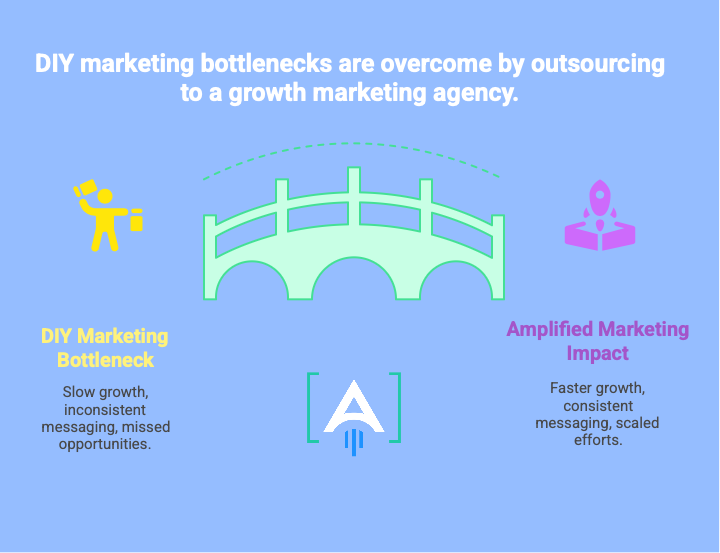
Even if you enjoy marketing, there comes a point where doing it yourself becomes a bottleneck. Founders who try to juggle every channel often notice slower growth, inconsistent messaging, or missed opportunities.
Key campaigns may get delayed, analytics may be underutilized, and scaling efforts stall; not because the founder lacks talent, but because time and bandwidth are finite.
Outsourcing doesn’t mean giving up control; it means leveraging specialized expertise to amplify your impact. By bringing in a growth marketing agency, you gain access to professionals who can execute campaigns efficiently, provide data-driven insights, and implement strategies that would take months to manage alone.
This frees you to focus on what drives the business forward, while ensuring your marketing engine keeps running at full speed.
Signal 1: Marketing Takes More Than 10 Hours Weekly
Track how much time you actually spend on marketing tasks each week.
The Opportunity Cost Calculation
Founders spend time on email, social media, content creation, advertising management, and analytics review. Add up these hours honestly.
If marketing takes more than 10 hours per week, calculate the opportunity cost by multiplying those hours by your effective hourly value, which is determined by dividing your annual revenue goal by the number of working hours in a year. For example, a founder targeting $1M in annual revenue (assuming 2,000 working hours per year) should value their time at roughly $500 per hour ($1,000,000 ÷ 2,000 hours).
Ten hours weekly on marketing costs $5,000 in opportunity cost. That’s $20,000 per month or $240,000 per year in founder time that could be redirected to higher-value activities like product development, sales, or fundraising.
What Founders Should Focus On Instead
Your unique value as a founder lies in the areas where only you can do it effectively.
Highest Value Founder Activities:
- Product vision and development
- Key customer relationships
- Fundraising and investor relations
- Strategic partnerships
- Company culture and team building
Marketing agencies can handle execution. They can’t replace you in these founder-specific areas.
Signal 2: Marketing Results Have Plateaued
Growth stalls when you’ve maxed out your personal marketing capacity and expertise.
Recognizing The Plateau
Review your marketing metrics over the past six months. Flat or declining lead generation, stable customer acquisition despite increased effort, inability to scale beyond the current level, and missing growth targets consistently all indicate a plateau.
Plateaus happen when you’ve optimized what you know but lack the knowledge to reach the next level. Fresh expertise breaks through these ceilings.
The Expertise Founders usually excel at only one or two marketing channels, lacking full-spectrum depth.
You might be great at content but weak at paid advertising. You understand SEO but know nothing about email automation. You cYou can create social content, but can’t run effective paid campaigns. Agencies fill these gaps, providing specialized expertise across all channels. Final 3: You’re Missing Strategic Opportunities
Reactive marketing, focused on daily tasks, prevents strategic thinking.
Common Missed Opportunities
Founders who are buried in execution miss bigger-picture opportunities.
Strategic Gaps Include:
- Failing to test new channels
- Ignoring marketing automation possibilities
- Missing seasonal opportunities
- Not leveraging customer data effectively.
- Overlooking partnership opportunities
These misses compound over time, creating competitive disadvantages that become harder to overcome.
The Strategic Versus Tactical Trap
Marketing requires both strategic thinking and tactical execution. Founders doing everything themselves default to tactical work because it feels productive.
Strategic work, such as market positioning, customer segmentation, channel strategy, and competitive differentiation, gets pushed aside for urgent tasks like posting on social media or responding to comments.
Outsourcing tactical execution frees you for strategic work that actually moves the business forward.
Signal 3: Customer Acquisition Costs Keep Rising
Increasing CAC without corresponding improvements indicates efficiency problems.
Tracking CAC Trends
Calculate the monthly customer acquisition cost by dividing all marketing and sales expenses by the number of new customers acquired.
Rising CAC suggests you’re working harder for each customer. This happens when you’ve exhausted the easy wins in your current approach but lack the knowledge to find new sources of efficiency.
When Agencies Drive CAC Down
Experienced agencies have optimized campaigns across dozens of companies. They know which tactics work and which waste money.
They bring proven frameworks for targeting, messaging, creative, and conversion optimization. This accumulated knowledge typically reduces CAC by 20% to 40% compared to founder DIY efforts.
Signal 4: Revenue Exceeds $500K Annually
Business stage and revenue determine when outsourcing makes financial sense.
The Revenue Threshold
For annual revenue below $500K, most founders should handle marketing themselves. The cost of outsourcing consumes too large a percentage of revenue.
Between $500K and $2M, hybrid models work well. Founders provide strategy while agencies handle execution.
Above $2M, full outsourcing or building internal teams becomes justified by revenue scale.
Budget Allocation Math
Marketing typically requires 7% to 10% of revenue. At $500K revenue, that’s $35,000 to $50,000 annually.
Marketing agencies charge $5,000 to $15,000 per month, or $60,000 to $180,000 per year. This fits the budget at $600K to $2M revenue, but stretches too thin below that threshold.
Signal 5: You Need Multiple Channel Expertise
Modern marketing requires capabilities across numerous channels simultaneously.
The Multi-Channel Reality
Effective marketing today demands presence across SEO and organic content, paid search advertising, social media organic and paid, email marketing, conversion optimization, and analytics.
No founder possesses deep expertise across all these areas. Attempting to learn everything yourself delays results and delivers mediocre performance.
Specialist Versus Generalist
Founders are generalists by necessity. Marketing increasingly rewards deep specialist knowledge in specific channels.
Growth marketing agencies employ specialists in each channel. Their SEO expert focuses only on SEO. Their paid media specialist runs ads all day. This specialization delivers superior results.
Signal 6: Competitors Are Outpacing You
If competitors are growing faster with similar products, marketing likely explains the gap.
Competitive Intelligence
Monitor competitor marketing activity across website updates and content production, social media presence and engagement, paid advertising, and content marketing volume.
Growing competitors usually invest more in marketing or execute more effectively. Either way, you need to match or exceed their efforts to compete.
Catching Up Versus Staying Ahead
Founders who do their own marketing while competitors use agencies face an uphill battle. The expertise-execution gap widens over time.
Closing that gap requires either matching their investment in professional marketing or accepting a permanent competitive disadvantage in customer acquisition.
Making The Transition: What To Expect
Understanding the outsourcing process helps founders make successful transitions.
Initial Investment Period
Expect three to six months before seeing significant results from agency partnerships. Agencies need time to learn your business, audience, and market before they can optimize effectively.
Budget for this ramp period without expecting immediate transformation. Set realistic goals focused on learning and foundation building in the early months.
Founder Role After Outsourcing
Outsourcing execution doesn’t mean being completely hands-off. A successful growth marketing agency relationships require ongoing founder involvement in specific areas.
Provide strategic direction and priorities. Share customer insights and market knowledge. Approve major initiatives and budget allocation. Review performance and provide feedback.
Think of your role as CEO of marketing strategy, while the marketing agency serves as the execution team.
Conclusion: Recognizing Your Timing
Knowing when to outsource marketing comes down to recognizing clear signals: marketing consuming over 10 hours weekly, results plateauing despite effort, strategic opportunities being missed, customer acquisition costs rising, revenue exceeding $500K, needing multi-channel expertise, and competitors outpacing you.
Most founders wait too long to outsource, trying to handle everything themselves well past the point where it makes sense to do so.
With [A] Growth Agency, you can rest assured that your marketing analysis, calculations and strategy will be perfectly scheduled as per algorithms. We always treat our clients individually and consider all risk factors when determining a content marketing strategy for each business separately.
The right timing maximizes your highest-value activities while ensuring marketing execution aligns with your growth ambitions. Recognize the signals, make the decision, and focus your time where only you can create value.
Seeing these signals in your business?
Talk to growth marketing experts who understand founder challenges and deliver results without the overhead of building internal teams.