
Zero-click search represents the defining challenge for paid advertising in 2026. Business owners and CEOs face a fundamental shift in how customers discover and purchase products, and traditional PPC strategies no longer deliver results.
The numbers paint a clear picture. Approximately 60% of Google searches now end without a click, according to SparkToro research.
For queries triggering AI Overviews, that figure climbs to 83% based on Similarweb data. Your landing pages may never see visitors who would have clicked through just two years ago.
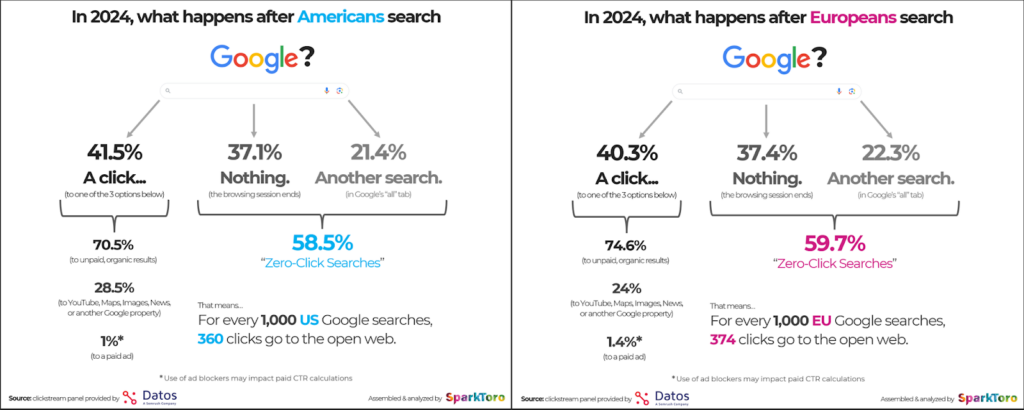
Moreover, AI search advertising demands entirely new strategies. Traditional PPC metrics like click-through rate no longer capture true campaign performance. Conversion attribution has become complex as purchase journeys fragment across AI platforms.
This isn’t about abandoning paid search. Companies using AI marketing optimization reduce customer acquisition costs by an average of 37%.
In this guide, we’ll break down how to adapt Google Ads, Meta, and LinkedIn campaigns for zero-click environments, master attribution models, and implement creative approaches that drive results when AI curates search results.
Understanding Zero-Click Search Optimization in the AI Era
Zero-click search happens when users get answers directly on search results pages without clicking any external links. This behavior existed before AI through featured snippets and knowledge panels. However, Google’s AI Overviews have supercharged the trend dramatically.
Additionally, AI Overviews appeared on 46% of U.S. desktop queries in March 2025, doubling from January. Longer conversational queries trigger these AI summaries twice as often as shorter keywords. Users find immediate answers and move on without clicking through.
How AI Platforms Are Changing Search Behavior
ChatGPT reached 810 million weekly active users by August 2025. Google’s AI Overviews serve over 1 billion people. These platforms don’t just answer questions; they complete entire research processes without users leaving the interface.
Furthermore, generative AI traffic to U.S. retail sites increased 3,300% year-over-year during Prime Day 2025. This massive growth demonstrates high purchase intent, not casual browsing. Users come prepared to buy after AI assistants pre-qualify options.
Traditional search followed predictable patterns: query, scan results, click multiple links, compare options. In contrast, AI-first search compresses this journey into one interaction. The platform synthesizes information from multiple sources and presents unified recommendations.
The Attribution Challenge in Zero-Click Environments
Organic click-through rates dropped by March 2025. Meanwhile, clicks to Google-owned properties like YouTube and Maps increased. Users stay within Google’s ecosystem rather than visiting third-party websites.
For advertisers, this creates attribution chaos. A customer might consult ChatGPT early in research, view your AI Overview presence days later, and purchase through a completely different channel. Standard last-click attribution misses AI influence entirely.
Consequently, performance marketing in the AI era requires new measurement frameworks. Impression-to-answer rate tracks how often your brand appears in AI responses. Assisted conversions capture AI touchpoints that don’t generate immediate clicks but influence eventual purchases.
The ChatGPT Ads 2026 Opportunity
OpenAI is building advertising infrastructure for ChatGPT’s 810 million weekly users. Internal revenue projections show $1 billion from “free user monetization” in 2026, growing to nearly $25 billion by 2029.
ChatGPT ads in 2026 will differ fundamentally from Google Ads. The platform emphasizes trust-based recommendations rather than pay-to-play rankings. CEO Sam Altman stated Google earns money when search fails, while ChatGPT aims to profit when it delivers the best answers.
Expected ad formats include contextual recommendations within conversations, embedded product links, sponsored research results, and affiliate-based placements. These ads integrate naturally into chat flow rather than interrupting user experience.
Early Adopter Advantages
Launch timing estimates point to Q1 or Q2 2026. Early adopters benefit from low competition and lower customer acquisition costs before market saturation drives prices up.
STM Agency research indicates initial periods on new platforms create rare windows of opportunity. Advertisers enjoy high exposure with lower costs compared to mature networks. This advantage typically lasts 6-12 months before competitive pressure increases.
Preparation steps for ChatGPT advertising:
- Audit product information for conversational AI understanding
- Develop natural language descriptions matching how customers speak
- Create content that AI platforms can synthesize and recommend
- Establish brand presence in sources ChatGPT references
- Allocate experimental budget for immediate testing at launch
Companies prepared to test quickly will dominate early placements. Those waiting for “proof” will pay premium prices for inferior positioning once competition arrives.
Google Ads Performance in AI-First Search
Google’s advertising revenue continues to demonstrate sustained platform dominance as we move through 2025. However, the nature of that revenue is transforming. Search campaigns still capture the majority of total Google ad investment, but performance dynamics have changed significantly.
Organic CTR has plummeted dramatically for queries with AI Overviews. Paid CTR dropped across the board regardless of AI Overview presence. The erosion of click-through rates signals a fundamental shift in how users interact with search results.
Performance Max campaigns, Google’s AI-driven format, maintain steady adoption despite aggressive promotion. Adoption remains cautious as advertisers balance automation benefits against loss of manual control.
AI Max for Search Campaigns
Google launched AI Max for Search in 2025, delivering substantially more conversions at similar CPA or ROAS compared to campaigns using exact and phrase match keywords. This represents significant performance improvement through AI optimization.
The system dynamically customizes ads and drives to the most relevant landing pages. Ads adapt to new search experiences, including AI Overviews and AI Mode. This flexibility ensures continued visibility as Google’s interface evolves.
Average CPC across industries continues rising annually as competition intensifies. Consequently, AI-powered campaign optimization becomes essential for maintaining profitability at current pricing.
Measuring Success Beyond Click-Through Rate
Traditional metrics don’t capture AI-era performance. CTR alone no longer reflects true campaign impact when most queries never generate clicks.
Essential metrics for generative search PPC:
- Impression-to-answer rate measuring brand presence in AI responses
- Assisted conversions tracking AI touchpoints before purchase
- Share of voice in AI-generated recommendations versus competitors
- View-through conversions for users exposed to ads but not clicking
- Multi-touch attribution connecting early AI interactions to final sales
Seer Interactive data shows CTRs may decline another 0.5% by January 2026, continuing the steady erosion. Budget allocation must account for lower click volume while maintaining lead quality.
Paid Search Strategies for AI Overviews
AI Overviews occupy massive screen real estate. When expanded, they take 1,345 pixels; when collapsed, 403 pixels. The first organic result gets pushed to 1,686 pixels, requiring significant scrolling on most screens.
Your ads must compete for attention in this compressed space. Traditional ad copy optimized for standard search results may not perform in AI-dominated SERPs.
Optimizing Ad Creative for AI Discovery
Natural language ad copy outperforms keyword-stuffed approaches. AI systems analyze conversational intent, so ads should match how customers actually speak.
Context becomes everything in AI-assisted search. Users engaging with AI Overviews have specific intent shaped by the AI-generated answer. Your ads must align with that mindset rather than generic keyword targeting.
Dynamic creative optimization allows testing dozens of variants weekly. Brands report 30% increases in ad performance and 25% cost reductions through AI-driven audience targeting.
Bidding Strategies When AI Curates Results
Maximize Conversions and Target ROAS each captured about 33% of advertiser spend in 2025. Maximize Conversion Value accounted for another 15%. Automated bidding dominates as manual optimization can’t match AI processing speed.
Google’s algorithm analyzes thousands of signals in real time: time of day, device type, browsing history, and conversion probability. This granular optimization happens continuously, adjusting bids hundreds of times daily.
An AI-first ad strategy requires trusting automation while maintaining strategic oversight. Allow machine learning to handle tactical bid adjustments. Focus human effort on audience definition, creative strategy, and performance analysis.
LinkedIn and Meta Advertising in Zero-Click Landscape
While Google dominates search, LinkedIn and Meta face their own zero-click challenges. Social platforms keep users on-platform through native content, reducing external link clicks.
LinkedIn reached 1 billion members globally. Meta properties serve billions daily. These platforms offer alternatives to search-dependent visibility, though they’re developing their own AI features.
Meta Advantage+ Campaigns
Meta’s Advantage+ campaigns use AI to automate creative, targeting, and placement decisions. The system generated 32% higher ROAS compared to manual campaign management in Meta’s own testing.
Creative testing velocity matters more than perfection. Successful brands test 20-50 creative variants weekly, letting data identify winners. This volume-based approach requires AI assistance; manual production can’t maintain the pace.
Social media marketing now emphasizes short-form video and interactive content. Users consume content within platform feeds rather than clicking through to websites. Ads must deliver complete messages without requiring external clicks.
Instagram and Facebook Shops enable in-platform purchases. This native commerce aligns with zero-click behavior by removing friction. Users discover products through AI-curated feeds and buy without leaving the app.
Building AI-Optimized Landing Pages
When users click through from AI platforms, landing pages must justify that action. Page experience directly impacts conversion rates and advertising efficiency.
Google’s Core Web Vitals remain ranking factors. Load times, interactivity, and visual stability affect both organic placement and ad quality scores. Slow pages penalize campaign performance through higher CPCs and lower ad positions.
Conversion Rate Optimization for AI Traffic
AI-referred traffic demonstrates different characteristics than traditional search traffic. Users arrive pre-qualified by AI recommendations. They’ve already received initial information and expect depth, not repetition.
AI content optimization ensures pages communicate effectively with both human visitors and AI systems analyzing your site. Structured data helps AI platforms understand product details, pricing, availability, and specifications.
High-converting landing page elements for AI traffic:
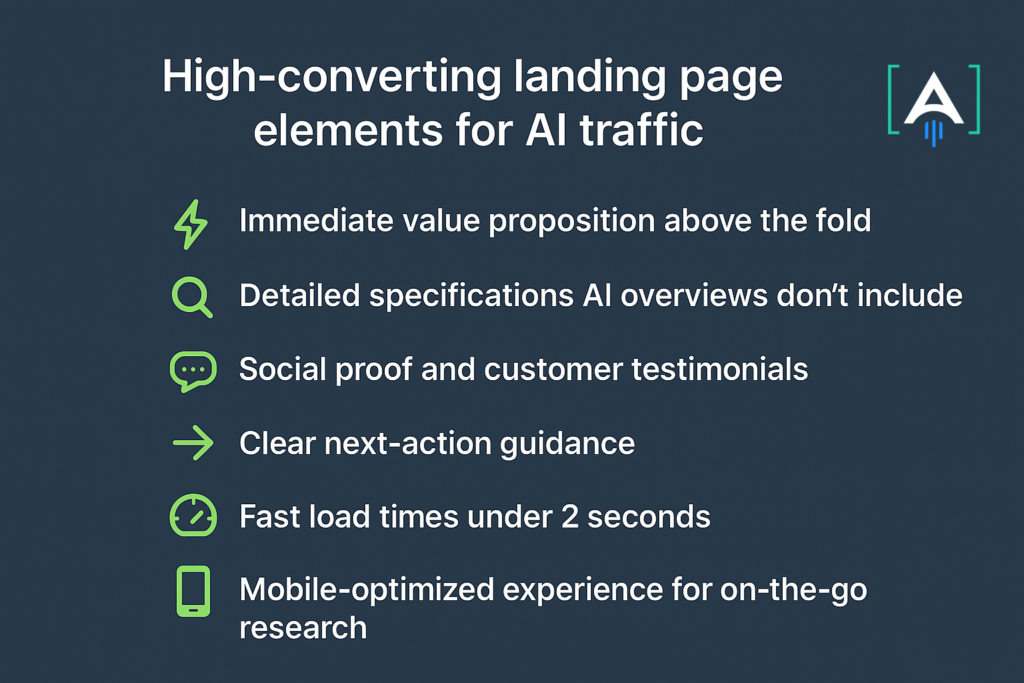
- Immediate value proposition above the fold
- Detailed specifications and AI overviews don’t include
- Social proof and customer testimonials
- Clear next-action guidance
- Fast load times under 2 seconds
- Mobile-optimized experience for on-the-go research
AI traffic shows 38% higher conversion likelihood according to Adobe data. These users arrive with purchase intent shaped by AI recommendations. Your landing pages must close deals efficiently.
Multi-Touch Attribution Models
Standard attribution models break down in AI-first environments. Last-click attribution ignores AI interactions that occurred days before conversion. First-click misses subsequent research across multiple AI platforms.
Data analytics and reporting platforms track customer touchpoints across channels. When someone consults ChatGPT, encounters your Google AI Overview, and later clicks a Facebook ad before purchasing, all three touchpoints contribute.
GA4’s data-driven attribution model uses machine learning to weigh channel contributions. The system analyzes conversion paths and assigns credit based on statistical impact.
Creative Strategies That Work in AI Advertising
Creative quality determines AI advertising success more than targeting precision. Algorithms handle audience finding; your leverage comes from creative assets.
Volume matters. Testing 20-50 creative variants weekly identifies outliers that scale. This velocity requires AI-assisted production; manual creative development can’t maintain the pace.
AI-Generated Ad Creative
Tools like Midjourney and DALL-E generate custom images in minutes. ChatGPT writes ad copy variations optimized for specific audiences. These AI tools democratize creative production previously requiring agency budgets.
Urban Threads, a fashion brand, switched from $5,000 monthly agency retainers to AI-generated creative. The AI analyzed customer reviews, discovered “deep pockets” as a hidden selling point, and auto-generated ads highlighting that feature. Performance exceeded agency-produced creative by 5% of the cost.
AI creative optimization workflow:
- Analyze customer reviews and testimonials for language patterns
- Generate 20-30 creative variants using AI tools
- Launch variants in Campaign Budget Optimization format
- Allow platform AI to identify top performers
- Iterate winning concepts with new variants
The compound effect of AI creative generation and AI campaign optimization delivers substantial CAC reductions.
The 2026 Advertising Budget Framework
Zero-click reality requires new budget allocation frameworks. Traditional search-heavy splits no longer optimize for AI-first discovery.
An experimental budget becomes essential. Allocate 10-15% to emerging platforms and format testing. This includes ChatGPT ads when they launch, Google AI Mode, and Performance Max pilots.
Channel Mix for AI-First Marketing
Search maintains importance, but share decreases. Allocate 40-45% to Google Ads with heavy emphasis on AI Max for Search campaigns. This captures remaining click-through traffic while adapting to AI Overviews.
Social advertising grows to 30-35% of the budget. Meta and LinkedIn offer alternatives to search-dependent visibility. In-platform commerce reduces reliance on external clicks.
Branding agency work receives 10-15% budget allocation. Brand presence in AI responses requires strong recognition and authority. Paid brand-building campaigns establish the foundation of AI platforms’ reference.
Content marketing and organic investment take 10-15%. AI platforms synthesize information from high-quality sources. Your content must earn placement in those reference sets.
Working With a PPC Agency in the AI Era
The complexity of AI-first advertising exceeds most in-house capabilities. Platform evolution happens monthly; maintaining cutting-edge expertise requires dedicated focus.
Professional PPC agency partnerships provide several distinct advantages. Agencies working across dozens of clients accumulate optimization insights faster than individual companies. They see patterns and test strategies across industries.
The Value of Specialized Expertise
AI advertising platforms require technical knowledge beyond traditional media buying. Performance Max optimization, AI Max for Search campaigns, and emerging ChatGPT advertising each demand specific expertise.
AI marketing agency specialists understand both advertising mechanics and AI technology. This dual expertise proves essential as platforms blur lines between traditional ad buying and AI-powered recommendation systems.
The strategic guidance helps navigate rapid change. When ChatGPT ads launch, experienced agencies will have tested strategies ready for immediate deployment. DIY advertisers will spend months learning through expensive mistakes.
Conclusion
Zero-click search represents the defining challenge for paid advertising in 2026.
For business owners and CEOs, the strategic imperative is clear. You must transform your paid advertising approach for generative search PPC environments now. The brands that act decisively build sustainable competitive advantages as AI platforms become the dominant discovery channel.
Azarian Growth Agency combines over 20 years of growth marketing expertise with cutting-edge AI capabilities.
Our approach addresses paid advertising, organic optimization, and attribution modeling for zero-click environments while maintaining profitability and growth.
Partner with us to build your AI-first advertising strategy. We combine deep platform expertise with strategic vision, helping you adapt paid campaigns for zero-click search while driving measurable results.