
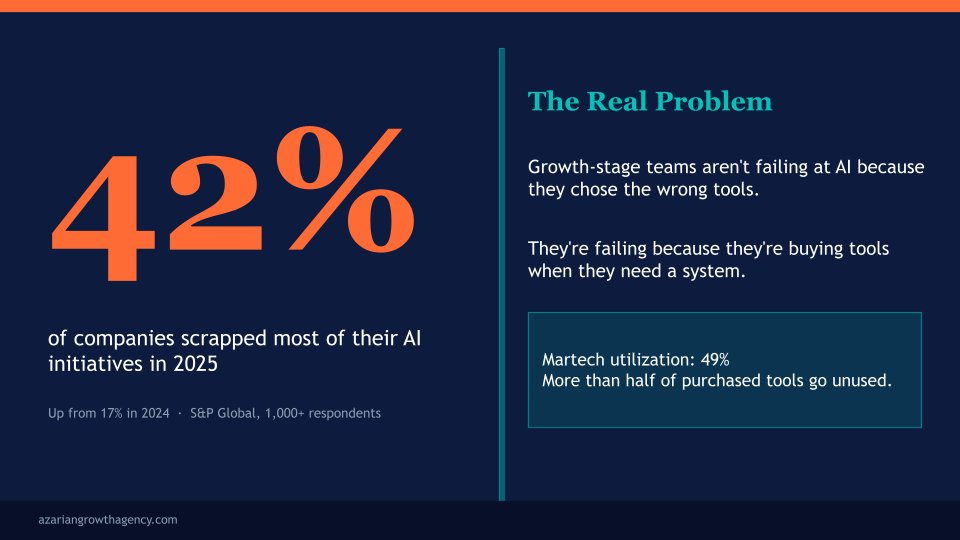
Here’s a number that should give every CMO pause: 42% of companies scrapped the majority of their AI initiatives in 2025, up from 17% the year before. Not because AI doesn’t work. Because they were buying tools when they needed a system.
If you’re running paid media at a growth-stage company, you’ve probably felt this firsthand. Your team is stretched. The board wants more pipeline. The budget hasn’t moved. And somewhere in your stack, you have a collection of AI tools that promised to fix everything and mostly created more work to manage.
The good news is that a real solution exists. I’m not talking about another tool. I’m talking about building the infrastructure that lets your team produce more, optimize faster, and tie every paid dollar to the metrics that actually matter at the board level.
At Azarian Growth Agency, this is exactly what we help growth-stage marketing teams build. We cover the full operational playbook in our session, More Output, Same Team, if you want to see it in action. But first, let me walk you through the framework.
The Real Reason Your AI Tools Aren’t Working
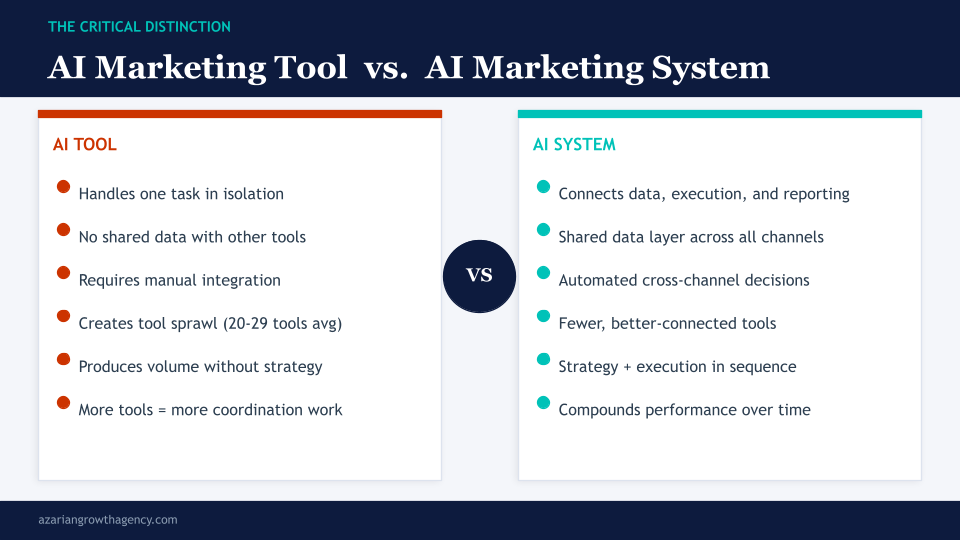
Before we get into what works, it’s worth being honest about what doesn’t. Most growth-stage teams aren’t failing at AI because they chose the wrong tools. They’re failing because martech utilization has dropped to 49% according to Gartner. More than half of what’s purchased goes unused. Meanwhile, the average marketing team juggles 20 to 29 tools with no integration layer connecting them.
The result? Your team spends more time managing software than driving results.
There’s a meaningful difference between an AI marketing tool and an AI marketing automation system. A tool handles one job in isolation. A system connects data, execution, intelligence, and reporting into a sequence that can run at scale without a person manually touching every step.
Forrester put numbers to this in 2025: companies that run five or fewer core tools report 23% higher marketing-attributed pipeline per headcount than those running ten or more. Less is more, but only if the fewer tools actually work together.
This is what I mean by infrastructure. It’s not about adding a better bid management tool or a smarter creative generator. It’s about building the layer that connects them, feeds them good data, and reports their output in terms your CFO understands.
What Is AI Marketing and What It Actually Does for Paid Media
So what is AI marketing, exactly? At the operational level, it’s the use of machine learning and automation to handle the high-frequency decisions in your paid media operation, such as bid adjustments, audience signals, creative rotation, and budget reallocation, without requiring a human to review each one.
This matters because paid media at a growth-stage company has become genuinely difficult to manage manually. Google’s AI Max for Search processes keyword-free search campaigns using Gemini and delivers up to 14% more conversions than standard Search. Meta’s Andromeda engine now uses models 10,000 times larger than its previous system, shifting the entire platform from audience-first to creative-first ad delivery. LinkedIn’s Accelerate campaigns build and optimize in roughly five minutes and deliver 42% to 52% lower cost per action versus manually managed campaigns.
These platforms are making decisions at a speed and scale no human team can match. The question is no longer whether to let AI run in your paid media. It’s whether you’re giving AI the right inputs, the right guardrails, and the right connection to your revenue outcomes.
The Headcount Math That Most Teams Are Getting Wrong
Let’s talk about the cost comparison directly, because this is what actually lands in board conversations.
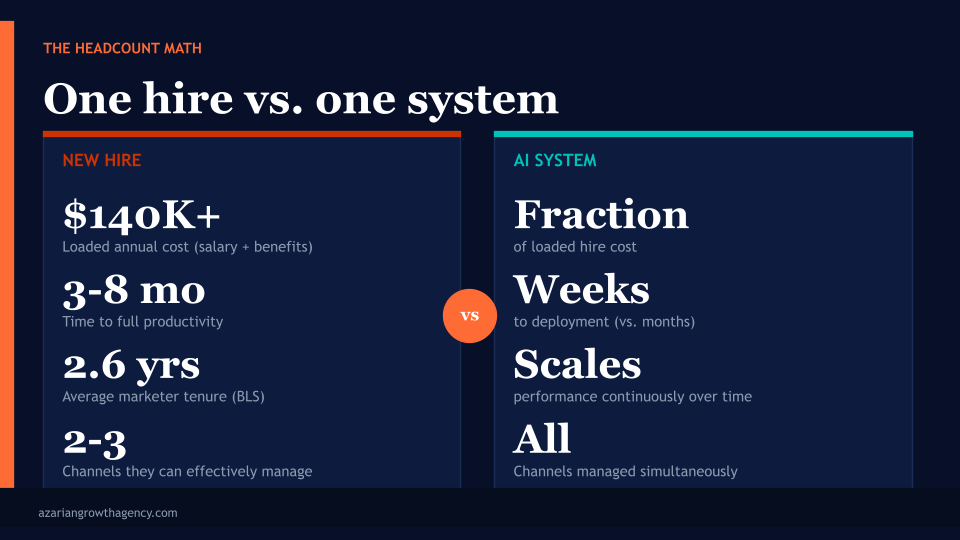
A performance marketing manager in a major US market costs roughly $140,000 to $165,000 loaded with benefits. They take three to eight months to reach full productivity, according to Glean’s onboarding research, and based on Bureau of Labor Statistics data, the median marketer stays at a company for about 2.6 years. That’s a meaningful investment for someone who can effectively manage two or three channels at a time.
An AI marketing system built on the right infrastructure can run across all your channels simultaneously, deploy in weeks rather than months, and improve its performance over time based on outcome data, not personal learning curves.
I want to be clear: this isn’t an argument against hiring talented people. It’s an argument for being honest about what adding a headcount actually solves versus what a system solves. For most growth-stage teams, the bottleneck isn’t human intelligence. It’s execution capacity and data integration.
The CMO Survey from 2025 found that 59% of CMOs already report insufficient budget to execute their strategy, and 39% plan to cut headcount spending this year. The era of staffing up to hit targets is over. The teams winning right now are the ones that have built systems.
How the System Architecture Actually Works
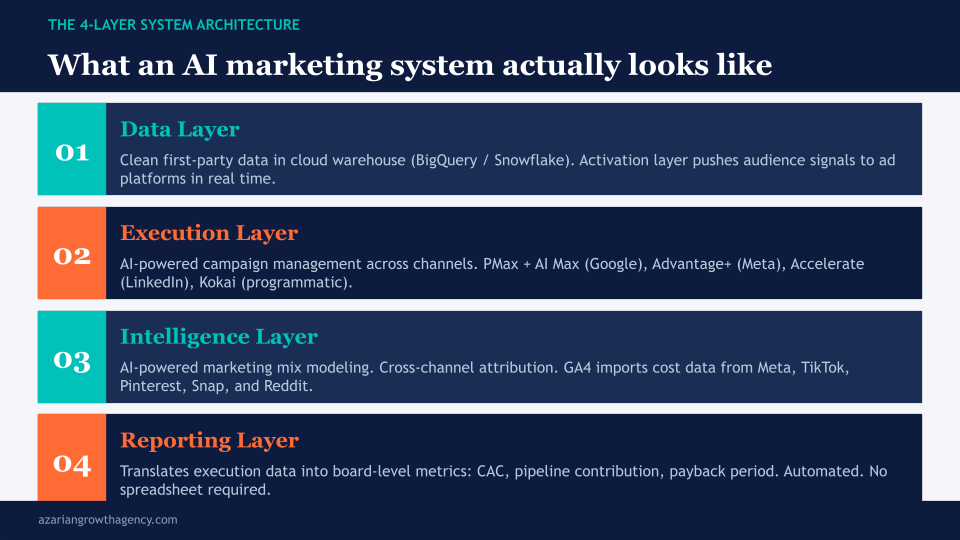
Here’s what an AI marketing strategy built for paid media performance looks like across four connected layers.
The Data Layer
This is the foundation, and where most teams skip ahead too fast. Your AI can only be as good as the data feeding it. A composable data architecture keeps your first-party data in a cloud warehouse such as BigQuery or Snowflake, with an activation layer that pushes audience signals into your ad platforms in real time. Without this, your automated bidding strategies are optimizing against incomplete conversion data, which is one of the leading causes of Performance Max campaigns cannibalizing budget from higher-intent Search traffic.
The Execution Layer
This is where the AI advertising tools operate. At the platform level, it means running Performance Max and AI Max together for Google, Advantage+ campaigns for Meta, and Accelerate for LinkedIn B2B targeting. At the cross-platform level, tools like Smartly.io and Metadata.io provide a unified layer where budget allocation and creative rotation happen based on shared performance signals across channels rather than in silos.
The Intelligence Layer
This is what connects execution to outcomes. AI-powered marketing mix modeling has moved from a six-to-twelve-month enterprise project to something that can produce recommendations in hours. Google’s Meridian, Northbeam, and Rockerbox are doing this for growth-stage companies at a cost and timeline that wasn’t possible two years ago. GA4’s cross-channel budgeting now imports cost data from Meta, TikTok, Pinterest, Snap, and Reddit alongside Google, giving you a unified view that actually supports cross-channel decisions.
The Reporting Layer
Your board doesn’t care how many campaigns you ran. They care about CAC, pipeline contribution, and payback period. The reporting layer of an AI marketing system should translate execution data into those terms automatically, without someone manually building a spreadsheet at the end of each month.
Platform-by-Platform: What AI Can Do Right Now
Google Ads in 2026
Performance Max now drives 62% of all Google ad clicks, with one million-plus advertisers running it globally. The 2025 updates finally addressed the transparency problem by adding campaign-level negative keywords, channel performance reporting, and brand exclusions, making it far more manageable for lean teams.
The critical thing to know about PMax: an Optmyzr study of 503 accounts found that 91.45% had keyword overlap between Search and PMax, with Search campaigns in more than half of accounts affected by cannibalization. This is a data layer problem. When your conversion tracking is clean and your audience signals are current, PMax performs as promised. When they’re not, it burns budget.
AI Max for Search is Google’s newest keyword-free Search product, using Gemini to match ads to intent rather than exact queries. Early data shows up to 14% more conversions versus standard Search. For growth-stage teams managing multiple campaigns, this meaningfully reduces the keyword management workload without sacrificing control over brand safety.
Meta and the Andromeda Shift
Meta Andromeda changed the fundamental logic of Meta advertising. The platform no longer asks “who should see this ad?” It asks “which ad should this person see?” The implication for your team is significant: creative diversity is now the primary performance lever, not audience segmentation.
The practical rules under Andromeda: you need 8 to 15 genuinely different creative concepts per campaign, refreshed every 7 to 14 days. Broad targeting now outperforms interest stacking because Andromeda needs room to find its own signals. Advantage+ campaigns grew 70% year-over-year in Q4 2024 and are now the default setup for Sales, Leads, and App Promotion objectives.
What this means for team capacity: a small team running Meta well under Andromeda needs a creative production system, not more campaign managers. The optimization is handled. The creative supply chain is the bottleneck.
LinkedIn for B2B Pipeline
For growth-stage B2B companies, LinkedIn Accelerate campaigns are producing the most compelling efficiency numbers in the market right now. The campaign setup that used to take up to 15 hours now happens in roughly five minutes. The AI predicts your ideal audience, builds the campaign structure, and reallocates budget on an hourly basis.
The 42% to 52% lower cost per action versus Classic campaigns isn’t a best-case scenario. It’s LinkedIn’s published data from early Accelerate testing. For B2B teams where LinkedIn represents the highest-quality demand channel but also the highest cost, this efficiency shift materially changes the pipeline math.
Programmatic and the CTV Opportunity
The Trade Desk’s Kokai platform processes 13 million impressions per second and delivers an average 5x ROAS across US and Canada advertisers based on 665 analyzed campaigns. Its Koa AI engine is now moving toward conversational campaign creation, meaning a team member can brief a campaign in natural language, and Kokai builds the targeting and bidding structure.
For growth-stage teams not yet running programmatic, this is the entry point that makes it operationally viable without a dedicated trading desk.
Connecting AI Marketing Automation to the Metrics That Matter
Here’s the part most marketing automation guides skip: the connection to board-level metrics.
Companies that integrate AI across their paid media operation report CAC reductions of 30% to 37% versus non-AI approaches. Forrester’s AI-Powered Customer Acquisition Index for 2026 puts the number at 44% for B2B SaaS specifically. These aren’t tool vendor numbers. They represent the compounding effect of better audience signals, faster creative iteration, and cross-channel budget allocation working together.
The Metadata.io data from real B2B campaigns is worth looking at directly: Writer reduced cost per MQL by 86% and increased lead volume by over 1,000%. Webex Events increased its pipeline by 60% while cutting its budget by 73% over three months.
These are outlier results, but they illustrate the direction of travel. When you build a system that connects your CRM data, your ad platforms, your attribution model, and your budget allocation logic, the optimization compounds rather than improving one variable at a time.
The KPI Framework for AI-Powered Paid Media
For your board and leadership reporting, here’s how to frame AI-driven paid media performance:
Revenue and efficiency metrics: Blended CAC by channel, LTV:CAC ratio (target 3:1 to 5:1), pipeline contribution from paid, payback period (healthy SaaS: 12 to 18 months), and ROAS by channel (Google Search benchmark: 5.17x, Meta benchmark: 1.86x to 2.19x).
Operational efficiency metrics: Campaigns managed per team member, creative volume per campaign cycle, time from brief to launch, and cross-channel budget utilization rate.
When you report on these metrics rather than impressions and click-through rates, you change the conversation from “what did marketing do” to “what did marketing contribute.” That’s the framing that protects your budget and your headcount decisions in board reviews.
Where Humans Stay in the Loop (This Part Is Critical)
Marketing professionals are right to question full AI reliability. A Gartner survey from late 2025 found that 45% of martech leaders say existing vendor-offered AI agents fail to meet their expectations. WordStream research found 20% error rates in AI marketing tools under certain conditions. Google’s own data shows that accounts that removed human oversight entirely saw a 14% revenue dip.
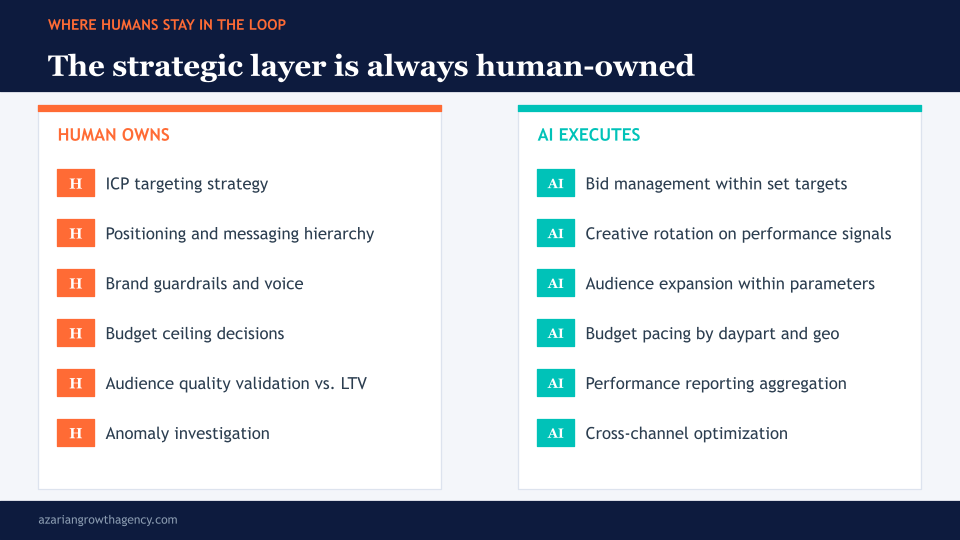
The system works when humans own the strategic layer, and AI owns the execution layer. That means:
Humans set the positioning, the ICP targeting rationale, the messaging hierarchy, the brand guardrails, and the budget ceilings. Humans review anomalies, validate audience quality against LTV data, and approve major budget reallocations.
AI handles bid management within your set targets, creative rotation based on performance signals, audience expansion within defined parameters, budget pacing across dayparts and geographies, and performance reporting aggregation.
The failure mode is always one of two things: over-automating the strategic layer or under-automating the execution layer. Most growth-stage companies are stuck in the second failure mode. They do everything manually because they don’t trust the system. The path forward is building enough confidence in the data layer to let the execution layer run.
A 90-Day Starting Framework
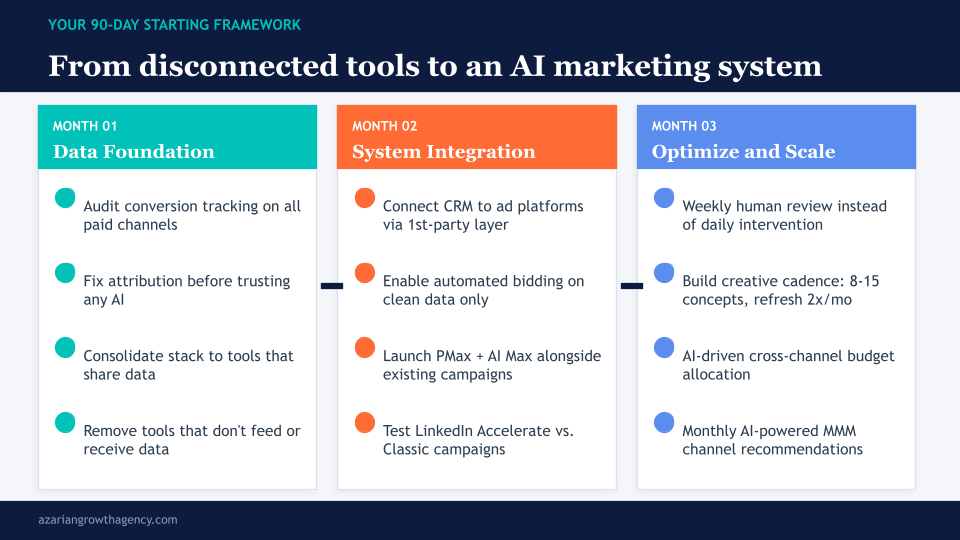
If you’re starting from a disconnected tool stack, here’s a practical sequence:
Month 1: Data Foundation
Audit your conversion tracking across every paid channel. Fix attribution before you trust any AI optimization. Consolidate your martech to the tools that actually inform decisions. If a tool doesn’t feed data to another tool or receive data from another tool, it probably shouldn’t be in the stack.
Month 2: System Integration
Connect your CRM to your ad platforms using a first-party data activation layer. Enable automated bidding only after conversion data is clean. Run Performance Max and AI Max in parallel with existing campaigns before reallocating budget. Launch LinkedIn Accelerate for your top B2B segments alongside Classic campaigns to validate CPA differences.
Month 3: Optimization and Scaling
Let the system run with a weekly human review rather than daily manual intervention. Build a creative production cadence around the Andromeda requirements: 8 to 15 concepts, refreshed every two weeks. Begin cross-channel budget allocation based on attribution model outputs, not intuition. Set up AI-powered MMM reporting to produce monthly channel efficiency recommendations.
By month three, your team should be spending more time on strategic decisions and less time on execution management. That’s the shift from tool operator to system architect, and it’s where real operational leverage comes from.
About Azarian Growth Agency
Azarian Growth Agency is a full-funnel, AI-native growth marketing agency founded by Hamlet Azarian. We work with growth-stage companies, including VC-backed SaaS startups, B2B tech companies, and private equity-backed portfolio businesses, to build the marketing infrastructure that connects paid media, analytics, and pipeline to measurable revenue outcomes.
We don’t manage campaigns in isolation. We build the systems that make campaigns run better over time: from data architecture and attribution modeling to AI-powered bid management, cross-channel budget allocation, and board-ready reporting. Our team has helped companies collectively raise over $269M by building marketing engines that scale output without scaling headcount.
If you’re at a growth-stage company facing pressure to deliver more pipeline with the same team, we built our More Output, Same Team session specifically for that situation.
It’s a live working session where we demonstrate exactly how these systems are built and what they produce, so you can evaluate whether the approach fits your operation before committing to anything.