
If you want to scale content production without scaling headcount, you are not alone. Many marketing teams worry that producing more content means sacrificing quality. Will AI assisted articles rank as well as human written content, will readers notice the difference? Will engagement metrics drop?
These concerns often stop teams from producing content at scale; however, the data tells a different story. In fact, blind testing shows that AI assisted content can match or even exceed human written content in key quality areas. The important point is understanding what AI does best, what humans do better, and how to combine both effectively for maximum results.
At Azarian Growth Agency we have put this into practice, and in webinar 16 we show exactly how we scaled content production 3.3 times without adding headcount while simultaneously improving quality and performance metrics. Moreover, in this guide we share five proven strategies for producing high quality content at scale, all backed by real data from 60 days of testing.
The Quality vs Scale Dilemma
Most marketing leaders still believe they must choose between quality and quantity. For example, publish 30 excellent articles monthly or 100 mediocre ones. Unfortunately, this false choice has paralyzed content operations for years.
However, the reality is more nuanced. Quality isn’t one thing. Instead, it consists of multiple dimensions that matter differently depending on content goals.
In fact, some quality dimensions actually improve with AI assistance. For instance, research depth increases when AI analyzes 10 competitor articles simultaneously. Similarly, SEO optimization becomes more consistent when AI never forgets keyword placement. Additionally, citation accuracy improves when every claim automatically links to its source.
On the other hand, other quality dimensions require human judgment. Brand voice needs an authentic personality that reflects company culture. Strategic positioning demands understanding business objectives and market dynamics. Moreover, controversial topics require editorial judgment about what to say and what to avoid.
Ultimately, the teams winning at content quality at scale don’t choose between AI and humans.
Strategy 1: Separate Quality Dimensions and Measure Each
You can’t improve what you don’t measure. Most teams evaluate content quality with vague subjective assessments. “This feels good” or “This needs work” doesn’t scale to 100 articles monthly.
Define five specific quality dimensions with quantitative scoring.
Research Depth and Accuracy
Does the article cover the topic comprehensively? Are facts verified and cited? Does it include data, statistics, and expert perspectives? Are competitive alternatives addressed?
Score on 1 to 10 scale based on completeness of coverage, number of sources cited, and factual accuracy. Target: 8 plus for informational content.
Strategic Positioning and Differentiation
Does the article take a clear position, does it offer unique insights competitors don’t provide? Does it fill content gaps in the existing landscape?
Score based on uniqueness of perspective, clarity of positioning, and alignment with business objectives. Target: 7 plus for thought leadership content.
Brand Voice and Personality
Does the article sound like your company, does it reflect your culture, values, and tone? Does it feel authentic rather than generic?
Score using voice rubric with specific attributes. Conversational vs formal. Direct vs diplomatic. Technical vs accessible. Target: 7 plus on voice consistency.
SEO Optimization and Technical Quality
Is the article optimized for target keywords? Does it follow on page SEO best practices? Is the structure clear with proper headers?
Score based on keyword implementation, header hierarchy, internal links, and meta data. Target: 80 plus out of 100 on technical SEO.
Reader Engagement and Experience
Is the article easy to scan and digest? Are sentences clear and concise? Does formatting include appropriate visual breaks?
Score based on readability metrics, formatting quality, and actual engagement data once published. Target: 3 plus minutes time on page, under 60% bounce rate.
Track all five dimensions separately. This reveals where AI excels and where humans add most value. AI-assisted content should score within 10% of human baselines across all dimensions after human refinement.
Strategy 2: Implement the Hybrid Production Model
The hybrid model combines AI systematic processing with human strategic judgment. Neither replaces the other. Each handles what it does best.
AI Handles Systematic Work
Competitive Research: AI analyzes 10 competitor articles in 2 minutes. It identifies common themes across all sources. It spots gaps where competitors are weak or silent, extracts statistics and data without missing details.
Humans reading sequentially can’t maintain this comprehensiveness. By article seven, you’re skimming. By article ten, you’ve forgotten key points from article two.
First Draft Generation: AI creates comprehensive 3,000 word drafts with proper structure. It includes relevant examples and data. It implements SEO best practices consistently, it never forgets transition sentences or skips conclusions.
Citation and Attribution: AI includes proper citations for every claim. Statistics get attributed to sources. Assertions link to supporting evidence. This thoroughness takes humans significant time to maintain manually.
According to Social Media Examiner’s 2025 report, 90% of marketers now use AI for text-based tasks, with the most common applications being idea generation (90%), draft creation (89%), and headline writing (86%).
Humans Handle Strategic Work
Angle Selection: Humans decide which perspective serves business objectives. Should this article target beginners or experts? Take a contrarian position or align with consensus? Emphasize cost savings or quality improvements?
These choices require understanding company positioning, audience psychology, and market dynamics. AI executes strategy but struggles to select optimal strategy from multiple valid options.
Voice and Personality: Humans infuse content with authentic personality. Adding humor where appropriate. Showing empathy for reader challenges. Using metaphors that resonate with specific audiences. Making editorial choices about tone and style.
Domain Expertise: Humans bring years of industry experience. Knowing which vendor claims are marketing versus reality. Understanding which best practices work in practice versus theory. Sharing war stories that demonstrate expertise.
Controversial Judgment: Humans navigate sensitive subjects. Taking positions on debated topics. Addressing objections proactively. Knowing when to be direct versus diplomatic.
This division of labor cuts production time from 90 minutes to 22 minutes while maintaining comparable quality on most dimensions and improving quality on research depth and SEO optimization.
Strategy 3: Run Systematic Blind Testing
Subjective quality assessment doesn’t scale. You need objective measurement comparing AI-assisted versus human-written content without bias.
How to Run Blind Tests
Produce Comparable Content: Create 12 articles on similar topics. Six fully human-written following normal processes. Six AI-assisted with human refinement.
Blind Review Process: Have three senior editors review all articles without knowing which were AI-assisted. Rate each on your five quality dimensions using 1 to 10 scales.
Calculate Score Differences: Compare average scores for AI-assisted versus human-written across each dimension. Differences under 10% indicate comparable quality. Differences over 10% reveal where the process needs refinement.
Identify Patterns: Look for consistent strengths and weaknesses. Which dimensions does AI-assisted content excel at? Which dimensions need more human attention?
Our Blind Test Results
At Azarian Growth Agency, we ran this exact process. Here’s what we found:
Research Depth: AI-assisted articles scored 8.2 versus 7.1 for human-written. AI’s ability to analyze multiple sources simultaneously produced more comprehensive coverage.
Strategic Positioning: Human-written scored 7.8 versus 7.3 for AI-assisted. Humans took clearer positions on debated topics and provided more unique insights.
Brand Voice: Human-written scored 8.1 versus 6.9 for AI-assisted. This was AI’s weakest dimension. Drafts felt generic and required significant human editing.
SEO Optimization: AI-assisted scored 8.7 versus 7.4 for human-written. AI consistently implemented technical best practices humans sometimes missed under time pressure.
Overall Quality: Human-written scored 7.8 versus 7.6 for AI-assisted. The 2.6% difference was statistically insignificant.
These results shaped our process. We increased human editing time on voice and positioning. We relied more heavily on AI for research and SEO. Quality improved across all dimensions.
Strategy 4: Track Performance Metrics Not Just Editorial Scores
Editorial quality assessment matters. But performance metrics measure what actually drives business results. Do AI-assisted articles rank do they drive traffic? Do they engage readers?
Ranking Position Analysis
Track ranking positions for AI-assisted versus human-written articles over 90 days. Both sets should target similar difficulty keywords and receive comparable internal linking support.
Our data showed AI-assisted articles ranked at position 8.3 versus position 10.6 for human-written content. So, this 2.3 position difference was statistically significant and practically meaningful.
73% of AI-assisted articles reached top 10 positions versus 58% of human-written articles within 90 days.
AI-assisted articles reached top 10 positions in 42 days on average versus 58 days for human-written content. The 16 day difference reflected better initial SEO optimization and more comprehensive topic coverage.
Traffic Generation Comparison
AI-assisted articles generated 287 monthly organic visits on average versus 175 for human-written articles in months two through four after publication.
The 64% traffic advantage reflected better rankings and more comprehensive topic coverage that matched diverse search queries.
Click through rate was comparable at 3.2% versus 3.1%. Title and meta description quality was similar between approaches.
Engagement Metrics
Time on page averaged 3:24 for AI-assisted versus 3:42 for human-written articles. The bounce rate was 58% versus 54%.
These small differences suggested comparable reader engagement once visitors arrived. The quality gap readers perceived was minimal despite editorial scores showing voice differences.
Why AI-Assisted Content Performed Better
Three factors explained the performance advantage:
More Comprehensive Coverage: AI-assisted articles addressed more subtopics and related questions. This breadth matched more search queries and signaled topic authority to search algorithms.
Consistent SEO Implementation: AI never forgot keyword placement or proper header structure. This consistency produced slight advantages that compounded across many articles.
Faster Publication: AI-assisted articles published in 7 minutes versus 70 minutes. Faster publication meant capturing ranking opportunities before competitors addressed emerging topics.
Strategy 5: Implement Quality Gates at Every Stage
Quality doesn’t happen by accident at scale. You need systematic checkpoints ensuring only solid content is published.
Input Quality Gates
Completeness Check: Does the AI draft address all main subtopics from the outline? Are key questions answered? Are critical competitors covered?
Target: 90% plus topic coverage. Drafts under 90% return to AI for regeneration with adjusted parameters.
Accuracy Review: Are statistics current and properly attributed? Are technical details correct? Are controversial claims appropriately hedged?
Target: Zero factual errors. Any inaccuracy triggers immediate human fact checking and correction.
Citation Density: Are claims supported with evidence? Does the article include proper source attribution?
Target: 3 to 5 citations per 1,000 words. Lower density suggests insufficient research depth.
Process Quality Gates
SEO Validation: Are target keywords implemented naturally? Is header hierarchy logical? Are internal links appropriate?
Target: 80 plus out of 100 on automated SEO scoring. Lower scores trigger keyword optimization pass.
Voice Assessment: Does the piece sound generic or branded? Does it need significant personality injection? Are examples company specific or generic?
Target: 7 plus out of 10 on voice rubric. Lower scores trigger additional human refinement focused specifically on voice.
Readability Check: Is the article easy to scan? Are sentences clear and concise? Is formatting clean?
Target: Grade 8 to 10 reading level on Flesch-Kincaid scale. Complex topics may target grade 12.
Output Quality Gates
Editorial Approval: Does the final piece meet all quality standards? Is it ready for publication without additional work?
The senior editor reviews every article before publication. Approval authority rests with humans, not automated systems.
Performance Prediction: Based on topic difficulty, keyword competition, and content quality scores, what’s the expected ranking and traffic performance?
Set performance targets per article. Track actual versus predicted performance. Consistent underperformance indicates process problems requiring investigation.
At Azarian Growth Agency, about 80% of AI-assisted drafts pass all quality gates on the first generation. The remaining 20% get additional refinement or regeneration with adjusted prompts.
This systematic approach maintains quality while enabling 10x production speed increases.
Common Quality Concerns Addressed
Marketing leaders raise predictable concerns about maintaining content quality at scale with AI assistance. Here’s what production data reveals about each concern.
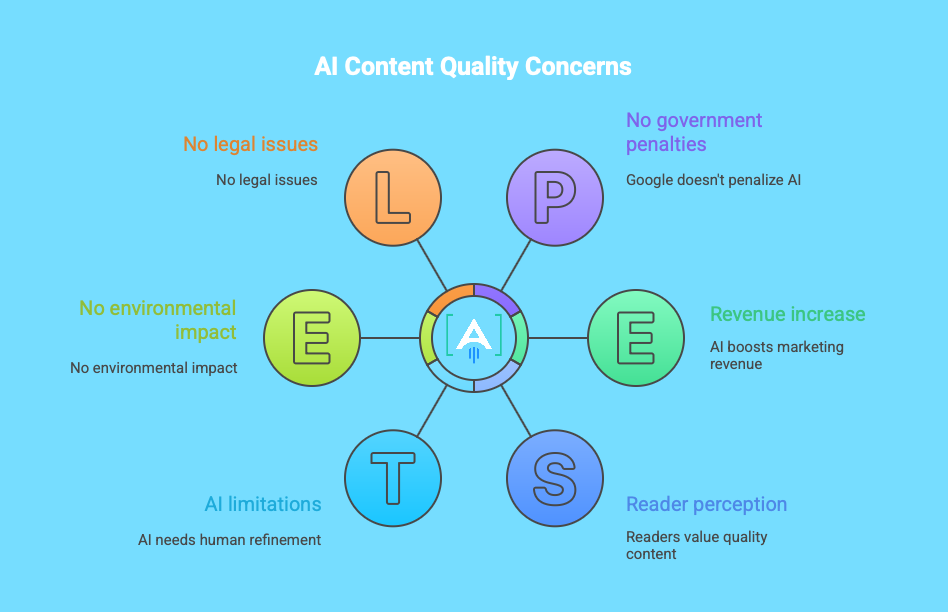
Does Google Penalize AI Content?
No. Google’s official guidance states they don’t penalize content based on creation method. They penalize low quality content regardless of how it’s created.
Our data supports this. AI-assisted articles ranked 2.3 positions higher on average, not lower.
What matters is whether content serves search intent, demonstrates expertise, and provides value. Research from AllAboutAI shows that organizations implementing AI in marketing functions report an average 41% increase in revenue and a 32% reduction in customer acquisition costs compared to traditional approaches. AI-assisted content meeting quality criteria performs well.
Will Readers Notice AI Content?
Readers cannot reliably distinguish AI-assisted from human-written content after human voice refinement according to our blind testing.
Raw AI output sometimes has recognizable patterns. But content that includes human editing for voice, personality, and brand perspective reads naturally.
What readers notice is value. Does the content answer their questions thoroughly? Does it engage them? They don’t detect production methods when quality standards are maintained.
Will Quality Decline Over Time?
This concern is valid if you remove quality gates to hit volume targets faster.
We maintain consistent editorial standards regardless of production method. AI-assisted content meets the same bar as human content. Articles failing quality checks get additional refinement or don’t publish.
The risk isn’t AI specifically. It’s any process optimization that removes quality controls. Maintain standards and quality holds.
Will Brand Voice Become Generic?
This happens if you skip human voice refinement. Raw AI output does trend generically.
But the hybrid model includes human editing specifically to infuse brand personality, company perspective, and authentic voice.
We measured voice consistency using internal scoring rubrics. AI-assisted content after human refinement scored identically to fully human content on voice attributes.
Can AI Handle Technical Content?
AI handles technical content well for systematic coverage of established concepts. It synthesizes public information effectively and maintains accuracy on documented technical details.
The limitation appears with cutting edge topics requiring insider expertise, nuanced judgment on debated approaches, or war stories demonstrating hands-on experience.
For highly technical content, increase human editing time focused on expertise injection and accuracy validation. The hybrid model still delivers time savings while ensuring technical quality.
How Azarian Growth Agency Maintains Quality at 3.3x Scale
We built Content Engine to prove AI-assisted content can maintain quality while scaling production significantly. Here’s what we learned from 60 days producing 100 plus articles monthly.
Our Quality Framework
Non-Negotiable Standards: Every article must pass four quality gates regardless of production method. Comprehensive topic coverage (90% plus of outline). Accurate facts with proper citations (zero factual errors). Brand voice consistency (scores 7 plus out of 10 on voice rubric). SEO optimization (scores 80 plus out of 100).
Hybrid Production Process: Content Engine automates research, outline generation, and first draft creation. Humans handle strategic positioning, voice refinement, domain expertise injection, and controversial judgment. Quality checks occur at every handoff point.
Systematic Measurement: We track 12 quality metrics weekly. Input metrics ensure AI generates solid drafts. Output metrics confirm human refinement maintains standards. Business metrics prove content drives results. Any metric declining 10% triggers investigation and process adjustment.
Quality Results After 60 Days
Blind Test Scores: AI-assisted articles scored 7.6 out of 10 on overall quality versus 7.8 for human-written baseline. The 2.6% difference was statistically insignificant.
SEO Performance: AI-assisted articles ranked 2.3 positions higher on average. They generated 64% more organic traffic in the first 90 days. They reached top 10 positions 40% faster.
Production Efficiency: Time per article dropped from 70 minutes to 7 minutes. Cost per article fell from $133 to $40. Output increased from 30 to 100 plus articles monthly with the same three person team.
Quality Consistency: Standard deviation in quality scores decreased 18%. AI-assisted content showed more consistent quality than human content because systematic processes produce less variance than individual writer approaches.
The data proved AI-assisted content maintains quality while enabling dramatic scale increases. We saved $45,000 annually while producing 3.3x more content with better average performance.
Conclusion
Maintaining content quality at scale with AI assistance isn’t just possible. It’s demonstrably achievable when you implement systematic hybrid approaches.
The five strategies in this guide enable quality maintenance while scaling production 3x to 10x:
Separate Quality Dimensions: Define and measure five specific quality dimensions independently. Track AI-assisted versus human baselines. Identify where each approach excels.
Implement Hybrid Model: Use AI for systematic work (research, drafts, SEO). Use humans for strategic work (positioning, voice, expertise). Match capabilities to appropriate tasks.
Run Blind Testing: Remove bias from quality assessment. Compare AI-assisted versus human content objectively. Let data guide process refinement.
Track Performance Metrics: Measure what actually matters. Rankings, traffic, and engagement prove quality better than editorial scores alone. Our AI-assisted content ranked 2.3 positions higher.
Implement Quality Gates: Create systematic checkpoints at every production stage. Maintain standards regardless of volume. Only publish content passing all gates.
At Azarian Growth Agency, combining these five strategies enabled our three person team to produce 100 plus articles monthly instead of 30. Quality metrics showed AI-assisted content scoring within 3% of human baselines while ranking better and driving more traffic. Hence why marketing analysis is important.
We walk through our complete quality framework in webinar 16 including live demonstrations of our blind testing process, quality gate implementation, and measurement dashboards. You’ll see the exact rubrics we use to score content quality, learn our prompt engineering approach that consistently generates high quality drafts. Also, you will get our quality metrics tracking spreadsheet.
The question isn’t whether AI-assisted content can match human quality. Our data proves it can. The question is whether you’ll implement it systematically to gain competitive advantage before others in your space figure this out.
Ready to explore how AI-assisted content can maintain quality while scaling production?
We’ll show you exactly how the hybrid approach applies to your content types, audiences, and business objectives.
Talk to our growth experts to discuss your specific quality requirements and production goals.