
Prompt engineering marketing has become the secret weapon for brands dominating AI recommendations. Business owners and CEOs who understand how AI language models work can structure their digital presence to earn citations that competitors miss entirely.
The opportunity is massive. 88% of marketers now use AI daily, with 75% of consumers using AI search tools more than a year ago. Your prospects consult ChatGPT, Perplexity, and AI Overviews for purchase guidance. Brands invisible in these responses lose market share to optimized competitors.
In this guide, we’ll reveal how AI models decide which brands to recommend, show you content structures AI prefers, and provide testing methodologies that increase recommendation frequency dramatically.
Understanding How AI Models Work
AI language models don’t search the internet like Google. They analyze vast training data, identify patterns, and generate responses based on learned associations. Your goal is to become part of that learned knowledge.
Furthermore, AI platforms prioritize authoritative, comprehensive information. Sparse content gets filtered out. Clear, detailed value propositions win AI visibility through semantic relevance rather than keyword manipulation.
AI marketing agency expertise accelerates optimization dramatically. Understanding model behavior requires specialized knowledge that most marketing teams lack internally.
The Training Data Reality
ChatGPT, Claude, and similar models were trained on internet content through specific cutoff dates. Content published after those dates doesn’t exist in base models unless systems incorporate real-time search capabilities.
Consequently, citation-worthy content from before cutoff dates carries more weight. Historical authority compounds over time. Recent content requires real-time search integration to appear in responses.
This dual reality demands strategy. Build foundational authority through established content while optimizing for real-time search integration AI platforms increasingly use.
How AI Decides Brand Recommendations
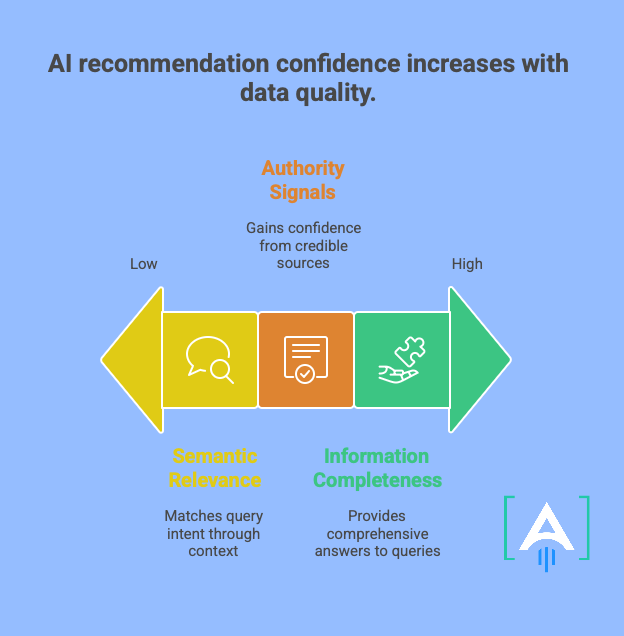
Semantic relevance determines if your brand matches the user query intent. AI analyzes meaning beyond keywords, understanding context and relationships between concepts.
Authority signals influence recommendation confidence. Brands mentioned across multiple credible sources get cited more frequently than those appearing in single locations.
Information completeness affects selection. When AI needs specific details, comprehensive content providing complete answers wins over fragmented information.
Additionally, AI content optimization ensures your content speaks AI’s language while remaining compelling for human audiences.
Reverse-Engineering AI Prompts
Understanding what prompts users actually ask helps structure the content AI recommends. Most brands optimize for imagined queries rather than real user behavior.
Consequently, systematic testing reveals actual query patterns. Ask ChatGPT variations of category questions prospects might pose. Document which brands appear and why.
Content marketing strategies must align with discovered query patterns. Create content explicitly answering questions users actually ask AI platforms.
Common Query Categories
Comparison queries like “Compare X vs Y” represent a huge opportunity. AI synthesizes feature differences, pricing, and ideal use cases when responding.
Recommendation queries ask “What’s the best solution for [specific need]?” These high-intent questions directly influence purchase decisions when AI suggests brands.
Definition queries establish category understanding. When users ask “What is [category]?” AI references authoritative sources defining the space.
Implementation queries address practical deployment. Questions about setup, integration, and getting started reveal buyer readiness and solution evaluation.
Moreover, data analytics tracks which query types drive your brand mentions most frequently.
Testing Methodologies
Systematic prompt testing documents brand visibility across query variations. Test 20-30 relevant prompts monthly, recording when your brand appears and how AI describes you.
Competitive analysis reveals which rivals dominate AI responses. Understanding competitor positioning informs your differentiation strategy.
Longitudinal tracking measures improvement over time. Monthly testing shows if content optimization increases recommendation frequency as intended.
Testing isn’t a one-time activity. AI models update regularly. Continuous monitoring ensures sustained visibility as systems evolve.
Content Structures AI Prefers
AI platforms extract and synthesize specific content formats more effectively than others. Structure determines whether your information gets cited or ignored.
Additionally, natural language outperforms keyword-stuffed approaches. AI analyzes semantic meaning, rewarding clear communication over optimization tricks.
Social media marketing amplifies content reach. Distribution matters for building authority signals that AI recognizes.
Question-Answer Formats
Direct answers following question-formatted headings align perfectly with how users query AI. Structure content addressing “What,” “How,” “Why,” “When,” and “Which” questions explicitly.
Concise responses of 2-3 sentences provide complete answers AI can extract. Follow with detailed explanations for users wanting depth.
Structured data through schema markup helps AI understand content context and relationships. Implement FAQPage, HowTo, and Article schemas appropriately.
Furthermore, AI content optimization ensures all formats perform across traditional search and AI platforms simultaneously.
Comparison and Feature Documentation
Feature matrices presenting capabilities side-by-side enable AI extraction for comparison queries. Structure tables with clear headers that AI can parse.
Specifications list, details technical attributes comprehensively. When users ask about specific capabilities, AI pulls from complete specification documentation.
Use case descriptions connect features to real-world applications. AI references these when matching solutions to user-described needs.
Additionally, conversion optimization ensures AI-referred traffic converts effectively when reaching your website.
Building Citation-Worthy Authority
Citation-worthy content gets referenced repeatedly across different queries. This authority compounds over time, increasing visibility systematically.
Consequently, authoritative positioning requires more than isolated blog posts. Comprehensive topic coverage establishes the definitive source status AI platforms prefer.
Content marketing at scale builds authority that individual posts cannot achieve. Coordinated content strategies demonstrate expertise breadth.
Original Research and Data
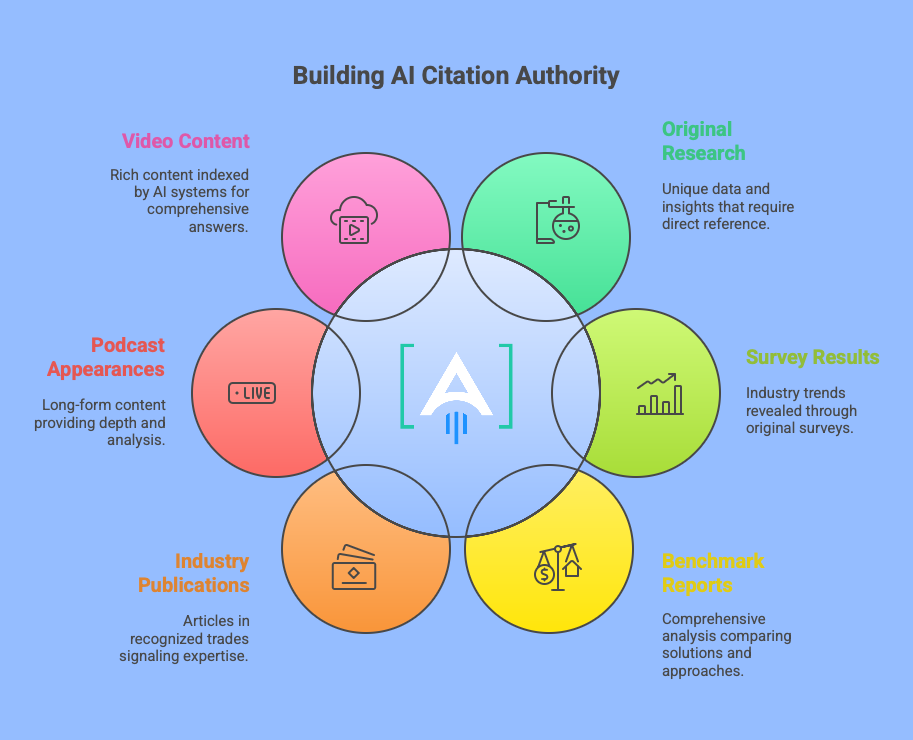
Proprietary insights force AI citation. Unique data can’t be synthesized from existing sources, requiring direct reference to your content.
Survey results revealing industry trends establish authority. AI platforms cite original research when users ask about market dynamics.
Benchmark reports comparing solutions or approaches get referenced repeatedly. Comprehensive analysis becomes a go-to resource for category understanding.
Moreover, data analytics proves which content types earn the most AI citations for your specific category.
Multi-Channel Distribution
Industry publications provide citation authority beyond owned content. Articles in recognized trades signal expertise that AI systems acknowledge.
Podcast appearances create long-form content that AI can analyze. Conversational formats demonstrate depth that short posts can’t match.
Video content increasingly gets indexed by AI systems. YouTube, in particular, provides rich content AI platforms as a reference for comprehensive answers.
Distribution isn’t optional. The more places your expertise appears, the stronger authority signals become for AI recommendation algorithms.
Measuring AI Recommendation Frequency
Systematic measurement reveals optimization effectiveness. Without tracking, you’re flying blind on what actually increases AI visibility.
Additionally, data analytics platforms unify AI-specific metrics with traditional performance indicators.
Regular monitoring catches changes as AI models update. Platforms evolve monthly; your measurement must keep pace.
Key Metrics to Track
Citation frequency measures how often AI platforms mention your brand when answering relevant queries. Monthly testing across 20-30 prompts documents trends.
Competitive displacement shows progress relative to rivals. Track when your brand appears versus competitors in comparative responses.
Query coverage reveals which question types surface your brand. Understanding coverage gaps informs content strategy priorities.
Position in responses matters. Being first-mentioned carries more weight than appearing after multiple competitors.
Furthermore, AI marketing agency specialists implement comprehensive tracking that most brands can’t build internally.
Tools and Frameworks
Prompt testing templates standardize measurement. Use consistent query formats enabling fair month-over-month comparison.
Response documentation captures exact AI answers. Screenshot or copy responses for analysis and competitive intelligence.
Sentiment analysis reveals how AI describes your brand. Positive, neutral, or negative framing affects user perception.
Attribution tracking connects AI visibility to business outcomes. When possible, track traffic and conversions from AI-referred visitors.
Measurement informs optimization. Data reveals what works, enabling systematic improvement rather than guessing.
Practical Implementation Steps
Systematic implementation beats random optimization attempts. Follow structured approaches for consistent results.
Consequently, start with high-impact activities before expanding to advanced tactics. Build momentum through quick wins that demonstrate value quickly.
Content marketing teams should prioritize AI optimization alongside traditional SEO rather than treating it as a separate initiative.
Core Implementation Framework
Establish Your Baseline
- Test 20-30 category-relevant prompts across major AI platforms
- Document current brand visibility and competitor presence
- Analyze why AI recommends specific competitors over others
- Identify highest-priority query gaps to address first
Optimize Existing Content
- Restructure pages using question-answer formats
- Add comprehensive details AI can extract easily
- Implement schema markup (FAQPage, HowTo, Article)
- Use natural language over keyword-stuffed approaches
Create New Citation-Worthy Material
- Develop original research AI must reference directly
- Build comprehensive guides covering complete topics
- Address query types currently surfacing competitors
- Expand coverage to adjacent category areas
Build Cross-Platform Authority
- Secure placements in industry publications AI references
- Develop video and podcast content demonstrating expertise
- Distribute consistently across multiple channels
- Accumulate authority signals from credible sources
Additionally, AI content optimization accelerates content production while maintaining quality standards.
Ongoing Optimization
Continuous Measurement:
- Re-test core prompts regularly tracking citation frequency
- Monitor competitive displacement and position changes
- Identify emerging query patterns and coverage gaps
- Adjust strategy based on what data reveals
Strategic Expansion:
- Scale successful content formats and topics
- Double down on channels driving strongest authority signals
- Refine messaging based on how AI describes your brand
- Maintain consistency over sporadic intensive efforts
Success Principles:
- Authority compounds through sustained effort
- Small regular improvements deliver major long-term gains
- Multi-channel distribution strengthens AI recommendation likelihood
- Systematic testing reveals what actually works
Why Professional Implementation Matters
Prompt engineering marketing complexity exceeds typical marketing capabilities. Model behavior, testing methodologies, and optimization require specialized expertise.
Furthermore, AI marketing agency partnerships accelerate results dramatically. Professional implementation prevents costly mistakes while capitalizing on opportunities faster.
The knowledge gap between basic AI usage and optimization mastery is substantial. Most teams lack bandwidth for deep specialization while managing daily operations.
The Expertise Advantage
Model understanding requires staying current with rapid AI evolution. Platform updates change behavior monthly. Agencies track changes systematically.
Testing frameworks developed through dozens of client implementations deliver proven approaches. Avoid trial-and-error waste.
Content optimization balancing AI visibility with human conversion demands dual expertise. Few teams excel at both simultaneously.
Time-to-market advantages matter enormously. Professional guidance compresses learning curves from months to weeks.
Conclusion
Prompt engineering marketing has become essential for brand visibility as 88% of marketers use AI daily, and 75% of consumers increasingly rely on AI search. Understanding how AI models work, reverse-engineering actual user queries, and creating content structures AI prefers determines which brands dominate recommendations while competitors remain invisible.
The framework spans semantic relevance optimization, citation-worthy authority building, systematic testing methodologies, and comprehensive measurement tracking AI recommendation frequency. Brands implementing these strategies systematically see 10x increases in AI mentions versus competitors using traditional approaches.
Azarian Growth Agency combines over 20 years of growth marketing expertise with cutting-edge prompt engineering capabilities. We’ve helped clients secure over $4 billion in funding and generate more than $500 million in revenue through systematic strategies capturing AI recommendation advantages.
Our AI marketing agency services implement comprehensive optimization, earning AI citations that competitors miss. We build content architectures AI platforms prefer, test systematically across query variations, and measure results quantifying true visibility gains.
Partner with us to dominate AI recommendations. We combine model understanding with strategic implementation, helping your brand appear 10x more often when prospects consult AI tools for purchase guidance.