

Private markets’ digital strategy has become essential for value creation as private equity firms navigate unprecedented market complexity.
Business owners and CEOs of PE-backed companies face mounting pressure to demonstrate growth efficiency, with operating partners demanding measurable marketing ROI across portfolio companies.
The opportunity is massive. More than 40% of private equity firms have adopted formal AI strategies or are piloting generative AI in operations. Additionally,81% of PE firms cite digital transformation as essential in 2025.
Moreover, 30,000+ portfolio companies sit in the exit backlog, creating urgency for firms to accelerate value creation through systematic growth initiatives rather than relying solely on multiple expansion.
In this guide, we’ll reveal how PE-backed companies can implement AI-driven marketing across portfolios, create scalable GEO playbooks, and demonstrate marketing ROI that satisfies operating partners and positions companies for premium exits.
Understanding Private Equity Marketing Strategy
Private marketing strategy differs fundamentally from traditional corporate marketing. PE-backed companies operate on compressed timelines with 3-5 year hold periods demanding rapid, documented value creation.
Furthermore, operating partners evaluate marketing through financial lenses: EBITDA impact, customer acquisition payback periods, and revenue contribution metrics. Vanity metrics like impressions or social followers don’t impress PE boards focused on valuation multipliers.
Private markets agency expertise becomes essential for implementing systematic growth programs across portfolio companies. Traditional marketing approaches lack the rigor and documentation PE ownership demands.
The PE Value Creation Imperative
PE firms acquire companies, improve operations, and exit at higher valuations. Marketing must demonstrably contribute to this value creation thesis through measurable revenue growth and margin improvement.
Consequently, technology accounts for 33% of buyout deal value in 2025, with AI-powered portfolio companies achieving substantially better burn multiples. These firms leverage AI for competitive advantage, reducing customer acquisition costs while accelerating growth rates.
Digital transformation surged across PE portfolios as firms recognize that modern buyers research and purchase differently. Roughly 20% of portfolio companies have operationalized generative AI with measurable outcomes. This adoption gap creates opportunities for differentiation.
Portfolio-Wide vs. Company-Specific Strategies
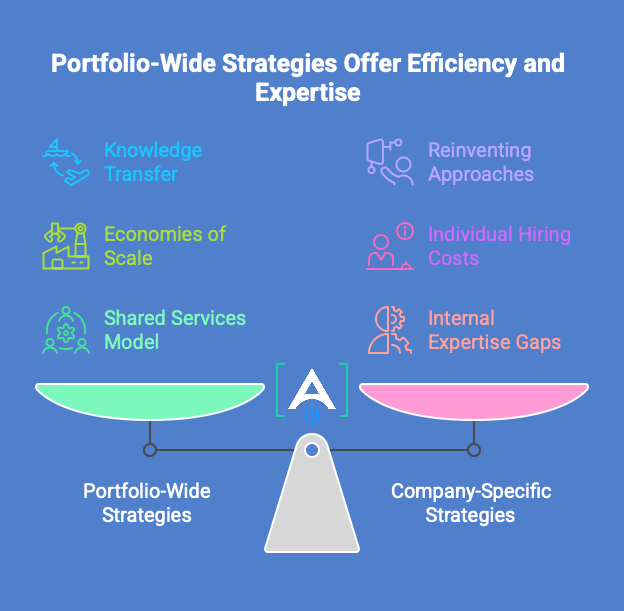
PE firms benefit from implementing consistent frameworks across portfolio companies rather than reinventing approaches for each asset. This portfolio-wide strategy enables knowledge transfer, benchmark comparison, and economies of scale.
Moreover, AI marketing agency partnerships provide specialized expertise that individual portfolio companies can’t justify hiring internally. Shared services models distribute costs while maintaining quality.
Standardized reporting frameworks enable portfolio-level visibility. Operating partners track marketing performance across companies, identifying best practices to replicate and underperformers requiring intervention.
Creating Scalable GEO Playbooks
Generative Engine Optimization positions portfolio companies as authoritative sources AI platforms cite. This builds category leadership that supports premium valuations while reducing customer acquisition costs systematically.
Additionally, GEO delivers compound benefits over hold periods. Each citation increases brand authority, making subsequent marketing more efficient. This compounding effect creates measurable value that enhances exit valuations.
AI platforms now influence 68% of B2B purchase research. Portfolio companies invisible in ChatGPT, Perplexity, and Google AI Overviews miss a significant market opportunity while competitors capture AI-driven demand.
Building Portfolio-Wide GEO Infrastructure
Centralized content creation enables portfolio companies to share research, thought leadership, and technical content. One comprehensive industry report can be customized for multiple portfolio assets, multiplying ROI.
Citation tracking systems monitor which companies earn AI platform mentions. This portfolio-level visibility reveals GEO effectiveness and informs resource allocation decisions.
Expert positioning programs elevate portfolio company executives as industry authorities through coordinated PR, speaking engagements, and content distribution. This systematic approach builds citation-worthy authority faster than individual company efforts.
Furthermore, content marketing at a portfolio scale achieves efficiency that individual companies cannot match. Shared creative resources, distribution channels, and optimization insights accelerate results.
Implementing Systematic Thought Leadership
AI platforms prioritize authoritative, well-researched content when synthesizing information. Portfolio companies must produce citation-worthy material consistently rather than sporadically.
Original research initiatives generate proprietary data AI platforms must cite directly. These unique insights can’t be synthesized from existing sources, forcing AI to reference your portfolio companies specifically.
Industry benchmark reports establish portfolio companies as data authorities. Annual or quarterly benchmarks create recurring citation opportunities while demonstrating thought leadership to potential acquirers.
Technical documentation and guides addressing complex industry topics earn citations when users ask detailed questions. Comprehensive resources become reference materials AI platforms rely on repeatedly.
Moreover, social media marketing amplifies thought leadership distribution. LinkedIn engagement signals content quality to both algorithms and AI platforms monitoring social proof indicators.
Implementing Cross-Portfolio Attribution
Cross-portfolio attribution reveals which marketing investments generate returns and which waste capital. This visibility enables data-driven resource allocation across portfolio companies.
Consequently, standardized measurement frameworks allow operating partners to compare performance fairly. Companies operating in different sectors still share fundamental marketing metrics: CAC, LTV, payback periods, and ROAS.
Attribution complexity increases in B2B environments where sales cycles span months. Multi-touch attribution captures the full customer journey from awareness through closed revenue, revealing marketing’s true contribution.
Building Unified Reporting Dashboards
Operating partners need portfolio-level visibility without drowning in company-specific details. Unified dashboards present key metrics consistently across assets.
Essential portfolio metrics include:
- Customer acquisition cost trends by company and cohort
- Marketing-sourced pipeline as percentage of total pipeline
- Conversion rates by stage showing funnel efficiency
- LTV:CAC ratios demonstrating unit economics
- Marketing spend efficiency (revenue per marketing dollar)
- Quarter-over-quarter growth rates normalized for seasonality
Additionally, data analytics and reporting platforms integrate data from disparate CRM, marketing automation, and advertising systems. This centralized infrastructure provides the single source of truth operating partners require.
Demonstrating Marketing ROI to Operating Partners
Operating partners evaluate marketing through financial impact, not campaign metrics. Your reporting must connect marketing activities directly to EBITDA contributions.
Pipeline contribution reporting shows revenue in various stages: marketing-qualified, sales-accepted, opportunity, and closed-won. This visibility demonstrates marketing’s impact on business outcomes that PE boards actually care about.
Cohort analysis reveals how customer behavior evolves over time. Show improving retention, expansion, and LTV for recent cohorts versus earlier customers. This progression demonstrates marketing quality improvement.
Payback period calculations show how quickly each customer acquisition investment returns cash. Shorter payback periods improve burn multiples and accelerate capital efficiency that PE investors monitor closely.
Moreover, conversion rate optimization expertise builds measurement frameworks quantifying marketing’s revenue contribution. Operating partners demand this accountability across portfolio holdings.
AI-Powered Content Systems at Scale
Manual content creation can’t match the volume and velocity PE growth targets demand. AI-powered systems generate content at scale while maintaining quality and brand consistency.
Furthermore, centralized content operations enable portfolio companies to share resources. One content team supporting multiple assets achieves efficiency that individual companies cannot justify.
AI content generation delivers 10x testing velocity. This enables rapid iteration toward optimal messaging that traditional creative processes can’t match within compressed PE hold periods.
Implementing Portfolio Content Operations
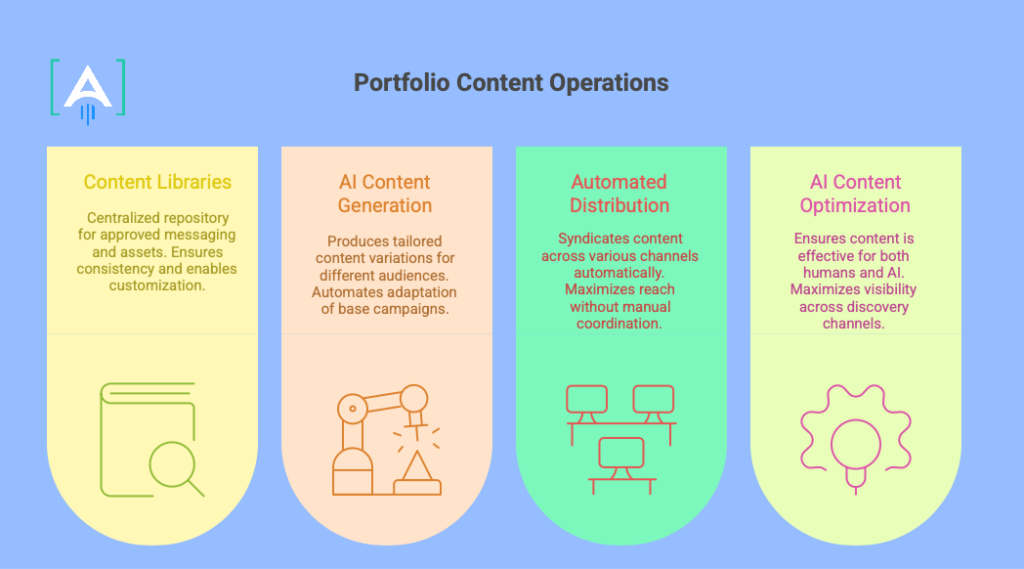
Content libraries store approved messaging, brand guidelines, and creative assets accessible to all portfolio companies. This centralized repository ensures consistency while enabling customization.
AI content generation platforms produce variations tailored to different industries, company sizes, and buyer personas. One base campaign becomes hundreds of targeted variations adapted automatically.
Automated distribution systems syndicate content across owned channels, social platforms, and third-party publications. This orchestration maximizes reach without manual coordination overhead.
Additionally, AI content optimization ensures material speaks effectively to both human audiences and AI systems analyzing content for citation. This dual optimization maximizes visibility across all discovery channels.
Dynamic Creative Optimization
Static creative underperforms in competitive markets. Dynamic optimization tests dozens of variations weekly, identifying winners faster than manual approaches. This is particularly critical in private markets, where investor expectations and competition for attention are high.
Automated A/B testing runs continuously across advertising platforms. Remove underperforming variants automatically while scaling winners. This optimization operates 24/7 without manual intervention.
Personalized landing pages adapt content based on traffic source, industry, company size, and browsing behavior. AI determines optimal messaging for each visitor segment, improving conversion rates by 30-50%. Applying these insights across private markets portfolio companies ensures consistent messaging that resonates with sophisticated audiences.
Performance benchmarking across portfolio companies reveals which creative approaches work best. These insights inform creative development for all assets, compounding learning effects and creating scalable advantages across private markets investments.
Portfolio-Wide Implementation Timeline
Implementing AI-driven marketing across PE portfolios requires systematic phasing. Attempting everything simultaneously overwhelms resources and dilutes impact.
Consequently, prioritize portfolio companies by growth potential, exit timing, and competitive positioning. Focus initial efforts on the highest-impact assets demonstrating proof of concept before scaling portfolio-wide.
Quick wins build operating partner confidence in marketing investments. Demonstrate measurable results within 90 days to secure continued support and budget for broader rollout.
- Foundation and Pilot (Months 1-3)
Select 2-3 portfolio companies for pilot implementation. Choose assets with strong fundamentals requiring growth acceleration rather than turnaround situations.
Implement core infrastructure:
- Unified analytics and reporting platforms
- Marketing automation systems
- CRM integration for pipeline tracking
- Attribution modeling frameworks
- Content management systems
Establish baseline metrics documenting pre-implementation performance. These starting points prove subsequent improvement attributable to marketing initiatives.
Launch initial campaigns demonstrating AI-powered optimization. Use these pilots to validate approaches before portfolio-wide deployment.
- Scaling and Standardization (Months 4-9)
Expand successful pilot approaches to additional portfolio companies. Standardize processes, templates, and reporting frameworks for consistency.
Build portfolio-level capabilities:
- Centralized content creation teams
- Shared advertising accounts with portfolio-wide optimization
- Cross-portfolio benchmark reports
- Best practice documentation and training
- Regular portfolio marketing reviews
Document wins and lessons learned from the pilot phase. Create playbooks enabling rapid onboarding of newly acquired portfolio companies.
Implement GEO strategies, positioning key portfolio executives as industry authorities. Coordinate PR, speaking engagements, and content distribution systematically.
- Optimization and Exit Prep (Months 10+)
Continuously optimize marketing performance based on cross-portfolio learnings. Shift budgets towardthe highest-performing channels and tactics.
Prepare for exits:
- Document marketing systems and processes for acquirer due diligence
- Build marketing as strategic asset enhancing valuation
- Demonstrate sustainable growth trajectories through data
- Create transition plans ensuring continuity post-acquisition
Moreover, data analytics and reporting platforms generate the documentation acquirers require during diligence. Systematic marketing demonstrates professional management and sustainable growth.
Technology Stack for PE Portfolio Marketing
Successful portfolio marketing requires integrated technology infrastructure. These platforms enable consistency, measurement, and optimization across companies.
Marketing automation platforms like HubSpot or Marketo enable sophisticated nurture sequences and lead scoring. Choose solutions offering multi-company management within single instances for portfolio efficiency.
CRM systems unified across portfolio companies enable comparative analysis. Salesforce remains dominant in PE portfolios due to customization capabilities and third-party integrations.
Attribution platforms like Ruler Analytics or HockeyStack track customer journeys across channels. These tools connect marketing touchpoints to revenue outcomes that operating partners evaluate.
Furthermore, AI marketing agency specialists select and implement technology stacks optimized for PE requirements. Vendor relationships negotiated at the portfolio level achieve pricing individual companies cannot access.
Conclusion
Private markets digital strategy has evolved from optional enhancement to essential value creation driver as PE firms navigate complex market conditions. With 81% of firms citing digital transformation as essential and more than 40% adopting formal AI strategies, the competitive bar has risen dramatically across portfolio companies.
Azarian Growth Agency combines over 20 years of growth marketing expertise with deep private markets specialization. We’ve helped clients secure over $4 billion in funding and generate more than $500 million in revenue through systematic strategies designed for PE value creation timelines.
Our private markets agency services implement portfolio-wide marketing infrastructure operating partners demand. We build the measurement frameworks, optimization systems, and thought leadership programs that demonstrate traction while improving capital efficiency across holdings. Our AI marketing agency expertise delivers the automation and scale PE growth targets require.
Additionally, our data analytics and reporting capabilities create board-ready dashboards quantifying marketing contribution in formats CFOs and operating partners understand. We don’t just execute campaigns; we build marketing as strategic assets enhancing portfolio valuations.
Partner with us to build your PE portfolio growth engine. We combine strategic guidance with technical implementation, helping you demonstrate the value creation and efficiency that drive premium exit multiples.