
Multi-touch attribution has become the cornerstone of accurate marketing measurement in 2026. Business owners and CEOs face an unprecedented challenge: customers now interact with brands across ChatGPT, Google AI Overviews, Perplexity, traditional search, and social media before converting.
The complexity demands sophisticated attribution frameworks. 75% of companies now use multi-touch attribution models to measure marketing performance, up dramatically from just a few years ago. Additionally, the multi-touch attribution market reached $2.43 billion in 2025 and is projected to hit $4.61 billion by 2030, reflecting massive industry investment in solving attribution challenges.
In this guide, we’ll break down new attribution frameworks for AI-influenced journeys, reveal tracking methodologies that capture conversions across all platforms, and provide implementation guidance for GA4 and custom solutions that deliver accurate ROI measurement.
Understanding Multi-Touch Attribution in the AI Era
Multi-touch attribution assigns conversion credit across multiple customer touchpoints rather than crediting a single interaction. This approach reflects how modern buyers actually make decisions: through extended research spanning numerous channels and platforms.
Traditional single-touch models credited either the first interaction (first-touch) or final interaction (last-touch) with 100% of conversion value. These simplistic approaches miss the complex reality of customer journeys that now average 3-5 touchpoints before conversion.
Furthermore, AI platforms add entirely new layers of complexity. A customer might discover your brand through a ChatGPT recommendation, research further via Google AI Overviews, engage with social content, click a retargeting ad, and finally convert through direct navigation. Which channel deserves credit?
The Evolution From Single-Touch to Multi-Touch Models
Single-touch attribution worked when customer journeys were simpler and linear. Buyers relied primarily on salespeople for information, making purchase decisions quickly with minimal independent research.
Those days are gone. Modern B2B buyers complete 70% of their purchase journey independently before ever contacting sales. Digital touchpoints proliferate across owned media, paid advertising, organic content, social platforms, and now AI assistants.
57.9% of marketers now use dedicated attribution tools to track these complex journeys. However, nearly half still lack proper attribution infrastructure, flying blind on which channels drive genuine results versus vanity metrics.
Why AI Search Demands New Attribution Frameworks
AI search platforms like ChatGPT, Perplexity, and Google AI Overviews fundamentally change product discovery. These tools synthesize information from multiple sources, present unified recommendations, and often complete entire research processes without users clicking external links.
Traditional attribution tracking relies on website visits and clicks. When 60% of searches end without clicks, and AI tools handle research internally, standard measurement frameworks break down completely.
Moreover, AI interactions occur early in customer journeys, influencing consideration sets before prospects ever visit your website. Standard analytics platforms can’t track these pre-website touchpoints, creating blind spots in attribution models.
AI Search Attribution: Tracking ChatGPT and AI Overview Conversions
AI search attribution requires tracking brand exposure in AI-generated responses even when users don’t immediately click through. This impression-based measurement captures influence that traditional click-tracking misses entirely.
Consequently, brands must implement new tracking methodologies. Monitor citation frequency in ChatGPT responses through systematic query testing. Track how often your brand appears in Google AI Overviews for target keywords. Measure Perplexity recommendations through competitive analysis.
These AI touchpoints shape consideration sets and influence eventual purchases even without direct traffic. The customer who discovers your solution through ChatGPT recommendations may not visit your website for days or weeks, but arrives pre-sold when they finally do.
Implementing First-Party Tracking for AI Touchpoints
First-party data becomes critical for connecting AI exposure to eventual conversions. When prospects self-identify through form submissions or account creation, that identifier links their prior AI interactions to conversion events.
Ask customers “How did you hear about us?” during signup, specifically including options for ChatGPT, AI search tools, and AI assistants. This self-reported attribution fills gaps that technical tracking can’t capture.
Additionally, implement UTM parameter systems that identify AI referral traffic. When platforms do provide click-through links, proper tagging ensures GA4 correctly attributes these sources. Create dedicated source/medium combinations like “chatgpt/referral” or “perplexity/search” for clear segmentation.
Data analytics and reporting platforms unify these disparate data sources. Customer data platforms (CDPs) connect self-reported attribution with behavioral tracking, creating comprehensive journey visibility impossible through single platforms.
Multi-Touch Attribution 2026: Core Models and Frameworks
Several attribution models distribute conversion credit differently across touchpoints. Understanding each model’s strengths and limitations helps select the right approach for your business.
Linear Attribution assigns equal credit to all touchpoints. If five interactions occurred before conversion, each receives 20% credit. This democratic approach ensures all touchpoints get recognized, but doesn’t account for varying influence.
Time Decay Attribution weights recent interactions more heavily. Interactions closer to conversion receive more credit than older touchpoints. This model suits businesses where recency matters more than initial awareness.
Position-Based (U-Shaped) Attribution assigns 40% credit to first and last interactions, splitting the remaining 20% among middle touchpoints. This acknowledges both initial discovery and conversion catalyst while recognizing middle-journey nurturing.
Data-Driven Attribution: The AI-Powered Approach
Data-driven attribution (DDA) uses machine learning to assign credit based on actual conversion patterns in your data. GA4’s DDA became the default model in 2023, analyzing historical data to identify which touchpoints genuinely influence conversions.
The algorithm considers multiple factors: timing of interactions, user engagement levels, time between touchpoints and conversion, and the statistical probability each touchpoint contributed. This dynamic approach adapts to your specific business rather than applying predetermined rules.
However, DDA requires substantial data volume to function effectively. Accounts with fewer conversions lack sufficient information for statistical modeling. Google recommends at least 400 conversions per month for stable DDA performance.
Moreover, conversion rate optimization agency expertise helps interpret DDA results correctly. The model provides credit allocation but requires strategic thinking to act on insights effectively.
Choosing the Right Attribution Model
No single model perfectly captures attribution reality. The best approach combines multiple models to triangulate truth from different perspectives.
Use Linear attribution for awareness-heavy campaigns where all touchpoints matter equally. This works well for new product launches or market entry, where every impression builds crucial recognition.
Use Time Decay for sales-driven businesses with short consideration windows. When purchase decisions happen quickly, recent interactions matter more than distant awareness touchpoints.
Use Position-Based for B2B with longer sales cycles. The model acknowledges both initial discovery (often from content or social) and final conversion catalyst (typically paid search or direct).
Use Data-Driven when you have sufficient volume and want AI to identify patterns. This sophisticated approach works best for complex, multi-channel marketing with substantial conversion data.
Cross-Platform Attribution AI: Connecting Touchpoints
Cross-platform attribution connects customer interactions across Google Ads, Meta, LinkedIn, organic search, email marketing, and AI platforms. This unified view reveals how channels work together rather than competing in silos.
The challenge is technical: each platform uses different tracking mechanisms, attribution windows, and conversion definitions. Google Ads defaults to data-driven attribution, Meta uses 7-day click and 1-day view windows, LinkedIn has its own attribution logic.
Furthermore, these platforms compete for credit, each claiming outsized influence on conversions. Without unified measurement, you’re comparing apples to oranges, making budget allocation decisions based on incomparable metrics.
Building Unified Customer Data Platforms
Customer data platforms (CDPs) create single sources of truth by ingesting data from all marketing platforms. These systems connect touchpoints through persistent customer identifiers that survive across channels and devices.
When someone engages with your LinkedIn ad, receives an email, searches on Google, and converts via direct navigation, the CDP links all four touchpoints to a single customer profile. This enables true multi-touch attribution across your entire marketing ecosystem.
AI marketing agency specialists implement CDP infrastructure that most businesses can’t build internally. The technical complexity of data ingestion, identity resolution, and attribution modeling requires dedicated expertise.
Popular CDP solutions include Segment, mParticle, and Adobe Experience Platform. These enterprise tools cost $10,000-$100,000+ annually but deliver accurate attribution impossible through platform-native reporting alone.
Server-Side Tracking and Privacy Compliance
Browser-based tracking faces increasing restrictions from privacy regulations and browser vendors. Third-party cookies are deprecated, Apple’s ITP blocks tracking, and users actively reject consent prompts.
Server-side tracking bypasses these limitations by capturing data on your servers rather than in user browsers. This approach maintains measurement accuracy while respecting privacy preferences and regulatory requirements.
GA4’s enhanced measurement and server-side tagging enable cookieless attribution. The platform uses first-party data, behavioral modeling, and conversion APIs to maintain attribution visibility despite tracking restrictions.
Additionally, data analytics and reporting implementation ensures compliant tracking infrastructure. GDPR, CCPA, and emerging regulations demand careful attention to consent management and data processing.
Generative Search Analytics: Measuring AI-Influenced Journeys
Generative search analytics tracks how AI tools influence customer research and purchase decisions. This emerging discipline adapts traditional analytics for AI-first discovery environments.
Standard metrics like bounce rate and time-on-site become less relevant when AI platforms answer questions externally. New KPIs include citation frequency, recommendation placement, and AI-referred conversion rates.
Track which AI queries surface your brand. Systematic testing reveals how ChatGPT, Perplexity, and Google AI Overviews respond to target keywords. Document which competitors appear alongside your brand, identifying share-of-voice in AI recommendations.
Creating AI-Specific Attribution Windows
AI interactions occur earlier in customer journeys than traditional touchpoints. A prospect might consult ChatGPT weeks before visiting your website, making standard 7-day attribution windows insufficient.
Extend attribution windows to 30-60 days for AI-influenced journeys. This captures the full consideration cycle from initial AI discovery through eventual website visit and conversion.
Implement custom parameters tracking “days since AI discovery” when prospects self-report ChatGPT usage. This temporal data reveals how long AI recommendations influence before triggering action.
Moreover, cohort analysis segments customers by discovery source. Compare lifetime value, conversion rates, and sales cycle length for AI-discovered versus traditionally-sourced customers. These insights inform budget allocation toward channels delivering highest-quality conversions.
AI Impression Tracking Through Surveys
Since technical tracking can’t capture most AI interactions, survey-based measurement fills critical gaps. Regular customer research reveals AI’s influence on purchase decisions.
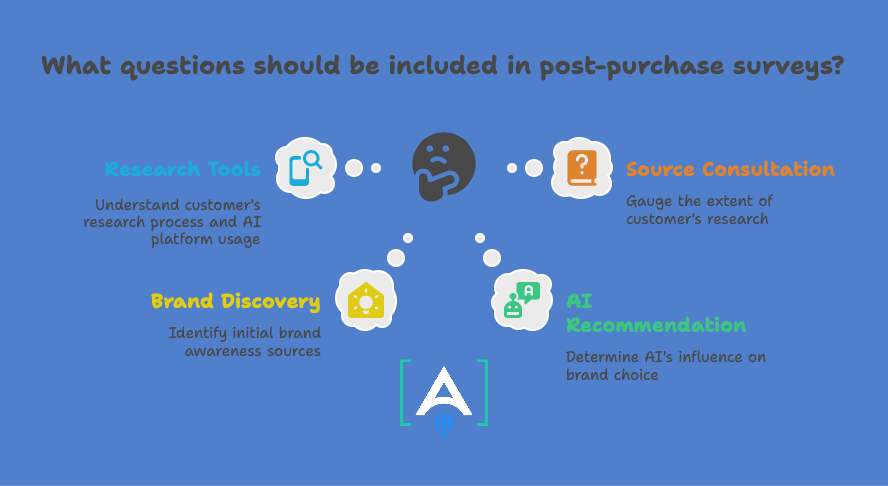
Post-purchase surveys should include:
- “Which tools did you use to research solutions?” (with AI platform options)
- “Where did you first learn about [your brand]?”
- “Did ChatGPT or AI search tools recommend us?”
- “How many different sources did you consult before deciding?”
Correlation analysis connects survey responses to conversion data. When 40% of customers report ChatGPT discovery but only 5% of traffic shows AI referrals, you know self-reported attribution captures substantial unmeasured influence.
Run surveys quarterly to track AI’s growing role over time. Document changes in research behavior, channel preferences, and discovery patterns. This longitudinal data reveals how AI transforms your specific market.
GA4 Implementation for Multi-Touch Attribution
Google Analytics 4 provides robust attribution capabilities when properly configured. However, default settings often miss critical customization opportunities for accurate multi-touch measurement.
Start by selecting your primary attribution model under Admin > Attribution Settings > Reporting Attribution Model. GA4 offers data-driven (recommended), last-click, and custom options. Data-driven attribution became default in 2023 but may not suit all businesses.
Furthermore, configure proper conversion events. GA4 tracks multiple conversion types: purchases, form submissions, phone calls, and custom events. Ensure all valuable actions are marked as conversions for attribution analysis.
Configuring Attribution Windows and Conversion Paths
Attribution windows define how long after touchpoint exposure conversions can be credited. GA4’s default 90-day window works for most businesses, but may need adjustment for your specific sales cycle.
B2B companies with 6+ month sales cycles should extend windows to 180 days or longer. Fast-moving consumer products with days-long consideration may reduce windows to 30 days for more relevant data.
Additionally, the Conversion Paths report reveals multi-touch customer journeys. Access it under Advertising > Attribution > Conversion Paths. This visualizes how users move across channels before converting, identifying common patterns worth optimizing.
Filter paths by conversion event to analyze specific actions. Purchase paths differ from email signup paths, requiring separate strategic analysis. Don’t treat all conversions identically when building attribution insights.
Model Comparison for Strategic Insights
The Model Comparison tool (Advertising > Attribution > Model Comparison) shows how different attribution approaches credit the same conversions differently. This reveals model bias and helps select the most appropriate framework.
Compare data-driven versus last-click attribution to see which channels benefit from multi-touch recognition. Channels showing large increases under data-driven models contribute substantial early-journey value that last-click misses.
PPC agency expertise interprets these comparisons correctly. Large model discrepancies signal opportunities or problems depending on context. Professional guidance prevents misinterpretation that leads to poor budget decisions.
Run model comparisons monthly to track changes over time. Shifts in attribution patterns reveal evolving customer behavior, competitive dynamics, or campaign effectiveness changes requiring strategic response.
Custom Tracking Solutions Beyond GA4
GA4 provides solid attribution foundations but has limitations. Many businesses require custom tracking solutions for complete multi-touch visibility across all channels and touchpoints.
BigQuery integration enables advanced attribution modeling using your raw GA4 data. Export event-level information to BigQuery, then build custom attribution models using SQL or Python. This approach provides unlimited flexibility for sophisticated analysis.
Third-party attribution platforms like Hyros, Ruler Analytics, and Triple Whale specialize in multi-touch measurement. These tools integrate with GA4 while adding capabilities like offline conversion tracking, call attribution, and enhanced cross-device matching.
Building Custom Attribution Models in BigQuery
BigQuery allows creating sophisticated attribution models tailored to your business logic. Access raw GA4 event data and apply custom rules, machine learning algorithms, or hybrid approaches.
Popular custom models include:
- Shapley Value attribution using game theory to distribute credit fairly
- Markov Chain models calculating removal effects to quantify channel importance
- Custom time decay with industry-specific decay rates
- Hybrid models combining rule-based and algorithmic approaches
Python libraries like marketing-attribution-models simplify building these custom frameworks. The DP6 library specifically supports GA4 BigQuery exports for streamlined implementation.
However, technical expertise is essential. Most businesses partner with data analytics and reporting specialists rather than building custom models internally. The complexity exceeds typical marketing team capabilities.
Integrating Offline Conversions and Call Tracking
Multi-touch attribution must capture offline conversions to reflect complete customer journeys. Phone calls, in-store visits, and sales meetings contribute to revenue but occur outside standard digital tracking.
Call tracking platforms like CallRail and CallTrackingMetrics assign unique phone numbers to different marketing channels. When prospects call, the system logs which channel generated the inquiry and attributes eventual revenue accordingly.
Offline conversion imports feed sales data into GA4 and advertising platforms. When CRM records show closed deals, conversion APIs push this information back to analytics platforms for complete attribution visibility.
This closed-loop measurement connects marketing spend directly to revenue rather than proxy metrics like leads or form submissions. CFOs demand this revenue-level accountability, making offline integration increasingly essential.
Marketing Attribution AI Era: Emerging Trends
The attribution landscape evolves rapidly as AI transforms both marketing execution and measurement. Several trends will define multi-touch attribution through 2026 and beyond.
Algorithmic attribution models are expanding at 14.3% CAGR, holding 34.8% market share in 2024. These AI-powered approaches surpass rule-based models in accuracy and insight generation.
Predictive attribution uses historical data to forecast future conversion probability. Rather than retrospectively assigning credit, these models prospectively identify high-value opportunities worth increased investment.
Furthermore, incrementality testing complements attribution by measuring causal impact. Hold-out tests reveal what would have happened without specific marketing activities, validating attribution model findings through controlled experimentation.
Privacy-First Attribution Solutions
Privacy regulations and browser restrictions force attribution evolution toward privacy-compliant methodologies. First-party data, consent-based tracking, and server-side measurement replace deprecated third-party cookies.
Consent mode in GA4 adjusts measurement based on user privacy preferences. When users reject cookies, the platform uses behavioral modeling to estimate conversions while respecting choices. This maintains measurement accuracy without violating privacy.
Additionally, differential privacy techniques add noise to data, protecting individual users while enabling accurate aggregate analysis. Apple’s SKAdNetwork for iOS attribution pioneered this approach; expect broader adoption across platforms.
Conversion rate optimization agency partnerships ensure compliant implementation. Regulations change frequently, and non-compliance risks substantial penalties. Professional guidance prevents costly mistakes.
Real-Time Attribution and Dynamic Budget Optimization
Real-time attribution enables dynamic budget shifts toward the highest-performing channels. Rather than monthly or quarterly reallocation, algorithms automatically move spending based on live performance data.
Platforms like SegmentStream provide real-time attribution with automated budget optimization. Machine learning identifies underperforming spend and reallocates to high-efficiency channels continuously, maximizing ROI without manual intervention.
This automation requires trust in attribution model accuracy. Validation through lift tests and incremental testing ensures algorithms optimize correctly before granting full control over budget decisions.
Implementation Guide: Getting Started With Multi-Touch Attribution
Implementing multi-touch attribution doesn’t require massive upfront investment. Start with foundational steps, then progressively sophisticate your approach as capabilities and confidence grow.
Foundation (Month 1-2)
Begin with GA4 configuration, ensuring proper tracking infrastructure. Install the GA4 tag on all properties, configure conversion events, and select your primary attribution model. This establishes a baseline measurement for future enhancement.
Implement UTM parameter standards for consistent campaign tagging. Create naming conventions for sources, mediums, and campaigns that everyone follows. Inconsistent tagging undermines attribution accuracy regardless of model sophistication.
Additionally, enable BigQuery export to preserve raw data for future custom analysis. This costs minimal amounts monthly but creates irreplaceable historical data, enabling sophisticated modeling later.
Integration (Month 3-4)
Connect GA4 with advertising platforms through native integrations. Import conversions into Google Ads, Meta, and LinkedIn to enable platform-native optimization while maintaining centralized reporting.
Implement call tracking for businesses where phone inquiries matter. Assign tracked numbers to different campaigns, capturing this critical offline touchpoint in your attribution framework.
Moreover, add post-purchase surveys asking about research sources and discovery channels. This self-reported data fills gaps technical tracking misses, particularly for AI discovery and dark social referrals.
Sophistication (Month 5+)
Explore custom attribution models in BigQuery as data volume grows. Test Shapley, Markov, and hybrid approaches against GA4’s built-in options. Validate findings through lift tests before using custom models for strategic decisions.
Partner with conversion rate optimization agency specialists for advanced implementation. Attribution complexity grows exponentially with channel count and journey length. Professional expertise accelerates sophistication while avoiding costly mistakes.
Establish regular attribution review cadence. Monthly deep-dives identify trends, validate model accuracy, and inform budget optimization. Attribution isn’t “set it and forget it”; it requires ongoing attention and refinement.
Conclusion
Multi-touch attribution in 2026 represents the only path to accurate marketing measurement as customer journeys fragment across AI search, traditional search, and social platforms. Business owners and CEOs must move beyond simplistic last-click models that drastically misrepresent channel value and lead to poor budget decisions.
Azarian Growth Agency combines over 20 years of growth marketing expertise with cutting-edge attribution capabilities. We’ve helped clients secure over $4 billion in funding and generate more than $500 million in revenue through data-driven strategies that quantify true marketing ROI.
Our data analytics and reporting services build attribution infrastructure connecting all touchpoints, from AI discovery through final conversion.
Additionally, our conversion rate optimization approach integrates attribution insights with optimization testing. We don’t just measure which channels drive conversions; we systematically improve performance through data-informed experimentation.
Our AI marketing agency expertise ensures your attribution framework captures AI-influenced journeys that traditional measurement misses.
Partner with us to build a multi-touch attribution infrastructure that delivers accurate ROI measurement across AI search, traditional search, social, and all marketing channels. We combine technical implementation with strategic guidance, helping you make confident budget decisions based on reliable attribution data rather than platform-biased reporting or intuition.