
Meta Advantage campaigns have transformed the advertising landscape dramatically. Agentic AI SaaS systems are fundamentally changing how businesses approach Meta advertising. Manual campaign structures that worked in 2022 are now delivering significantly worse results than AI-driven alternatives.
The data is compelling. Advertisers using Advantage+ shopping campaigns are seeing a 32% increase in return on ad spend compared to traditional manual setups.
Instagram Reels placements through Advantage+ deliver average CPMs of $4.29, making them one of the most cost-efficient formats available. Meanwhile, the average cost per lead across industries sits at $21.98, representing substantial savings over traditional Google Ads.
These aren’t marginal improvements. They represent a fundamental shift in performance marketing. So, founders and CMOs who continue relying on manual audience segmentation and static creative testing are leaving significant revenue on the table.
The future of Meta advertising isn’t about micromanaging every audience parameter. It’s about understanding how to train, trust, and scale through AI-driven Advantage+ campaigns. Strategic marketing partners who understand Agentic AI SaaS frameworks can help businesses navigate this transition effectively.
This article breaks down exactly what’s working, what’s changed, and how to adapt your Meta advertising strategy for maximum performance.
The Meta Advantage+ Revolution: What Changed
Advantage+ represents Meta’s most significant advertising evolution since the introduction of the Facebook pixel. This isn’t simply another campaign type. It’s a completely different approach to how ads are bought, optimized, and delivered across Meta’s platforms.
Traditional Ads Manager campaigns gave marketers extensive control. You selected audiences, placements, budgets, and creative variations manually. Every decision required human input. Therefore, advantage+ flips this model entirely by leveraging Meta’s AI to automate these decisions at scale.
In addition, the system operates on three core automation pillars. First, audience discovery uses real-time signal analysis to identify high-intent users beyond traditional demographic parameters. Second, creative testing happens automatically with dynamic combinations of headlines, visuals, and calls to action. Third, budget allocation shifts spending toward the highest-performing audiences and placements without manual intervention.
When advertisers who did not previously use Advantage+ creative turned on its AI-driven targeting features, they experienced a 22% increase in ROAS from our ads.
This performance lift comes from Meta’s ability to process billions of data points per second. Human marketers simply cannot match this processing speed or pattern recognition capability.
The platform’s evolution from 2019 to 2025 shows consistent movement toward automation.
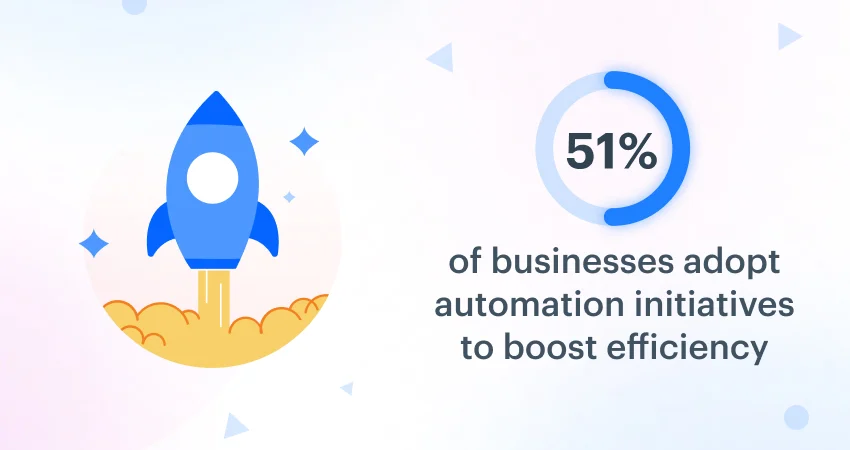
Over half of businesses (51%) are adopting automation initiatives to enhance efficiency. Early dynamic ads tested simple product catalogs. Current Advantage+ campaigns now optimize across audience discovery, creative iteration, and real-time budget reallocation simultaneously. This represents the first mainstream application of Agentic AI SaaS principles in paid social advertising.
Therefore, understanding this shift is critical. Advantage+ doesn’t just make campaign management easier. It fundamentally changes what’s possible when machine learning systems have access to better data and broader optimization parameters.
The Numbers Behind the Shift
The most striking performance metric is return on ad spend. Advertisers using Advantage+ shopping campaigns are seeing a 32% increase in return on ad spend compared to traditional conversion campaigns with manual audience segmentation.
This improvement stems from how Meta Advantage+ algorithm processes intent signals. Broad targeting in 2025 outperforms narrow segmentation because the platform now analyzes thousands of behavioral indicators in real time.
Purchase history, engagement patterns, browsing behavior, and cross-platform activity create a more accurate intent profile than any manually selected interest category.
Three key factors explain why Agentic AI SaaS broad targeting now wins consistently. First, Meta’s aggregated event measurement captures signals across devices and sessions that manual targeting cannot access. Second, predictive modeling identifies high-value users before they exhibit obvious purchase intent. Third, the algorithm learns faster with larger audience pools, accelerating the optimization cycle.
Testing data support this shift decisively. Meta advertising campaigns that formerly relied on lookalike audiences and detailed interest targeting now perform 15% to 25% worse than their broad-targeting equivalents.
The algorithm needs volume and variety to identify patterns that manual segmentation would miss entirely.
Instagram Reels Deliver Lower CPMs
Instagram Reels have become Meta’s performance engine for cost-efficient reach. The average CPM for Instagram Reels Ads is $4.29, with a $1.21 CPLC and a 0.35% LCTR, making them significantly more affordable than traditional feed placements. A good Instagram advertising strategy can guide this process.
This pricing advantage reflects both algorithmic prioritization and user behavior. Meta pushes Reels content aggressively because it drives engagement and platform time. Advertisers benefit from this prioritization through lower auction costs and higher attention spans. Users spend more time watching Reels compared to scrolling static feed content.
Real-world performance data validates these metrics. “ YouTube Shorts led short-form video engagement with a 5.91% rate, followed by TikTok at 5.75%, and Facebook Reels at 2% (Statista; HubSpot).
Hence, Facebook ads optimization would help to get it done professionally. The format’s full-screen, immersive nature creates stronger brand recall than traditional image ads. Motion-first creative performs exceptionally well with mobile-first audiences.
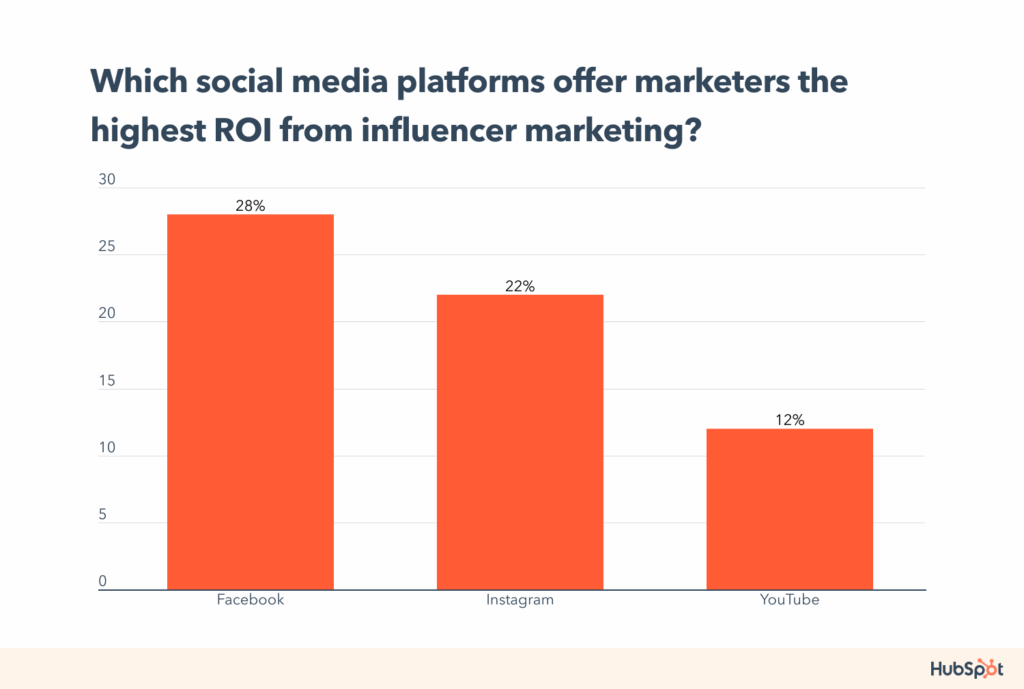
Cost efficiency extends beyond CPM metrics. Reels placements often deliver 20% to 30% higher click-through rates compared to Stories or Feed ads when the creative is optimized for the format.
This combination of lower cost and higher engagement creates significant ROAS improvements for brands that invest in proper Reels creative development.
Why Lookalike Audiences Are Becoming Obsolete
Lookalike audiences dominated Meta’s advertising strategy from 2015 through 2021. They represented the most sophisticated targeting option available. However, that era has definitively ended. iOS 14.5 privacy changes fundamentally broke the data foundation that made lookalikes effective.
Before iOS 14.5, Meta could track user behavior across websites and apps with precision. This granular data enabled accurate modeling of which users resembled high-value customers. Unfortunately, post-iOS 14.5, that tracking capability disappeared for most iOS users. As a result, the platform lost access to the behavioral signals that powered lookalike modeling.
Today, current Meta advertising relies on aggregated audience signals rather than static audience lists. The algorithm analyzes patterns across billions of users in real time. This dynamic approach adapts to changing user behavior instantly. Lookalike audiences, by contrast, represent a static snapshot that becomes outdated quickly.
Moreover, performance data confirms this shift conclusively. Campaigns using broad Advantage+ targeting now consistently outperform lookalike-based structures by 18% to 28% in cost per acquisition. Similarly, click-through rates for broad campaigns average 1.8% to 2.2%, while lookalike campaigns typically deliver 1.3% to 1.6%. Furthermore, the gap widens further when evaluating conversion quality and customer lifetime value.
Ultimately, the algorithmic approach to audience discovery represents a fundamental advancement. Meta’s AI can now identify intent signals that human marketers would never consider. Seasonal browsing patterns, cross-device behavior, engagement with competitor content, and dozens of other factors combine to create more accurate targeting than any manually constructed audience.
Inside Meta’s AI: How Creative Decisions Are Made
Dynamic Creative Optimization transforms how Meta tests and delivers ad variations. Essentially, DCO allows advertisers to provide multiple headlines, images, descriptions, and calls to action. Then, the algorithm tests thousands of combinations automatically to identify the highest-performing variations for each user segment.
Notably, the performance impact is substantial. Campaigns using DCO consistently achieve 20% to 30% lower CPMs compared to static creative approaches. Moreover, ads that used standard enhancements delivered 14% more incremental purchases per dollar spent by automatically adjusting brightness, aspect ratios, and text placement for optimal performance.
Meanwhile, the process operates through continuous feedback loops. Meta’s AI serves different creative combinations to small audience segments, measures engagement and conversion rates, then reallocates delivery toward winning variations. Importantly, this happens in real time across millions of impressions daily. As a result, no manual testing structure can match this velocity or scale.
Furthermore, creative signal feedback represents the system’s learning mechanism. The algorithm doesn’t just measure which ads perform better. Instead, it identifies why certain imagery, messaging, or formats resonate with specific audience segments. Consequently, this insight then informs future creative delivery across all campaigns in the account.
Human Plus AI Creative Synergy
Automation doesn’t eliminate the need for a human creative strategy. Instead, it changes what marketers should focus on. In fact, the most successful Meta Advantage+ campaigns combine algorithmic optimization with strategic human oversight and high-quality creative input.
Five principles guide effective creative testing for Advantage+ AI-powered campaigns. First, feed variety, not volume. Provide 5 to 8 distinct creative approaches rather than 20 minor variations of the same concept. Second, use high-contrast visuals that perform well on mobile screens. Third, keep one goal per creative asset to avoid confusing the algorithm’s optimization process.
Fourth, align the message to metric. Creative optimized for awareness should differ fundamentally from creative designed for conversion. Specifically, the Meta Advantage+ algorithm needs clear performance signals to learn effectively. Fifth, update creative assets every 3 to 4 weeks to combat ad fatigue and provide fresh learning data.
Ultimately, this human-AI partnership creates better outcomes than either could achieve alone. Marketers provide strategic direction, brand understanding, and creative quality. Meanwhile, the algorithm handles optimization speed, pattern recognition, and real-time adaptation. Together, they generate performance that manual management cannot match.
Budget Optimization: Letting AI Do the Heavy Lifting
Budget allocation represents one of the most impactful areas where automation outperforms manual management. Traditional campaign structures required marketers to manually distribute spending across ad sets based on performance data. This approach introduced delays, human bias, and suboptimal resource allocation.
Advantage+ eliminates these inefficiencies through real-time automated budget optimization. The system continuously monitors performance across all placements, audiences, and creative variations. It shifts spending toward the highest-performing combinations instantly. This creates a self-optimizing loop that manual management cannot replicate.
Performance data validates this approach decisively. The improvement stems from Meta’s ability to identify micro-opportunities that human analysis would miss. A placement might perform exceptionally well on Thursdays for users aged 25 to 34. The algorithm detects and capitalizes on these patterns automatically.
The optimization loop operates in three phases: learning, delivery, and iteration. During learning, the algorithm tests performance across available options. In delivery, it concentrates spending on proven winners.
Through iteration, it continues testing variations to prevent local optimization maxima. This cycle repeats continuously, creating performance improvements that compound over time.
Marketers maintain strategic control through objective selection and budget caps. The algorithm handles tactical execution and micro-optimization. This division of responsibility allows human expertise to focus on strategy while AI manages optimization at scale.
Mastering the Learning Phase: The 30 Conversion Rule
The learning phase determines whether Advantage+ campaigns succeed or struggle. Understanding how it works is essential for every marketer using Meta’s automation features. The platform needs sufficient conversion data to optimize effectively. Without it, performance remains inconsistent and costs stay elevated.
Meta’s algorithm requires approximately 30 conversions per week per ad set to exit the learning phase. This threshold provides enough data for the system to identify patterns and optimize delivery. Campaigns that never reach this volume remain stuck in perpetual learning, Three strategies accelerate the learning phase effectively.
First, combine ad sets to increase conversion volume per set. Rather than splitting audiences into multiple narrow segments, use broader targeting to consolidate conversions.
Second,temporarily increase daily budgets during the first week to generate conversion volume faster.
Third, consider optimizing for a higher-funnel event initially, then shifting to purchase optimization once volume increases.
Meanwhile, troubleshooting stuck learning phases requires systematic analysis. First, verify conversion tracking is working correctly through the Events Manager. Second, check that the campaign is receiving an adequate daily budget relative to target cost per conversion. Third, evaluate whether the target audience is large enough to support the conversion volume needed. Fourth, review creative performance to ensure ads are generating clicks and engagement.
Ultimately, when campaigns exit learning successfully, performance typically improves 15% to 25% in cost per acquisition within 7 to 14 days. Specifically, the algorithm shifts from exploration to exploitation, focusing on the delivery of the highest-performing combinations it identified during the learning phase.
Measuring ROI: Cost Per Lead Reality Check
Lead generation costs vary dramatically across platforms and industries. Understanding competitive benchmarks helps businesses evaluate their performance accurately. The average cost per lead across industries on Meta sits at $21.98, representing significant value compared to other platforms.
Platform comparison reveals strategic opportunities. Meta excels for visual products, lifestyle brands, and impulse purchases. Google dominates high-intent searches where users actively seek solutions. TikTok performs well for trend-driven products and younger demographics. The most sophisticated advertisers leverage all three platforms strategically rather than choosing just one.
Integrating Advantage+ Into Your Full Stack
Meta Advantage doesn’t operate in isolation. Maximum performance requires integration with CRM systems, analytics platforms, and first-party data sources. These connections enable the algorithm to learn faster and optimize more effectively.
Three integration points matter most. First, the Meta Advantage Conversions API provides server-side event tracking that captures data browser tracking might miss. This improves attribution accuracy and provides the algorithm with better optimization signals. Second, Customer Match uploads allow MetaAdvantage to target existing customers or high-value prospects directly.
Third, offline conversion uploads connect in-store purchases or phone sales back to original ad exposure.
First-party data dramatically improves AI accuracy. When Meta Advantage knows which ad exposures led to high-value purchases, it can identify similar patterns in future targeting. This creates a compounding advantage over time as the algorithm learns which signals predict valuable outcomes.
The data flow architecture should connect in both directions. Customer data flows into Meta to improve targeting. Conversion data flows back into CRM and analytics systems to measure business impact. This bidirectional integration creates a complete picture of advertising performance from impression through customer lifetime value.
Technical implementation requires coordination between marketing, development, and analytics teams. Most businesses benefit from working with experienced agencies that understand both the technical requirements and strategic implications. The initial setup complexity pays ongoing dividends through improved performance and measurement accuracy.
Creative Best Practices for AI Optimization
Creative quality determines Meta Advantage performance more than any other factor. The algorithm can only work with the assets marketers provide.
Superior creativity enables superior results. Several data-backed principles guide effective creative development for 2025.
Emotional storytelling creates memorable brand connections. Users don’t scroll social media to see advertisements. They want entertainment, connection, and inspiration. Creative that delivers these experiences while integrating products naturally performs best.
Specific formats consistently deliver strong results. User-generated content-style videos outperform polished studio production. Behind-the-scenes content creates authenticity that resonates with skeptical audiences. Problem-solution narratives that show transformation drive conversion effectively. Tutorial-style content provides value while demonstrating product benefits.
Testing remains essential despite automation. The algorithm optimizes delivery, but humans must provide the creative variations to test. Plan to develop 5 to 8 distinct creative approaches per campaign. Let Meta’s AI determine which performs best rather than relying on subjective judgment.
Troubleshooting Guide: When Advantage+ Fails
Advantage+ performs best when configured correctly. Underperformance usually stems from a few common issues:
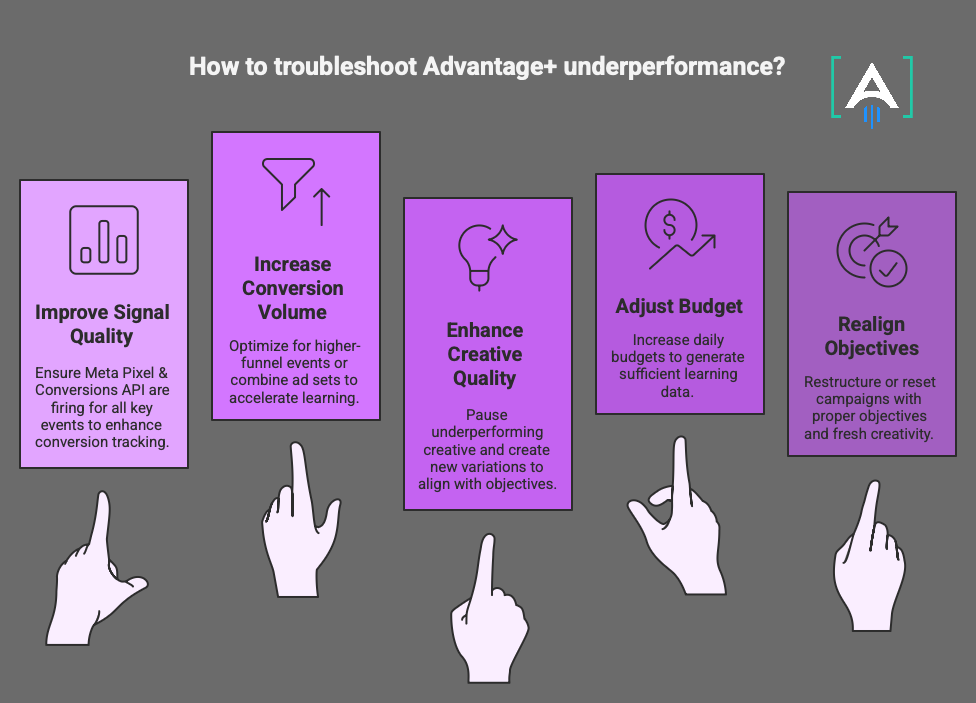
- Poor signal quality – Inadequate conversion tracking; ensure Meta Pixel & Conversions API are firing for all key events.
- Limited conversion volume – Algorithm stays in learning phase; optimize for higher-funnel events or combine ad sets to increase volume.
- Inconsistent creative quality – Confuses optimization; ensure all creative meets quality standards and align with campaign objectives.
- Budget underdelivery – Daily budgets too low; increase to 2–3x target cost per conversion to generate sufficient learning data.
- Misaligned objectives – Campaign objective doesn’t match business goals; restructure campaigns with correct objectives or reset if needed.
Solutions:
- Verify event tracking and implement Conversions API.
- Increase budgets or optimize for higher-funnel events to boost conversions.
- Pause underperforming creative and create new variations.
- Adjust daily budgets to support learning.
- Restructure or reset campaigns with proper objectives and fresh creativity.
The Rise of Agentic AI SaaS in Paid Social
Advantage+ represents the first mainstream application of Agentic AI SaaS principles in advertising. Essentially, this technology category uses autonomous AI agents that make decisions and take actions to achieve defined goals. Importantly, the approach differs fundamentally from traditional automation.
Traditionally, automation follows predefined rules. If the cost per click exceeds $2, pause the campaign. In contrast,Agentic AI learns patterns and makes strategic decisions. For instance, it might increase spending on a seemingly expensive placement because it identifies high lifetime value customers that traditional analysis would miss.
Similarly, Advantage+ demonstrates this principle through its audience discovery and budget allocation features. The system doesn’t just execute rules. Instead, it identifies opportunities, tests hypotheses, and adapts strategy based on results. Clearly, this represents a genuine advancement in marketing technology, not just an incremental improvement.
Looking ahead, the next evolution extends these principles across the entire marketing stack. Full-stack Agentic systems will integrate learnings across Meta, Google, TikTok, email, and owned media. Furthermore, they’ll identify patterns that span channels and optimize holistically rather than in silos. Ultimately, this cross-platform intelligence creates competitive advantages that single-platform optimization cannot achieve.
Meanwhile, forward-thinking agencies are building these Agentic frameworks now. They connect data across platforms, implement unified measurement, and leverage AI to identify optimization opportunities humans would miss. Indeed, this represents the future of performance marketing as automation becomes more sophisticated and integrated.
Trust the Algorithm, But Train It Well
Meta Advantage automation is outperforming manual campaigns across every major performance metric. The data is clear and consistent. Advertisers using Advantage+ shopping campaigns are seeing a 32% increase in return on ad spend compared to traditional approaches. Instagram Reels deliver cost-efficient reach at $4.29 CPM.
Lead costs average $21.98 across industries, substantially lower than alternative platforms.
This represents a fundamental evolution in digital marketing. The future belongs to businesses and agencies that understand Agentic AI SaaS principles and implement them effectively. Choosing the right marketing partner makes this transition significantly easier and more successful.
[A] Growth Agency specializes in building AI-powered growth systems that leverage Advantage+ and other Agentic marketing technologies. Our team combines deep platform expertise with strategic business understanding to deliver measurable revenue growth. We don’t just run campaigns.
We build comprehensive marketing systems that scale efficiently and improve continuously through AI-driven optimization.
Partner with Azarian Growth Agency to build your AI-powered growth engine. Schedule a consultation with Hamlet Azarian today to discover how agentic AI SaaS can transform your Meta advertising performance and accelerate business growth.