

Marketing budget allocation by channel determines whether your investment drives growth or gets wasted on underperforming tactics. Digital marketing now accounts for 57.1% of total marketing budgets, yet many executives still allocate resources based on historical precedent rather than performance data. Fast-growing companies take a different approach: they continuously analyze channel performance and reallocate budgets toward what actually works.
The challenge isn’t just deciding how much to spend. The real question is how to distribute that budget across multiple channels to maximize return. Should you invest heavily in paid search, double down on content marketing, or explore emerging platforms? The answer depends on your business model, growth stage, and target audience.
In this guide, we’ll show executives how fast-growing companies allocate their marketing budgets by channel. Whether managing internal teams or partnering with growth marketing agencies, these benchmarks help you make informed decisions about channel mix.
The Current State Of Marketing Budget Allocation By Channel
Understanding how leading companies allocate budgets provides context for your own planning. Social media receives 11.3% of total marketing budgets, content marketing gets 10.2%, and paid search receives 9.8%, according to recent CMO surveys.
Top Channel Investments:
- Social media: 11.3% of marketing budget
- Content marketing: 10.2% of marketing budget
- Paid search: 9.8% of marketing budget
- SEO and organic: 8% to 12%, depending on industry
- Email marketing: 5% to 8% of marketing budget
These averages serve as benchmarks, but your allocation should reflect your unique business and channel performance.
B2B Versus B2C Allocation Patterns
The business model fundamentally affects the optimal channel mix. B2B and B2C companies allocate budgets differently based on where their customers actually engage.
B2B Channel Priorities: Website, blog, and SEO efforts drive the highest ROI for B2B brands. Paid social media content ranks second, with LinkedIn typically receiving the largest share. Content marketing supports longer sales cycles common in B2B.
B2C Channel Priorities: Email marketing delivers the strongest ROI for B2C brands. Paid social media content ranks second. Social media shopping tools provide the third-highest returns as consumers increasingly purchase directly through social platforms.
The 70/20/10 Framework For Marketing Budget Allocation By Channel
Fast-growing companies use the 70/20/10 framework to balance proven tactics with growth opportunities and experimentation.
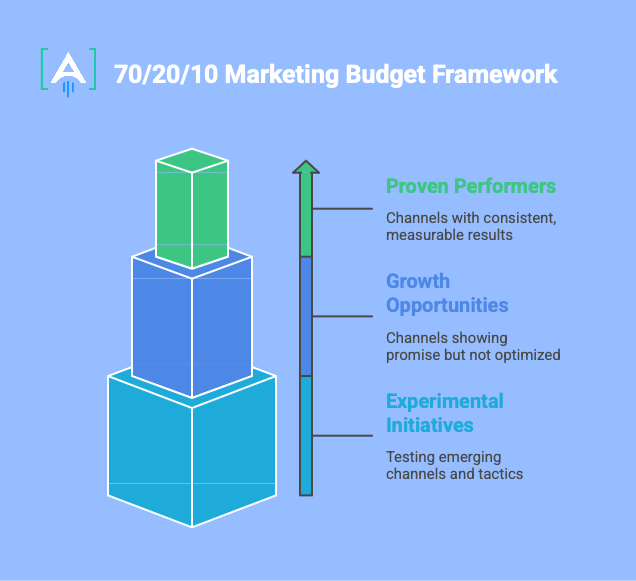
70% To Proven Performers
Allocate the majority of your budget to channels delivering consistent, measurable results. These are your reliable revenue drivers that fund the rest of your marketing efforts.
For most companies, this includes channels like paid search for high-intent keywords, SEO for long-term organic traffic, and email marketing for nurturing existing relationships. Data should guide which specific channels earn this allocation.
20% To Growth Opportunities
Reserve a portion of the budget for channels that show promise but are not yet fully optimized. This might include expanding into new social platforms, testing influencer partnerships, or scaling content production.
Growth channels have demonstrated some success but need additional investment to reach full potential. Track these carefully and promote successful experiments into the 70% category.
10% To Experimental Initiatives
Maintain a small budget for testing emerging channels and tactics. This experimentation budget prevents stagnation and helps you identify future growth opportunities before competitors.
Test new platforms, formats, or strategies without risking core performance. Many of today’s proven channels started as small experiments that showed unexpected potential.
How Business Stage Affects Marketing Budget Allocation By Channel
Your growth stage determines which channels deserve the largest allocations.
Early Stage Companies
Early-stage companies with limited budgets must ruthlessly focus their resources. Allocate heavily to channels with the fastest time-to-results and clearest attribution.
Paid search typically receives 30% to 40% of the budget for targeting high-intent buyers. Content marketing accounts for 20% to 30% of building organic visibility. Social media accounts receive 15% to 25% of their audience-building and engagement.
Growth Stage Companies
Growing companies can diversify across more channels while maintaining an efficiency focus. Budget spreads more evenly as you scale what works and test new opportunities.
Typical allocation includes 25% to 30% for content and SEO, 20% to 25% for paid search, 15% to 20% for paid social, 10% to 15% for email marketing, and 10% to 15% for emerging channels and testing.
Mature Companies
Mature companies emphasize brand building and market share maintenance alongside direct response tactics. Allocations balance immediate results with long-term positioning.
Budget often includes 30% to 35% for brand and content marketing, 20% to 25% for paid search, 15% to 20% for paid social, 10% to 15% for retention and email, and 10% to 15% for innovation and new channels.
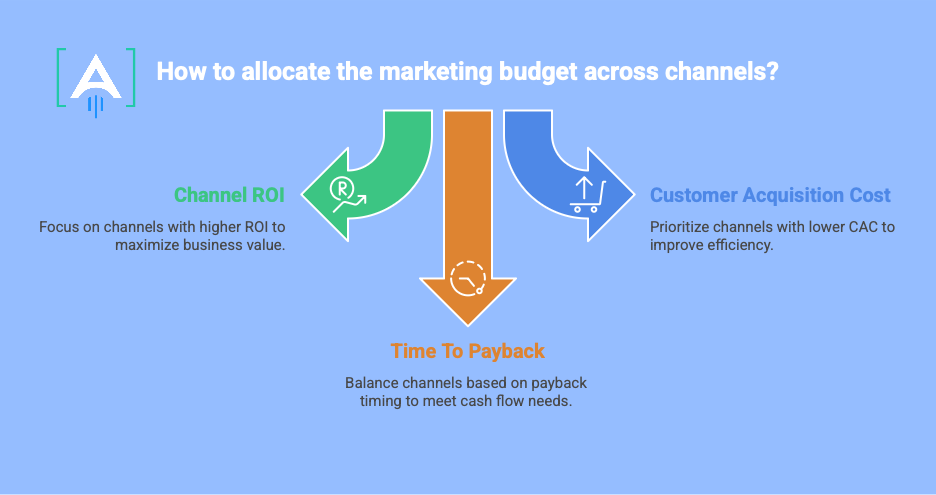
Key Metrics For Evaluating Marketing Budget Allocation By Channel
Track metrics to determine if your allocation works or needs adjustment.
Channel Specific ROI
Calculate return on investment for each channel independently. This reveals which allocations drive real business value versus which drain resources.
Track revenue generated per dollar spent by channel. Include both direct and assisted conversions in attribution modeling. Compare channel performance to identify reallocation opportunities.
Customer Acquisition Cost By Channel
CAC varies significantly across channels. Understanding these differences helps optimize budget allocation for efficiency.
Channels with lower CAC relative to customer lifetime value deserve larger budget allocations. High-CAC channels need optimization or reduced investment unless they serve other strategic purposes, such as brand building.
Time To Payback By Channel
Some channels deliver immediate results while others require patience. Factor payback timing into allocation decisions.
Paid search typically delivers fast payback. SEO requires three to six months before showing strong returns. Content marketing compounds over time. Balance your mix based on your cash flow situation and growth timeline.
Common Mistakes In Marketing Budget Allocation By Channel
Avoid these frequent errors that undermine channel mix effectiveness.
Mistake 1: Equal Distribution Across All Channels
Spreading the budget evenly across all channels dilutes impact. Not all channels perform equally, and treating them identically wastes money on underperformers while underfunding winners.
Mistake 2: Setting And Forgetting Annual Budgets
Market conditions change, channel performance shifts, and new opportunities emerge. Annual budgets without quarterly reviews miss opportunities for reallocation that could significantly improve results.
Mistake 3: Ignoring Channel Synergies
Channels don’t operate in isolation. Paid social builds awareness that improves email open rates. SEO content supports paid search quality scores. Account for these interactions when evaluating performance.
Mistake 4: Chasing Vanity Metrics
Focus allocation decisions on business outcomes, not engagement metrics. Impressions, clicks, and likes matter only when they drive revenue. Allocate based on conversions and customer acquisition, not activity levels.
Adjusting Marketing Budget Allocation By Channel Quarterly
Regular reviews ensure your allocation remains optimal as conditions evolve.
Quarterly Performance Review Process
Evaluate each channel’s performance against targets every 90 days. Look for trends rather than reacting to monthly fluctuations.
Review Checklist:
- ROI by channel compared to targets
- Customer acquisition cost trends
- Budget utilization and pacing
- Competitive landscape changes
- New channel opportunities are emerging
Make allocation adjustments based on data, not opinions or preferences.
When To Reallocate Between Channels
Shift budgets when evidence clearly shows performance changes requiring a response.
Move budget from channels showing declining ROI to those delivering improving returns. Increase investment in channels, hitting capacity constraints with room to scale. Cut the budget for channels that consistently underperform despite optimization efforts.
Conclusion: Optimizing Marketing Budget Allocation By Channel
Marketing budget allocation by channel isn’t a set-it-and-forget-it decision. Fast-growing companies continuously analyze performance and reallocate resources to the channels that drive real business results.
The 70/20/10 framework provides a starting structure: 70% to proven performers, 20% to growth opportunities, and 10% to experimentation. Your specific business stage, model, and target audience determine which channels deserve the largest allocations within this framework.
Many executives find that working with growth marketing agencies helps optimize channel allocation. Agencies bring cross-company experience, showing which channel mixes work in different situations. They also provide objective, data-driven analysis free from internal politics or historical precedent.
This is where [A] Growth Agency comes in. We help companies translate strategy into execution by aligning budgets with channels that generate measurable impact. Our work spans content marketing, AI-driven marketing, SEO, email marketing, performance optimization, and analytics, enabling leadership teams to test, scale, and rebalance channel investments with confidence.
Struggling with channel mix decisions?
Get expert guidance on optimizing your marketing budget allocation based on real performance data, not guesswork.