
LinkedIn ads are experiencing a revolutionary transformation as signal-based AI targeting enables B2B marketers to reach decision-makers at the precise moment they’re ready to buy. Business owners and CEOs who master this combination unlock unprecedented campaign performance and dramatically lower customer acquisition costs.
The platform now reaches 1.2 billion users with ad capabilities, including over 40 million decision-makers in influential positions. Moreover, 68% of B2B marketers are increasing their investment in intent data to drive faster sales and a larger pipeline.
This convergence of LinkedIn’s professional targeting with AI-powered buying signals creates the most sophisticated B2B advertising opportunity ever available.
In this guide, we’ll reveal how to combine LinkedIn’s AI targeting capabilities with signal-based outreach for hyper-personalized campaigns, identify buying signals through AI, implement dynamic ad personalization, and integrate LinkedIn ads with tools that slash cost per lead while reaching your ICP at peak buying intent.
Understanding LinkedIn AI Targeting and Signal-Based Advertising
LinkedIn AI targeting leverages machine learning to analyze engagement data, first-party information, and behavioral patterns. The platform’s Predictive Audiences feature creates new audience segments predicted to take actions similar to your source data.
Furthermore, this technology operates similarly to Meta’s Advantage+ but with B2B-specific signals. The system identifies patterns in job titles, company engagement, and professional behavior that human marketers would miss. Early adopters using Predictive Audiences for lead gen objectives saw a 21% reduction in cost-per-lead.
Signal-based advertising extends beyond LinkedIn’s platform data. It incorporates intent signals from across the web: content consumption, comparison searches, technology stack changes, and competitive research. When someone researches your category, reviews competitors, or exhibits buying behavior, these signals indicate readiness.
How Intent Signals Transform B2B Advertising
Traditional B2B advertising targets firmographics: company size, industry, job title. This approach reaches the right people but at the wrong time. Most of your target market isn’t in-market right now; 95% aren’t ready to buy, though 70% will be within 18 months.
Intent signals solve the timing problem. They reveal which accounts are actively researching solutions in your category. Consequently, your PPC agency campaigns can prioritize accounts showing genuine buying interest rather than cold prospects.
The average B2B sales cycle lasts 4-6 months. Intent data allows marketers to intercept opportunities before competitors, and 35-50% of deals go to the vendor that responds first to a prospect’s interest. Signal-based targeting ensures your LinkedIn ads appear when decision-makers are researching, not months before or after.
The LinkedIn Advantage for Intent-Based Campaigns
LinkedIn’s professional context makes it uniquely valuable for signal-based advertising. Users access the platform while in a business mindset, researching solutions and evaluating vendors. This intent-rich environment amplifies targeting effectiveness.
Additionally, 80% of all B2B social media leads come from LinkedIn, surpassing Meta and Google. When you layer intent signals onto LinkedIn’s professional targeting, campaign performance compounds dramatically.
The platform’s advertising reach grew by 13.9% in just one year, adding 125 million potential users. This expanding audience, combined with AI targeting, creates unprecedented scale for signal-based campaigns.
Identifying Buying Signals Through AI
AI identifies buying signals humans would never catch manually. Machine learning analyzes patterns across millions of data points: content engagement, search behavior, technology evaluations, and competitive research.
First-party intent signals come from your owned properties. Website behavior, email engagement, content downloads, and product demo interactions reveal interest levels. When prospects visit pricing pages repeatedly, engage with case studies, or explore specific features, they signal buying intent.
Third-party intent signals track behavior across the broader web. Platforms like Bombora monitor 5,000+ B2B sites where buyers actively research when ready to purchase. When someone reads competitor reviews, downloads industry reports, or researches solutions in your category, these signals indicate market readiness.
Key Intent Signals That Predict Purchase Readiness
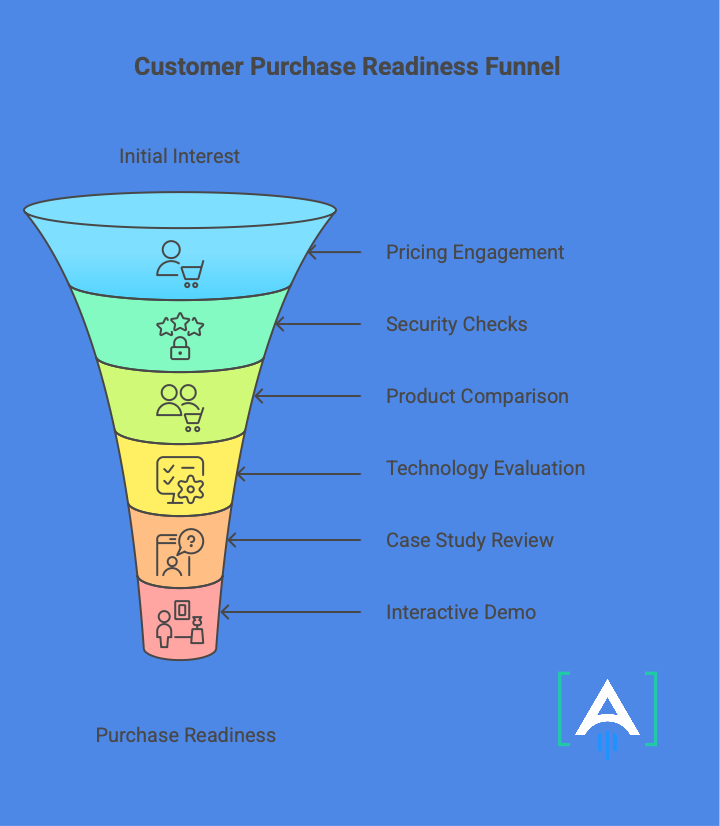
High-value intent signals include:
- Pricing page visits and repeated engagement with cost information
- Security and compliance page views indicating advanced purchase discussions
- Product comparison research across multiple vendor sites
- Technology stack evaluation and integration compatibility checks
- Case study consumption seeking real-world validation
- Interactive demo engagement showing active solution exploration
Moreover, combining multiple signals creates stronger predictions. A single page view means little, but three high-intent actions within seven days signal genuine buying interest. Businesses using intent data increase conversion rates by 2.5x compared to traditional lead gen campaigns.
AI-powered platforms aggregate these signals, score account readiness, and trigger campaign activation. When accounts cross defined thresholds, your LinkedIn ads automatically serve to decision-makers within those organizations.
Building Your Signal Detection Infrastructure
Effective signal-based advertising requires proper infrastructure. Install LinkedIn’s Insight Tag to track website visitors and build retargeting audiences. This pixel captures 38% more accurate audience targeting according to platform data.
Implement website analytics that identify high-intent page visitors. Tools like Clearbit Reveal or RB2B deanonymize visitors, connecting individual behavior to company accounts. When high-value prospects visit critical pages, immediate alerts trigger sales follow-up.
Integrate data analytics and reporting platforms that unify first-party and third-party signals. GA4’s data-driven attribution model uses machine learning to weigh channel contributions. Enhanced conversions upload first-party data to improve match rates across privacy-restricted environments.
Dynamic Ad Personalization for Intent-Driven Campaigns
Static ads underperform in signal-based campaigns. When you know prospects are researching specific solutions, generic messaging wastes the opportunity. Dynamic personalization adapts creatives to individual account context and buying stage.
LinkedIn’s dynamic ads automatically customize content using profile data: name, photo, job title, and company. When combined with intent signals, this personalization becomes surgical. Prospects researching integration capabilities see ads highlighting your API and partnership ecosystem. Those evaluating security receive compliance-focused messaging.
AI content optimization ensures ads resonate with specific buyer needs. Natural language processing identifies pain points from customer feedback. AI copywriting incorporates these phrases into a creative that authentically reflects customer voice.
Creative Strategies That Convert Signal-Based Traffic
JPMorgan Chase tested AI-generated ad copy variations and found the best version lifted click-through rates by 450% compared to human-written ads. This dramatic improvement demonstrates AI’s power in creative optimization.
Context becomes everything in intent-driven advertising. Users engaging with specific research topics have intent shaped by that exploration. Your ads must align with their current mindset rather than generic value propositions.
High-performing creative elements include:
- Pain point specificity addressing exact challenges prospects research
- Proof points relevant to their evaluation stage (case studies for late-stage, thought leadership for early-stage)
- Personalized value propositions connecting features to their specific use cases
- Dynamic testimonials from similar companies in their industry
- Stage-appropriate CTAs (educational content for early research, demos for late-stage)
Testing velocity matters more than perfection. Successful brands test 20-50 creative variants weekly, letting data identify winners. This volume requires AI assistance; manual production can’t maintain the pace necessary for continuous optimization.
Automated Campaign Triggers Based on Signal Strength
Signal-based campaigns operate automatically, launching when accounts reach defined thresholds. Set minimum criteria like “3 high-intent actions in 7 days” to trigger ad serving. This prevents wasting budget on weak signals while ensuring a fast response to genuine interest.
Campaign automation platforms enable sophisticated workflows. When prospects engage with interactive demos, immediate retargeting campaigns serve case studies. After pricing page visits, ads highlight ROI calculators and implementation timelines. This sequential messaging guides prospects through buying journeys.
Moreover, social media marketing automation synchronizes LinkedIn campaigns with email nurture and sales outreach. When intent signals fire, coordinated touchpoints across channels create cohesive buying experiences.
Integrating LinkedIn Ads With Clay and Smartlead
LinkedIn advertising reaches maximum effectiveness when integrated with sales intelligence and outreach platforms. Clay and Smartlead enable hyper-personalized campaigns combining LinkedIn’s targeting with advanced automation.
Clay aggregates data from 75+ sources, enriching LinkedIn audiences with intent signals, technographic data, funding information, and hiring patterns. This enrichment transforms basic LinkedIn targeting into precision account selection based on multiple buying indicators.
The platform’s AI research agent analyzes accounts at scale, identifying personalization opportunities human researchers would miss. When combined with LinkedIn’s professional targeting, this creates advertising campaigns that feel individually crafted rather than mass-distributed.
Building Integrated Signal-Based Workflows
Effective integration requires systematic workflows connecting data sources, ad platforms, and outreach tools. Start with account identification using intent signals and LinkedIn targeting criteria. Clay enriches these accounts with additional context: technology stack, recent funding, leadership changes, and competitive displacement opportunities.
LinkedIn ads warm these accounts through targeted awareness campaigns. Sponsored content, video ads, and thought leadership establish familiarity before direct outreach. This content marketing approach builds trust that cold outreach alone cannot achieve.
Smartlead automates personalized email sequences triggered by LinkedIn ad engagement. When prospects view ads multiple times or click through to landing pages, automated outreach begins with context-aware messaging. This multi-touch approach combines paid visibility with direct communication.
Integrated workflow components:
- Intent signal detection identifying in-market accounts
- Clay enrichment adding context and personalization data
- LinkedIn ad campaigns warming target accounts
- Engagement tracking monitoring ad interactions
- Smartlead automation triggering personalized outreach
- CRM integration maintaining unified account records
Measuring Multi-Touch Attribution
Standard attribution models break down in signal-based campaigns. LinkedIn ad impressions, website visits, email engagement, and sales conversations all contribute to conversions. Multi-touch attribution assigns credit across the entire journey.
Track the impression-to-answer rate, measuring how often your brand appears in prospects’ research. Monitor assisted conversions, capturing touchpoints that don’t generate immediate clicks but influence eventual purchases. Analyze view-through conversions for users exposed to ads who later convert through other channels.
LinkedIn’s Campaign Manager provides detailed performance data, but complete attribution requires connecting platform metrics to CRM outcomes. Data analytics and reporting expertise helps build these measurement systems, quantifying ROI from signal-based investments.
Advanced Targeting Strategies for Maximum ROI
LinkedIn’s targeting capabilities extend far beyond basic job title selection. Advanced strategies combine multiple targeting layers with intent signals for precision audience building.
Matched Audiences enable retargeting website visitors, uploading contact lists, and implementing account-based marketing strategies. For website retargeting, the LinkedIn Insight Tag tracks and re-engages visitors. With contact targeting, upload existing customer or prospect email lists for precise audience building.
Account-based targeting focuses on specific companies using the Account Targeting feature. This proves particularly valuable for enterprise B2B campaigns targeting defined account lists. Best practices include maintaining minimum list sizes of 300 matched records and regularly updating contact lists for better match rates.
Audience Sizing and Budget Optimization
Finding the right balance between audience size and budget allocation proves critical for campaign success. Aim for audience sizes between 50,000 and 300,000 members. Smaller audiences limit learning and scale; larger audiences dilute targeting precision.
Narrower audience targeting under 50,000 members delivers 37% higher CTR according to platform benchmarks. However, these audiences require a sufficient budget for statistical significance. Start with a $1,380 monthly spend, the average per advertiser on LinkedIn.
Dynamic bidding strategies automatically optimize spend based on conversion probability. Maximize Conversions and Target ROAS each capture about 33% of advertiser spend. These automated approaches analyze thousands of signals in real time, adjusting bids hundreds of times daily.
Predictive Audiences and AI Expansion
LinkedIn’s Predictive Audiences now incorporate company lists and retargeting sources, expanding targeting capacity significantly. This proves particularly valuable for B2B marketers enabling exclusions and expanded business profiling based on performance insight.
The technology analyzes on-platform engagement data alongside your first-party data: conversions API data, lead gen forms, and CRM information. By identifying patterns and similar characteristics, it creates audiences predicted to convert like your best customers.
Give Predictive Audiences time to learn and sufficient budget to test. Underfunded campaigns lack data for effective optimization. Allocate 15-20% of budget to AI-powered targeting while maintaining traditional campaigns for comparison and critical brand terms.
Building Your Signal-Based LinkedIn Strategy
Implementing signal-based LinkedIn advertising requires a systematic approach. Start with foundation building: install tracking infrastructure, establish intent data sources, and integrate platforms.
Define your ideal customer profile with precision. Move beyond basic firmographics to behavioral characteristics: which content do best customers consume, what triggers their buying process, how long do evaluations typically last. These insights inform signal selection and campaign design.
Phase One: Foundation and Testing
Begin with pilot campaigns targeting known high-intent accounts. Use existing customer lists as Matched Audiences, then expand with Predictive Audiences to find similar prospects. This controlled approach validates signal quality before scaling.
Test multiple creative variations addressing different pain points and buying stages. A/B test systematically, focusing on one variable at a time. Run tests for at least two weeks maintaining statistical significance with adequate sample sizes.
Monitor campaign metrics daily: CTR, conversion rates, and cost-per-lead trends. Track which signals predict conversions most accurately. Document all test results and insights for future optimization.
Phase Two: Integration and Automation
Connect LinkedIn campaigns with Clay for enrichment and Smartlead for automated outreach. Build workflows that trigger based on ad engagement and intent signal strength. Ensure CRM integration maintains unified account records across touchpoints.
Implement multi-touch attribution tracking impression-based conversions alongside click-through metrics. This reveals signal-based advertising’s full value, including influenced conversions that don’t generate immediate clicks.
Gradually increase budget allocation to top-performing signal-based campaigns. Scale successful targeting combinations while maintaining experimental budget for testing new approaches.
Phase Three: Optimization and Scale
Refine audience definitions based on conversion data. Which intent signals predict purchases most accurately? What account characteristics correlate with fastest sales cycles? Use these insights to sharpen targeting continuously.
Expand creative testing velocity using AI-generated variations. Analyze which messages resonate with specific account segments. Build dynamic creative libraries that automatically serve optimal combinations.
Branding agency partnerships help create distinctive positioning that AI systems recognize and communicate. Generic messaging struggles in competitive markets; clear differentiation wins signal-based campaigns.
The Future of LinkedIn AI Targeting
LinkedIn continues investing heavily in AI capabilities. Conversational ads with AI-powered responses, enhanced analytics for real-time optimization, and expanded Predictive Audiences functionality all point toward increasingly sophisticated targeting.
The platform’s advertising revenue reached $8.2 billion in 2025, with B2B brands accounting for 85% of total spend. This massive investment funds continued innovation in AI targeting and campaign automation.
Video ad usage is expected to grow 35% in the coming year, with AI-powered creative optimization becoming standard. Interactive ad formats like polls and carousels trend upward, providing additional engagement signals for targeting refinement.
Account-based marketing campaigns on LinkedIn already deliver 200% better ROI than traditional approaches. As AI targeting improves, this advantage will compound further, making signal-based advertising increasingly essential for B2B success.
Conclusion
LinkedIn ads combined with signal-based AI targeting represent the most powerful B2B advertising approach available today. The platform’s 1.2 billion user reach, 40 million decision-makers, and 113% B2B ROAS create an unmatched opportunity when layered with intent signals.
Business owners and CEOs implementing these strategies achieve 67% lower cost per lead, 2.5x higher conversion rates, and dramatically shorter sales cycles. The key lies in reaching your ICP precisely when they’re most ready to buy, not months before or after.
Azarian Growth Agency combines over 20 years of growth marketing expertise with cutting-edge AI capabilities. We’ve helped clients secure over $4 billion in funding and generate more than $500 million in revenue through data-driven strategies that leverage platforms like LinkedIn at maximum effectiveness.
Our approach integrates AI marketing agency capabilities with deep B2B expertise. We build signal-based targeting infrastructure, create dynamic personalization systems, and implement multi-touch attribution that quantifies every campaign’s true impact. Additionally, our PPC agency services ensure your LinkedIn investment drives measurable pipeline growth.
Partner with us to build your signal-based LinkedIn advertising strategy. We combine technical platform expertise with strategic vision, helping you reach decision-makers when they’re actively searching for solutions like yours.