
AI Content Marketing Prompts: 7 Production-Ready Prompts for ChatGPT, Claude & Gemini
Most content marketing teams are burning time on the wrong tasks. You’ve probably invested in AI writing tools like ChatGPT, Jasper, or Copy.ai, expecting them to solve your content production bottleneck. But three months later, your team still spends hours researching competitors, analyzing keywords, and planning content strategy before writing a single word.
The problem isn’t the writing. It’s everything that happens before writing.
At Azarian Growth Agency, we built Content Engine to automate complete content workflows. Our AI marketing services focus on the research and strategy phases that consume 70% of content production time. In webinar 16, we demonstrate how automating the judgment layer; not just the execution layer, reduces article production from 70 minutes to 7 minutes.
This guide explains why AI writing tools fail to deliver meaningful productivity gains and what the judgment layer concept means for your content operations.
Understanding the Two Layers of Content Creation
Content production splits into two distinct phases that require fundamentally different capabilities.
The Execution Layer: Writing the Words
The execution layer involves putting words on the page. Drafting sentences. Choosing vocabulary. Structuring paragraphs. Refining tone and voice.
This is what most AI writing tools automate. You provide a topic and outline, the tool generates draft text, you edit for quality and brand voice. In content marketing, this layer is often the most visible because the output is what readers interact with directly.
Traditional AI writing tools focus here because it’s technically straightforward. Language models excel at text generation. The demos look impressive. But this layer represents only 30-40% of total content production time, even in content marketing teams.
The Judgment Layer: Making Strategic Decisions
The judgment layer encompasses everything before writing. Competitive research. Keyword analysis. Angle selection. Outline creation. Content gap identification. Strategic positioning.
This phase requires analysis, comparison, and strategic thinking. It answers fundamental questions:
- What are competitors covering on this topic?
- What angles are oversaturated versus underexplored?
- What keywords should we target for maximum search visibility?
- How should we structure content to differentiate from competitors?
- What unique value can we provide that others haven’t?
Marketing teams spend 30-45 minutes per article on judgment layer work according to Content Marketing Institute research. Yet most AI tools provide zero automation for this phase, which is a major bottleneck in content marketing strategies.
Why the Judgment Layer Is Your Real Bottleneck
Content directors managing teams of 5-8 writers consistently report the same pattern. Writers don’t struggle with drafting. They struggle with research and strategic planning.
The Manual Research Process Takes Too Long
Here’s what happens before your team writes a single word:
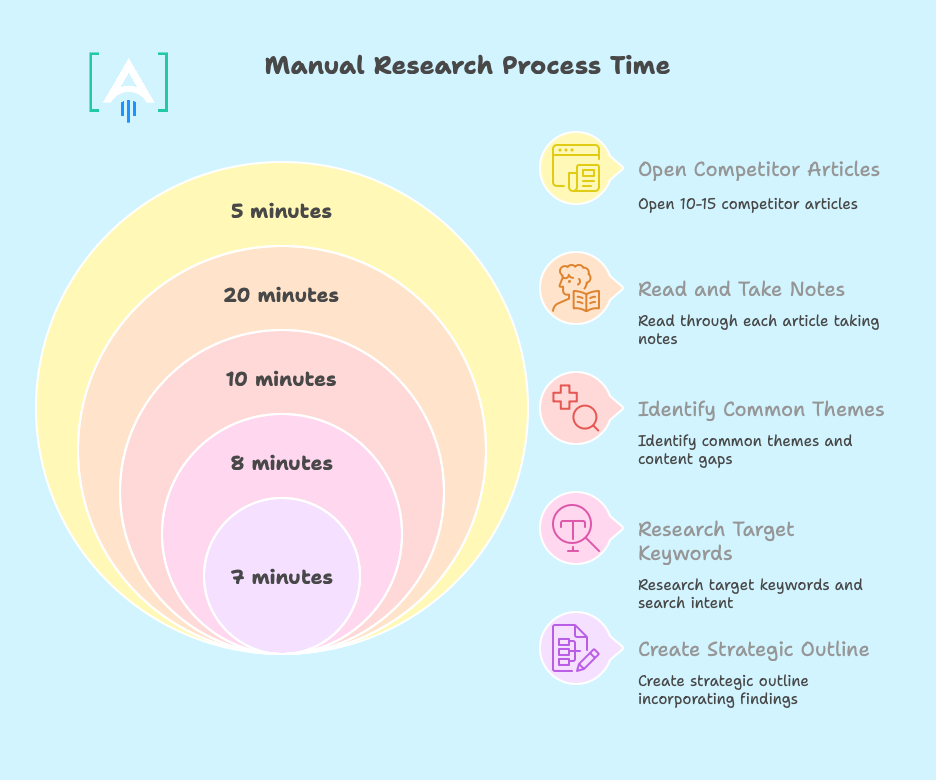
- Open 10-15 competitor articles in browser tabs (5 minutes)
- Read through each article taking notes (20 minutes)
- Identify common themes and content gaps (10 minutes)
- Research target keywords and search intent (8 minutes)
- Create strategic outline incorporating findings (7 minutes)
Total time: 50 minutes of judgment layer work before 20 minutes of execution layer writing.
Writer Skill Gaps Compound the Problem
Most content writers aren’t SEO strategists. They don’t naturally think about search intent, keyword optimization, or competitive positioning. They excel at crafting compelling narratives and maintaining brand voice.
Asking writers to perform deep competitive analysis and SEO strategy is like asking your accountant to also handle sales. Different skill sets. Different mental models. Suboptimal results.
Quality Inconsistency Across Team Members
Some writers naturally understand strategic content planning. Others focus purely on creative execution. This creates quality inconsistency where articles from different team members vary dramatically in strategic depth.
Your top writer produces well-researched, strategically positioned content. Your newest writer produces fluffy articles that miss competitive opportunities. Managing this inconsistency requires director-level review of every piece.
Scaling Requires Expensive Hiring
The traditional solution to content scaling is hiring more writers. But this multiplies your judgment layer bottleneck. Five writers each spending 50 minutes on research means 250 minutes of research time per five articles.
At $50-75 per hour for skilled content writers, you’re paying $200-300 in labor costs just for research before generating any drafts. Our SEO services focus on automating this expensive research phase.
Why Traditional AI Writing Tools Don’t Solve This
ChatGPT, Jasper, Copy.ai, and similar tools promised to revolutionize content production. They haven’t. Here’s why.
They Automate the Fast Part
Writing is already the faster part of content creation. Experienced writers draft 3,000-word articles in 20-30 minutes once research is complete.
AI writing tools make this even faster; maybe 10-15 minutes. But you’ve only saved 10-15 minutes while the 50-minute research phase remains completely manual.
Total time reduction: 15%. Not the 10x improvement marketing promised.
They Still Require Manual Research
Every AI writing tool requires you to provide:
- Target topic and angle
- Competitive landscape context
- Key points to cover
- Strategic positioning
You’re doing all the judgment layer work manually, then using AI for the easy execution layer work. The bottleneck remains untouched, which means content marketing teams still spend a lot of time on research rather than scaling strategy.
They Don’t Provide Competitive Intelligence
ChatGPT doesn’t know what your competitors published last week. It can’t analyze their content strategy. It doesn’t identify gaps in their coverage or opportunities for differentiation.
You still need to manually research 10-15 competitor articles, analyze their approaches, and identify strategic opportunities. Then you feed this analysis to the AI writing tool—a critical step for effective content marketing.
They Create a False Sense of Productivity
Teams feel productive because they’re generating content faster. But total time from topic selection to published article barely improves.
According to HubSpot’s 2024 State of Marketing Report, 82% of marketers use AI writing tools, yet only 23% report significant time savings. The disconnect comes from automating the wrong layer, a mistake many content marketing teams make when they focus only on execution.
The Judgment Layer Automation Approach
Automating the judgment layer requires fundamentally different AI capabilities than text generation. You need analysis, comparison, and strategic reasoning.
Competitive Research Automation
Instead of manually reading 10-15 competitor articles, AI systems analyze them automatically:
- Extract main topics and subtopics covered
- Identify content structure and organization patterns
- Analyze depth of coverage for each section
- Compare approaches across multiple competitors
- Calculate content gaps and opportunities
This analysis happens in 2-3 minutes versus 30 minutes manually. More importantly, it’s systematic and comprehensive. Human researchers unconsciously skip details or miss patterns. Automated analysis catches everything.
Strategic Outline Generation
With competitive intelligence gathered, AI can generate strategically optimized outlines:
- Include topics competitors covered well (table stakes)
- Emphasize topics competitors covered poorly (differentiation opportunities)
- Add unique angles competitors missed entirely (competitive advantage)
- Structure for optimal user experience and search visibility
- Incorporate target keywords naturally throughout
The outline isn’t generic. It’s strategically crafted based on actual competitive analysis of your specific topic and market.
Content Gap Identification
The most valuable judgment layer capability is identifying what to say differently. Automated systems compare your planned content against competitor coverage:
- Which topics are oversaturated and should be summarized briefly?
- Which topics are underexplored and deserve deep coverage?
- What questions are competitors failing to answer?
- What practical examples are missing from existing content?
This strategic intelligence transforms commodity content into differentiated assets. Our webinar marketing agency uses this approach to create unique event content.
AI Content Marketing Prompts: 7 Production-Ready Prompts for ChatGPT, Claude & Gemini
How to Evaluate Your Judgment Layer Bottleneck
Most content teams don’t realize how much time they spend on judgment layer work because it’s fragmented throughout the process.
Track Time Per Content Phase
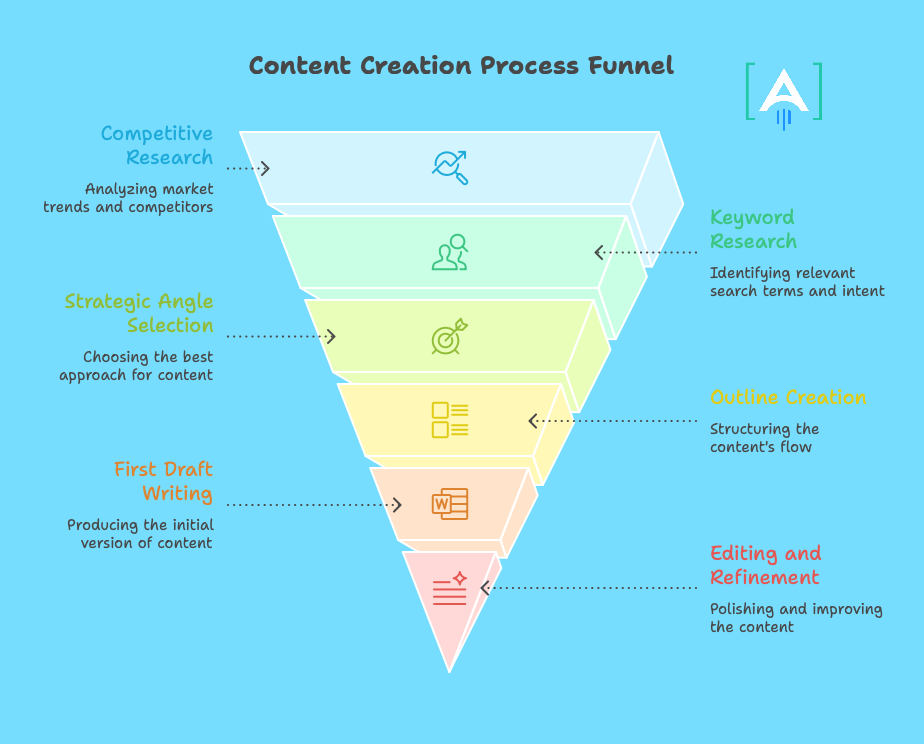
For your next 10 articles, track time spent in each phase:
- Competitive research and analysis
- Keyword research and search intent analysis
- Strategic angle selection
- Outline creation
- First draft writing
- Editing and refinement
Calculate what percentage happens before writing begins. Most teams discover 60-70% of time occurs in the judgment layer.
Calculate Cost Per Article
Multiply time spent by your team’s hourly cost:
- Writer time: $50-75 per hour
- Editor review time: $75-100 per hour
- Director strategic guidance: $100-150 per hour
Include all labor costs, not just the writer’s time. Most teams underestimate true cost per article by 40-60% by excluding research and strategic oversight.
Identify Skill Gaps in Your Team
Survey your content team about where they struggle:
- Do they feel confident with competitive research?
- Can they identify content gaps independently?
- Do they understand SEO strategy and keyword optimization?
- Are they comfortable with strategic positioning decisions?
If writers lack these skills, you’re either producing lower-quality content or requiring expensive director involvement for every article. Our signal-based outreach services use similar analysis for sales content.
Measure Quality Consistency
Review articles from different team members. Do they vary significantly in research depth, strategic positioning, and competitive awareness?
High variance indicates some writers have strong judgment layer skills while others don’t. This inconsistency signals opportunity for automation that standardizes strategic quality.
Building Judgment Layer Automation
If you’re ready to automate judgment layer work, here’s the technical approach we used for Content Engine.
Use AI APIs That Support Tool Integration
Claude API with MCP (Model Context Protocol) servers enables AI to interact with external tools and data sources. This matters because judgment layer automation requires:
- Web scraping competitor content
- Analyzing multiple articles simultaneously
- Comparing structures and approaches
- Generating strategic recommendations
Traditional AI chatbots can’t do this. They’re sandboxed without access to external data. AI APIs with tool integration can.
Build Custom Research Workflows
Generic AI writing tools can’t automate judgment layer work because research workflows vary by industry, content type, and competitive landscape.
You need custom automation that:
- Identifies your specific competitors
- Analyzes content types relevant to your business
- Evaluates factors that matter in your market
- Generates strategic recommendations based on your positioning
Our approach uses Next.js with Claude API and custom MCP servers. Development took 30 days using Cursor (AI-powered code editor). We cover the complete technical implementation in webinar 16.
Focus on Analysis Before Generation
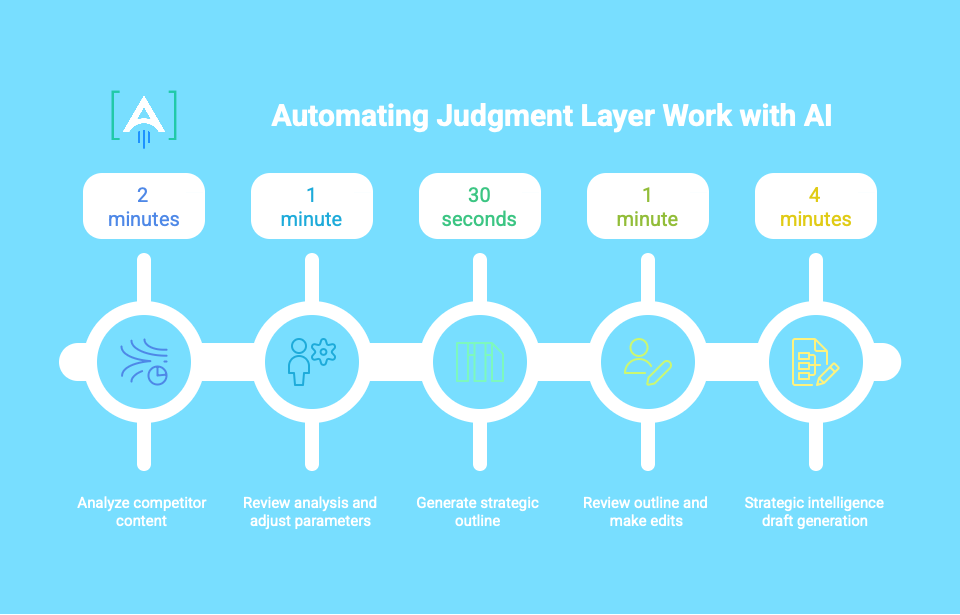
Most teams jump straight to AI text generation. Better approach: Use AI for analysis first.
- Analyze competitor content (2 minutes)
- Review analysis and adjust parameters (1 minute)
- Generate strategic outline (30 seconds)
- Review outline and make edits (1 minute)
- Generate draft incorporating strategic intelligence (4 minutes)
This workflow keeps humans in the loop for judgment calls while automating time-consuming research.
Maintain Source Attribution
Judgment layer automation analyzes external content. Proper attribution matters for credibility and avoiding plagiarism concerns.
Content Engine includes source citations for every strategic recommendation:
- “This content gap identified based on analysis of [competitor article]”
- “This keyword opportunity identified in [specific competitor] coverage”
- “This structural approach differs from [three competitors] who used [alternative structure]”
Transparency builds trust and allows human review of automated strategic decisions.
The Future of Content Operations
Content teams will increasingly split into two roles: strategic analysts and creative writers.
Strategic analysts focus on:
- Competitive landscape monitoring
- Content strategy and positioning
- Performance analysis and optimization
- Workflow automation and improvement
Creative writers focus on:
- Brand voice and tone
- Storytelling and narrative structure
- Persuasive writing and conversion optimization
- Editorial refinement
Judgment layer automation doesn’t eliminate strategy roles. It amplifies their impact by handling systematic research while they focus on creative strategic decisions.
Teams that adopt this model will produce 3-5x more content with the same headcount. Teams that don’t will struggle to compete with automated competitors.
Start Automating Your Judgment Layer This Month
Don’t wait for perfect solutions. Start with your biggest judgment layer bottleneck.
Map Your Current Workflow
Document time spent in each content phase:
- How long does competitive research take?
- How long does strategic planning take?
- How long does outline creation take?
- How long does writing take?
Identify which judgment layer activities consume the most time. That’s your automation target.
Test AI Research Capabilities
Use Claude or ChatGPT with web browsing to analyze competitor content:
- Provide links to 5 competitor articles on a topic
- Ask AI to identify common themes and unique angles
- Ask AI to generate strategic outline incorporating gaps
- Compare AI analysis quality to manual research
This quick test shows whether AI can handle judgment layer work for your content type.
Calculate Your Automation ROI
Based on time savings potential:
- Current time per article x articles per month = total monthly hours
- Potential time per article x articles per month = automated monthly hours
- Time saved x hourly cost = monthly savings
If monthly savings exceed $2,000, automation investment pays back in under six months even with custom development costs.
Conclusion
AI writing tools solve the wrong problem. The bottleneck in content production isn’t writing—it’s the research and strategic planning that happens before writing begins.
The judgment layer (research, analysis, strategic planning) consumes 60-70% of content production time. The execution layer (writing, editing) consumes 30-40%. Traditional AI tools automate execution while leaving judgment layer work completely manual.
Real productivity gains come from automating both layers. At Azarian Growth Agency, we reduced article production from 70 minutes to 7 minutes by automating competitive research, strategic outline generation, and content gap analysis. The same three-person team now produces 100+ articles monthly versus 30 articles previously.
In webinar 16, we demonstrate our complete judgment layer automation system live. You’ll see how we use Claude API with MCP servers to analyze competitors, generate strategic outlines, and publish finished articles to WordPress. We share our exact technical architecture, cost breakdowns, and 60 days of production data.
Ready to automate your judgment layer?
Let’s talk to our growth experts about your content production bottleneck.