
DTC brand authority marketing 2026 demands radical channel diversification as traditional social media reach declines and customer acquisition costs spiral upward.
Business owners and CEOs of direct-to-consumer brands face a critical inflection point: adapt to AI-first discovery or watch competitors capture market share through emerging channels.
82% of consumers now use social media for product discovery and research, but they’re increasingly discovering brands through AI platforms before ever visiting Instagram. Moreover, U.S. DTC e-commerce sales are expected to hit $212.9 billion in 2025, representing 16.6% growth, with winners mastering omnichannel strategies beyond paid social dependency.
In this guide, we’ll reveal how to optimize product content for AI shopping assistants, build brand authority through GEO strategies, and implement omnichannel approaches that reduce reliance on Instagram while capturing AI-driven demand.
Understanding DTC Brand Authority Marketing 2026
DTC brand authority marketing 2026 requires accepting an uncomfortable truth: the playbook that worked 2-3 years ago is obsolete. Performance marketing on Meta and TikTok delivered predictable returns when CAC remained manageable. Those days are gone.
Furthermore, marketplaces averaged 40% year-over-year growth in 2024, with some brands surpassing 200-300% growth across platforms like Amazon, TikTok Shop, and Macy’s. Meanwhile, pure-play DTC brand authority growth stagnated as acquisition costs consumed margin.
E-commerce DTC brand authority marketing agency expertise becomes essential for navigating this transition. Brands attempting solo pivots often waste months testing channels before finding sustainable acquisition strategies.
The Social Media Reach Decline
Organic reach on Instagram and Facebook has plummeted over the past three years. The platforms prioritize video content and paid placements, making free discovery nearly impossible for most brands.
Consequently, 58% of DTC brands allocate at least 41% of marketing budgets to digital channels, representing a slight decrease from 61% in 2023. This shift reflects growing recognition that paid social alone can’t deliver required growth rates.
The decline creates opportunity. Brands reducing Instagram dependency ahead of competitors gain advantages in emerging channels where audience attention remains available and CAC stays manageable.
Why AI Shopping Assistants Matter
AI shopping assistants fundamentally change product discovery. ChatGPT Shopping, Amazon Rufus, and Google AI Overviews synthesize information across sources, presenting unified recommendations without requiring users to visit multiple brand websites.
Moreover, over $100 billion in revenue is projected from social media product purchases in 2025, demonstrating a massive commerce opportunity. However, the discovery increasingly happens through AI tools rather than organic social feeds.
Brands invisible in AI recommendations miss substantial demand from high-intent shoppers. These users consult AI assistants specifically for purchase guidance, representing warmer leads than casual Instagram scrollers.
AI Shopping Assistant Optimization
AI shopping assistant optimization positions products for recommendation when users consult ChatGPT, Perplexity, or AI Overviews for purchase guidance. This differs fundamentally from traditional SEO or social media optimization.
Additionally, AI platforms prioritize authoritative, comprehensive product information. Sparse descriptions and vague specifications exclude products from recommendations. Detailed, structured content wins AI visibility.
Content marketing strategies must evolve beyond blog posts and social captions. Product content becomes the critical optimization target for AI discovery.
Optimizing Product Content for AI Recommendations
Comprehensive product descriptions addressing common questions preemptively satisfy AI systems seeking complete information. When someone asks “What’s the best water bottle for hiking,” your product description should explicitly answer durability, insulation, size, and weight questions.
Structured specifications enable AI extraction and comparison. Present dimensions, materials, care instructions, and technical details in consistent formats AI can parse accurately.
Use case documentation shows products in context. AI assistants favor content explaining when and why to use specific products over generic marketing copy.
Furthermore, AI content optimization ensures descriptions communicate effectively with both AI systems and human shoppers. This dual optimization maximizes visibility across discovery channels.
Schema Markup for Product Pages
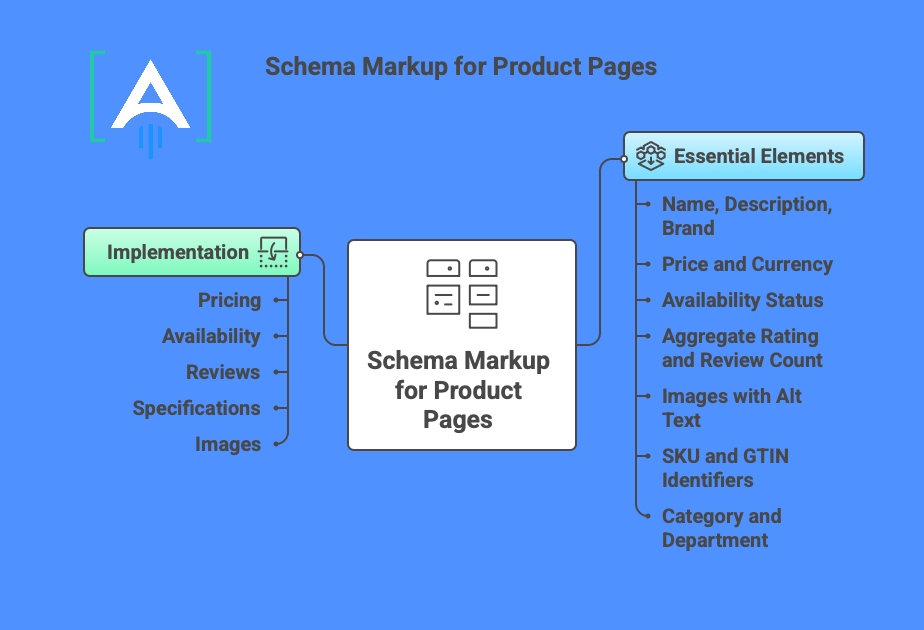
Schema.org Product markup provides structured data that AI platforms can extract directly. Implement comprehensive markup, including pricing, availability, reviews, specifications, and images.
Essential product schema elements:
- Name, description, and brand
- Price and currency
- Availability status
- Aggregate rating and review count
- Images with alt text
- SKU and GTIN identifiers
- Category and department
Validate implementation using Google’s Rich Results Test. Incorrect schema hurts more than having none at all, as AI systems may misinterpret product details.
Building Brand Authority Through GEO
Generative Engine Optimization positions brands as authoritative sources AI platforms cite. This builds category leadership that supports premium pricing while reducing customer acquisition costs systematically.
Consequently, thought leadership becomes tangible business asset rather than vanity metric. Citations in AI responses create brand awareness and consideration before prospects ever visit your website.
Social media marketing amplifies GEO content but shouldn’t be the primary distribution channel. LinkedIn, YouTube, and podcast appearances build authority AI systems recognize and reference.
Creating Citation-Worthy Content
Original research generates proprietary insights AI platforms must cite directly. Survey your customers, compile usage data, or analyze market trends. These unique perspectives can’t be synthesized from existing sources.
Comprehensive buying guides addressing entire product categories earn citations when users ask AI for purchase recommendations. Cover decision criteria, key features to evaluate, and how products compare across price points.
Expert interviews and case studies demonstrate real-world application. AI assistants favor content showing actual results over theoretical benefits.
Moreover, data analytics and reporting capabilities track which content earns AI citations. This feedback loop informs content strategy, focusing resources on high-impact formats.
Strategic Partnerships for AI Visibility
Industry publication placements increase AI citation likelihood. Target media outlets AI platforms frequently reference: industry trades, major business publications, and authoritative review sites.
Podcast appearances provide rich content AI platforms extract. Long-form conversation demonstrates expertise while creating transcribed content AI can analyze and cite.
Retail partnerships signal brand legitimacy. Brands available through Sephora, Target, or specialty retailers gain credibility that influences AI recommendations.
E-Commerce Beyond Social Media
E-commerce beyond social media requires building owned traffic sources and marketplace presence. Reducing Instagram dependency means systematically developing alternative channels.
Additionally, omnichannel customers spend 34% more than single-channel shoppers, according to McKinsey research. Diversification drives higher lifetime value while reducing platform risk.
Successful 2026 DTC brands master sophisticated channel mixes including retail partnerships, marketplaces, email/SMS, and AI-driven organic discovery.
Marketplace Strategy
Marketplaces provide ready-made audiences actively seeking products. Amazon, Walmart, Target, and specialty platforms deliver immediate visibility without building awareness from scratch.
Furthermore, brands selling on marketplaces averaged 40% YoY growth, with some exceeding 200-300% across top platforms. This growth dramatically outpaces pure-play DTC channels.
Marketplace optimization requires:
- Enhanced product content with A+ pages
- Competitive pricing accounting for platform fees
- Review generation systems driving social proof
- Advertising within marketplace ecosystems
- Inventory management ensuring consistent availability
Marketplaces complement rather than replace owned channels. Use them for customer acquisition, then migrate buyers to direct relationships through email and SMS.
Email and SMS: Owned Channel Foundations
Email and SMS deliver consistent performance independent of algorithm changes
List building strategies beyond social:
- Exit-intent popups offering compelling incentives
- Post-purchase email collection with discount codes
- SMS opt-in at checkout for order updates
- Product sampling programs requiring email signup
- Interactive quizzes and product finders
Moreover, conversion rate optimization expertise improves email and SMS performance. Small conversion rate improvements compound into substantial revenue gains over time.
Selecting Creators for Brand Building
Relevance beats reach in creator selection. A micro-influencer with 10,000 highly engaged followers in your niche drives better results than a mega-influencer with millions of disengaged followers.
Content quality matters more than follower count. Creators producing thoughtful product reviews and educational content build authority AI platforms recognize. Shallow unboxing videos provide minimal lasting value.
Platform diversity extends beyond Instagram. YouTube, TikTok, podcasts, and blogs each serve different discovery functions. Multi-platform creator partnerships maximize brand exposure across channels.
Additionally, AI marketing agency specialists implement creator programs at scale. Managing dozens of relationships while maintaining brand consistency requires systematic processes that individual brands struggle to build internally.
Measuring Creator Impact Beyond Direct Attribution
Traditional last-click attribution dramatically undervalues creator partnerships. These relationships build awareness and consideration that eventually convert through other channels.
Track creator impact through:
- Brand search volume increases correlated with campaign timing
- New customer surveys asking about discovery source
- Promo code usage as one signal among many
- Social listening for brand mentions and sentiment
- Overall sales trajectory during and after campaigns
Creator partnerships work best as part of integrated strategies rather than isolated tactics. Combine creator content with GEO initiatives, marketplace optimization, and owned channel development.
Omnichannel DTC Strategies
Omnichannel DTC strategies integrate multiple sales and marketing channels into cohesive customer experiences. The goal isn’t channel proliferation but strategic presence where target customers actually shop and discover products.
Furthermore, 53% of global users purchase directly through social platforms, but discovery increasingly happens elsewhere. Build presence across the full customer journey from AI-powered research through purchase and retention.
Successful omnichannel requires unified inventory, consistent branding, and seamless experiences regardless of how customers interact with your brand.
Physical Retail Integration
Physical retail provides discovery channels completely independent of digital algorithm changes. Warby Parker operates over 200 retail locations despite starting as a pure-play DTC, recognizing omnichannel’s power.
Retail partnership benefits:
- Immediate brand credibility from retailer association
- Product discovery by shoppers not researching online
- Try-before-buy experiences for tactile products
- Geographic expansion without building infrastructure
- Reduced customer acquisition costs compared to paid digital
Pop-up shops and temporary retail provide testing opportunities before committing to permanent locations. Use data from pop-ups to inform expansion decisions.
Technology Infrastructure for Omnichannel
Omnichannel execution requires sophisticated technology stacks. Inventory management, order fulfillment, customer data, and marketing automation must integrate seamlessly across channels.
Essential omnichannel platforms:
- Unified commerce platforms (Shopify, BigCommerce) managing all channels
- Order management systems routing fulfillment efficiently
- Customer data platforms connecting touchpoints
- Marketing automation coordinating messaging across channels
- Analytics platforms tracking cross-channel journeys
Moreover, data analytics and reporting capabilities reveal which channel combinations drive highest lifetime value. This insight guides resource allocation toward most profitable acquisition paths.
Measuring Success Beyond Instagram Metrics
Traditional social media metrics mislead when evaluating omnichannel strategies. Follower count, engagement rate, and post reach don’t capture brand discovery happening through AI platforms, marketplaces, and retail.
Consequently, focus on business outcomes: customer acquisition cost, lifetime value, contribution margin, and growth rate. These fundamentals determine business viability regardless of channel mix.
Essential omnichannel KPIs:
- Blended CAC across all channels
- Channel contribution to new customer acquisition
- Customer lifetime value by acquisition source
- Repeat purchase rates and frequency
- Contribution margin after all channel costs
- Brand search volume as awareness proxy
Track these metrics consistently, comparing channel performance fairly by accounting for full-funnel impact rather than last-click attribution.
Conclusion
DTC brand authority marketing 2026 demands strategic diversification as social media reach declines and customer acquisition costs make Instagram-dependent strategies unsustainable. With 82% of consumers using social for research but discovering brands through AI platforms, and U.S. DTC sales hitting $212.9 billion in 2026, the winners master omnichannel strategies, capturing AI-driven demand.
Azarian Growth Agency combines over 20 years of growth marketing expertise with cutting-edge e-commerce capabilities. We’ve helped clients secure over $4 billion in funding and generate more than $500 million in revenue through systematic strategies designed for modern DTC realities.
Our e-commerce marketing agency services implement omnichannel framework,s reducing social media dependency while improving overall customer acquisition efficiency. We build the AI optimization, marketplace strategies, and creator programs that drive sustainable DTC growth.
Our AI content optimization ensures product content performs across traditional search, AI platforms, and marketplace environments simultaneously.
Additionally, our conversion rate optimization approach systematically improves performance across all channels. We don’t just diversify traffic sources; we optimize each channel for maximum efficiency and lifetime value contribution.
Partner with us to build your AI-discoverable e-commerce strategy. We combine technical implementation with strategic guidance, helping you reduce Instagram dependency while capturing demand through emerging channels competitors haven’t mastered.