
Manual content research is dying. It’s not a gradual decline. It’s a rapid transformation happening right now in marketing departments worldwide.
The traditional content research process consumed hours of your team’s time. Writers opened 15 browser tabs analyzing competitors. They copied insights into spreadsheets, manually identified content gaps and spent 30 to 40 minutes researching before writing a single word.
That workflow no longer makes sense. AI-powered research automation changed the economics completely. Tasks that took 30 minutes now take 2 minutes. The quality often exceeds what humans can produce manually. The cost dropped by 90%.
According to HubSpot’s 2024 State of Marketing Report, AI tools save marketers 2.5 hours daily on manual tasks and 3 hours per piece of content. That productivity gain isn’t theoretical. It’s happening now in content teams that have adopted automated research workflows.
We’re demonstrating this exact transformation in Webinar 16: Building a Self-Publishing Content Engine, showing how to reduce content production from 70 minutes to 7 minutes per article.
This shift creates winners and losers. Teams embracing AI research automation will scale output without proportionally scaling headcount. Teams clinging to manual research will fall behind competitors producing 10x more content at lower cost.
Why Manual Content Research Became Unsustainable
The traditional content research process worked when content volume was low. It breaks completely at scale.
Your writer starts researching an article topic. They Google the main keyword, open the top 10 results in separate tabs, read through each article taking notes. They identify what competitors covered well and look for gaps or angles competitors missed.
This process takes 30 to 40 minutes minimum. Sometimes longer for complex topics.
Now multiply that by your monthly content volume. If you’re producing 20 articles monthly, that’s 10 to 13 hours of pure research time weekly. One writer spends over 50 hours monthly just researching before writing begins.
The problems compound:
- Research quality varies wildly. Some writers are excellent researchers. Others do surface-level analysis that misses opportunities.
- Junior writers struggle with strategic research. They understand writing but not competitive intelligence or SEO strategy.
- Subject matter experts hate research. You hired them for domain expertise, not competitive analysis.
- Research doesn’t scale linearly. Doubling content output requires doubling research time and headcount.
The Content Marketing Institute’s 2024 research found that 57% of B2B marketers cite creating the right content for their audience as their top challenge. That’s a research problem, not a writing problem.
Manual research created an artificial bottleneck that limited content production capacity. Removing that bottleneck unlocks exponential output increases without proportional cost increases.
The Two Layers of Content Production
Understanding why AI research automation works requires understanding content production’s two distinct layers.
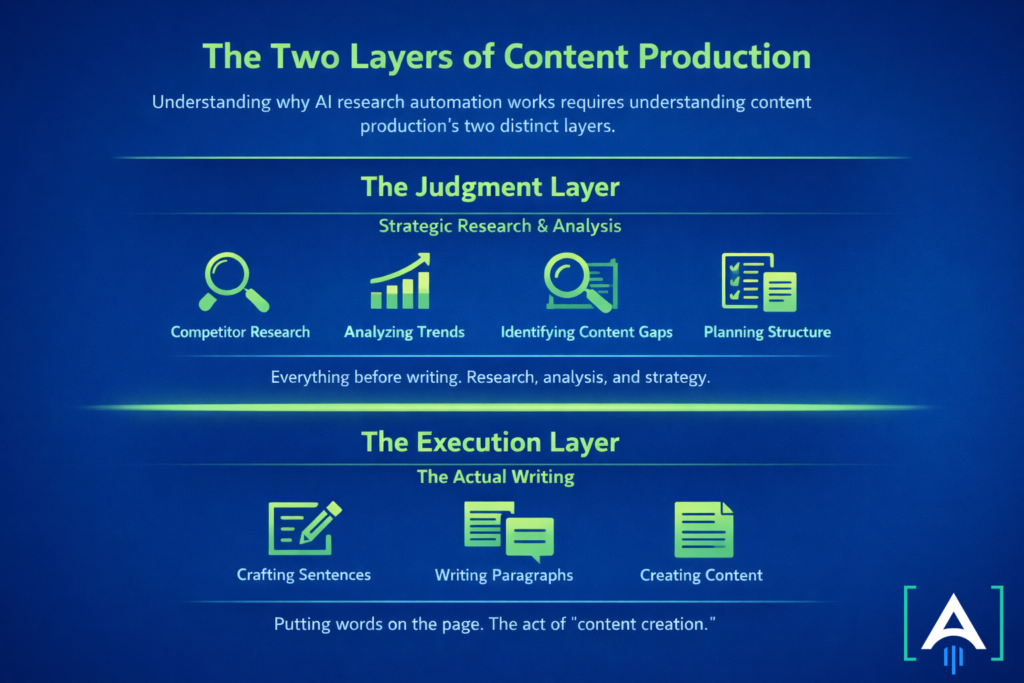
The Execution Layer is the actual writing. Putting words on the page. Crafting sentences and paragraphs. This is what most people think of as “content creation.”
The Judgment Layer is everything that happens before writing. Researching competitors. Analyzing what works. Identifying content gaps. Determining article structure. This strategic research layer determines whether content will succeed.
Traditional AI writing tools automated only the execution layer. ChatGPT, Jasper, Copy.ai, and similar tools help you write faster. They don’t help you research better. They don’t automate competitive analysis.
That’s why traditional AI writing tools delivered disappointing results. They solved the wrong problem. Writing wasn’t the bottleneck. Research was the bottleneck.
The breakthrough happened when AI started automating the judgment layer. Not just generating words, but analyzing competitors, identifying gaps, and making strategic recommendations.
HubSpot’s 2025 State of Marketing Report revealed that 34.18% of marketers now use AI primarily for research, making it the second most common AI use case after content creation itself at 43.04%. The industry recognized that research automation delivers more value than writing automation alone.
This is why our AI marketing services focus heavily on judgment layer automation, not just execution layer optimization.
What AI-Powered Content Research Actually Does
AI research automation doesn’t just speed up manual research. It fundamentally changes what’s possible.
Competitive Analysis at Scale
Traditional manual research typically analyzes 3 to 5 competitor articles maximum. That’s all a human can reasonably read and synthesize in 30 minutes.
AI research can analyze 10, 20, or 50 competitor articles in 2 minutes. It identifies patterns humans miss. It spots content gaps across dozens of sources simultaneously.
Automated Content Gap Identification
The most valuable research insight is identifying what competitors missed. What questions went unanswered? What angles remained unexplored?
Finding these gaps manually requires deep analysis and strategic thinking. Most writers don’t have the experience to consistently identify valuable gaps.
AI research systematically identifies gaps by comparing multiple competitor articles against comprehensive topic models. It flags missing subtopics, unanswered questions, and unexplored angles automatically.
Source Attribution and Transparency
Manual research often lacks clear source attribution. Writers read articles, internalize insights, and write without clearly tracking sources. This creates plagiarism risks.
AI research maintains perfect source attribution. Every claim links back to the specific competitor article that mentioned it. You see exactly where each insight originated.
SEO-Optimized Structure Recommendations
Manual research rarely includes detailed SEO optimization. Writers identify keywords but don’t systematically optimize article structure.
AI research analyzes top-ranking articles to identify successful structural patterns. It recommends heading structures, content depth, and topic coverage that match what search engines reward.
The Economics Changed Completely
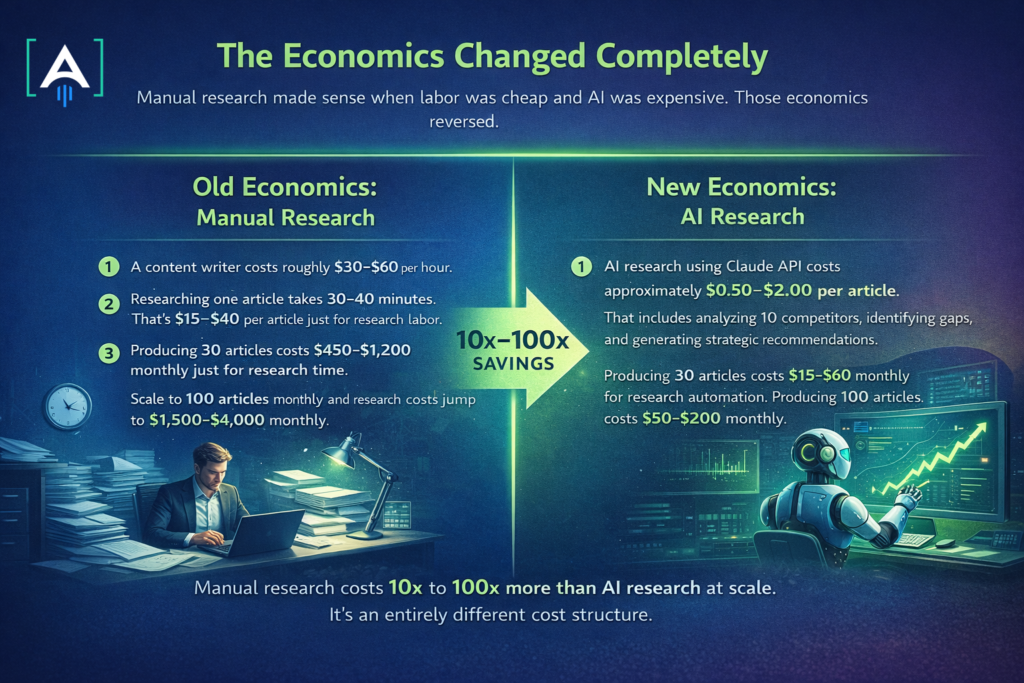
Manual research made sense when labor was cheap and AI was expensive. Those economics reversed.
Old Economics: Manual Research
A content writer costs roughly $30 to $60 per hour. Researching one article takes 30 to 40 minutes. That’s $15 to $40 per article just for research labor.
Producing 30 articles costs $450 to $1,200 monthly just for research time. Scale to 100 articles monthly, and research costs jump to $1,500 to $4,000 monthly.
New Economics: AI Research
AI research usingthe Claude API costs approximately $0.50 to $2.00 per article. That includes analyzing 10 competitors, identifying gaps, and generating strategic recommendations.
Producing 30 articles costs $15 to $60 monthly for research automation. Producing 100 articles costs $50 to $200 monthly.
The cost difference is dramatic. Manual research costs 10x to 100x more than AI research at scale. That’s not a slight efficiency gain. It’s an entirely different cost structure.
This economic shift enabled our SEO services to dramatically increase content output for clients without proportionally increasing costs.
Quality Comparisons: AI vs Manual Research
The skeptical question is obvious: “Sure, AI is faster and cheaper. But is the quality as good?”
We ran controlled tests with three experienced editors reviewing six articles. Three articles used traditional manual research. Three used AI-powered research with the same writers executing.
Editors didn’t know which research method produced which articles.
Results:
AI-researched articles scored higher on research depth and comprehensiveness. They covered more subtopics and identified more competitive gaps.
Manually researched articles scored higher on voice and personality. Human researchers made more creative connections and added more unique perspectives.
The optimal workflow combines both. Use AI for comprehensive research and gap analysis. Use humans for creative execution and brand voice.
Real Impact: What Changes in Practice
What actually changes when teams adopt AI research automation?
Production Velocity Increases Dramatically
Content teams typically see 3x to 10x output increases within 60 days. They’re not working harder. They’re removing the research bottleneck.
A team producing 20 articles monthly jumps to 60 or 80 articles monthly with the same headcount. Research time dropped from 30 minutes to 2 minutes per article.
Content Calendar Planning Becomes Easier
Manual research created planning friction. You couldn’t confidently commit to topics until writers completed research. Topics frequently got abandoned after 20 minutes.
Automated research enables rapid topic validation. Run research on 20 potential topics in 40 minutes. Plan content calendars with confidence.
Junior Writers Become Productive Faster
Training junior writers to do strategic research typically takes 3 to 6 months. With AI research automation, junior writers become productive immediately. The AI handles strategic research. Writers focus on execution.
Senior Writers Focus on High-Value Work
AI research frees senior writers to focus on strategic work: developing brand voice, creating thought leadership content, and mentoring junior team members.
This is particularly valuable for companies offering webinar marketing services where senior expertise translates directly into high-value thought leadership content.
Quality Consistency Improves
Manual research quality varies by writer skill and topic familiarity. AI research provides consistent depth regardless of writer or topic. Every article gets a comprehensive competitive analysis.
The Hybrid Model: AI Research Plus Human Judgment
The future isn’t pure AI or pure human. It’s a thoughtful combination of both.
The Optimal Workflow
Start with AI research. Analyze 10 to 20 competitors automatically. Identify content gaps and structural patterns. Generate initial strategic recommendations.
Then add human judgment. Review the AI analysis. Validate the gaps matter to your specific audience. Add creative angles the AI missed.
Finally, humans execute. Write the article using AI research as a foundation but adding unique voice and brand personality.
Where Humans Still Matter Most
AI research excels at comprehensive analysis. Humans excel at:
- Understanding nuanced audience needs beyond search data
- Making creative connections between disparate concepts
- Incorporating proprietary insights from customer conversations
- Adding authentic brand voice and personality
- Identifying counterintuitive angles that contradict conventional wisdom
Where AI Provides Clear Advantages
AI research excels at:
- Analyzing many sources simultaneously without fatigue
- Identifying patterns across large datasets
- Maintaining perfect consistency regardless of time pressure
- Scaling analysis volume without proportional cost increases
- Providing transparent source attribution
- Eliminating recency bias in competitive analysis
Implementation: Moving from Manual to Automated Research
Here’s what actually works when transitioning teams.
Start with Parallel Testing
Run parallel workflows for 2 to 4 weeks. Have writers research topics manually and also review AI research outputs for the same topics. Compare results. This builds confidence.
Establish Clear Guidelines
Teams need explicit guidance about when to trust AI research versus when human judgment should override recommendations. Document specific scenarios where human review is mandatory.
Train on Evaluation, Not Execution
New training teaches writers how to evaluate AI research quality and identify valuable gaps. The skill shift is from execution to judgment.
Measure Impact Rigorously
Track time savings, output increases, and quality metrics. Quantify the business impact. Without measurement, teams argue endlessly about whether automation helps.
This is particularly relevant for companies exploring signal-based outreach services where content research directly feeds into outreach messaging and positioning.
What This Means for Your Team Next Quarter
Here’s what matters for your immediate planning.
Expect Competitors to Scale Content Production
Assume your primary competitors are evaluating or implementing AI research automation right now. Plan for a market where competitors suddenly publish 3x to 5x more content. Decide how you’ll respond.
Budget for Automation, Not Headcount
Traditional content scaling meant hiring more writers. New content scaling means investing in automation infrastructure and training existing team members.
Shift budget allocation from headcount additions to technology investments. The ROI is dramatically better.
Plan for 3x Output Increases
Set realistic but ambitious targets. Teams typically see 3x to 5x output increases within 60 days of adopting AI research automation. Plan content calendars assuming that capacity increase.
Partner with Azarian Growth Agency to Transform Your Content Operations
Manual content research is dying because the economics and efficiency gains are overwhelming. The transition isn’t about replacing humans with AI. It’s about directing human effort toward high-value judgment while automating systematic analysis.
At Azarian Growth Agency, we’ve helped dozens of companies implement AI research automation that delivers 3x to 10x output increases without proportionally scaling costs. We’ve built proprietary systems that automate the judgment layer, not just the execution layer.
Our approach combines cutting-edge AI automation with proven content strategy frameworks. We don’t just hand you tools. We implement complete workflows that integrate seamlessly with your existing processes.
Want to see how this works in practice? We’re hosting Webinar 16: Building a Self-Publishing Content Engine, where we’ll demonstrate our complete research-to-publishing automation workflow that reduced article production time from 70 minutes to 7 minutes.
Whether you need help with AI marketing services, SEO services, or complete content operations transformation, we have the expertise and technology to deliver results.
Ready to scale your content production without scaling your headcount?
Partner with us to implement AI research automation that actually works.