
Integrated marketing strategy has reached its inflection point. Business owners and CEOs managing separate teams for SEO, GEO, and paid media waste resources fighting internal competition while competitors capture market share through unified approaches.
The data confirms convergence. 70% of marketing teams lack integrated content strategies, yet integrated approaches deliver 50% more ROI compared to siloed execution. Your prospects don’t distinguish between organic search, AI recommendations, and paid ads. They research across all channels simultaneously, demanding coordinated presence.
In this guide, we’ll reveal why traditionally separate channels are converging, show you unified content strategies serving all platforms, and provide frameworks for building integrated growth teams that outperform specialist silos.
Understanding Why Channels Are Converging
The lines between SEO, GEO, and paid media have blurred beyond recognition. Content optimized for traditional search now influences AI recommendations. Paid campaigns generate signals improving organic rankings. The ecosystem has become interconnected.
Furthermore, customer journeys fragment across touchpoints. Someone might discover your brand through ChatGPT, research via Google, see retargeting ads on social, and convert through direct navigation. Which channel gets credit?
GEO agency expertise recognizes this convergence reality. Specialists understanding only one channel miss how platforms increasingly reference each other.
The Technical Convergence
Schema markup serves multiple masters. Structured data helping Google understand content also enables AI platforms to extract information accurately. One implementation benefits all channels.
Content quality signals influence every platform. Well-researched, comprehensive material earns backlinks (SEO), gets cited by AI (GEO), and improves Quality Scores (paid media) simultaneously.
User behavior metrics like engagement, bounce rate, and conversion affect organic rankings, AI citation likelihood, and advertising costs. Strong performance compounds across channels.
Additionally, AI content optimization ensures content performs across traditional search, AI platforms, and paid landing pages simultaneously.
The Economic Reality
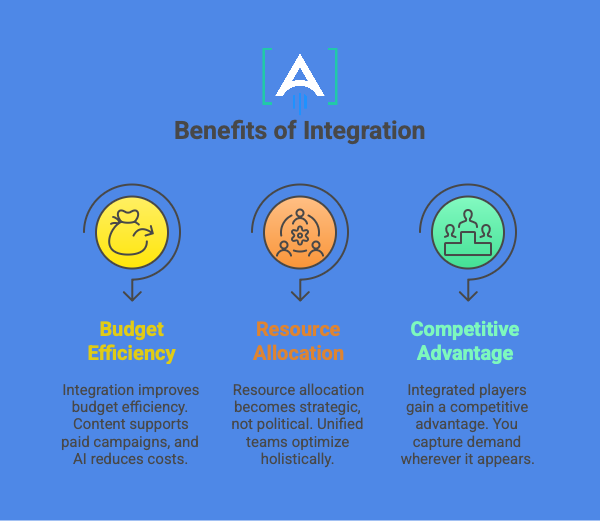
Budget efficiency improves through integration. Content created for organic discovery supports paid campaigns. AI visibility reduces paid acquisition costs. The channels amplify each other.
Resource allocation becomes strategic rather than political. Unified teams optimize holistically versus competing for fixed budgets based on last-click attribution.
Competitive advantage accrues to integrated players. While competitors debate channel ownership, you capture demand wherever it appears.
Moreover, data analytics reveals how channels work together rather than competing. Multi-touch attribution shows true contribution.
Unified Content Strategies
Unified content strategies create once, deploy everywhere. The same foundational content serves organic search, AI recommendations, and paid campaigns through strategic adaptation.
Consequently, production efficiency increases dramatically. Instead of separate assets for each channel, create comprehensive materials tailored for multiple uses.
Content marketing must evolve beyond channel-specific silos. Modern content architects design for omnichannel discovery.
The Content Core
Comprehensive guides anchor your presence across platforms. These definitive resources rank organically, get cited by AI, and serve as paid campaign landing destinations.
Modular components enable flexible deployment. Break comprehensive content into discrete sections that work independently or combined based on channel requirements.
Question-answer formats satisfy all platforms. Clear, direct responses work for featured snippets, AI extraction, and paid ad extensions simultaneously.
Furthermore, AI marketing agency specialists structure content for maximum cross-channel leverage from initial creation.
Channel-Specific Optimization
While core content stays consistent, presentation adapts. Organic search demands technical SEO. AI platforms need semantic clarity. Paid campaigns require conversion focus.
SEO optimization ensures crawlability, keyword targeting, and internal linking. This technical foundation supports discovery through traditional search.
GEO optimization adds structured data, natural language, and citation-worthy authority. Content becomes extractable for AI synthesis.
Paid media optimization focuses on conversion elements: compelling CTAs, trust signals, and streamlined user flows. Landing pages convert traffic from all sources.
Additionally, conversion optimization ensures unified content converts regardless of traffic source.
Holistic Measurement Frameworks
Traditional attribution breaks down when customers interact across SEO, GEO, and paid before converting. Holistic measurement frameworks reveal true channel contribution.
Consequently, multi-touch attribution assigns credit across the journey. Early touchpoints receive appropriate recognition alongside final-click channels.
Data analytics platforms unify measurement across traditionally siloed reporting systems.
Beyond Last-Click Attribution
Data-driven models use machine learning to weigh each touchpoint’s statistical contribution. This reveals which combination of channels drive conversions most efficiently.
Assisted conversion tracking captures touchpoints that don’t generate immediate clicks but influence eventual purchases. AI exposure today may drive conversion weeks later.
Incrementality testing measures what would happen without specific channels. This validates true contribution versus correlation.
Moreover, an expert AI marketing agency implements sophisticated measurement that most brands can’t build internally.
Unified Dashboards
Executive visibility requires unified dashboards showing performance across all channels. Separate reports create confusion and political channel competition.
Key integrated metrics include blended CAC across channels, contribution by discovery source, multi-touch conversion paths, and unified ROI calculations.
Cohort analysis reveals which channel combinations attract the highest-value customers. Some acquisition paths produce better retention and expansion than others.
Regular unified reviews guide budget allocation toward the highest-performing channel combinations rather than arbitrary fixed splits.
Organizational Structures for Integration
Traditional org structures with separate SEO, GEO, and paid teams create internal competition. Integrated growth teams optimize holistically.
Furthermore, specialist silos made sense when channels operated independently. That reality no longer exists. The organization must reflect convergence.
Content marketing leadership coordinates across specialists rather than owning isolated channels.
The Integrated Growth Team Model
Growth marketers understand all channels rather than specializing narrowly. They optimize journeys, not individual touchpoints.
Channel specialists provide expertise within unified teams. SEO, GEO, and paid experts collaborate rather than competing.
Shared objectives align everyone toward business outcomes instead of channel-specific KPIs. Revenue and CAC matter; organic rankings alone don’t.
Additionally, GEO agency partnerships provide the integrated expertise that individual specialists lack.
Decision-Making Frameworks
Unified strategy determines which channels to emphasize based on holistic performance, not political advocacy from channel owners.
Budget flexibility enables dynamic reallocation. Money flows toward the highest-performing channel combinations weekly, not annually.
Shared technology breaks down silos. Everyone accesses unified analytics, testing platforms, and content management systems.
Cross-functional planning ensures campaigns launch with coordinated SEO, GEO, and paid support rather than sequential handoffs.
Implementation Roadmap
Transitioning from silos to integration requires systematic change management. Abrupt reorganization creates chaos; phased evolution enables smooth transition.
Consequently, start with unified measurement before reorganizing teams. Demonstrate integration benefits through data before structural changes.
Phase One: Unified Measurement
Implement cross-channel analytics revealing how SEO, GEO, and paid work together. Show leadership that channels amplify versus compete.
Deploy multi-touch attribution tracking complete customer journeys. Demonstrate early touchpoint value often invisible in last-click models.
Create unified dashboards presenting integrated performance. Replace separate channel reports with holistic business outcome tracking.
Document specific examples where integrated approaches outperform siloed execution. Use data to build change mandates.
Phase Two: Content Integration
Develop content serving multiple channels simultaneously. Prove production efficiency gains and performance improvements.
Pilot integrated campaigns where one content core supports SEO, GEO, and paid simultaneously. Measure results versus siloed approaches.
Document efficiency gains from unified production. Show how creating once and deploying everywhere reduces costs while improving performance.
Build internal capabilities for modular content architecture. Train teams on multi-channel content design.
Share wins broadly. Internal marketing builds momentum for broader organizational change.
Phase Three: Organizational Evolution
Restructure teams around integrated growth rather than channel silos. Do this after demonstrating integration value, not before.
Form growth pods with cross-functional membership. Each pod owns business outcomes, not channels.
Maintain specialist expertise within an integrated structure. Don’t lose deep knowledge; deploy it collaboratively.
Align incentives with integrated performance. Reward holistic success over channel-specific metrics.
Moreover, conversion optimization across all channels justifies continued integration investment.
The Maturity Model
Organizations progress through predictable stages from silos to integration. Understanding your current position guides the next steps.
Stage 1: Complete Silos – SEO, GEO, and paid operate independently with separate strategies, budgets, and reporting. Internal competition exists.
Stage 2: Aware But Separate – Teams recognize integration value but maintain separate structures. Occasional collaboration happens.
Stage 3: Coordinated – Regular cross-team planning occurs. Campaigns launch with multi-channel support. Measurement remains partially siloed.
Stage 4: Integrated – Unified teams own outcomes across channels. Shared metrics and collaborative planning are standard.
Stage 5: Optimized – Organization continually refines integration. AI and automation handle tactical execution; humans focus on strategy.
Most organizations sit between Stages 2 and 3. Moving to Stage 4 requires deliberate effort but delivers substantial competitive advantages.
Why Professional Guidance Matters
Integrated marketing strategy complexity exceeds typical organizational capabilities. Managing change, implementing new measurement, and retraining teams demands external expertise.
Furthermore, AI marketing agency partnerships provide proven frameworks for accelerating transition.
Internal politics often prevent integration. External partners navigate organizational resistance that specialists can’t overcome from within.
The Implementation Challenge
Change management requires skills that marketing teams typically lack. Restructuring, stakeholder alignment, and capability building demand dedicated focus.
The technical implementation of unified measurement and content systems involves complexity beyond standard marketing operations.
Ongoing optimization as channels continue evolving requires staying current with rapid platform changes across SEO, GEO, and paid simultaneously.
Professional guidance compresses transition timelines from years to quarters while avoiding costly mistakes that trial-and-error approaches make repeatedly.
Conclusion
Integrated marketing strategy has reached inevitable convergence as 70% lack coordination despite integrated approaches delivering 50% more ROI. SEO, GEO, and paid media no longer operate independently; they influence and amplify each other systematically.
The framework spans understanding technical and economic convergence, driving integration, unified content strategies, creating once and deploying everywhere, holistic measurement revealing true channel contribution, and organizational structures enabling collaborative optimization.
Azarian Growth Agency combines over 20 years of growth marketing expertise with cutting-edge integrated capabilities. We’ve helped clients secure over $4 billion in funding and generate more than $500 million in revenue through systematic strategies capturing convergence advantages.
Our GEO agency services implement truly integrated strategies coordinating SEO, GEO, and paid media rather than optimizing channels in silos. We build unified measurement frameworks, content architectures serving multiple platforms, and organizational structures enabling collaboration.
Partner with us to navigate convergence strategically. We combine change management with technical implementation, helping you transition from channel silos to integrated growth teams that outperform competitors stuck in outdated structures.