
Your content writers spend 40 minutes researching and 30 minutes drafting each article. AI can now do both tasks in 6 minutes combined. What happens to your content team when AI handles the work they were hired to do?
This question keeps marketing leaders awake at night. You’ve invested in building a content team. You’ve trained writers on your voice and audience. Now AI threatens to make those skills obsolete.
The reality is more nuanced. AI doesn’t replace content teams. It transforms what skills matter. The content team of the future looks fundamentally different from today’s team, but it’s more valuable, not less.
63% of marketing leaders plan to restructure their content teams around AI capabilities within the next 24 months. The transformation is happening now, not in some distant future.
This guide shows you exactly what skills matter for the content team of the future. You’ll learn which traditional skills become less important, which new skills become critical, and how to transition your team successfully.
Why Traditional Content Skills Are Becoming Less Valuable
The skills that made great content writers five years ago don’t determine success today. AI fundamentally changed the value equation.
Research Skills: From Critical to Commodity
Research was always the most time-consuming part of content creation. Writers spent 30 to 40 minutes per article reading competitor content, taking notes, and synthesizing insights. This skill differentiated good writers from mediocre ones.
AI automated this entire process. Claude can analyze 10 competitor articles in 2 minutes, identifying patterns humans miss when reading sequentially. It generates structured research briefs showing exactly what exists, what’s missing, and where opportunities are.
The research skill that took writers years to develop became commodity capability available to anyone with an AI subscription. Writers who built careers on thorough research suddenly find their core strength automated away.
This doesn’t mean research skills have zero value. It means the type of research that matters changed. Manual information gathering is obsolete. Strategic research direction, knowing what questions to ask, and interpreting research insights remain valuable.
First Draft Writing: From Craft to Starting Point
Writing compelling first drafts was the core content writer skill. The ability to take research and transform it into clear, engaging prose separated professionals from amateurs.
AI writes coherent first drafts in 4 minutes that would take human writers 30 minutes. The drafts maintain consistent structure, incorporate research systematically, and follow instructions precisely. They’re not perfect, but they’re good enough to be useful starting points.
71% of content teams now use AI for first draft generation. The skill of drafting from scratch declined in value as AI made it accessible to non-writers.
This changes what “writing skill” means. The craft of assembling sentences is less valuable. The art of refining drafts, injecting personality, and ensuring clarity becomes more valuable. Writers transition from creators to editors.
SEO Optimization: From Specialized Knowledge to Built-In Feature
SEO optimization required specialized knowledge about keyword placement, header structure, and search intent. Writers learned these skills through training and experience. SEO-savvy writers commanded premium rates.
AI tools now include SEO optimization as standard features. They place keywords naturally, structure headers appropriately, and align content with search intent automatically. The specialized knowledge that differentiated writers became table stakes.
Writers who built expertise around SEO mechanics find that expertise less valuable. The strategic SEO skills around understanding why certain approaches work, evaluating competitive landscapes, and choosing positioning remain important. But technical SEO execution became automated.
The Skills That Matter for The Content Team of The Future
As traditional skills commoditize, new skills become critical differentiators. The content team of the future needs capabilities AI can’t replicate.
Strategic Judgment and Positioning
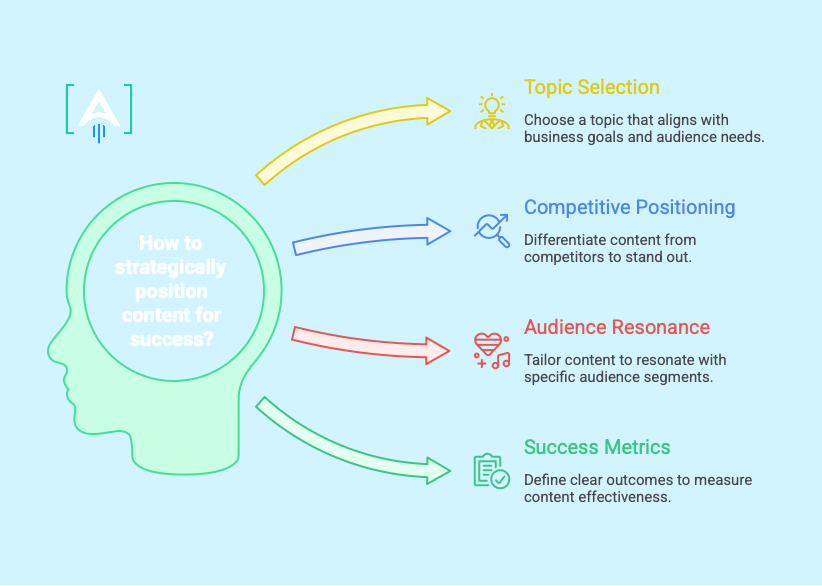
What This Means: The ability to make strategic decisions about what content to create, how to position it, and why it matters. This is the judgment layer work that determines content success before any writing begins.
AI excels at execution when given clear direction. It struggles with strategic judgment requiring business context, audience understanding, and competitive positioning. These decisions require human expertise AI lacks.
The content team of the future starts every project with strategic decisions:
- What topic actually serves our business goals and audience needs?
- How should we position this to differentiate from competitors?
- What angle resonates with our specific audience segment?
- What outcomes define success for this content?
These judgment calls determine whether content succeeds or fails. Getting strategy right makes execution easy. Getting strategy wrong means even perfect execution produces content that doesn’t perform.
According to our work at Azarian Growth Agency, articles based on systematic competitive analysis and strategic positioning rank 2.3 positions higher on average than articles without strategic foundation. The judgment layer matters more than execution quality.
Brand Voice and Personality
What This Means: The ability to inject distinctive personality, tone, and perspective that makes content recognizably yours. This is what transforms generic information into branded content that builds relationships with readers.
AI generates competent, professional prose. It lacks personality, distinctive voice, and brand character. Every AI-written draft sounds similar regardless of company or industry. This sameness is AI’s biggest limitation for brand building.
The content team of the future owns the brand voice completely. They take AI-generated drafts and transform them through voice editing:
- Replacing generic phrases with brand-specific language
- Injecting personality through word choice and sentence rhythm
- Adding perspective and point of view that reflects brand values
- Creating emotional connection through tone and style
This skill can’t be automated because it requires a deep understanding of brand identity, audience relationships, and cultural context. It’s the human layer that makes content feel authentic rather than machine-generated.
Companies like Mailchimp built entire brands on distinctive voices. Their content sounds uniquely theirs regardless of topic. This brand voice differentiation becomes even more valuable when AI makes generic content effortless to produce.
Creative Direction and Ideation
What This Means: The ability to generate original ideas, unique angles, and creative approaches that make content interesting rather than just informative. This is what separates memorable content from forgettable content.
AI generates ideas based on patterns in training data. It suggests what already exists, not what could exist. Original creative thinking requires human imagination, cultural awareness, and willingness to take risks AI can’t replicate.
The content team of the future generates the creative concepts that AI executes:
- Original frameworks and mental models that organize information uniquely
- Unexpected angles and perspectives that challenge conventional thinking
- Creative storytelling approaches that make dry topics engaging
- Innovative formats and structures that differentiate from standard articles
This creative direction determines whether content stands out or blends in. AI makes executing ideas easier. Humans remain essential for generating ideas worth executing.
At Azarian Growth Agency, our most successful content comes from original frameworks like the judgment layer versus execution layer concept. This framework didn’t exist before we created it. AI could help articulate it clearly once we invented it, but it couldn’t invent the framework itself.
Quality Control and Editorial Judgment
What This Means: The ability to evaluate whether content actually works, catches errors AI misses, and ensures output meets standards before publication. This is the final quality gate that prevents publishing mediocre content.
AI produces consistent output but lacks judgment about whether that output is actually good. It can’t evaluate if an explanation makes sense, if examples resonate with your audience, or if the overall piece achieves its purpose.
The content team of the future serves as the quality control layer:
- Fact-checking claims and verifying accuracy of all statements
- Evaluating whether explanations actually make sense to target readers
- Assessing if examples are relevant and resonate with your audience
- Ensuring logical flow and coherence across the entire piece
- Catching subtle errors AI overlooks like inconsistent positioning
This editorial judgment requires deep domain expertise, audience understanding, and quality standards that AI can’t internalize. The human quality control gate becomes more important as AI handles more execution.
Our blind tests at Azarian Growth Agency showed that AI-assisted content with thorough human review rated higher on quality than either pure AI content or pure human content. The combination of AI execution plus human judgment produces the best outcomes.
Audience Empathy and Understanding
What This Means: Deep knowledge of who your audience is, what they struggle with, what they care about, and how they think. This understanding informs every content decision from topic selection to word choice.
AI lacks real understanding of human psychology, emotional needs, and cultural context. It can’t truly empathize with reader struggles or anticipate what will resonate emotionally. It operates on pattern matching, not genuine understanding.
The content team of the future brings audience expertise that AI can’t replicate:
- Understanding the specific pain points your audience faces daily
- Knowing what keeps them awake at night and what they aspire to achieve
- Anticipating objections, questions, and concerns before they’re voiced
- Recognizing what examples and stories will resonate emotionally
- Adapting messaging to audience sophistication and knowledge level
This audience empathy determines content relevance and impact. AI can execute well-directed content strategy. Humans must provide direction based on deep audience understanding.
Strategic Storytelling
What This Means: The ability to craft narratives that connect information to human experience, making abstract concepts concrete and memorable through story. This is what transforms information dumps into compelling content.
AI provides information but doesn’t tell stories that stick with readers. It lacks the narrative instinct that makes content memorable rather than just informative. Story requires understanding human emotion and experience that AI doesn’t have.
The content team of the future weaves strategic storytelling throughout content:
- Opening with scenarios that readers recognize from their own experience
- Using case studies that illustrate concepts through real examples
- Creating metaphors and analogies that make complex ideas accessible
- Building narrative arcs that create tension and resolution
- Connecting abstract concepts to concrete human situations
This storytelling skill differentiates content that changes behavior from content that just informs. AI provides the facts. Humans provide the story that makes facts meaningful and memorable.
Our most successful content at Azarian Growth Agency always includes strategic storytelling. The Content Engine case study showing how we reduced production from 70 to 7 minutes resonates because it’s a specific story, not just an abstract claim about efficiency.
How Top Content Teams Are Restructuring Around AI
Leading content teams already restructured roles and workflows around AI capabilities. Their organizational models show what the content team of the future looks like in practice.
The New Content Team Structure

Traditional content teams had writers, editors, and maybe an SEO specialist. The content team of the future needs different roles with different focuses.
Content Strategists own the judgment layer completely. They conduct competitive research, identify content gaps, determine positioning, and create strategic briefs that direct all content creation. They spend zero time writing but make all strategic decisions that determine content success.
These roles require 5+ years of marketing experience, deep audience understanding, and strategic thinking ability. They’re senior roles with higher compensation than traditional writers because they multiply the entire team’s output through strategic direction.
Content Editors transform AI-generated drafts into polished, branded content. They inject voice and personality, ensure clarity and coherence, add creative elements that differentiate, and serve as the final quality control gate. They spend zero time on first drafts but focus entirely on refinement and brand consistency.
These roles require exceptional editing skills, deep brand understanding, and strong judgment about quality. They’re also senior roles because they ensure everything published meets standards.
Content Coordinators manage the AI tools, workflows, and production process. They generate AI drafts based on strategic briefs, coordinate between strategists and editors, manage publishing and distribution, and optimize prompts and workflows for efficiency.
These are mid-level roles requiring technical comfort with AI tools, project management skills, and understanding of the complete content production process.
This structure separates strategic judgment (strategists), quality control and brand (editors), and execution and coordination (coordinators with AI). Each role focuses on what humans do better than AI.
Workflow Changes in AI-Powered Teams
The production workflow changed dramatically as teams adopted AI at scale.
Traditional workflow was linear: strategist briefs writer → writer researches → writer drafts → editor reviews → publish.
The content team of the future uses a parallel workflow: strategist creates detailed brief with competitive analysis and positioning → coordinator generates AI draft and editor refines simultaneously → final quality review → publish.
This parallel workflow reduces production time from 70 minutes to under 20 minutes per article. The strategist’s work happens upfront and thoroughly. AI handles execution at scale. Editors focus purely on refinement.
The key difference is strategic work happens before any drafting, not during drafting. Writers traditionally figured out positioning while writing. The content team of the future separates strategy from execution completely.
Training and Skill Development Focus
Content teams investing heavily in training around AI-era skills. The focus shifted dramatically from traditional writing training.
Strategic thinking workshops teach team members competitive analysis frameworks, positioning strategies, and audience research methods. This develops the judgment layer skills AI can’t replicate.
Voice and editing training focuses on brand voice development, editing techniques for personality injection, and quality evaluation frameworks. This strengthens the human contribution that most differentiates content.
AI tool mastery ensures teams extract maximum value from AI capabilities through advanced prompting techniques, workflow optimization, and integration strategies.
Creative development builds skills in ideation, framework creation, storytelling, and unique angle development that make content stand out.
According to statistics, marketing teams implementing AI tools in their content generation get 41% higher revenue.
The content strategy services at Azarian Growth Agency include team training on strategic thinking, competitive analysis, and AI-powered workflows that develop these critical future skills.
Transitioning Your Current Team to The Future Model
You can’t flip a switch and transform your content team overnight. The transition requires systematic planning and execution.
Step 1: Audit Current Skills and Gaps
Start by honestly assessing what skills your current team has versus what the content team of the future needs.
Evaluate each team member across the critical future skills:
- Strategic judgment and positioning ability
- Brand voice and personality injection
- Creative direction and ideation
- Quality control and editorial judgment
- Audience empathy and understanding
- Strategic storytelling capability
Rate each person’s current skill level. Identify who already has strengths in future-critical areas. Identify who relies heavily on skills AI is commoditizing.
This audit reveals the gap between current and future capabilities. It shows you who can transition successfully and who may struggle. It guides your training and hiring decisions.
Step 2: Redesign Roles and Responsibilities
Restructure team roles around AI-powered workflows rather than traditional linear production.
Create the three core roles: content strategists focusing on judgment layer work, content editors focusing on refinement and quality, and content coordinators managing AI tools and workflows.
Not everyone fits neatly into these new roles. Some current writers have strong strategic skills and can transition to strategist roles. Others excel at editing and quality control and fit editor roles. Some enjoy process and tools and thrive as coordinators.
Be honest about fit. Not every traditional content writer succeeds in the content team of the future. The skills required are genuinely different. Some team members may need to transition to different roles outside the content team.
Step 3: Implement Training and Development
Invest in systematic training that develops future-critical skills. Don’t assume team members will figure it out themselves.
Strategic thinking training should include competitive analysis frameworks, positioning workshops, content gap identification methods, and audience research techniques. Allocate 20 to 30 hours of training over 8 to 12 weeks.
Voice and editing workshops should cover brand voice development, personality injection techniques, quality evaluation frameworks, and editing for clarity and engagement. This requires 15 to 25 hours over 6 to 8 weeks.
AI tool mastery should include prompt engineering, workflow optimization, integration strategies, and staying current as capabilities evolve. Allocate 10 to 15 hours initially plus ongoing learning.
Creative development should build ideation skills, framework creation ability, storytelling techniques, and angle development capabilities. This requires 20 to 30 hours over 8 to 12 weeks.
Total training investment is 65 to 100 hours per team member over 3 to 6 months. This seems substantial, but it’s essential for a successful transition. Teams that skimp on training struggle with the transformation.
Step 4: Pilot AI-Powered Workflows
Don’t transition your entire team and all content simultaneously. Run pilots to test and refine approaches.
Select 5 to 10 articles to produce using AI-powered workflows. Assign team members to new roles for these pilot articles. Follow the new parallel workflow where strategy happens upfront, AI generates drafts, and editors refine for brand and quality.
Measure time savings, quality outcomes, and team satisfaction. Compare pilot articles to traditionally produced articles across key metrics like production time, ranking performance, engagement rates, and editor quality ratings.
Use pilot results to refine your approach. Identify what works well and what needs adjustment. Iterate on workflows, training, and tool usage based on real implementation feedback.
Scale gradually from 5 pilot articles to 10 to 20 to full production. This staged approach reduces risk and allows continuous improvement as you learn.
Step 5: Manage The Human Side of Change
The biggest challenges in team transformation are human, not technical. People resist change, fear job loss, and struggle with new skill requirements.
Address job security concerns directly. Be transparent about what’s changing and why. Explain that roles are transforming, not disappearing. The content team of the future needs fewer people doing different work, not more people doing the same work.
Celebrate new skills. Recognize team members who excel at strategic thinking, voice development, or creative direction. Make these skills visibly valuable, not just nice-to-haves.
Support those who struggle. Some team members won’t successfully transition to future-critical skills despite training. Help them find roles better suited to their strengths rather than forcing poor fits.
Communicate the vision. Help the team understand why transformation matters and what success looks like. Share progress regularly. Show how new workflows improve outcomes.
The teams that manage the human transition well achieve successful transformation. The teams that focus only on tools and processes while ignoring people struggle regardless of technical execution.
Hiring for The Content Team of The Future
Your hiring criteria must change to build the content team of the future. Traditional content writer job postings attract the wrong candidates.
What to Look for in New Hires
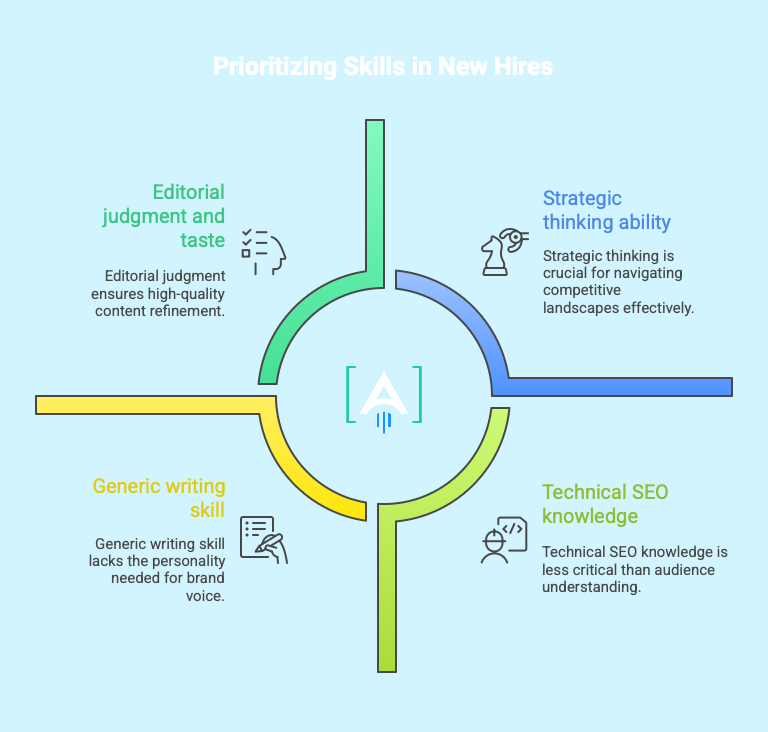
Strategic thinking ability matters more than writing portfolios. During interviews, ask candidates to analyze competitive landscapes, identify content gaps, and recommend positioning strategies. Evaluate their judgment layer thinking.
Editorial judgment and taste matters more than drafting speed. Share AI-generated drafts and ask candidates to critique them, identify weaknesses, and explain improvements. Assess their quality standards and refinement capability.
Brand voice development matters more than generic writing skill. Ask candidates to take a bland draft and transform it with personality and voice. Evaluate their ability to inject character and differentiation.
Creative thinking matters more than process following. Present challenges and evaluate whether candidates generate original frameworks, unexpected angles, or creative storytelling approaches.
Audience understanding matters more than technical SEO knowledge. Ask candidates to describe target audience pain points, motivations, and how they’d speak to different segments. Evaluate genuine empathy and understanding.
What Matters Less Than Before
Writing speed is irrelevant when AI drafts in minutes. Don’t test typing speed or words-per-hour output.
Research thoroughness is less valuable when AI analyzes 10 sources in 2 minutes. Don’t focus on the research process or note-taking ability.
SEO technical knowledge is commoditized when AI handles optimization automatically. Don’t emphasize keyword placement or header structure mechanics.
Topic expertise is less critical when AI provides information. Look for strategic thinking and judgment rather than deep subject matter knowledge in every area you cover.
This inverted hiring criteria feels uncomfortable at first. You’re hiring for skills that seem less tangible than “can write well.” But the content team of the future requires exactly these less tangible skills.
Interview Questions That Reveal Future-Critical Skills
Use these questions to evaluate whether candidates have skills that matter when AI handles research and drafting.
For Strategic Judgment: “I’ll give you a topic we’re considering covering. Walk me through how you’d determine whether it’s worth creating content for, what angle to take, and how to differentiate from competitors.” Evaluate their systematic thinking, not their first idea.
For Brand Voice: “Here’s an AI-generated draft on our standard topic. How would you transform this to sound like it came from our brand specifically?” Provide an actual brand to reference. Evaluate their voice development ability.
For Creative Direction: “Our audience is tired of generic how-to guides on this topic. What’s a fresh approach that would make this interesting?” Evaluate originality and creative thinking, not just execution ideas.
For Editorial Judgment: “Here’s a draft that seems okay at first glance. Identify what’s wrong with it and explain how you’d fix it.” Seed the draft with subtle issues like unclear explanations or weak examples. Evaluate their quality standards and diagnostic ability.
For Audience Empathy: “Describe our target audience’s biggest frustrations with existing content on this topic. How would you address those frustrations?” Evaluate whether they understand audiences deeply or superficially.
These questions reveal capabilities that matter for the content team of the future better than traditional “tell me about your writing process” interviews.
TheAI marketing services at Azarian Growth Agency include hiring strategy consulting that helps companies build content teams with future-critical skills rather than hiring for obsolete capabilities.
The ROI of Investing in Future Skills
Transforming your content team requires investment in training, potentially hiring, and workflow redesign. The ROI justifies the investment quickly.
Productivity Gains from AI-Powered Workflows
Teams successfully implementing AI-powered workflows with future-skilled team members see dramatic productivity improvements.
At Azarian Growth Agency, our content team went from producing 30 articles monthly to over 100 articles monthly with the same 3-person team. That’s 3.3x capacity increase without adding headcount. The time savings came from AI handling research and drafting while humans focused on strategic judgment and refinement.
This productivity increase means you produce more content with the same team, or maintain output with fewer people, or redirect capacity to higher-value work like strategy and distribution. All three options improve content ROI significantly.
Quality Improvements from Strategic Focus
Counterintuitively, quality improves when teams separate strategic judgment from execution. Our blind quality tests showed AI-assisted content with strong human strategic direction rated higher than purely human-created content.
The reason is simple. When humans handle both strategy and execution, they often rush strategy to have time for execution. When AI handles execution, humans can invest fully in strategy. Better strategy produces better outcomes even with AI execution.
Articles based on systematic competitive analysis and strategic positioning rank 2.3 positions higher on average. They generate 64% more organic traffic in the first 90 days. Better rankings compound into significantly more traffic and leads over time.
The quality improvement comes from humans focusing on what they do better than AI (strategy, judgment, creativity, voice) while AI handles what it does better than humans (systematic research, structured drafting, consistent execution).
Cost Savings and Economic Benefits
The economic benefits extend beyond productivity gains. We saved $45,000 annually while producing 3.3x more content by implementing AI-powered workflows with a restructured team.
The savings came from reducing time per article from 70 minutes to 7 minutes, allowing the same team to produce more without incremental labor costs. AI API costs of $250 monthly were far less than hiring additional writers.
Teams can choose to maintain output with fewer people, saving salary costs, or increase output with the same team, increasing content ROI. Either approach improves economics substantially.
Teams successfully adopting AI with proper skill development are improving the content quality and speed.
Conclusion
The content team of the future looks very different from today’s team. Traditional skills like research thoroughness and first draft writing matter less when AI handles these tasks in minutes. New skills; strategic judgment, brand voice development, creative direction, editorial quality control, audience empathy, and storytelling become critical differentiators.
Hiring and role design should focus on strategic thinking, editorial judgment, creative direction, and brand voice development rather than speed, research process, or technical SEO. These future-critical skills determine success when AI handles execution.
Teams implementing AI powered workflows produce more high quality content with the same resources much faster. `
The content team of the future needs fewer people doing higher value work. They focus on strategy, creativity, and quality while AI handles execution at scale.
The question is not whether to transform your content team. The question is whether you will do it intentionally with a systematic plan or reactively as competitors pull ahead.
The tools and framework exist today. Watch webinar 16 to see how to implement AI powered content transformation successfully.