

Your content operations’ team is drowning in research. Thirty minutes per article spent analyzing competitors, identifying keywords, and planning structure. Another thirty minutes writing. Seventy minutes total if everything goes smoothly.
Now multiply that by twenty articles per month. That is 23 hours of pure execution time, not counting editing, revisions, or publishing.
The problem is not the writing. It is everything that happens before writing starts.
Learn how to streamline this process in webinar 16.
Understanding the Content Operations Bottleneck
Most marketing teams focus on the wrong problem. They see content production as a writing challenge and buy AI writing tools to solve it. ChatGPT, Jasper, Copy.ai; these tools promise faster execution.
But speed without strategy creates volume without value.
The real bottleneck lives upstream in your workflow, where decisions get made about what to write, how to structure it, and which competitive gaps to fill. Research from the Content Marketing Institute shows that 72% of B2B marketers use generative AI tools, yet 61% report their organization lacks guidelines for proper implementation.
The Two Layers of Content Production
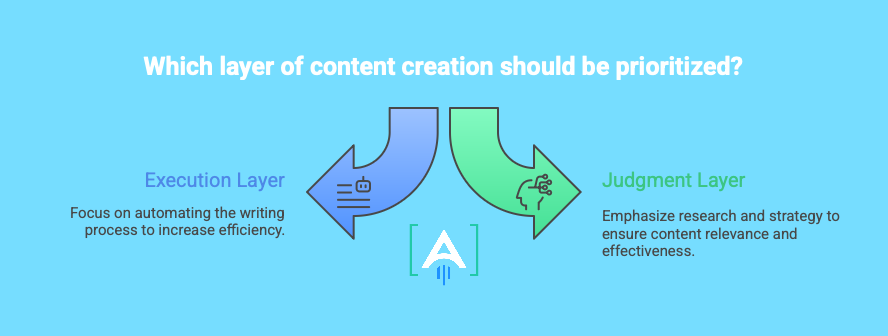
Every piece of content creation involves two distinct layers of work:
The Execution Layer: This is the writing itself. The words on the page. The actual draft creation. This is what most AI tools automate.
The Judgment Layer: This is the research, strategy, and planning. Analyzing competitors. Identifying content gaps. Determining structure. Choosing keywords. Making decisions about what and how to write.
So, traditional AI writing tools only touch the execution layer. They help you write faster, but they don’t help you research faster or strategize smarter.
Hence why many marketing teams feel disappointed after adopting AI writing tools. They expected 10x productivity gains but got 2x at best. The bottleneck moved but didn’t disappear.
When we analyzed our own content workflow at Azarian Growth Agency, we discovered something surprising. Our writers spent 30 minutes researching and planning, then another 30 minutes writing. The research phase consumed 43% of the total production time but received 0% of the automation investment.
We were optimizing the wrong layer.
Mapping Your Current Content Operations Workflow
Before you can automate intelligently, you need visibility into where time actually gets spent. Most marketing leaders can’t answer these questions with precision:
- How long does competitive research take per article?
- What percentage of time is spent on strategic decisions vs execution?
- Which workflow steps create the most bottlenecks?
- Where do quality inconsistencies originate?
Here’s how to map your content operations workflow accurately:
Step 1: Document Every Task in Your Production Process
Break down your workflow into discrete tasks. It’s also good to know that most content operations include these phases:
Research Phase:
- Topic selection and keyword research
- Competitor article analysis
- Audience research and persona alignment
- Content gap identification
- Source gathering and fact verification
Strategy Phase:
- Outline creation and structure planning
- SEO optimization decisions
- Differentiation angle selection
- Internal linking strategy
- CTA and conversion goal definition
Writing Phase:
- First draft creation
- Fact-checking and citation addition
- Voice and tone refinement
- Readability optimization
Publishing Phase:
- Final review and approval
- WordPress formatting and metadata
- Image selection and optimization
- Internal and external linking
- Distribution and promotion
Step 2: Time Track for Two Weeks
Ask your content team to track time spent on each phase for every article produced over two weeks. Use a simple spreadsheet with columns for each phase.
You’ll likely discover patterns you didn’t expect. One client found their writers spent 45 minutes per article just analyzing competitor content—more time than the actual writing phase.
Step 3: Identify Decision Points vs Execution Points
Mark each task as either a decision point (judgment layer) or execution point (execution layer):
Decision Points: Require human judgment, strategy, or creativity. Examples include angle selection, audience targeting, differentiation strategy.
Execution Points: Follow established patterns or rules. Examples include keyword density, meta description length, competitor analysis methodology.
Here’s the insight most teams miss: execution points can often be automated even if they seem complex. So, analyzing ten competitor articles feels like it requires human judgment, but it actually follows a repeatable pattern that AI can learn.
Step 4: Calculate the Cost of Each Phase
Multiply the time spent by your team’s hourly rate. If a writer earning $60,000 annually spends 30 minutes researching, that’s roughly $15 per article in research costs alone.
At 30 articles per month, that’s $450 monthly just for the research phase. Annually, that’s $5,400 per writer dedicated to a task that could potentially be automated.
Where AI Automation Creates the Biggest Impact
Not all automation opportunities deliver equal value. Focus on areas where AI can handle repetitive judgment work that currently requires significant human time.
High-Impact Automation Opportunities
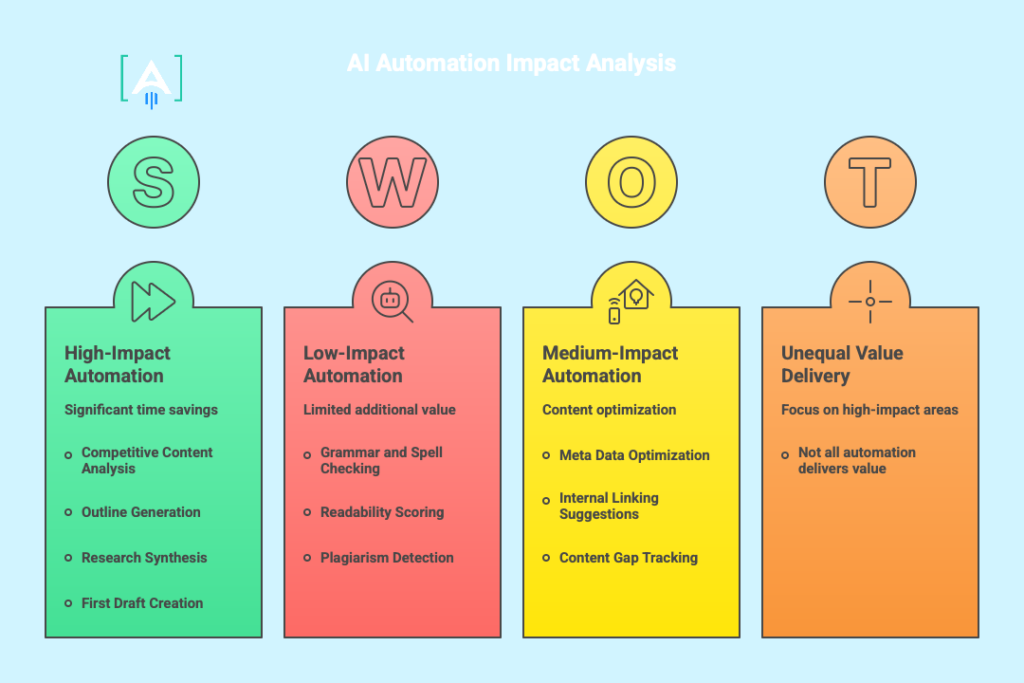
Competitive Content Analysis: AI can analyze dozens of competitor articles in minutes, extracting key themes, identifying gaps, and recommending differentiation angles. What takes a human 30 minutes takes AI 2 minutes.
Outline Generation: AI can create SEO-optimized outlines based on competitive research, keyword strategy, and content gaps. Strategic structure without the manual planning time.
Research Synthesis: AI can gather information from multiple sources, verify claims, and organize findings into usable formats. The heavy lifting of information processing happens automatically.
First Draft Creation: With proper context and strategic direction, AI can produce comprehensive first drafts that human editors then refine. This shifts the human role from creation to curation.
Medium-Impact Automation Opportunities
Meta Data Optimization: Title tags, meta descriptions, and structured data can be generated automatically based on content and SEO requirements.
Internal Linking Suggestions: AI can analyze your existing content library and recommend relevant internal linking opportunities.
Content Gap Tracking: Automated monitoring of competitor content can alert you to topics you haven’t covered yet.
Low-Impact Automation Opportunities
Grammar and Spell Checking: Already widely adopted, limited additional value.
Readability Scoring: Useful but doesn’t save significant time.
Plagiarism Detection: Important for quality control but not a major time sink.
The Content Operations Maturity Model
Most content teams progress through predictable stages as they adopt AI automation:
Level 1: Manual Everything
All research, writing, and publishing done by hand. AI tools used occasionally for inspiration or editing assistance. Time per article: 60-90 minutes. Cost per article: $50-75.
Level 2: Execution Layer Automation
AI writing tools adopted for first draft creation. Research and strategy are still manual. Time per article: 40-60 minutes. Cost per article: $35-50.
Level 3: Partial Judgment Layer Automation
Some research tasks are automated (keyword research, competitor tracking). Strategic planning still manual. Time per article: 20-40 minutes. Cost per article: $20-35.
Level 4: Full Workflow Automation
Both judgment and execution layers are automated. Human oversight focused on review, refinement, and strategic direction. Time per article: 7-15 minutes. Cost per article: $5-15.
According to CMI research, only a small fraction of B2B marketers have reached advanced automation maturity. The opportunity for competitive advantage remains massive for teams that can advance quickly.
Building Your Automation Roadmap
Moving from your current state to full workflow automation requires a structured approach. So, here’s how to build a realistic roadmap:
Phase 1: Baseline and Benchmark (Week 1-2)
Map your current workflow completely. Time track every task. Calculate costs per phase. Identify the biggest time sinks. Set baseline metrics for quality and speed.
Phase 2: Quick Wins (Week 3-6)
Start with low-risk, high-impact automation. Competitive analysis automation typically delivers immediate value with minimal risk. Outline generation follows closely behind.
Test with 5-10 articles before scaling. Compare AI-assisted articles against fully manual articles in blind quality tests. Track time savings precisely.
Phase 3: Workflow Integration (Week 7-12)
Connect automated tasks into a continuous workflow. Research feeds into outline generation. Outlines feed into draft creation. Drafts feed into publishing.
This is where the real productivity gains emerge. Individual task automation saves minutes. Workflow automation saves hours.
Phase 4: Optimization and Scale (Month 4+)
Refine prompts and configurations based on results. Train your team on the new workflow. Scale production volume while maintaining quality standards.
One of our clients increased output from 20 articles monthly to 65 articles monthly with the same three-person team after implementing full workflow automation. The cost per article dropped from $67 to $22, a 67% reduction.
Common Pitfalls to Avoid
Many teams stumble when implementing content automation. Here are the mistakes we see repeatedly:
Pitfall 1: Automating Before Standardizing
You can’t automate chaos. If your content process lacks clear standards and repeatable patterns, automation will amplify inconsistency rather than eliminate it.
So, Document your content standards first. Style guides, quality criteria, SEO requirements, brand voice parameters. Give AI clear rules to follow.
Pitfall 2: Treating AI as a Complete Replacement
AI excels at processing information and generating first drafts. It struggles with nuanced brand voice, controversial topics, and content requiring deep subject matter expertise.
The goal isn’t to eliminate human involvement. The goal is to shift human time from repetitive research work to strategic thinking and creative refinement.
Pitfall 3: Ignoring Quality Measurement
Speed without quality creates volume without value. Track quality metrics as aggressively as you track speed metrics.
We recommend blind testing where editors review articles without knowing which were AI-assisted and which were fully manual. This removes bias and gives you objective quality data.
Pitfall 4: Optimizing One Task Instead of the Workflow
Automating article writing but leaving research manual creates a new bottleneck. Automating research but leaving publishing manual creates friction.
Think in terms of end-to-end workflows, not individual tasks. The goal is removing as many handoffs and manual steps as possible from topic selection to published articles.
Measuring Success: The Metrics That Matter
Traditional content metrics (pageviews, time on page, rankings) remain important, but automation introduces new KPIs you should track:
Efficiency Metrics:
- Time per article (research + writing + publishing)
- Cost per article (team time + tool costs)
- Articles produced per team member per month
- Bottleneck identification (which phase takes longest)
Quality Metrics:
- Blind quality scores (AI vs manual comparison)
- Editorial revision time required
- SEO performance relative to manual content
- Engagement metrics compared to baseline
Business Impact Metrics:
- Content production cost as percentage of marketing budget
- Revenue per article published
- Conversion rate by content type
- Team satisfaction and burnout indicators
The teams seeing the best results track all three categories simultaneously. Speed matters, but not at the expense of quality or team morale.
The Future of Content Operations
Content automation continues evolving rapidly. Model Context Protocol (MCP) servers now allow AI to interact directly with your WordPress installation, your SEO tools, and your content management systems.
What this means practically: the gap between strategy and execution continues shrinking. Soon, the instruction “create an article about email marketing automation targeting Marketing Ops Managers” will trigger a fully automated workflow that researches, writes, optimizes, and publishes without human involvement in the execution steps.
Human expertise will shift entirely to the strategic layer: which topics to prioritize, what brand voice to maintain, which audiences to target, how to differentiate from competitors.
This shift is already happening. Data from HubSpot’s 2025 research shows that 43% of marketers now use AI for content creation (emails and so on) as their primary use case, with research (34%) and brainstorming (27%) following closely. The question isn’t whether to adopt automation, but how quickly you can implement it effectively.
Getting Started This Week
You don’t need to rebuild your entire content operation immediately. Start with these three actions this week:
Action 1: Map your current workflow using the framework in this article. Identify where time gets spent and where bottlenecks occur.
Action 2: Calculate the cost per article in your current process. Time spent multiplied by team hourly rate plus tool costs. This gives you a baseline to measure improvement against.
Action 3: Choose one high-impact automation opportunity to test. Competitive analysis automation typically delivers the fastest ROI with the lowest risk.
Test with five articles. Compare results against your manual process. Measure time savings and quality differences. Scale from there.
Ready to See Content Automation in Action?
We built Content Engine to show what is possible when the full content workflow is automated; research, strategy, writing, and publishing. It reduces article production time from 70 minutes to 7 minutes while maintaining quality. We use it daily to produce over 100 articles per month across multiple industries.
At Azarian Growth Agency, we have spent the last year refining content operations through real world implementation. We map workflows, identify bottlenecks, and implement automation solutions that deliver measurable results. Clients typically see 60-70% cost reduction and 3 to 5 times output growth within the first quarter.
In our webinar 16, you can see how full content workflow automation works in practice. The session walks through research, strategy, writing, and publishing, showing how Content Engine reduces article production time from 70 minutes to 7 minutes while maintaining quality.
We also demonstrate live examples, including competitive research automation, strategic outline generation, and one click WordPress publishing.
Watch webinar 16 to see how AI transforms content production from a bottleneck into a competitive advantage..