
The AI Content Automation Playbook. Strategy, Workflow Design, and Implementation Guide
Content automation in 2026 goes far beyond AI writing assistants that help you draft faster. Most marketing teams still think content automation means using ChatGPT or Jasper to generate articles. They’re missing the transformation happening right now.
True content automation handles complete workflows from research through publication. It analyzes competitors, identifies gaps, creates strategic outlines, writes drafts, optimizes for SEO, and publishes to WordPress automatically. All in under 10 minutes per article.
According to Content Marketing Institute research, 72% of B2B marketers use generative AI tools. But adoption without workflow redesign fails to deliver expected results.
At Azarian Growth Agency, we cover content automation in 2026 extensively in webinar 16. You’ll see our Content Engine automate the complete workflow using Claude API and MCP servers. Our AI marketing services include implementing these systems for SEO, webinar marketing, and content operations. This guide shows what’s actually possible in 2026.
The Five Phases of True Content Automation
Writing assistants automate one phase. Complete content automation handles all five phases systematically.
Phase 1: Intelligent Research Automation
What Writing Assistants Do:
- Nothing. You manually research competitors and provide context to the AI.
What Content Automation in 2026 Does:
- Automatically scrapes and analyzes 10 competitor articles
- Identifies common themes across all sources
- Spots content gaps where competitors are weak
- Extracts key statistics and supporting data
- Returns structured research brief in 2 minutes
Our competitive (content) marketing analysis automation catches patterns humans miss reading sequentially. Time drops from 30 minutes to 2 minutes per article.
Phase 2: Strategic Planning Automation
What Writing Assistants Do:
- Generate outlines if you provide detailed instructions about structure, keywords, and positioning.
What Content Automation in 2026 Does:
- Creates SEO optimized outline automatically
- Incorporates identified content gaps
- Structures around target keywords
- Plans internal linking opportunities
- Determines differentiation angle
- Completes in 30 seconds versus 15 minutes manually
Strategic planning requires understanding the competitive landscape and business objectives. Automation handles systematic analysis. Humans validate the strategic direction.
Phase 3: Content Generation With Context
What Writing Assistants Do:
- Generate article text based on outline and instructions you provide.
What Content Automation in 2026 Does:
- Creates comprehensive 3,000 word draft
- Includes proper source citations automatically
- Implements keyword strategy naturally
- Maintains consistent brand voice
- Structures content for readability
- Completes in 4 minutes versus 30 minutes manually
The draft quality depends on research and planning inputs. Complete automation provides this context automatically. Writing assistants require you to provide it manually.
Phase 4: Optimization and Quality Control
What Writing Assistants Do:
- Nothing. You manually check SEO, add metadata, and verify accuracy.
What Content Automation in 2026 Does:
- Validates SEO optimization automatically
- Checks citation accuracy and completeness
- Scores readability and structure
- Identifies missing elements
- Flags quality issues for human review
- Runs quality gates before publishing
Systematic quality control scales better than manual review. Content quality at scale requires automated measurement.
Phase 5: Publishing and Distribution
What Writing Assistants Do:
- Nothing. You manually copy to WordPress, format, add metadata, publish.
What Content Automation in 2026 Does:
- Publishes directly to WordPress
- Adds proper metadata automatically
- Handles formatting and images
- Manages categories and tags
- Triggers distribution workflows
- Completes instantly versus 10 minutes manually
Publishing integration eliminates the final manual bottleneck. Content flows from topic to live article without human copying and pasting.
Real Implementation: How We Automated Our Complete Workflow
We built Content Engine to prove complete automation works in production, not just demos.
The Challenge:
- Three person content team producing 30 articles monthly
- Leadership wanted 100 articles monthly
- Hiring six writers would cost $288,000 annually
- Manual process took 70 minutes per article
The Solution Architecture:
Research automation using a custom MCP server analyzing competitors in 2 minutes.
Strategy automation generating SEO optimized outlines in 30 seconds.
Content generation creating 3,000 word drafts with citations in 4 minutes.
Publishing automation handling WordPress formatting and metadata instantly.
Results After 60 Days:
- Same three person team now produces 100 plus articles monthly
- Time per article dropped from 70 minutes to 7 minutes
- Cost per article fell from $133 to $40
- Quality improved with AI research catching more patterns
- Articles ranked 2.3 positions higher on average
- Organic traffic increased 64% per article
Development cost $30,000 and paid back in under 2 months through labor savings.
Data from CoSchedule’s 2025 report shows 85.84% of marketing professionals plan to increase AI usage. Complete workflow automation delivers the productivity gains they’re seeking.
Beyond Content: What Else Automation Handles in 2026
Content automation principles apply across marketing operations. Complete workflow thinking transforms every function.
SEO Workflow Automation
Our SEO services automate competitive keyword research, content gap analysis, and technical audits. AI pulls ranking data, analyzes competitor strategies, identifies opportunities, and generates optimization recommendations.
The workflow runs: identify target keywords → analyze top 10 competitors → find content gaps → prioritize opportunities → generate optimization plan. Completes in 5 minutes versus 2 hours manually.
Webinar Campaign Automation
Through webinar marketing, we automate registration processing, attendee segmentation, follow up personalization, and content repurposing. AI analyzes attendee behavior, identifies engagement signals, and triggers appropriate nurture sequences.
The workflow runs: process registration → segment by intent → personalize communications → track engagement → optimize follow up. Handles 500 registrants with the effort of 50.
The AI Content Automation Playbook. Strategy, Workflow Design, and Implementation Guide
Outreach Campaign Automation
Our signal-based cold outreach automates trigger monitoring, prospect enrichment, message personalization, and sequence optimization. AI identifies buying signals, researches prospects, and generates contextual outreach automatically.
The workflow runs: monitor signals → enrich prospect data → generate personalized messaging → optimize sending times → track responses. Processes 100 prospects in the time of 10.
Link Building Intelligence
Through link building services, we automate opportunity identification, prospect research, and outreach personalization. AI analyzes competitor backlinks, identifies relevant prospects, and drafts contextual pitches.
The workflow runs: analyze backlink profiles → identify opportunities → research prospects → generate outreach → track placements. Scales link building without proportional team growth.
The Technology Stack Enabling Content Automation in 2026
Complete workflow automation requires specific technologies working together systematically.
AI APIs for Intelligence
Claude API provides the core intelligence for analysis, strategy, and generation. It handles unstructured data, reasons about context, and produces structured outputs.
GPT 4 offers strong general purpose performance with extensive documentation. Useful for tasks requiring broad capability rather than specialized analysis.
The key is matching AI capabilities to task requirements. Use the best tool for each job rather than one tool for everything.
MCP Servers for Integration
MCP servers connect AI to your actual tools and data. They expose resources AI can read, tools AI can execute, and workflows AI can orchestrate.
Without MCP servers, AI exists in isolation. With MCP servers, AI integrates into your complete stack. Research servers, publishing servers, analytics servers all work together.
Workflow Orchestration
Individual automations save minutes. Connected workflows save hours. The orchestration layer triggers next steps automatically as previous steps complete.
Research completion triggers outline generation. Outline completion triggers draft creation. Draft completion triggers publishing. No human handoffs between phases.
Quality Gates and Monitoring
Automation at scale requires systematic quality control. Gates check completeness, accuracy, optimization, and readability before publishing.
Monitoring tracks costs, performance, errors, and quality metrics. Weekly reviews catch degradation before it impacts significant volume.
Common Barriers Preventing Teams From Moving Beyond Writing Assistants
Most teams recognize writing assistants aren’t enough but struggle to advance. Four barriers keep them stuck.
Barrier 1: Thinking About Tools Instead of Workflows
Teams ask “which AI writing tool should we use” instead of “how do we automate our complete workflow.” This framing limits what they build.
Solution: Map your end to end process. Identify all phases from topic selection through publication. Design automation spanning the complete workflow, not just writing.
Barrier 2: Lacking Technical Resources
Building automation with AI APIs requires engineering skills. Most marketing teams don’t have developers who can build workflow integration.
Solution: Partner with agencies who’ve built similar systems. Or hire contractors for development then maintain internally. Or use platforms abstracting complexity at the cost of customization.
Barrier 3: Underestimating True Costs
Teams don’t calculate current cost per article including all labor. They can’t prove whether automation delivers ROI.
Solution: Time track every task for two weeks. Calculate cost per article with full labor costs. This baseline proves automation value and guides investment decisions.
Barrier 4: Resistance to Process Change
Writers resist becoming curators. Editors worry about job security. Managers struggle with new productivity metrics.
Solution: Invest in change management. Explain how automation benefits the team by eliminating boring work. Show time savings data. Make transition gradual with opt in adoption.
Getting Started With Content Automation in 2026
Start with one workflow proving complete automation works for your specific situation.
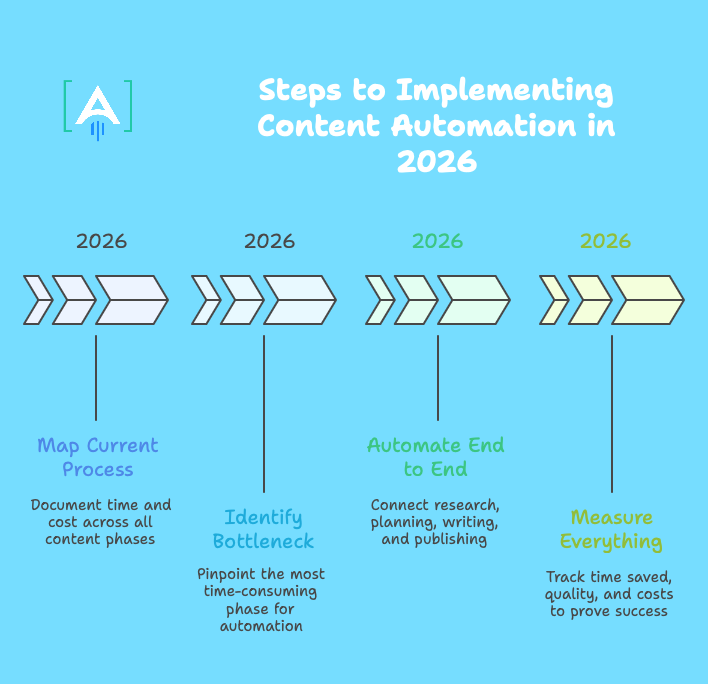
Map Your Current Process: Document where time goes across all phases. Research, planning, writing, editing, publishing. Calculate total time and cost per article.
Identify Your Bottleneck: Which phase consumes most time? Research typically takes 30 minutes. Planning takes 15 minutes. Attack the biggest constraint first.
Automate End to End: Don’t just automate writing. Connect research to planning to writing to publishing. Prove the complete workflow automation concept.
Measure Everything: Track time saved, quality scores, actual costs. Compared to manual baseline. Let data prove the approach works before scaling.
Most teams see 60 to 80% time reductions on their first complete workflow automation.
Conclusion
Content automation in 2026 means complete workflow automation, not writing assistance. AI handles research, strategy, writing, optimization, and publishing systematically. Humans provide strategic direction and final approval.
We built Content Engine automating our complete workflow using Claude API and MCP servers. Our three person team produces 100 plus articles monthly in 7 minutes per article. Quality improved because systematic AI research catches patterns humans miss.
In webinar 16, we demonstrate what complete automation looks like. You’ll see our end to end workflow handling research through publication. You’ll see the technology stack including AI APIs, MCP servers, and workflow orchestration. We share 60 days of production data proving the approach works.
We help teams move beyond writing assistants to complete workflow automation. Our approach works because we built these systems for our own operation first and use them daily in production.
Ready to see what’s actually possible in 2026?