
Building marketing automation with AI APIs transforms how companies execute campaigns, analyze data, and engage customers. But most teams rush into implementation without understanding costs, technical requirements, or realistic timelines. The result: abandoned projects, wasted budgets, and frustrated teams.
The difference between successful AI API implementations and failures comes down to preparation. You need to know which APIs solve your specific problems, how to calculate true costs beyond subscription fees, and what technical infrastructure your implementation requires.
At Azarian Growth Agency, we cover building marketing automation with AI APIs extensively in webinar 16. You’ll see how we built Content Engine using Claude API and MCP servers to automate complete workflows. Our AI marketing services include custom API implementation for SEO automation, webinar marketing, and signal-based outreach. This guide shares what you need to know before you start building.
Why AI APIs Enable Marketing Automation
Traditional marketing automation platforms provide predefined workflows. Email sequences trigger based on specific actions. Social posts are scheduled according to calendars. Analytics dashboards update on fixed intervals.
AI APIs enable dynamic automation that adapts based on data and results. Instead of following rigid rules, your marketing systems analyze performance, identify opportunities, and adjust strategies automatically.
Many organizations are beginning to experiment with AI agents, systems that can plan and execute multiple steps in real‑world workflows. Currently, 23% are scaling agentic AI in at least one function, while 39% have started experimenting.
However, adoption remains limited: most deployments are in only one or two functions, and in any single function, no more than 10% of respondents report scaling AI agents.
The Fundamental Difference
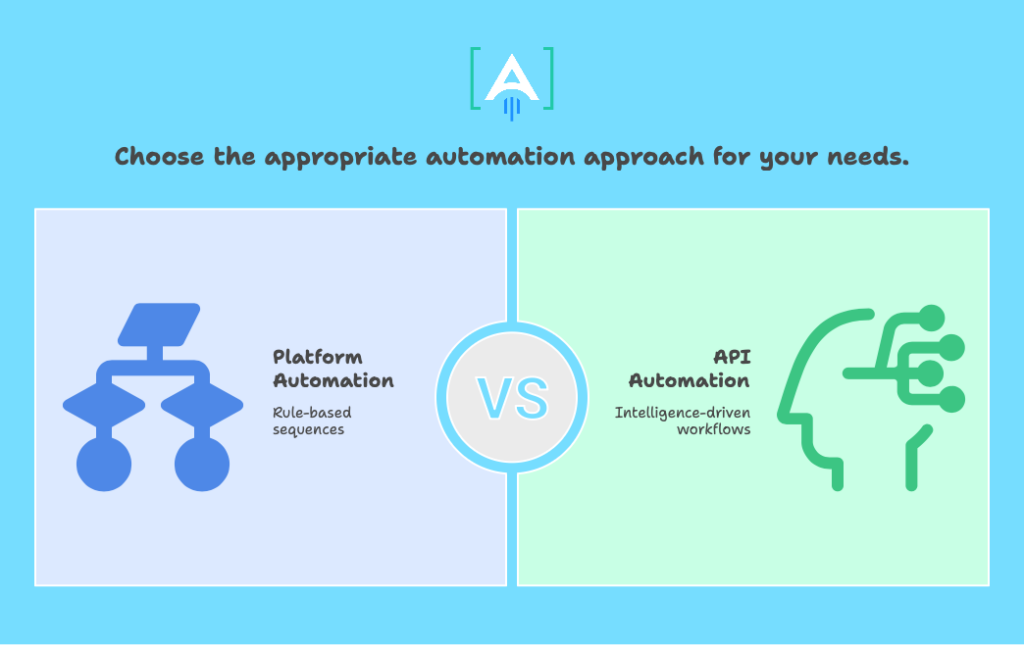
Platform Automation: Rules-based sequences you configure through interfaces. If the lead downloads the ebook, then send email series A. If a lead visits the pricing page three times, then notify the sales team.
API Automation: Intelligence-driven workflows that reason about data. Analyze lead behavior patterns. Compared to successful conversion paths. Generate personalized outreach addressing specific interests. Adjust messaging based on engagement signals.
The platform tells the system what to do. The API figures out what to do based on the objectives you define.
What Makes AI APIs Different From Regular APIs
Regular APIs provide data and functions. Weather APIs return forecast data. Payment APIs process transactions. CRM APIs read and write customer records.
AI APIs provide intelligence and generation. They analyze unstructured data like articles or customer feedback. Also, they generate new content like emails or ad copy. They make predictions about future behavior or outcomes.
This distinction matters for marketing automation. Regular APIs connect systems. AI APIs add reasoning capabilities that traditional automation platforms lack.
Understanding AI API Costs and Economics
AI API pricing differs from traditional SaaS subscriptions. Instead of paying per user or a flat monthly fee, you pay based on usage, which introduces both opportunities and potential surprises.
Token-Based Pricing
Most AI APIs charge based on tokens processed. Tokens are small pieces of text, roughly three-quarters of a word in English, and both the input you send and the output you receive count toward usage.
Estimating Costs
It’s easy to underestimate costs because real workflows involve multiple steps. For example, producing content with AI involves researching, drafting, and editing. Similarly, automating customer service requires analyzing inputs and generating responses. Costs grow quickly when scaled across many articles, tickets, or other tasks.
Hidden Infrastructure Costs
API charges are only part of the picture. Other considerations include:
- Development time: Building custom automations requires engineering resources.
- Hosting and infrastructure: Continuous server usage can add up.
- Monitoring and logging: Tracking usage, errors, and performance is essential.
- Maintenance and updates: AI models evolve, requiring ongoing code updates.
ROI Considerations
Companies that adopt AI early report significant value per dollar invested, but most organizations see satisfactory returns over 2 to 4 years; longer than typical technology payback periods. Agencies often charge more for AI-powered services due to these added infrastructure and maintenance requirements.
Data from Fullview research shows companies that moved early into AI adoption report $3.70 in value for every dollar invested, with top performers achieving $10.30 returns per dollar. However, most organizations achieve satisfactory ROI within 2 to 4 years, much longer than typical 7 to 12 month technology payback periods.
Hidden Infrastructure Costs
API costs represent only part of total expenses. Factor in these additional requirements:
Usage-based pricing: AI differs from traditional SaaS subscriptions—you pay based on usage, not per user or flat monthly fees. Most AI APIs charge per token, covering both input and output text.
- Example: OpenAI GPT‑4 Turbo costs $0.003 to $0.012 per 1,000 tokens depending on usage tier.
AI services and solutions:
- AI SEO services: Average $3,200/month, with retainers from $2,000 to $20,000+.
- Custom AI development: Projects typically range from $50,000 to $500,000+.
- SaaS AI tools: Start at $99/month.
- AI automation builds: Usually $2,500 to $15,000+, with ongoing monitoring retainers $500 to $5,000+.
Hidden costs:
- Development time for building custom automations.
- Hosting and infrastructure to run AI systems continuously.
- Monitoring and logging to track performance and errors.
- Maintenance and updates as AI models evolve.
ROI considerations:
- Early adopters can achieve significant value, but most organizations see measurable returns over a longer timeframe than typical tech investments.
Technical Requirements for AI API Implementation
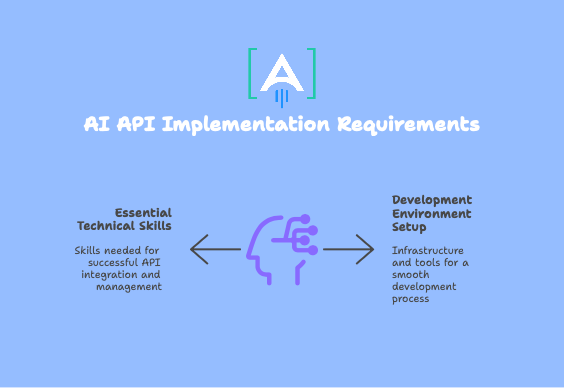
Building marketing automation with AI APIs requires specific technical capabilities. Assess your readiness honestly before starting.
Essential Technical Skills
API Integration: Understanding REST APIs, authentication, rate limiting, error handling. If your team hasn’t built API integrations before, expect a steep learning curve.
Prompt Engineering: Crafting effective prompts that reliably produce desired outputs. This skill determines quality and cost efficiency. Poor prompts waste tokens on irrelevant responses.
Data Processing: Cleaning and structuring data before sending to APIs. Parsing and validating responses. Handling edge cases where API output doesn’t match expected formats.
Error Handling: APIs fail. Networks drop. Rate limits hit. Your code must handle failures gracefully without losing data or corrupting workflows.
Security: Protecting API keys. Sanitizing inputs to prevent injection attacks. Implementing proper authentication and authorization.
Development Environment Setup
API Keys and Authentication: Secure storage for credentials. Never hardcode keys in source code. Use environment variables or secret management services.
Testing Infrastructure: Sandbox environments for development. Automated tests validating API interactions. Mock responses for testing without consuming API credits.
Monitoring and Alerts: Real time tracking of API usage. Automated alerts when errors spike or costs exceed thresholds. Logs for debugging issues.
Version Control: Git repository for code. Proper branching strategy. Documentation of changes and decisions.
Choosing Between Custom Build and Low Code Solutions
You face a decision: build custom using AI APIs directly or use platforms abstracting API complexity.
Build Custom When:
- Your workflow requires capabilities platforms don’t provide
- You need complete control over costs and optimization
- You have engineering resources comfortable with APIs
- The automation creates competitive differentiation
Use Platforms When:
- Your needs match platform capabilities
- Speed matters more than customization
- You lack engineering resources
- Ongoing maintenance burden would be prohibitive
Research from Intelliarts analysis shows 88% of marketers now use AI. Adoption jumped sharply from 29% in 2021 to 88% in 2025, with expectations reaching 95% by 2030. Platforms enable this rapid adoption for teams without deep technical resources.
Five Phase AI API Implementation Framework
1 Phase : Problem Definition and Scope
- Map current workflow: data sources, decisions, actions, timing.
- Identify automation opportunities: focus on tasks requiring judgment over repetitive work.
- Define success metrics: time saved, cost reduction, quality, or revenue impact.
- Estimate ROI: compare development and API costs vs. expected benefits.
2 Phase : API Selection and Testing
- Choose the best AI API for your use case (e.g., Claude for analysis, GPT-4 for general purpose, Gemini for high volume).
- Test with real data, not marketing examples.
- Measure token usage and compare total costs across providers.
3 Phase : Prototype Development
- Build a minimal version to validate the concept.
- Use sample data to test quality and reliability.
- Track costs, response times, and output quality.
- Gather user feedback before scaling.
4 Phase : Production Implementation
- Add error handling, logging, and monitoring for performance and costs.
- Optimize prompts, caching, and model selection to reduce costs.
- Build admin interfaces and document the system for maintenance.
5 Phase : Optimization and Scaling
- Analyze usage patterns and optimize prompts to improve quality and reduce costs.
- Implement caching for repeated queries.
- Expand automation to adjacent workflows.
- Monitor ROI and adjust strategy based on real results.
Common Mistakes That Destroy AI API Projects
Teams make predictable mistakes when building marketing automation with AI APIs. Avoid these to dramatically improve success odds.
Mistake 1: Underestimating Token Consumption
Marketing examples show simple prompts with clean inputs. Production workflows involve messier data, longer context, and iterative refinement.
A prompt that looks like it should cost $0.10 actually costs $2 when you include real data preprocessing, error recovery, and result validation. Multiply by 1,000 monthly executions and your budget explodes.
Solution: Test with real production data before committing to implementation. Measure actual token consumption across representative examples. Add 50% buffer to cost estimates for unexpected usage.
Mistake 2: Ignoring Prompt Engineering
Teams treat prompt writing as simple instruction giving. Reality: prompt engineering dramatically affects both quality and cost.
Poor prompts produce inconsistent outputs requiring human cleanup. They waste tokens on irrelevant responses. They miss edge cases causing errors.
Solution: Invest time in prompt development. Test dozens of variations. Use few shot examples showing desired outputs. Implement systematic evaluation of prompt performance.
Mistake 3: Building Without Sufficient Error Handling
APIs fail. Networks drop. Rate limits hit. Services go down. Your automation must handle failures gracefully or it corrupts data and frustrates users.
Most teams implement a happy path only during initial development. First production failure causes cascading issues because error handling doesn’t exist.
Solution: Build error handling from the start. Test failure scenarios explicitly. Implement retry logic with exponential backoff. Log all errors with full context. Alert humans when automatic recovery fails.
Mistake 4: Neglecting Security
API keys grant access to your accounts and billing. Leaked keys mean unauthorized usage and massive unexpected charges.
Teams accidentally commit keys to public GitHub repositories. They share keys in Slack or email. They hardcode keys in client side JavaScript.
Solution: Use environment variables or secret management services. Never commit keys to source control. Implement key rotation. Monitor for unusual usage patterns indicating compromise.
Mistake 5: Skipping Monitoring and Observability
You can’t optimize what you don’t measure. Teams launch AI automation without instrumentation, then wonder why costs spiral or quality declines.
Without monitoring, you don’t know which prompts consume the most tokens. You don’t see error patterns. You can’t trace quality issues to root causes.
Solution: Implement comprehensive monitoring from day one. Track costs per workflow and per operation. Log all API interactions. Set up dashboards showing usage trends. Review metrics weekly.
Getting Started This Week
Don’t try to transform your entire marketing operation immediately. Start with one workflow proving the AI API approach works.
Identify Your Highest Pain Point: Map your most time consuming manual workflow. Calculate current time investment and cost. This becomes your first automation target and ROI baseline.
Choose One AI API to Test: Pick Claude or GPT 4 to start. Sign up for API access. Test with 5 to 10 examples of your real data. Measure quality and token costs.
Build Minimal Prototype: Automate just the core workflow. Skip error handling and optimization initially. Prove the concept works with 10 to 20 test cases.
Measure Results: Track time saved, quality compared to manual work, and actual API costs. Calculate ROI based on real numbers, not estimates.
Most teams see 40 to 60% time reductions on their first AI API automation. This proves the approach and builds organizational confidence for expanding to additional use cases.
Conclusion
Building marketing automation with AI APIs requires technical preparation, realistic cost planning, and systematic implementation. Most failures stem from rushing into development without understanding requirements or measuring real usage patterns.
At [A] Growth Agency, we built content engines using Claude API and MCP servers to automate our complete content workflow. Three person team producing 100 plus articles monthly in 7 minutes per article versus 70 minutes manually. Development paid back in under 2 months through labor cost savings.
In webinar 16, we demonstrate our complete AI API implementation live. You’ll see how we integrated Claude API, built custom MCP servers, and optimized prompt engineering. We share our exact architecture, cost breakdowns, and 60 days of production data showing what works versus what marketing examples claim.
We help teams evaluate AI API options for their workflows, build custom implementations, and optimize costs through proper prompt engineering. Our approach works because we’ve built and optimized these systems in our own production environment first.
Ready to build marketing automation with AI APIs?