
You’re evaluating AI marketing tools and facing the build versus buy decision. Should you buy an existing platform or build something custom? The wrong choice wastes months of time and tens of thousands of dollars.
Most marketing leaders approach this decision emotionally. They get excited about building custom solutions that fit perfectly. Or they default to buying because it feels safer and faster. Both approaches skip the systematic analysis needed to make the right choice.
The build versus buy decision for AI marketing tools requires a strategic framework. This guide gives you that framework based on real implementation experience, not theory.
At Azarian Growth Agency, we cover this in webinar 16. You will get a strategic framework based on real implementation experience:
- When building makes sense
- When buying is smarter
- How to calculate true costs for both options
- Hidden factors most teams miss when evaluating AI marketing tools
We’ll show you exactly when building makes sense, when buying is smarter, and how to calculate true costs for both options. You’ll learn the hidden factors that most teams miss when evaluating AI marketing tools.
Why the Build vs Buy Decision Matters More Than Ever
The global marketing technology (MarTech) market is estimated at USD 557.94 billion in 2025 and is expected to grow from USD 669.14 billion in 2026 to approximately USD 2,863.76 billion by 2034, registering a CAGR of 19.93% between 2025 and 2034. This rapid expansion is fueled by the widespread adoption of digital technologies across businesses worldwide, leading to an ever-growing ecosystem of MarTech tools.
This explosion of tools creates a paradox. More options should make decisions easier. Instead, they make the build-versus-buy decision harder because the landscape changes constantly.
Off-the-shelf AI tools launch weekly with new capabilities. Custom development becomes more accessible through AI-assisted coding. The cost equation shifts monthly as both options evolve.
Making the wrong decision has serious consequences. Buying the wrong tool means paying for features you don’t need while missing capabilities you require. You’re locked into a vendor’s roadmap instead of controlling your own. Monthly costs compound across years.
Building when you should buy means months of development time before seeing results. Engineering resources get diverted from core product work. You inherit ongoing maintenance costs and technical debt. The opportunity cost is massive when you could have launched faster with an existing solution.
At Azarian Growth Agency, we’ve guided dozens of companies through this decision. We’ve seen both spectacular successes and expensive failures. The difference always comes down to having a systematic framework versus making gut-feel decisions.
The True Cost of Building AI Marketing Tools
Building custom AI marketing tools costs far more than most teams estimate initially. The obvious costs are clear. The hidden costs are what destroy budgets and timelines.
Obvious Development Costs
Engineering time represents the most visible cost. According to Glassdoor data, a senior engineer costs approximately $199,000 annually in total compensation. Indeed reports similar figures at $155,000 plus bonuses. Factor in 30% overhead for management, office space, and equipment. You’re looking at $195,000 to $260,000 per engineer annually.
Building a meaningful AI marketing tool requires at least 3 to 6 months of focused development time. One engineer working full time for 3 months costs roughly $48,000 to $65,000. Most projects need multiple engineers or longer timelines, pushing costs to $100,000 to $200,000 easily.
AI infrastructure costs add up quickly. Claude API costs approximately $15 per million tokens for input and $75 per million tokens for output. Processing 100 articles monthly analyzing 10 competitors each means roughly 50 million input tokens and 5 million output tokens monthly. That’s $1,125 in API costs monthly or $13,500 annually.
Add database hosting, application hosting, and supporting infrastructure. Budget another $500 to $2,000 monthly depending on scale. Total infrastructure runs $20,000 to $40,000 annually.
Hidden Costs Teams Miss
Opportunity cost is the biggest hidden expense. Engineering time spent building internal tools is time not spent on your core product. If that engineering capacity could ship features generating $50,000 monthly in revenue, the opportunity cost exceeds $600,000 annually. Most teams completely ignore this in their analysis.
Maintenance and updates consume significant resources annually. According to software development research, maintenance costs range from 15% to 30% of original development effort depending on the system’s lifecycle phase. A tool taking 6 months to build requires 1.5 to 2 months of maintenance yearly. AI models improve constantly. APIs change. Infrastructure needs updates.
Integration complexity grows as your stack evolves. The custom tool needs to work with your CRM, analytics platform, content management system, and other tools. Each integration takes 2 to 4 weeks of development. Budget 40% to 60% of initial development costs for integration work.
A 2024 Forrester survey found that 69% of data and analytics leaders plan to raise their budgets for data, data management, data science, and analytics compared to the previous year.
When Building Makes Financial Sense
Building becomes economically viable at a significant scale. The math shifts when:
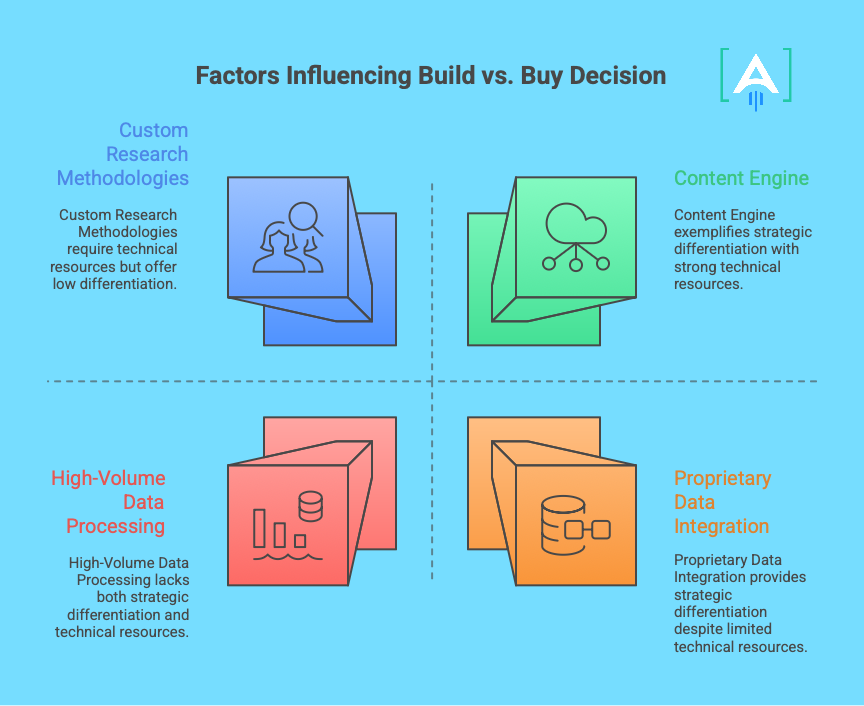
Your volume is extremely high. If you’re producing 50+ articles weekly or processing thousands of data points daily, per-unit API costs for off-the-shelf tools become prohibitive. Custom infrastructure with upfront development costs but low marginal costs makes more sense.
Your requirements are truly unique. If you need capabilities no existing tool provides and can’t work around limitations, building may be necessary. Custom research methodologies, proprietary data integration, or unique workflow requirements can justify building.
You have technical resources available. If you already employ engineers with AI and automation expertise who have capacity, the opportunity cost decreases significantly. Building with existing resources costs less than building requires new hires.
Strategic differentiation requires it. If the custom tool creates defensible competitive advantage central to your business model, building can justify higher costs. Content Engine is an example where the custom tool became the product, making development costs an investment rather than an expense.
Our AI marketing services help companies evaluate when building makes strategic sense versus when buying delivers better ROI.
The Real Cost of Buying AI Marketing Tools
Buying AI marketing tools seems simpler than building. Subscribe, onboard, and start using. The costs appear straightforward. The reality is more complex.
Obvious Subscription Costs
Monthly or annual subscriptions are the visible expense. AI content tools range from $29 monthly for basic plans to $500+ monthly for professional tiers. SEO tools like Ahrefs or SEMrush cost $99 to $399 monthly. Comprehensive marketing platforms cost $1,000+ monthly.
According to Gartner’s 2025 CMO Spend Survey, martech now accounts for 22% of total marketing budgets. Marketing budgets remain flat at 7.7% of overall company revenue, with 59% of CMOs reporting insufficient budget to execute their strategy in 2025. For growth stage startups and mid market companies, this typically translates to carefully allocated technology spending between existing tools and custom solutions.
Per-user pricing scales costs with team growth. Many tools charge per seat. Adding team members adds costs. A tool costing $49 per user monthly for 5 users costs $2,940 annually. Scale to 20 users and annual costs jump to $11,760.
Usage-based pricing creates variable costs. AI tools often charge per API call, per article generated, or per analysis run. These costs scale with volume but can spike unexpectedly if usage increases.
Hidden Costs of Buying
Integration and setup time consumes resources even with off-the-shelf tools. Connecting the tool to your existing stack takes 1 to 3 weeks typically. Training team members takes another 1 to 2 weeks. Figure 40 to 80 hours of internal time at $50 to $100 hourly. That’s $2,000 to $8,000 in hidden setup costs.
Feature gaps and workarounds force you to adapt processes to tool limitations. The tool doesn’t do exactly what you need, so you create manual workarounds. These workarounds add time to every workflow. If each article requires 5 extra minutes of manual work due to tool limitations, that’s 25 hours monthly for 300 articles. At $50 hourly, that’s $1,250 monthly or $15,000 annually in productivity loss.
Vendor lock-in creates long-term risk. Once your workflows depend on a specific tool, switching becomes expensive. Migration requires retraining, process redesign, and potential data loss. This limits negotiating power and forces you to accept price increases.
Limited customization means accepting the vendor’s feature priorities. If they don’t build what you need, you’re stuck. The roadmap serves their entire customer base, not your specific needs. Critical features you need might never ship.
When Buying Makes Financial Sense
Buying becomes the smart choice in most scenarios:
Your volume is moderate. If you’re producing under 50 articles weekly or have moderate data processing needs, subscription costs stay reasonable. The math favors buying because development costs would exceed years of subscriptions.
Your requirements are standard. If existing tools solve 80%+ of your needs without major gaps, buying makes sense. Don’t build custom solutions for generic problems already solved well.
You lack technical resources. If you don’t employ engineers with AI expertise or they’re fully occupied with core product work, buying is the only realistic option. The opportunity cost of diverting engineering resources is too high.
Speed to market matters. If you need capabilities operational quickly, buying wins. Existing tools launch in days versus months of custom development. The faster time to value often justifies higher ongoing costs.
You want vendor support. If you need ongoing support, documentation, and guaranteed uptime, buying provides these benefits. Custom tools require you to handle all support internally.
The marketing automation services at Azarian Growth Agency often recommend buying existing tools for clients because the time to value and lower risk justify the ongoing costs.
The Build vs Buy Decision Framework
Use this systematic framework to make data-driven decisions instead of emotional ones.
Step 1: Define Your Requirements Precisely
Start by documenting exactly what you need the tool to do. Be specific. “Help with content marketing” is too vague. “Automate competitive research for 30 topics monthly, identifying content gaps, and generating strategic outlines” is specific.
List requirements in three categories:
Must-have requirements are capabilities you absolutely need. The tool is useless without these. Be ruthless here. Most teams list too many must-haves.
Should-have requirements are capabilities that significantly improve the tool’s value but aren’t dealbreakers. You can work around their absence.
Nice-to-have requirements are features that would be convenient but don’t materially impact outcomes.
This categorization matters because it determines how you evaluate options. A buy option meeting 100% of must-haves but only 40% of nice-to-haves might be better than building custom to get 100% of everything.
Step 2: Calculate True Total Cost of Ownership
Calculate 3-year total cost of ownership for both options. Three years is the right timeframe because it captures initial costs plus ongoing expenses while being short enough to forecast reasonably.
For Building:
- Development costs (engineering time × hourly rate × estimated hours)
- Infrastructure costs (hosting, APIs, databases) × 36 months
- Maintenance costs (20% to 30% of development costs annually × 3 years)
- Integration costs (40% to 60% of development costs)
- Opportunity cost (what else could engineering time produce?)
For Buying:
- Subscription costs × 36 months
- Setup and integration time (hours × hourly rate)
- Training time (hours × hourly rate)
- Estimated productivity loss from feature gaps × 36 months
- Expected price increases (assume 5% to 10% annually)
Compare 3-year totals honestly. Most teams find buying costs 60% to 80% less than building when all factors are included.
Step 3: Evaluate Strategic Importance
Some capabilities matter more strategically than tactically. Ask:
Does this create defensible competitive advantage? If the capability is core to your unique value proposition, building might justify higher costs. If it’s generic infrastructure everyone uses, buying makes more sense.
How quickly will this become a commodity? AI capabilities commoditize rapidly. Features cutting-edge today become table stakes in 6 to 12 months. Building something that will be a commodity soon wastes resources.
Does this support your core business? If you’re a marketing agency, custom marketing automation might justify building. If you’re a SaaS company building software, marketing tools should be bought so engineering focuses on product.
Step 4: Assess Organizational Readiness
Honestly evaluate your organization’s ability to build and maintain custom tools.
Do you have the technical expertise? Building AI tools requires specific skills in AI, APIs, and automation. Do your engineers have this expertise? If not, can you hire it?
Do you have available capacity? Even if you have the expertise, are those people available? Or are they fully occupied with higher-priority work?
Do you have a maintenance plan? Who will maintain this tool in 6 months when the original developer has moved to other projects? Orphaned internal tools become technical debt quickly.
Do you have a track record? If you’ve never successfully built and maintained internal tools before, building AI marketing tools is a risky place to start.
Most organizations should answer no to building when honestly assessing readiness. The exceptions are organizations with strong engineering cultures and proven track records of successful internal tool development.
Step 5: Make the Decision and Commit
After systematic analysis, make a clear decision and fully commit to that path. Half measures don’t work. Buying a tool but not using it fully wastes money. Starting to build but abandoning the project halfway wastes even more.
If you decide to buy, commit to thorough adoption. Invest in training. Adapt processes to the tool’s capabilities. Use it consistently. Extract full value from the subscription.
If you decide to build, commit to completion and maintenance. Allocate engineering resources for the full project. Plan for ongoing maintenance. Don’t let it become abandoned internal project number 47.
Common Myths About Build vs Buy for AI Marketing Tools
Several myths distort the build versus buy decision. Understanding reality helps you avoid expensive mistakes.
Myth 1: Building Gives You Exactly What You Want
Reality: Requirements change during development. What you thought you needed at the start differs from what you actually need when the tool launches. Off-the-shelf tools evolve based on thousands of users’ feedback. Your custom tool evolves based only on your limited perspective.
We’ve seen this repeatedly. Teams build custom tools meeting original requirements perfectly. Then they discover the requirements were wrong. The tool doesn’t actually solve the problem. They’ve wasted 6 months building something they won’t use.
Myth 2: Buying Locks You Into Vendor Limitations Forever
Reality: Most modern tools offer APIs, webhooks, and integrations that extend functionality. You can often get 90% of what you need from the base tool plus 10% from customization. This hybrid approach costs far less than full custom development.
Data portability improved dramatically across marketing tools. Switching vendors is easier than it was 5 years ago. Lock-in risk decreased while tools became more interoperable.
Myth 3: Building Is Cheaper Long Term
Reality: Building custom marketing tools typically costs significantly more over time when you factor in maintenance, updates, integration work, and opportunity costs. According to Forrester research, 67% of software projects fail because of incorrect build versus buy choices.
The break even point typically arrives at a massive scale. You need to be processing thousands of transactions daily or operating at enterprise scale before build economics beat buy economics.
Myth 4: AI Tools Are Too Expensive to Buy
Reality: AI marketing tools deliver measurable returns quickly. According to McKinsey research, companies using AI in sales and marketing see 10-20 % higher ROI. The productivity gains justify the costs for most use cases.
AI tools are expensive compared to traditional software. But they’re cheap compared to human labor. A tool costing $500 monthly that saves 20 hours monthly of work at $50 hourly saves $1,000 monthly, delivering 2x ROI immediately.
Making the Decision: A Practical Checklist
Use this checklist to systematically evaluate your specific situation.
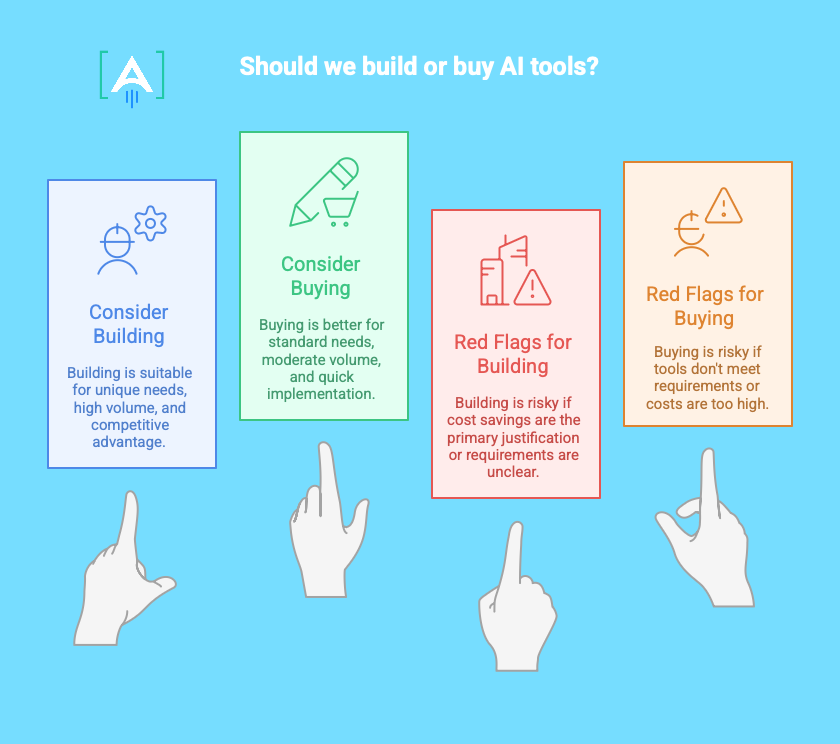
Consider Building If:
- You’re producing 50+ pieces of content weekly or processing thousands of data points daily
- Your requirements are genuinely unique with no existing tools solving 80%+ of needs
- You have engineers with AI expertise who have available capacity
- The capability creates defensible competitive advantage central to your business
- You have a track record of successfully building and maintaining internal tools
- 3-year build costs are 50%+ lower than buy costs when all factors are included
Consider Buying If:
- Your volume is moderate (under 50 pieces weekly)
- Your requirements are standard with existing tools solving 80%+ of needs
- You lack technical resources or they’re focused on core product work
- Speed to market is critical and you need capabilities operational quickly
- The capability is important but not strategically differentiating
- 3-year buy costs are competitive with build costs
Red Flags for Building:
- “We can save money by building this ourselves” is the primary justification
- You’ve never built internal tools successfully before
- Engineering team is already at capacity with core product work
- Your requirements keep changing or aren’t clearly defined
- You’re underestimating development time by more than 2x
Red Flags for Buying:
- No existing tool meets more than 50% of must-have requirements
- Subscription costs exceed $50,000 annually for your volume
- Vendor has unstable funding or unreliable product roadmap
- Tool requires extensive manual workarounds for basic workflows
- Integration with your existing stack is impossible or extremely difficult
Our growth marketing services include strategic consulting on build versus buy decisions for AI marketing tools based on your specific situation and requirements.
Hybrid Approaches: The Best of Both Worlds
The build versus buy decision isn’t always binary. Hybrid approaches often deliver the best outcomes by combining off-the-shelf tools with targeted customization.
Using Existing Tools as Foundation
Start with an established tool that solves 70% to 80% of your needs. Build custom integrations, automations, or enhancements for the remaining 20% to 30%. This approach reduces development time by 60% to 80% while still getting capabilities tailored to your needs.
Claude API enables this hybrid approach powerfully. Use Claude to build custom research and analysis layers on top of existing content tools. The existing tool handles publishing, formatting, and basic features. Your custom Claude integration handles strategic research and competitive analysis.
This is exactly how Content Engine works. We use WordPress (an existing tool) for publishing. We use Claude API (existing service) for AI. We built custom MCP Servers and an automation workflow connecting them. Development time was 30 days instead of 6+ months building everything from scratch.
Starting with Buy, Transitioning to Build Later
Many successful organizations start by buying existing tools to validate workflows and requirements. Once you understand exactly what you need and volume justifies building, you transition to custom solutions.
This de-risks the decision significantly. You learn what actually matters through real usage of existing tools. Your custom build targets proven requirements rather than theoretical needs. Development is faster because you know exactly what to build.
The key is choosing initial tools that don’t create lock-in. Ensure you can export data easily. Use tools with APIs that allow gradual replacement of components. Build your custom solution incrementally alongside the existing tool.
Implementing Your Decision Successfully
Once you’ve made the build versus buy decision, implementation determines whether you achieve expected outcomes.
If You Decided to Build
Start with clear scope. Define exactly what version 1.0 includes. List features explicitly. Set a launch deadline. Resist scope creep mercilessly.
Build iteratively. Launch a minimal viable version in 4 to 6 weeks. Gather feedback. Iterate. Don’t spend 6 months building a perfect tool nobody has tested.
Plan for maintenance. Allocate 20% to 30% of original development effort annually for ongoing maintenance. Assign specific people responsibility for maintaining the tool.
Measure rigorously. Track actual costs versus estimates. Monitor usage to ensure the tool delivers expected value. Be willing to kill the project if it’s not working.
If You Decided to Buy
Invest in onboarding. Don’t just subscribe and hope people use it. Schedule training. Create documentation. Assign champions who become experts and help others.
Adapt processes to the tool. Don’t try to force the tool to match your existing processes exactly. Adapt your workflows to leverage the tool’s strengths.
Use it consistently. Tools only deliver value when used. Build the tool into your standard operating procedures. Make usage non-optional for relevant workflows.
Review regularly. Assess every 6 months whether the tool still meets needs. Be willing to switch if a better option emerges. Don’t stick with suboptimal tools due to inertia.
The marketing automation services at Azarian Growth Agency help companies successfully implement both build and buy decisions with proven processes that maximize tool adoption and ROI.
Conclusion
The build vs buy decision for AI marketing tools should be driven by data, not intuition. In most cases, buying wins: when you account for development time, opportunity cost, and ongoing maintenance, in-house builds almost always exceed subscription costs.
Building only makes sense when all of the following align: high usage volume, truly unique requirements, strong in-house technical expertise, and clear strategic differentiation. Miss one, and ROI drops fast.
At Azarian Growth Agency, we walk teams through this decision in webinar 16 using a structured framework:
• Define must-have, should-have, and nice-to-have requirements
• Calculate a realistic 3-year total cost of ownership including hidden costs
• Assess whether the capability creates a defensible advantage
• Evaluate technical readiness and execution capacity honestly
For many teams, a hybrid approach proven tools combined with targeted customization delivers the best balance of speed, cost, and performance.
The teams that win with AI aren’t the ones that build everything themselves. They’re the ones that make disciplined, data-driven decisions and implement them well.
We’re waiting for you. Come and let’s discuss.