
Amazon ads are experiencing a seismic shift as AI shopping assistants like Amazon Rufus and ChatGPT Shopping fundamentally change how consumers discover and purchase products online. For business owners and CEOs, understanding this transformation isn’t optional; it’s essential for survival in 2026.This shift also redefines how Amazon ads operate in an AI-driven marketplace.
Amazon Rufus optimization has become the new battleground for brand visibility. Traditional keyword bidding and sponsored product placements are no longer enough. The game has changed, and the rules are being rewritten by artificial intelligence.
Customers who engage with Rufus during their shopping journey are 60% more likely to complete a purchase compared to those who don’t. Amazon’s AI assistant is on pace to generate an additional$10 billion in annualized sales for the platform.
These numbers aren’t predictions; they’re happening right now.Hence why, That’s exactly why Amazon ads remain a critical growth lever for every e-commerce brand.
In this guide, we’ll break down how to optimize product listings for AI recommendations, adapt sponsored product strategies when AI curates results, and master attribution in AI-assisted purchase journeys.
Understanding Amazon Rufus Optimization and AI Shopping Assistant Advertising
Amazon Rufus launched in February 2024 and has rapidly become a dominant force in product discovery. This generative AI-powered shopping assistant operates throughout Amazon’s ecosystem, from the homepage to product detail pages.
The system was trained on Amazon’s entire product catalog. It analyzes customer reviews, community Q&As, and information from across the web. Shoppers can ask broad questions like comparing trail shoes to road running shoes, or specific queries about whether a coat is suitable for winter.
How Rufus Changes the Purchase Journey
Traditional Amazon shopping followed a predictable path: search, scroll through results, click on products, read reviews, and purchase. Rufus disrupts this entire flow.
Now, customers engage in conversational product discovery. They ask questions like “What are the best wireless outdoor speakers?” or “Should I get trail shoes or running shoes?” Rufus provides curated recommendations with detailed explanations.
This creates a new challenge for brands. Your product must not only rank in traditional search results but also earn AI recommendation placement. The factors influencing these placements differ from traditional SEO.
This shift also changes how Amazon ads determine relevance, since AI now curates the first layer of product discovery.
The Scale of AI Shopping Assistant Impact
By mid-2025, 250 million shoppers had used Rufus. These adoption rates signal a fundamental shift in shopping behavior.
AI-assisted shopping via Rufus and other tools now drives 20% of purchases, with projections reaching 40% by late 2026. This isn’t emerging technology anymore; it’s mainstream consumer behavior.
Amazon’s advertising revenue reflects this transformation. The company generated $17.7 billion in advertising services revenue in Q3 2025, showing 24% year-over-year growth. Sponsored ads are now being tested within Rufus responses, creating entirely new ad placement opportunities.As these placements expand, optimizing Amazon ads for AI-generated environments becomes a core competitive advantage.”
Amazon Ads AI Strategy: Optimizing for Both Traditional and AI Discovery
The average cost per click on Amazon surpassed $1.00 in 2025, up from $0.70 in 2023. As competition intensifies, strategic optimization becomes more valuable than ever.Brands that integrate real-time signals into their Amazon ads gain higher visibility in both search results and AI-driven recommendations.
Your 2026 strategy must address both traditional PPC placements and AI-driven recommendations. These aren’t separate channels; they work together to influence purchase decisions.
Key Factors for AI Product Recommendations
Share of Voice (SOV) matters more than ever in AI shopping discovery. SOV measures how frequently your brand appears to customers compared to competitors. Higher SOV increases the likelihood that Rufus recommends your products, especially in general category searches.
Critical optimization elements include:
- Sales velocity and units sold, which Rufus uses to assess purchase likelihood
- Customer review quality and quantity across your product catalog
- Product detail page completeness with comprehensive specifications
- Brand reputation signals from across the web
- Competitive positioning in category comparisons
Unlike traditional AI models, generative AI uses trained data to create fresh content, which means Rufus synthesizes information rather than simply retrieving it. Your product information must support this synthesis.
Balancing Traditional Amazon Ads With AI Visibility Tactics
Sponsored Products remain foundational to Amazon’s advertising strategy. However, brands now need a persona-driven approach rather than simple keyword targeting.This evolution means Amazon ads need to reflect buyer intent patterns captured by machine learning systems.
Campaign structures should train Amazon’s AI on which shoppers are most likely to buy. This includes branded campaigns, category campaigns, competitive campaigns, and retargeting campaigns working together.
Each campaign type contributes different signals to Amazon’s recommendation algorithms. Branded campaigns establish authority, category campaigns demonstrate relevance, competitive campaigns show differentiation, and retargeting campaigns prove conversion likelihood.
Dynamic bidding strategies adjust ad spend in real time based on conversion probability. This optimization happens automatically as Amazon’s machine learning systems analyze shopping behavior patterns across millions of transactions.
E-Commerce AI Discovery: Product Listing Optimization for AI Recommendations
Product detail pages serve dual purposes in 2026. They must convert human shoppers while providing AI systems with comprehensive information for recommendations.
Traditional product listing optimization focused on keyword placement and compelling copy. AI optimization requires structured data that machines can interpret and synthesize.
Optimizing Product Content for AI Understanding
Natural language descriptions work better than keyword-stuffed copy for AI assistants. Rufus and similar tools analyze conversational queries, so your content should match how customers actually speak.
Clear feature communication matters more than keyword density. When someone asks Rufus about pool umbrellas for Florida weather, the AI synthesizes information about humidity resistance and durability. Your product details must explicitly state these attributes.
Essential content elements for AI optimization:
- Conversational product descriptions that answer common questions
- Comprehensive specifications in structured format
- Customer review synthesis highlighting key benefits and drawbacks
- Use case scenarios matching typical customer inquiries
- Feature explanations connecting product attributes to customer needs
Semantic understanding drives AI recommendations. The focus shifts from exact keyword matches to comprehensive meaning. Your content should clearly communicate what your product does, who it’s for, and why it’s the right choice.
Leveraging Customer Reviews for AI Placement
Customer reviews influence AI recommendations more heavily than traditional search rankings. Rufus analyzes review sentiment, specific feedback, and common themes when suggesting products.
Positive reviews with detailed feedback signal quality to AI systems. The AI doesn’t just count stars; it reads actual customer experiences. Products with thorough, authentic reviews explaining specific benefits gain recommendation advantages.
Addressing negative feedback promptly demonstrates brand commitment to customer satisfaction. This reputation management directly impacts AI recommendation algorithms. Brands that actively engage with reviews signal higher quality to automated systems.
Sponsored Product Strategies When AI Curates Results
Amazon’s testing of sponsored ads within Rufus conversations represents a major advertising evolution. These placements differ fundamentally from traditional sponsored product listings.
Dynamic ad placements based on conversational context create new targeting opportunities. Your ads can appear precisely when customers discuss relevant product categories or express specific needs.
Contextual Advertising in AI Conversations
Rufus may generate additional copy to enhance existing ads, adapting your message to the conversation flow. This means your ad creative must be flexible enough for AI enhancement while maintaining brand voice.
The targeting precision exceeds traditional keyword-based approaches. When a customer discusses specific requirements like “Florida weather” for outdoor products, contextually relevant ads integrate naturally into the conversation.
Brands report significant performance improvements from Rufus ad placements. One electronics company saw a 338% increase in ad click-through-rate versus other active Sponsored Video ads, with 89% new-to-brand offers and 121% return on ad spend.
To capitalize on this, brands must design their Amazon ads to remain relevant even when AI rewrites or reformats messaging.”
Measuring Success in AI-Driven Placements
Current reporting limitations present challenges for marketers. The Amazon Advertising Console doesn’t provide detailed Rufus-specific metrics yet. Brands must use indirect performance indicators
.Assessing Amazon ads performance now involves understanding how campaigns influence conversational pathways, not just direct clicks.
Optimization approaches include:
- Working closely with Amazon account managers for indirect insights
- Using Experiments tool to split-test different ad versions
- Monitoring overall campaign performance for trend identification
- Tracking broader engagement metrics as proxies for AI placement success
- Analyzing customer feedback for AI recommendation patterns
Attribution becomes more complex in AI-assisted purchase journeys. Amazon uses a seven-day rolling attribution model to capture delayed conversions from Rufus interactions. Purchases resulting from AI conversations may not happen immediately.
Attribution in AI-Assisted Purchase Journeys
Traditional attribution models assume linear customer journeys. AI shopping assistants create non-linear, conversation-based paths to purchase that challenge conventional tracking.
A customer might consult Rufus early in their research, leave Amazon entirely, and return days later to complete the purchase. Standard attribution misses this multi-touch influence.
Understanding Multi-Touch AI Attribution
Amazon tracks “downstream impact” to measure how features like Rufus drive additional consumer spending. For Rufus specifically, this includes purchases resulting from chatbot interactions even when transactions don’t happen immediately.
The seven-day attribution window captures delayed conversions but still misses longer consideration cycles. Business-to-business products or high-consideration items may see even longer influence periods from initial AI interactions.
First-party data becomes increasingly valuable for understanding customer journeys. Brands using data analytics and reporting tools can connect AI interactions to eventual purchases through unified customer profiles.
Adapting Campaign Measurement for AI Commerce
Conversion rate optimization takes on new meaning in AI commerce. The average Amazon advertising conversion rate reached 9.96% in 2025, significantly outperforming the standard e-commerce rate of 1.33% on other platforms.
AI-assisted purchases show different patterns than traditional shopping. Shoppers engaging with Rufus demonstrate 60% higher purchase likelihood, but their journey includes more touchpoints.
Measuring AI influence requires looking beyond last-click attribution. Consider customer touchpoints throughout the journey: initial AI conversation, subsequent product views, review reading, and final purchase decision.
Emerging AI Shopping Platforms: ChatGPT Shopping and Beyond
Amazon Rufus isn’t the only AI shopping assistant transforming e-commerce. ChatGPT Shopping launched with Instant Checkout in September 2025, creating direct competition for product discovery traffic.
OpenAI’s integration with Etsy and Shopify enables purchases directly within ChatGPT conversations. More than 700 million people use ChatGPT weekly, and they can now complete transactions without leaving the chat interface.
How ChatGPT Shopping Affects Amazon’s Strategy
ChatGPT referrals to retailer mobile apps increased 28% year-over-year during Black Friday 2025 shopping weekend. Amazon captured 54% of these referrals, up from 40.5% the previous year.
This growth demonstrates that AI shopping assistants can drive traffic to Amazon. However, it also reveals the competitive threat. Customers starting their product research on ChatGPT might never reach Amazon at all.
Adobe reported that AI traffic to U.S. retail sites increased by 805% year-over-year on Black Friday, and those who landed on a retail site from an AI chatbot were 38% more likely to make a purchase. These high-intent shoppers represent valuable traffic that brands must capture.
Cross-Platform AI Discovery Optimization
Your optimization strategy must extend beyond Amazon. ChatGPT Shopping Research uses a specialized GPT-5 mini variant trained specifically for shopping tasks, delivering personalized buyer’s guides after analyzing products across the web.
Product information consistency across platforms becomes critical. ChatGPT synthesizes data from multiple sources, so contradictory information damages credibility and recommendation likelihood.
Multi-platform optimization requirements:
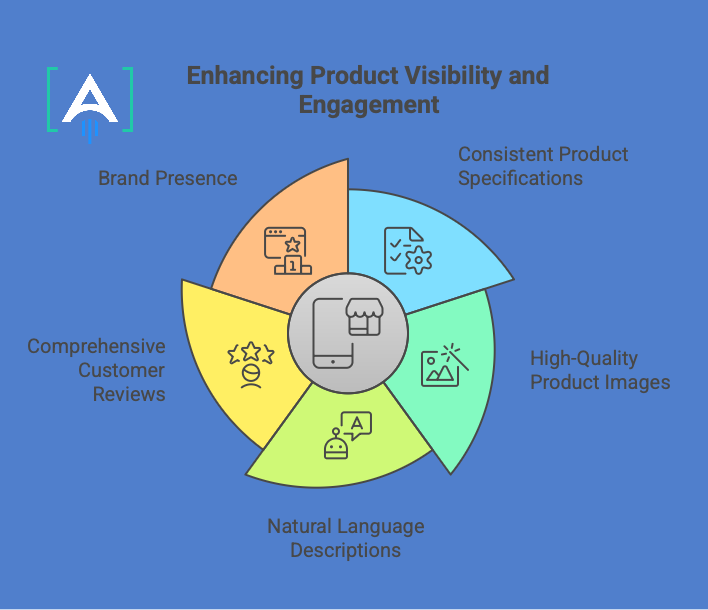
- Consistent product specifications across all retail channels
- High-quality product images meeting each platform’s requirements
- Natural language descriptions optimized for conversational AI
- Comprehensive customer reviews on multiple platforms
- Brand presence in credible comparison sites and review platforms
The battle for clicks is over; the battle for context has begun. Your products must be discoverable, understandable, and attractive to AI systems that communicate with consumers in real time.
Framework for Balancing Traditional Amazon Ads With AI Visibility Tactics
Success in 2026 requires integrating traditional advertising with AI optimization. These approaches complement rather than replace each other.
Traditional sponsored product campaigns continue generating immediate visibility and sales. They provide the sales velocity and conversion signals that influence AI recommendations.
The Integrated Advertising Framework
Your advertising architecture should include four core campaign types working together. Branded campaigns establish authority and capture high-intent searches for your products specifically.
Category campaigns demonstrate relevance in broader product searches. These campaigns help AI systems understand where your products fit within Amazon’s taxonomy. Strong category performance signals to Rufus that your products deserve recommendation consideration.
Competitive campaigns show differentiation from alternatives. When customers compare products or ask Rufus for recommendations, competitive ad presence influences consideration sets.
Retargeting campaigns prove conversion likelihood. Customers who previously viewed your products but didn’t purchase represent high-value opportunities. Retargeting demonstrates sustained interest patterns that AI systems recognize.
Audience Targeting and Dynamic Bidding
Amazon’s advanced audience segmentation tools allow precise targeting based on demographics, interests, and shopping behavior. This granular control ensures ads reach customers most likely to benefit from your products.
Dynamic bidding adjusts automatically based on conversion probability. The system analyzes thousands of signals in real time: time of day, customer shopping history, device type, and browsing behavior.
Strategic bidding approaches for 2026:
- Higher bids during high-intent shopping moments when conversion probability peaks
- Reduced spend on low-probability impressions to maximize efficiency
- Seasonal adjustments reflecting category-specific purchase patterns
- Competitive response bidding when rivals intensify their campaigns
- New product launch bidding to establish initial sales velocity
Machine learning optimization requires sufficient data volume. Start with $30 per day for automatic sponsored product campaigns to gather performance data, then scale based on results.
Advanced Tactics: Creative Studio and Agentic AI Tools
Amazon’s Creative Studio represents the next evolution in advertising efficiency. This agentic AI tool helps brands develop professional-quality ads through simple conversational prompts.
The system analyzes your products alongside Amazon shopping signals. It generates tailored ad concepts and explains its reasoning, giving you complete control while revealing new insights.
Transforming Ad Creation With AI
Traditional ad development required weeks of time and tens of thousands of dollars for professional creatives. Creative Studio compresses this process into hours at no additional cost.
The tool creates multi-scene videos and displays ads complete with animations, music, and voiceovers. These ads can run across Amazon’s entire ecosystem, including Prime Video, Fire TV, and third-party websites.
Nestlé Health Science and similar brands praise the tool for surfacing insights they wouldn’t have discovered independently. Mid-market clients can now scale campaigns in ways previously impossible without significant creative budgets.
AI-Powered Campaign Management
Amazon’s Ads Agent functions as an AI-powered advertising assistant handling hundreds of campaigns across accounts. It operates based on advertiser instructions in a conversational interface.
This agentic approach means the AI takes action on your behalf around the clock. It monitors performance, adjusts bids, pauses underperforming ads, and scales successful campaigns automatically.
The system learns your brand preferences and optimization goals. Over time, it makes increasingly sophisticated decisions aligned with your business objectives. This frees marketing teams to focus on strategy rather than tactical execution.
Preparing Your Organization for AI Commerce in 2026
The transition to AI-driven commerce requires organizational adaptation beyond marketing tactics. Your entire e-commerce operation must align with AI-first shopping experiences.
Product information management becomes more critical than ever. AI systems require comprehensive, accurate data to make recommendations. Incomplete or inconsistent information excludes your products from AI-curated results.
Building AI-Ready Product Data Infrastructure
Structured product data enables AI understanding. This means more than basic specifications; it requires semantic markup that machines can interpret.
Product taxonomies must align with how customers think and speak. When someone asks Rufus for “quiet vacuum for small apartment,” your product data should explicitly address noise level and suitability for compact spaces.
Essential data infrastructure elements:
- Comprehensive attribute specification covering all product characteristics
- Use case documentation matching common customer inquiries
- Comparative positioning data for category questions
- Inventory accuracy ensuring AI recommendations match availability
- Pricing consistency across platforms to maintain credibility
Content marketing strategies must adapt to AI discovery. Traditional SEO-focused content gave way to AI-optimized information architecture. Your content should answer the questions AI shopping assistants will ask on behalf of customers.
Developing AI Optimization Expertise
The skills required for success in AI commerce differ from traditional digital marketing. Teams need training in conversational optimization, semantic analysis, and AI-driven attribution.
Generative Engine Optimization (GEO) is emerging as a discipline parallel to SEO. This involves optimizing your brand presence for AI-generated recommendations rather than traditional search result rankings.
Professional AI marketing agency partnerships provide expertise and tools most organizations lack internally. The technology evolves rapidly, making it challenging for in-house teams to maintain cutting-edge knowledge.
Strategic Differentiation Through AI Presence
Product differentiation matters more in AI recommendations than traditional search. When Rufus compares products, subtle differences in features, reviews, or positioning determine recommendation hierarchy.
Branding agency partnerships help create the distinctive positioning AI systems recognize and communicate. Generic products struggle to earn AI recommendations; distinctive brands with clear value propositions thrive.
The competitive moat in AI commerce comes from comprehensive optimization across multiple dimensions. Brands excelling in product data, customer reviews, advertising performance, and brand positioning create compounding advantages.
Measuring Success: KPIs for AI-Driven Amazon Advertising
Traditional Amazon advertising metrics remain important but insufficient for measuring AI-era performance. You need new KPIs reflecting AI-assisted commerce realities.
Share of Voice in AI recommendations becomes a critical metric. Track how frequently your brand appears in AI responses for relevant category queries compared to competitors.
Essential Metrics for AI Commerce Performance
AI recommendation rate measures the percentage of relevant AI queries that include your products. This requires systematic testing of conversational queries matching your target customer needs.
Conversational conversion rate tracks purchases resulting from AI interactions. This differs from traditional conversion rates because it measures the entire AI-assisted journey rather than single-session conversions.
Core performance indicators for 2026:
- AI recommendation frequency across category queries
- Position in AI-generated comparison responses
- Conversion rate for AI-referred traffic
- Customer review velocity and sentiment trends
- Cross-platform product data consistency scores
- Traditional advertising ROAS maintaining profitability baselines
Long-term customer value from AI-acquired customers warrants separate analysis. Early indicators suggest AI-assisted shoppers demonstrate different loyalty patterns than traditional search-driven customers.
Competitive Intelligence in AI Commerce
Monitoring competitor AI visibility provides strategic insights. Track which brands Rufus recommends for your product categories and analyze their positioning strategies.
Systematic competitive analysis reveals optimization opportunities. When competitors consistently appear in AI recommendations, reverse engineer their success factors. Product features, review patterns, pricing strategies, and content approaches all contribute to AI visibility.
The most sophisticated brands use data analytics and reporting platforms to correlate AI visibility metrics with business outcomes. This quantifies the ROI of AI optimization investments and guides resource allocation.
Making the Transition: Your 2026 Action Plan
The transition to AI-optimized Amazon advertising doesn’t happen overnight. A phased approach manages risk while capturing opportunities.
Start with comprehensive product data audits. Identify gaps in specifications, inconsistent information, and missing content that AI systems require. Prioritize high-volume or high-margin products for initial optimization.
Phase One: Foundation Building
Optimize product detail pages for AI understanding using natural language and comprehensive specifications. Ensure every product has complete attribute data, clear use case explanations, and detailed feature descriptions.
Implement review generation programs encouraging satisfied customers to share detailed experiences. Focus on authentic, helpful reviews rather than generic positive feedback. AI systems recognize and reward substantive customer input.
Establish baseline metrics tracking current AI visibility and traditional advertising performance. You need starting points for measuring improvement as you implement optimization strategies.
Phase Two: Advertising Integration
Launch persona-driven campaign structures training Amazon’s AI on your ideal customer profiles. Move beyond simple keyword targeting to comprehensive campaign architectures demonstrating product relevance and conversion likelihood.
Implement dynamic bidding strategies leveraging Amazon’s machine learning capabilities. Allow the system to optimize bids in real time while monitoring performance against your profitability targets.
Test sponsored ad placements in Rufus conversations as availability expands. Early participation in new ad formats provides learning advantages and potential first-mover benefits.
Phase Three: Advanced Optimization and Scaling
Deploy Creative Studio for AI-assisted ad development, dramatically reducing creative production costs and time. Use the tool’s insights to identify messaging approaches resonating with AI-assisted shoppers.
Expand optimization beyond Amazon to ChatGPT Shopping and other emerging AI commerce platforms. Consistent cross-platform presence maximizes your share of AI-driven product discovery traffic.
Implement advanced attribution modeling, capturing AI-assisted purchase journeys. Connect early-stage AI interactions to eventual conversions, demonstrating the full value of AI optimization investments.
Why Professional Partnership Matters More Than Ever
The complexity of AI-optimized Amazon advertising exceeds the capabilities of most in-house teams. The technical requirements, platform evolution pace, and strategic sophistication demand specialized expertise.
Professional Amazon ads agency partnerships provide several distinct advantages. Agencies working across multiple brands accumulate insights faster than individual companies. They see patterns, test strategies, and identify opportunities your team might miss.
Tool access and data resources exceed what individual brands can justify. Enterprise-grade analytics platforms, AI optimization tools, and testing infrastructure require significant investment that agencies amortize across client bases.
The Azarian Growth Agency Advantage
Navigating the transition to AI-driven commerce requires partners who understand both traditional advertising and emerging AI platforms. Social media marketing expertise complements Amazon-specific optimization, creating a comprehensive digital presence supporting AI discovery.
The most effective strategies integrate multiple channels. AI content optimization ensures your brand communicates effectively with both human shoppers and AI recommendation systems. This dual optimization approach maximizes visibility across all discovery channels.
Azarian Growth Agency combines deep platform expertise with strategic vision. We help business owners and CEOs adapt their entire e-commerce operations for AI-first shopping experiences. Our approach addresses product data infrastructure, advertising optimization, attribution modeling, and organizational capability building.
The brands that thrive in 2026 will be those that adapt quickly and comprehensively. Success requires more than tactical adjustments; it demands strategic transformation guided by experienced partners who understand where commerce is heading.
Conclusion
Amazon ads in the age of AI shopping assistants represent both challenge and opportunity. The platforms are evolving rapidly, shopping behavior is transforming fundamentally, and traditional strategies are becoming obsolete.
For business owners and CEOs, the strategic imperative is clear. You must transform your Amazon advertising approach for the AI commerce era. The brands acting decisively now will build sustainable competitive advantages as AI shopping assistants become the dominant product discovery channel.
Choosing the right Amazon ads agency makes the difference between struggling to adapt and leading your category. Azarian Growth Agency combines over 20 years of growth marketing expertise with cutting-edge AI marketing agency capabilities.
We’ve helped clients secure over $4 billion in funding and generate more than $500 million in revenue through data-driven strategies. Our AI content optimization, data analytics, and reporting services deliver measurable results in AI-driven commerce.
Partner with us to build your AI-optimized Amazon advertising strategy. Let’s transform your e-commerce presence for the AI shopping assistant era together.