
Your competitors are already using AI marketing for businesses to cut costs, accelerate growth, and dominate their markets. While you’re evaluating whether AI is worth the investment, they’re already seeing returns that would make any CFO take notice.
According to McKinsey research, 78% of organizations now use AI in at least one business function, up from 55% just a year earlier. This represents one of the fastest technology adoption rates in recent decades. Your competitors using these systems aren’t seeing incremental improvements; they’re seeing transformational gains.
The gap isn’t about access to technology. Every company has access to the same AI tools. The gap is about implementation strategy, competitive intelligence, and knowing which AI marketing applications actually drive revenue versus which ones just sound impressive in board meetings.
In this guide, we’ll reveal how your competitors are leveraging AI marketing for businesses and what you can do to catch up through partnerships with growth marketing agencies.
Why The AI Marketing Gap Matters Now
Before examining specific competitive advantages, understanding why this gap creates lasting damage helps frame the urgency. AI marketing represents a fundamental shift in how marketing operates, not just an incremental improvement in existing processes.
The Compounding Nature Of AI Advantages
Traditional marketing improvements deliver linear gains. Hiring another marketer increases output proportionally. AI marketing delivers exponential gains, with the same team producing multiples of previous output while maintaining or improving quality.
This exponential difference is widening the gap between AI adopters and traditional marketers. After six months, competitors have built advantages that take years to overcome. After 12 months, some gaps become nearly insurmountable without a massive reallocation of resources.
The First Mover Advantage Window
Harvard Business School research demonstrates that professionals using AI assistance completed tasks 25% faster and produced 40% higher-quality results than those working without AI. These advantages compound monthly as AI-powered competitors build content libraries, customer insights, and market positioning that traditional approaches cannot match.
The window for catching up narrows each quarter. Early movers capture audiences, establish topical authority, and build cost structures that create sustainable competitive advantages.
How Competitors Are Operating At Higher Marketing Capacity
Track your marketing team’s output honestly. Count articles published, campaigns launched, and customer touchpoints created monthly compared to visible competitor activity.
The Production Volume Transformation
The adoption rate among leading organizations continues to accelerate across all marketing functions. This isn’t experimental anymore. It’s operational across content marketing, paid advertising, email campaigns, and customer analytics.
Research shows AI saves marketers an average of more than 2.5 hours every week. Those freed hours go toward strategy, partnerships, and initiatives that AI cannot automate. While your team spends hours on manual research and content drafting, competitors invest those same hours in high-value activities like strategic planning and relationship building.
Strategic Advantages From Scale
Higher capacity unlocks strategic advantages beyond just more content. Competitors can test more channels simultaneously without spreading resources too thin, respond faster to market changes through agile content production, and launch campaigns in days rather than weeks.
Why Their Customer Acquisition Costs Keep Falling
Calculate your CAC monthly by dividing total marketing and sales expenses by the new customers acquired. Track the trend over six months and compare against industry benchmarks.
The Efficiency Transformation
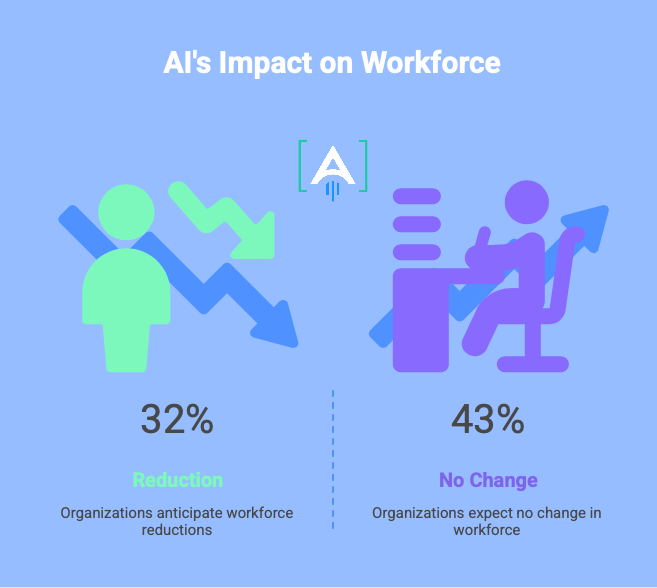
Regarding AI’s impact on workforce size over the next year, 32% of organizations anticipate reductions, 43% expect no change, and 13% project growth. When applied specifically to marketing operations, these improvements translate to dramatically lower customer acquisition costs while simultaneously increasing conversion rates.
This efficiency gap compounds over time. While your CAC trends upward from market saturation and increased competition, AI-powered competitors drive costs down through better targeting, personalization, and optimization.
The Mechanisms Behind Lower CAC
AI marketing for businesses reduces CAC through several mechanisms:
Key Optimization Areas:
- Better targeting using predictive analytics identifies high-intent prospects.
- Personalized messaging at scale resonates with individual pain points.
- Faster campaign optimization through automated testing
- Reduced waste from ineffective tactics gets identified quickly.
- Improved conversion rates from dynamically optimized landing pages
Many companies now invest in growth marketing agency partnerships to access these capabilities without building them internally.
How They Publish Content At Superior Velocity
Review how long your team actually spends on content production, from topic selection to published article, compared to how quickly competitors publish timely, relevant content.
The Speed To Market Advantage
Content creation requires both execution (writing, formatting, publishing) and judgment (competitive research, keyword analysis, strategic outlining). AI accelerates both layers simultaneously while traditional approaches only speed execution.
The speed advantage alone creates competitive gaps, but when combined with quality improvements, the advantage becomes nearly insurmountable.
Why Velocity Creates Market Position
This time advantage compounds over quarters. Speed improvement matters most when quality remains high or improves. Research consistently shows AI-assisted content maintains quality standards while dramatically accelerating production timelines. Competitors publish on emerging topics while you’re still in the research phase, capturing audience attention and search rankings first.
The Personalization Gap That’s Costing You, Customers
Review your email campaigns, ad targeting, and website experiences. Are they truly personalized, or are they just segmented into broad buckets? Compare this to competitor experiences.
Why Manual Personalization Fails At Scale
Modern consumers expect personalization across every touchpoint. Manual personalization doesn’t scale beyond basic segments, requiring hours of work per variation. AI-powered competitors create hundreds of micro-segments with dynamically generated content for each.
The Revenue Impact Of Personalization
AI-powered personalization drives measurable results across campaigns, with organizations implementing these systems seeing improved conversion rates and customer retention. Competitors using AI marketing for businesses analyze thousands of behavioral signals, predict individual preferences, generate personalized content automatically, and optimize messaging in real time based on engagement.
Your generic campaigns achieve baseline results. Their hyper-personalized experiences convert at multiples of your rates across the same audience.
How They Make Faster, Better Strategic Decisions
Audit how marketing decisions get made in your organization. Are they based on comprehensive data analysis or senior leader opinions? Watch how quickly competitors pivot and adapt.
The Intelligence Collection Revolution
AI marketing for businesses transforms how companies gather and use competitive intelligence. Traditional competitive analysis involves manually reviewing competitor websites periodically. AI-powered systems continuously analyze multiple competitors and track changes in real time.
This intelligence advantage means competitors know about market shifts within hours instead of weeks, identify trending topics before they peak, spot competitor weaknesses immediately, and make decisions backed by comprehensive analysis rather than gut instinct.
Many organizations combine AI competitive intelligence with growth marketing agency partnerships to capitalize on opportunities faster than manual processes allow.
Why Their Marketing Delivers More With Less Budget
Compare your marketing budget as a percentage of revenue to output metrics such as leads generated, content published, and campaigns launched. Benchmark against competitor activity levels.
The Cost Structure Shift
Traditional marketing scales directly with team size. AI-driven marketing allows businesses to scale output far beyond headcount. With the right tools in place, the same team can deliver dramatically more work, reshaping how marketing investment and returns function.
The Power Of Reinvestment
Leading companies do more than reduce costs. They redirect efficiency gains into faster experimentation, broader channel exploration, stronger talent acquisition, and strategic initiatives that unlock new revenue opportunities.
This momentum creates a self-reinforcing loop where operational efficiency fuels growth, and growth further amplifies efficiency and market position.
Why Top Marketing Talent Chooses Them
Look closely at recent marketing hires. Are you attracting high-performing professionals or settling for whoever is available? The most capable marketers are deliberate about where they work.
What Modern Marketers Actually Want
Top marketers want access to advanced tools and well-designed systems. AI marketing for businesses appeals to ambitious professionals who aim to amplify their impact rather than spend time on repetitive tasks.
When AI supports research and content creation, marketers can focus on strategy, creativity, and decision-making. This shift is increasingly shaping where top talent chooses to build their careers.
The Talent Multiplication Effect
Companies advertising AI-powered marketing roles receive more applications from higher-quality candidates. The best marketers understand that AI experience accelerates career growth, increases market value, enables focus on strategic work, and creates opportunities to make a bigger business impact.
Meanwhile, traditional marketing roles attract candidates willing to spend significant time on manual research and repetitive tasks. The talent gap compounds as competitors build teams of AI-savvy strategists while you hire task executors.
Making The Transition: Catching Up To Competitors
Understanding that competitors have moved ahead is only useful if you can systematically close the gap.
Audit Your Current State First
Measure baseline performance before implementing anything. Track time spent on each marketing activity, calculate cost per output for content and campaigns, identify where your team spends the most time, and document current performance metrics.
Most business leaders discover that their assumptions about time allocation are wrong. You cannot optimize what you haven’t measured.
Start With High-Value Use Cases
Don’t try to automate everything simultaneously. Begin with competitive research automation, content production with strategic outlining, email personalization based on behavioral data, and campaign performance analysis with automated reporting.
These focused starting points deliver visible wins that justify investment and build organizational confidence in AI capabilities.
Expect A Ramp Period
AI marketing for businesses isn’t plug-and-play. Expect three to six months before seeing significant results from AI implementation. Systems need time to learn your business, audience preferences, and market dynamics before they can optimize effectively.
Budget for this ramp period without expecting immediate transformation. Set realistic goals focused on learning and foundation-building in the early months.
Invest In Training
The quality of AI outputs depends directly on prompt quality and user skill. Organizations that invest in training achieve dramatically better results than those that expect plug-and-play functionality. Create prompt libraries, establish quality review processes, and designate AI champions who develop expertise.
Conclusion: Closing The Gap Before It’s Too Late
Knowing when to implement AI marketing for businesses comes down to recognizing clear competitive realities: competitors operating at higher capacity, customer acquisition costs rising while theirs drop, content production taking longer, personalization limited to basic segments, decisions based on gut feel, marketing budgets staying flat while output stagnates, and top talent choosing AI-enabled competitors.
Most business leaders wait too long to implement AI marketing, trying to handle everything with traditional methods well past the point where it makes sense.
Partnering with an experienced growth marketing agency like Azarian Growth Agency accelerates this transition. Through AI-driven strategy, SEO services, content marketing, email marketing, social media marketing, and data-informed execution, Azarian Growth Agency helps businesses close the gap before it becomes impossible to recover.
Seeing these competitive disadvantages in your business?
Partner with AI marketing expertswho understand competitive challenges and deliver measurable results within 60 days.