
The growth equation that built most B2B companies is broken. Need more pipeline? Hire more SDRs. Need more qualified leads? Add more BDRs. Need to hit your 4× coverage ratio? Grow the team.
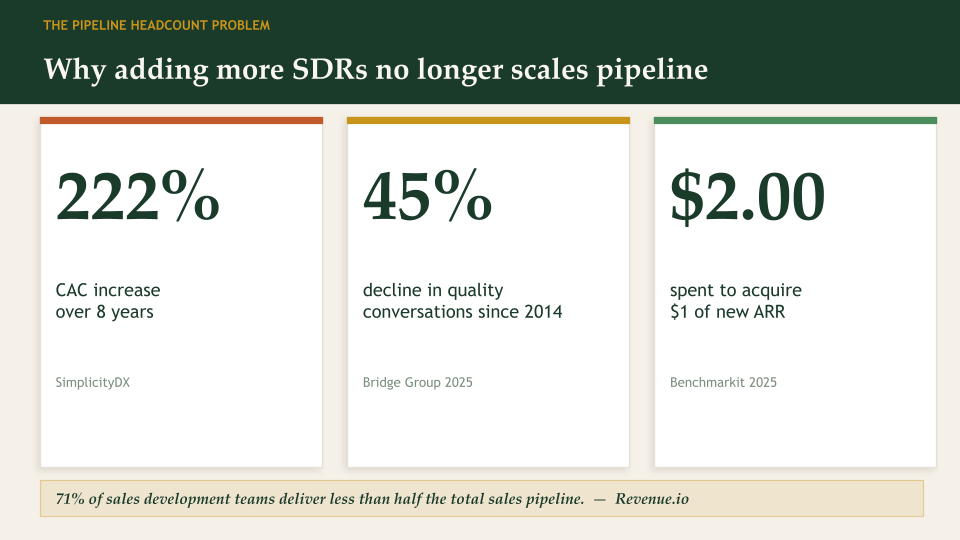
That equation worked when the cost to acquire a new customer was manageable. It does not work when B2B customer acquisition cost has surged 222% over eight years, with a 40 to 60 percent increase between 2023 and 2025 alone. The median B2B company now spends $2.00 to acquire $1 of new ARR. At that math, scaling headcount to scale the pipeline is not a growth strategy. It is a slow cash drain.
The CMOs and VPs who are hitting their pipeline targets without proportional headcount growth are not doing it by finding a better tool. They are doing it by building a different system. And that system is built on AI lead generation tools used not as individual point solutions, but as a connected infrastructure for pipeline generation.
If you want to see what that looks like in practice, the More Output, Same Team session shows the operational model built live. But first, let us establish the problem clearly and what the solution actually requires.
Why the Headcount-Pipeline Equation Has Stopped Working
The case against linear SDR scaling is now backed by data across every dimension of the role.
The fully loaded annual cost of an SDR in 2025 runs $110,000 to $150,000 when salary, benefits, taxes, tech stack, management overhead, and recruiting replacement costs are properly calculated. Remote Growth Partners places the upper bound at $210,000 for full-loaded in-house hires in major markets. Critically, that cost assumes a productive SDR. Most new hires take 3.1 to 3.2 months to reach full productivity, according to Bridge Group’s 2025 data, with some reports indicating the ramp now stretches to 5.7 months in complex environments.
Even a fully ramped SDR is delivering declining results. Quality conversations per SDR per day have fallen 45% since 2014, now sitting at 4.4 conversations daily. Cold call success rates for booked meetings run 2 to 5 percent. SDRs spend 5 to 7 hours per day on automatable activities, research, list building, data logging, leaving 1 to 2 hours for the conversations that actually build the pipeline. Quota attainment sits at 68% across the industry. That means nearly one-third of your SDR team is missing the target in any given quarter.
Attrition compounds the problem. Annual SDR turnover runs 32 to 50 percent. The median productive window after ramp is 15 to 17 months before a rep departs or stagnates. Each departure costs $100,000 to $150,000 in recruiting, ramp, and lost momentum. And only 19% of companies increased SDR headcount in 2025, the lowest level across all sales functions tracked by SaaStr. The market has already started shifting away from the linear model.
The conclusion is not that SDRs have no value. It is that using headcount as your primary lever for pipeline generation produces diminishing returns at exactly the moment your board is raising the coverage ratio bar.
What AI Lead Nurturing Actually Means (Most Teams Get This Wrong)
Before covering how to build a pipeline system, the terminology needs to be clarified. Most marketing teams use “AI lead nurturing” to mean one of two things: email drip sequences with AI-generated subject lines, or marketing automation workflows with a machine learning label attached. Neither is what the research describes as actually driving pipeline results.
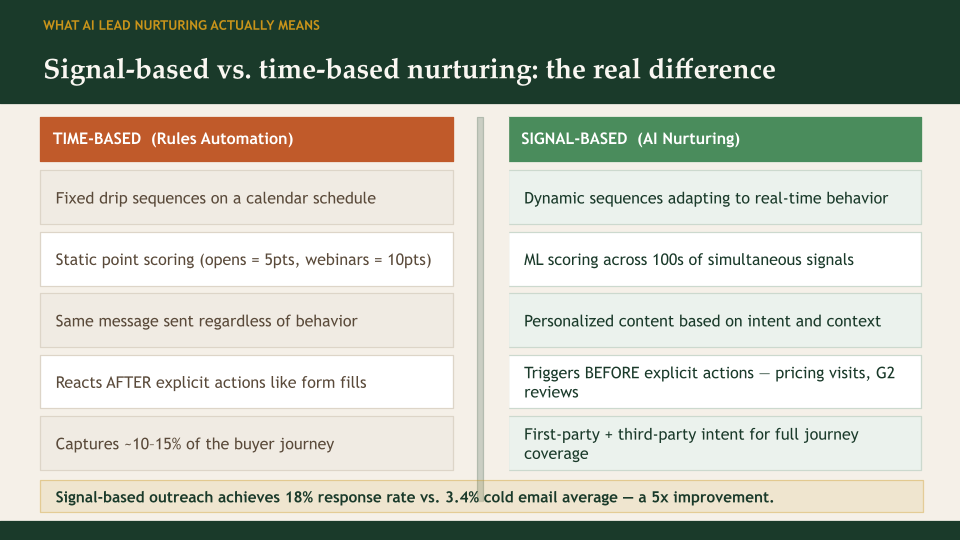
Traditional marketing automation uses predefined, rules-based workflows. Someone downloads a whitepaper, they enter Sequence A. Sequence A sends four emails over three weeks, regardless of what the prospect does in between. Scoring is manual and static: +5 points for an email open, +10 for a webinar, +15 for a demo request. The system runs on a timer, not on behavior.
Genuinely AI-powered lead nurturing uses machine learning, predictive analytics, and real-time behavioral signals to create dynamic, adaptive journeys. The specific capabilities that define the difference are dynamic scoring across hundreds of simultaneous data points rather than manual point accumulation, adaptive sequencing that modifies timing and content based on actual behavior rather than calendar, and predictive intent detection that anticipates where a prospect is in their buying journey rather than reacting to explicit signals.
The distinction that matters most operationally is signal-based versus time-based nurturing. Time-based nurturing asks who fits your ICP and sends them a sequence on a schedule. Signal-based outreach asks who is ready right now and prioritizes contact based on timing. When a prospect visits your pricing page at 11 PM, reviews a competitor on G2, or absorbs three pieces of content in the same week, those are buying signals. A signal-based system detects them and responds. A rules-based drip sequence does not.
The performance differential is measurable. Signal-based outreach achieves an 18% average response rate versus 3.4% for cold email — a roughly 5× improvement. Teams acting on intent signals within 24 hours see a 29% lift in opportunity creation. Champion job-change signals convert at 3× the rate of cold outreach because you are reaching the right person at the moment they are most receptive.
This is what changes when you build a system rather than run sequences.
The Data Infrastructure AI Nurturing Actually Requires
This is where most AI lead generation tool implementations fail. Teams purchase a platform, connect it to their CRM, and expect results. What they discover is that the platform is only as effective as the data feeding it. If your data infrastructure is broken, AI scales the dysfunction at ten times the speed.
An effective automated lead nurturing system requires five data inputs operating simultaneously:
Behavioral signals: Website visits, email engagement, content downloads, pricing page visits, product usage patterns. This is your first-party signal layer, and it only captures 10 to 15% of the buyer journey. Intentsify notes that 67% of the buyer journey happens before any form fill.
Intent signals: Third-party topic research data from providers like Bombora and 6sense, tracking content consumption across thousands of B2B websites. A Bombora Company Surge score above 70 indicates active in-market demand on a specific topic cluster.
Firmographic data: Company size, industry, tech stack, revenue range, and organizational structure that determines ICP fit before outreach begins.
Change signals: Funding rounds, leadership changes, hiring surges, M&A activity, and technology adoption events that create buying windows. These are the triggers that convert cold accounts into warm ones without any outbound effort on your part.
Enrichment data: Contact-level details, verified emails, phone numbers, and social profiles pulled from data providers through a waterfall enrichment process that checks multiple sources in sequence until a result is confirmed.
AI lead scoring combines all five inputs simultaneously to predict conversion likelihood. Teams using AI-powered lead scoring achieve a 55% MQL to SQL conversion rate versus 35% with manual scoring, a 20-point improvement across 939 companies tracked by Optifai. That single improvement, applied to your existing pipeline volume, represents a 57% increase in qualified opportunities from the same number of leads.
The Operational Workflow: From Signal to Pipeline Entry
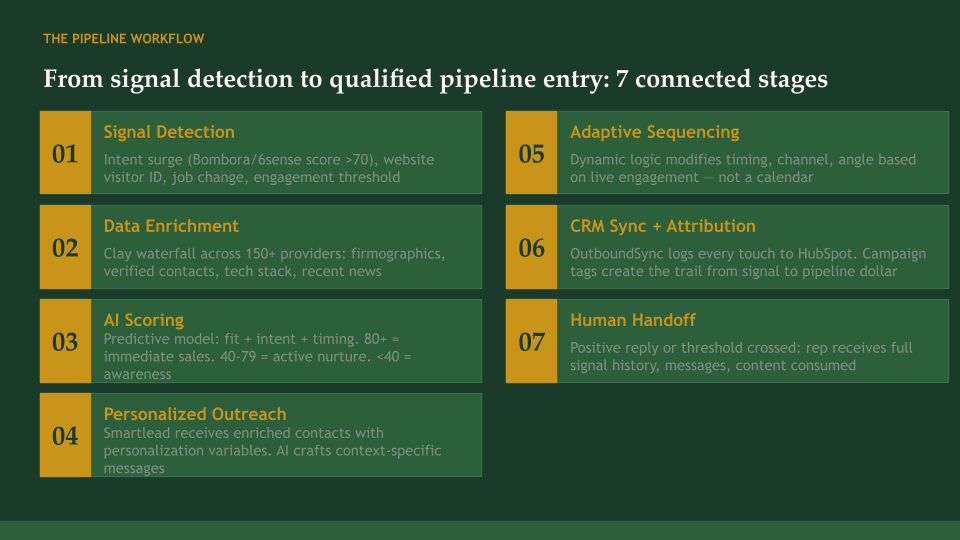
What does pipeline generation look like when it is built as a system rather than a tool collection? The full sequence from trigger to pipeline entry runs through seven connected stages.
Stage 1 — Signal detection: Intent surge detected (Bombora or 6sense score above 70), website visitor identified by a tool like Warmly or Clearbit, champion job change flagged, or engagement threshold crossed.
Stage 2 — Data enrichment: Clay, using a waterfall approach across 150+ data providers, enriches the contact with firmographics, verified contact details, tech stack data, recent company news, and LinkedIn activity. The AI research function, Claygent, scans prospect websites and summarizes their value proposition relative to your offer. Targeting below 1.5% duplicate rate at this stage is critical.
Stage 3 — AI scoring and qualification: A predictive model evaluates fit (firmographic match), intent (behavioral signals), and timing (change events). Contacts scoring 80 or above go to immediate sales engagement. Scores of 40 to 79 enter active nurture sequences. Below 40 enters awareness-level content tracks.
Stage 4 — Personalized outreach at scale: Smartlead receives the qualified, enriched contacts with personalization variables attached. The Clay to Smartlead API integration pushes this data natively. AI crafts messages referencing specific signals — the prospect’s funding round, the job change, the competitive content they consumed — rather than generic ICP-level copy.
Stage 5 — Multi-channel adaptive sequencing: Dynamic sequences run with conditional logic. If a prospect opens but does not reply, the next step shifts channel or angle. If they visit the pricing page after email one, the sequence escalates priority and notifies a human. The system adapts based on behavior, not calendar.
Stage 6 — CRM sync and attribution: OutboundSync handles the Smartlead to HubSpot sync, logging every email send, reply, open, and bounce to the contact timeline. Every contact receives a campaign tag before entering HubSpot, creating the attribution trail that connects outbound activity to pipeline dollars.
Stage 7 — Human handoff: When a prospect replies positively, requests a meeting, or crosses the engagement threshold, the system routes to the appropriate human with full context attached: which signals triggered the sequence, which messages generated engagement, and which content they consumed. The human picks up with complete intelligence rather than starting from scratch.
This is what lead generation automation looks like as infrastructure rather than as a sequence runner.
What the Data Shows: Hybrid Beats Pure AI by 2.3×
The most important finding for growth-stage CMOs building a pipeline development strategy is this: fully autonomous AI SDRs consistently underperform hybrid human-AI models on the metrics that matter.
Controlled testing across 14 companies by the GTM AI Podcast produced a clear result. AI-only pipeline generation produced 847 meetings booked with an 11% opportunity conversion rate. Hybrid human-AI produced 312 meetings booked with a 38% opportunity conversion rate. The hybrid model generated 2.3× more revenue from 63% fewer meetings because the meetings were better qualified, and the human engagement raised conversion quality.
SaaStr’s documented AI SDR deployment is the most detailed case study available. They deployed five specialized agents across inbound and outbound functions. Over six months with 1.2 humans replacing 8 to 9 salespeople: 19,847 total outbound messages sent, 6.7% overall response rate (approximately 2× industry average), $1M closed within the first 90 days from the inbound agent alone, and $5M in total additional pipeline with $2.4M closed over eight months.
The operational requirements are where most teams underestimate what this takes. Jason Lemkin’s direct observation: “If you hook up an AI SDR and go away and do nothing, you will get nothing. Zilch. Nada.” SaaStr required 15 to 20 hours of weekly human oversight. They ran 47 iterations on the inbound agent alone to calibrate its aggressiveness on pricing conversations. They treated the implementation as a $500,000 revenue initiative, not a $50/month subscription.
The decision framework for when AI handles nurturing versus when humans must engage follows deal size and complexity. Deals under $25,000 ACV with sales cycles under 30 days are candidates for autonomous AI sequencing. Deals above $25,000 ACV with multi-stakeholder buying committees require human-in-the-loop engagement. This is not a philosophical preference. It reflects where the conversion data shows genuine ROI from each model.
Why Most AI Nurturing Implementations Fail
MIT research found that 95% of generative AI pilots fail to achieve rapid revenue acceleration. The causes are not mysterious. Across the documented failures, three patterns repeat consistently.
Bolting AI onto broken processes. If your ICP definition is vague, your messaging is generic, and your SDR-to-AE handoff is inconsistent, AI scales all of those problems simultaneously at ten times the speed. The workflow above only works if the foundation is clean. Data quality, ICP precision, and messaging specificity are prerequisites, not afterthoughts.
Measuring volume instead of revenue. Teams celebrate 847 AI-booked meetings while ignoring that only 11% converted to qualified opportunities. The metric that determines whether your AI lead nurturing system is working is meeting-to-opportunity conversion rate, not meetings booked. If meetings are high and conversion is low, the system is generating noise, not pipeline.
Expecting zero maintenance. Every successful deployment tracked in the research required daily operational discipline: prompt adjustment, domain deliverability monitoring, reply analysis, false positive filtering, and sequence iteration. The 11x.ai case — which TechCrunch reported lost 70 to 80% of customers within months of acquisition after performance repeatedly fell short of claims — is the clearest warning about what happens when vendor promises replace operational discipline.
The teams that win treat AI nurturing implementation like a revenue initiative with owners, metrics, weekly reviews, and iteration cycles. The teams that fail treat it like a software purchase that runs itself.
The Pipeline KPIs That Actually Tell You If It Is Working
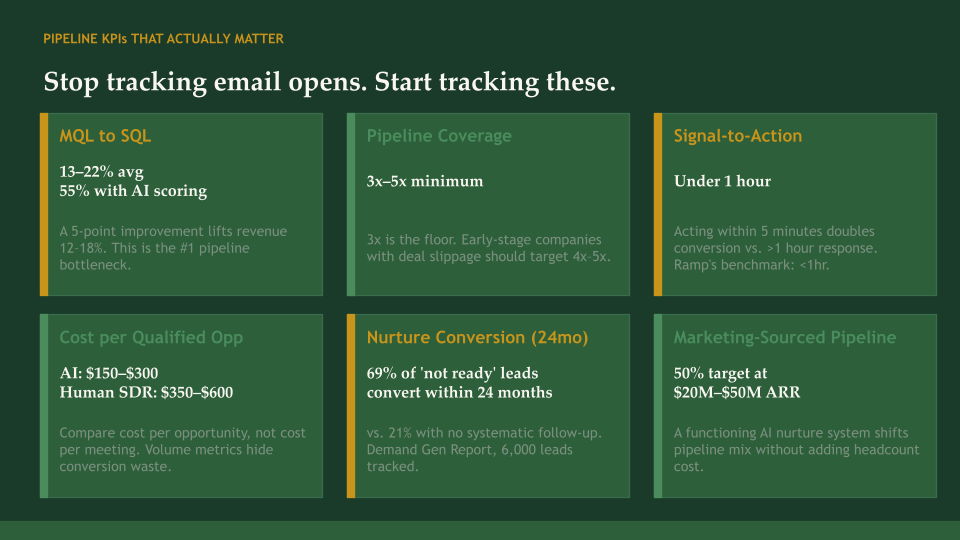
A pipeline development strategy built on AI nurturing requires a different measurement framework than traditional SDR metrics. Stop tracking emails sent and meetings booked. Start tracking these.
MQL to SQL conversion rate: The industry average is 13 to 22%. AI-enhanced scoring achieves 55%. If your rate is below 20%, the problem is either data quality or lead scoring, not volume.
Pipeline coverage ratio: Healthy B2B SaaS companies maintain 3× to 5× pipeline coverage. The 3× floor means $3 of pipeline for every $1 of revenue target. If you are below 3×, the system is not generating enough qualified opportunities, regardless of how many contacts it is touching.
Signal-to-action latency: How long from a buying signal detected to a rep engaging? Ramp’s benchmark is under one hour from product usage signal to sales rep task. Responding to intent within 24 hours produces a 29% lift in opportunity creation. If your system takes days, you are losing the buying window.
Cost per qualified opportunity: This is your true efficiency metric. A hybrid AI-human model should produce a cost per meeting of $150 to $300 versus $350 to $600 for a fully human SDR motion. But the relevant comparison is cost per qualified opportunity, meetings that actually advance, not cost per meeting booked.
Marketing-sourced pipeline percentage: At $20M to $50M ARR, marketing-sourced pipeline benchmarks at approximately 50% for mid-market B2B. If your AI nurturing system is working, this number rises as a percentage of the total pipeline without a corresponding increase in headcount cost.
The longitudinal data on lead nurturing makes a particularly compelling board-level argument. Demand Gen Report and Heinz Marketing tracked 6,000 B2B leads and found 69% of leads classified as “not ready” converted within 24 months when enrolled in structured nurturing programs, versus just 21% with no systematic follow-up. The pipeline you are not nurturing is a majority of your eventual revenue sitting untouched.
About Azarian Growth Agency
Azarian Growth Agency is a full-funnel, AI-native growth marketing agency founded by Hamlet Azarian. We work with growth-stage companies across SaaS, fintech, B2B tech, and e-commerce to build the marketing infrastructure that connects pipeline, CAC, and revenue metrics to actual operational systems.
The approach described in this post is not theoretical. We build signal-based lead nurturing systems, Clay and Smartlead workflows connected to CRM attribution, and AI-enhanced scoring models for partners who need to grow their pipeline without growing the team proportionally.
Our partners have helped their companies collectively raise $269 million in funding by building marketing engines that produce board-ready results on lean budgets.
Pipeline generation at scale without proportional headcount growth is not a staffing question. It is an architecture question. The More Output, Same Team session is where we show exactly what that architecture looks like and how to build it. If your board is asking how you plan to hit pipeline coverage this quarter with the team you have, this is where you get the operational answer.