
AI landing page builders have rapidly emerged as essential tools for business growth between 2024 and 2025. These platforms leverage artificial intelligence to automate design, copywriting, testing, and mobile optimization processes that traditionally required weeks of development time. Business owners now prioritize solutions that deliver faster build times, higher conversion rates, and significantly lower development costs.
The landscape has evolved into two distinct approaches: no-code AI tools and custom development solutions. Each offers different strengths, cost structures, and scalability potential. No-code platforms enable rapid deployment with minimal technical expertise, while custom development provides unlimited flexibility for brands requiring unique user experiences.
Modern AI landing page builders utilize conversion psychology, predictive analytics, and behavioral data to generate pages optimized for results. They eliminate guesswork by automatically testing layouts, headlines, and call-to-action placements. The right marketing agency can accelerate your growth by leveraging these AI tools strategically while maintaining brand authenticity.
What AI Landing Page Builders Actually Do
AI landing page builders are sophisticated platforms that automatically generate, design, and optimize landing pages using machine learning algorithms. These tools eliminate manual design work by analyzing conversion data from millions of pages. They predict which layouts, copy structures, and visual hierarchies will perform best for specific audiences.
Modern AI builders leverage pre-trained design models that understand conversion psychology. They analyze behavioral patterns to determine optimal button placements, headline formulations, and content flow. The landing page builders market is projected to grow from USD 715.5 million in 2025 to USD 2.72 billion by 2035, registering a 14.3% compound annual growth rate Future Market Insights.
Leading platforms include Unbounce with its Smart Traffic AI routing system, Framer AI offering intelligent design suggestions, and Webflow AI providing advanced customization. HubSpot integrates AI page builders directly into its marketing automation suite for seamless campaign execution.
Free AI Landing Page Builders
1. Wix
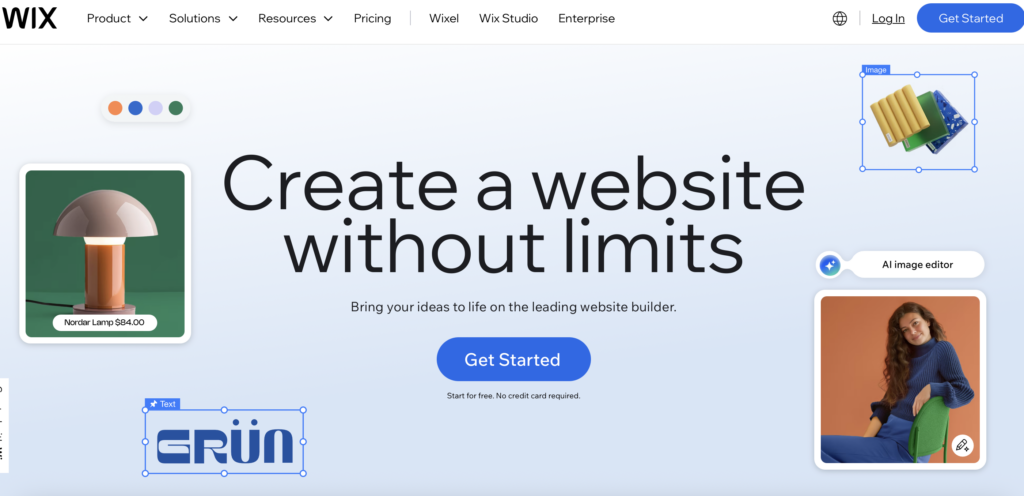
Services: AI website generation, drag-and-drop builder, hosting, domain management
Advantages:
- Completely free plan with no time limits
- Over 110+ landing page templates optimized for conversions
- AI-powered website builder creates pages from simple prompts
- Intuitive drag-and-drop editor requires zero coding
- Built-in SEO and analytics tools included
- Mobile-responsive designs automatically generated
- Extensive app marketplace with 300+ integrations
- Free hosting and SSL certificate included
- All-in-one solution for website creation
Disadvantages:
- Free plan displays Wix branding on pages
- Cannot use custom domain on free tier
- Limited storage (500MB on free plan)
- Cannot export site content to other platforms
- Ads displayed on free websites
- Less design flexibility than premium alternatives
- Advanced features require paid upgrade
- Can feel bloated with features for simple landing pages
Analysis: Wix dominates the free landing page space by offering professional-quality tools without cost barriers. The AI builder makes creation remarkably fast, though serious businesses will eventually need to upgrade to remove branding and access custom domains. Perfect for testing ideas and MVPs.
2. Carrd
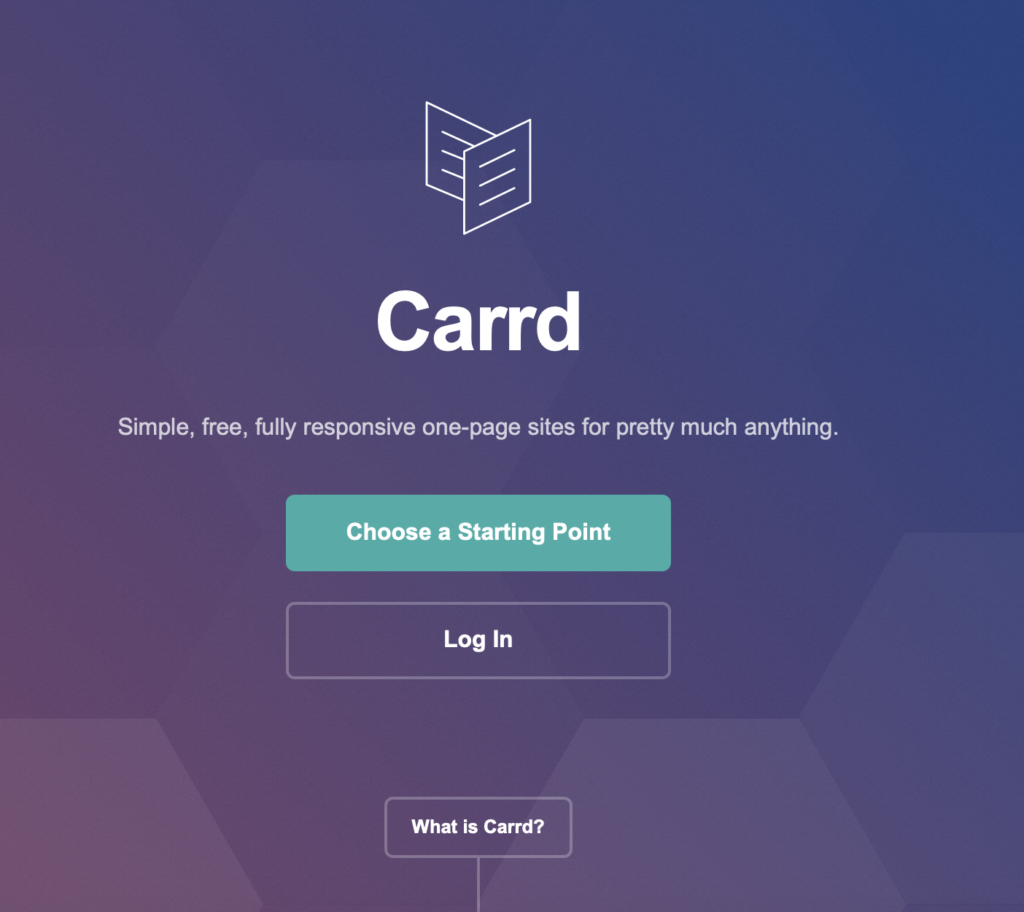
Services: Simple one-page site builder, responsive design, basic forms
Advantages:
- Extremely affordable at $19/year for Pro plan (essentially free compared to competitors)
- Ultra-simple interface perfect for beginners
- Fast loading, lightweight pages
- Mobile-responsive by default
- Free plan available with basic features
- Clean, minimalist templates
- Quick setup in under 30 minutes
- Low learning curve
- Perfect for simple landing pages
Disadvantages:
- Limited to one-page sites (no multi-page support)
- Free plan limited to 3 sites per account
- Cannot use custom domain on free tier
- Basic customization compared to full builders
- Fewer templates than competitors
- Limited integration options
- No A/B testing capabilities
- Lacks advanced marketing features
Analysis: Carrd excels at doing one thing exceptionally well—creating simple, beautiful one-page sites quickly and cheaply. The $19/year pricing makes it essentially free compared to monthly subscriptions. Ideal for personal projects, portfolios, and basic landing pages where simplicity trumps complexity.
3. Rollout AI
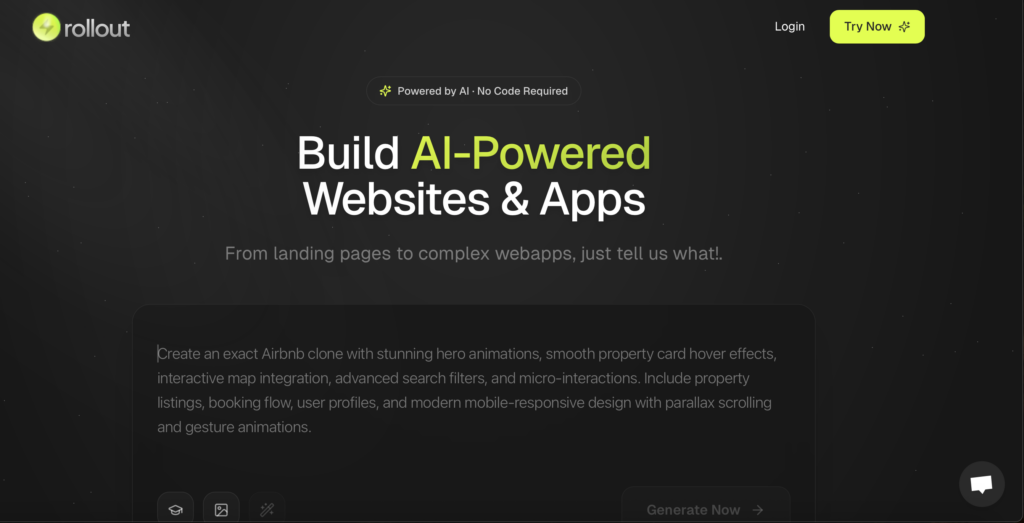
Services: AI-powered website generation, instant page creation, no-code customization
Advantages:
- Free tier available for testing
- Generates complete landing pages from simple prompts
- Works in any language
- Instant page creation in minutes
- Real-time editing with AI assistance
- Responsive design automatically included
- Export functionality in multiple formats
- No technical skills required
- Fast iteration and updates
Disadvantages:
- Limited features on free tier
- Newer platform with smaller user base
- May lack advanced customization options
- Template variety still growing
- Integration ecosystem less mature
- Free tier may have page limits
- Advanced AI features likely require paid plan
- Less proven track record than established competitors
Analysis: Rollout AI represents the cutting edge of AI-powered landing page creation, focusing on speed and simplicity. The ability to generate pages from conversational prompts makes it accessible to anyone, though users should test the free tier to ensure it meets their needs before committing.
4. Jotform
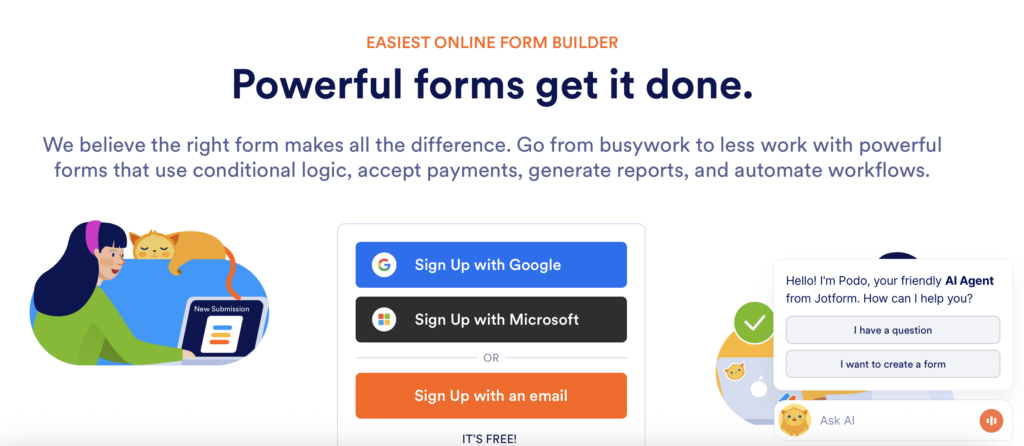
Services: AI landing page generator, form builder, payment processing, workflow automation
Advantages:
- Free plan available with generous features
- AI generates pages in 30-60 seconds
- Strong form building capabilities included
- Payment processing integration built-in
- Over 10,000+ templates available
- Drag-and-drop editor for easy customization
- Mobile-responsive automatically
- Excellent for lead generation and data collection
- No coding required
- Can handle complex workflows
Disadvantages:
- Free plan has submission limits (100/month)
- Jotform branding on free tier
- Some advanced features require paid plans
- Interface can feel cluttered
- Not primarily designed for landing pages
- Less design flexibility than dedicated builders
- Storage limits on free tier (100MB)
- Advanced analytics require upgrade
Analysis: Jotform shines when your landing page needs robust form functionality and data collection. The AI generator creates functional pages quickly, and the form builder is industry-leading. Best for businesses prioritizing lead capture and user data over pure design aesthetics.
5. Landingsite.ai
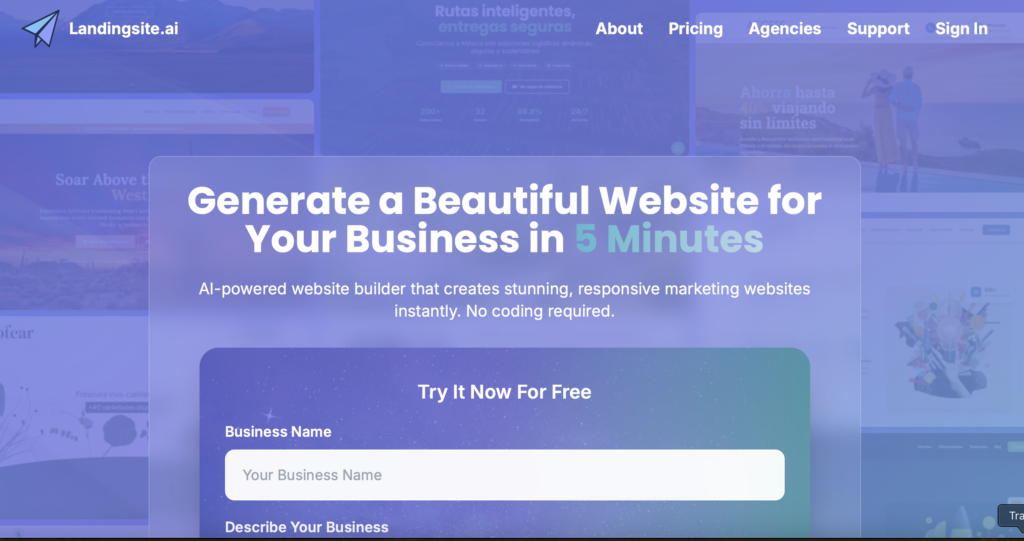
Services: AI website generation, logo creation, domain registration, hosting
Advantages:
- Free to start with no credit card required
- AI generates complete website in 5 minutes
- Includes AI logo design automatically
- SEO-optimized content written for your business
- Custom layouts based on your industry
- Free hosting with SSL included
- Responsive across all devices
- Stock image library access
- Simple chat interface for edits
- Domain connection or purchase available
Disadvantages:
- Free tier likely has limitations
- Newer platform with limited reviews
- May lack advanced customization
- Template variety unclear
- Integration options may be limited
- Long-term pricing not transparent
- Less community support
- Feature set still evolving
Analysis: Landingsite.ai delivers impressive speed and simplicity, generating complete branded websites in minutes. The all-in-one approach (website + logo + hosting) reduces friction for complete beginners. However, the platform’s newness means you should validate it meets your needs before building your entire presence here.
Paid AI Landing Page Builders
1. Unbounce
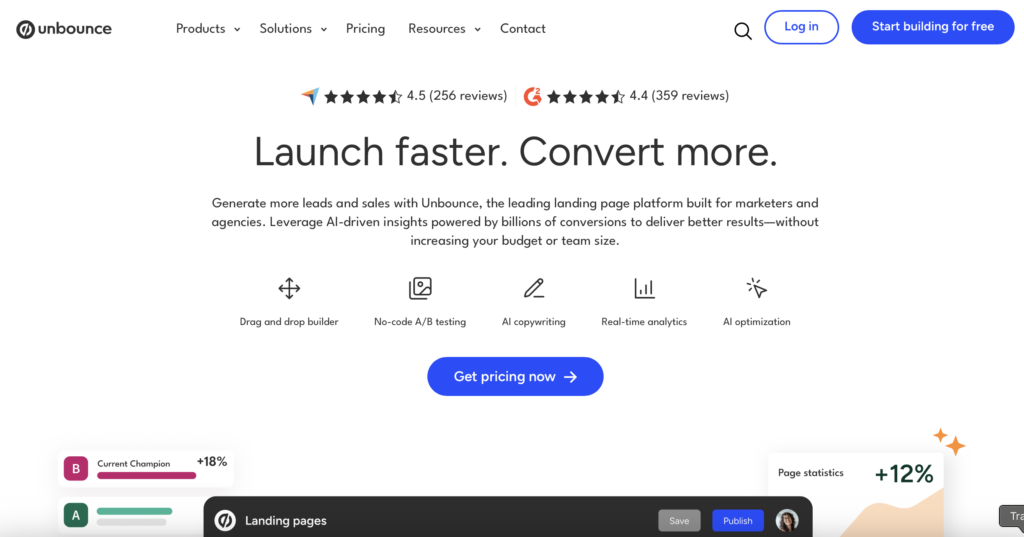
Services: AI-powered landing page builder, A/B testing, conversion optimization, Smart Traffic AI
Advantages:
- Industry-leading drag-and-drop builder with unlimited positioning
- Smart Traffic AI routes visitors to best-converting variants (up to 30% lift)
- Smart Builder generates layouts and copy with AI
- Dynamic text replacement matches ad keywords automatically
- AI copywriting tools for headlines and CTAs
- Over 100+ conversion-optimized templates
- Advanced A/B testing with one-click launch
- Pop-ups and sticky bars included
- AI Heatmaps predict visitor behavior before publishing
- Seamless integrations with marketing stack
- 14-day free trial available
Disadvantages:
- Expensive starting at $74/month (Build plan)
- Higher tiers reach $649/month for scaling
- Only one form per landing page
- Cannot mix/match template sections
- Learning curve for advanced features
- Full-page templates only (not modular)
- Pricing scales with conversions and traffic
- Best features require higher-tier plans
Analysis: Unbounce justifies its premium pricing with best-in-class AI optimization and conversion tools. The Smart Traffic feature alone can dramatically improve ROI by automatically optimizing visitor routing. Ideal for agencies and performance marketers managing high-volume campaigns where conversion rate improvements directly impact revenue.
2. Instapage
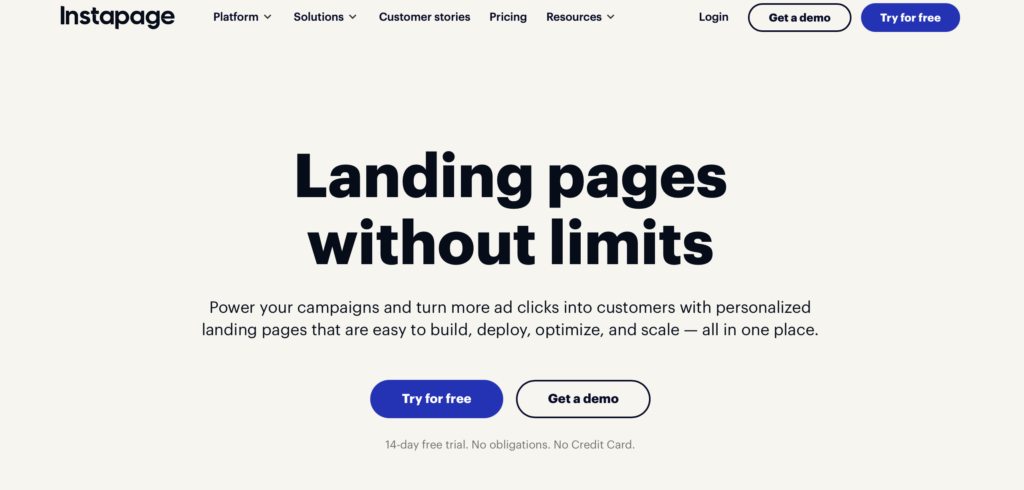
Services: Enterprise landing page platform, personalization, collaboration, conversion optimization
Advantages:
- Pixel-perfect WYSIWYG editor for precise design control
- Dynamic content personalization by visitor segment
- Instablocks feature saves reusable page components
- Native heatmaps and session recordings included
- Real-time collaboration with comments and version history
- Role-based access for team management
- Over 100+ customizable templates
- AMP page support for instant loading
- Thor Render Engine for fast page loads
- Advanced analytics linking ads to performance
- Enterprise-grade security and SLAs
Disadvantages:
- Very expensive starting at $199/month (Build plan)
- 15,000 unique visitor cap on base plan
- Exceeding limits requires custom pricing
- AMP and advanced features only on custom plans
- Steeper learning curve than competitors
- Overkill for small businesses
- Can become prohibitively expensive at scale
- Support hours limited (not 24/7)
Analysis: Instapage targets enterprise performance marketers who need deep personalization and team collaboration. The platform excels at post-click optimization with sophisticated visitor segmentation and visual analytics. Only makes financial sense for large organizations running high-budget advertising campaigns where granular optimization is critical.
3. Leadpages
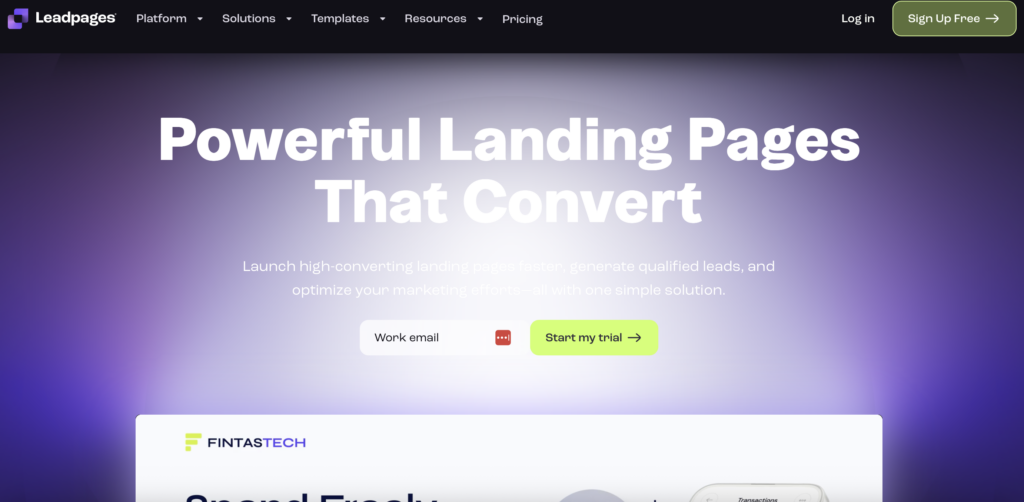
Services: Landing page builder, lead generation, website builder, conversion optimization
Advantages:
- Affordable pricing starting at $37/month
- Unlimited landing pages on all plans
- Leadmeter conversion assistant provides real-time optimization tips
- Built-in checkout widget powered by Stripe
- Alert bars and countdown timers included
- Templates categorized by industry, type, style, and color
- Functions as full website builder
- Pop-ups and lead capture forms included
- 14-day free trial available
- Clean, professional templates
- Strong mobile optimization
Disadvantages:
- Less flexible than Unbounce or Instapage
- Limited advanced AI features
- Basic A/B testing compared to competitors
- Templates good but not as extensive
- Fewer integrations than enterprise solutions
- Some features restricted to higher tiers
- Not as powerful for pure conversion optimization
- Custom domain limited on lowest tier
Analysis: Leadpages offers the best value proposition for small to medium businesses needing professional landing pages without enterprise pricing. The Leadmeter feature provides helpful conversion guidance, and the all-in-one approach (pages + pop-ups + checkout) reduces tool sprawl. Perfect middle ground between free tools and enterprise platforms.
4. Webflow
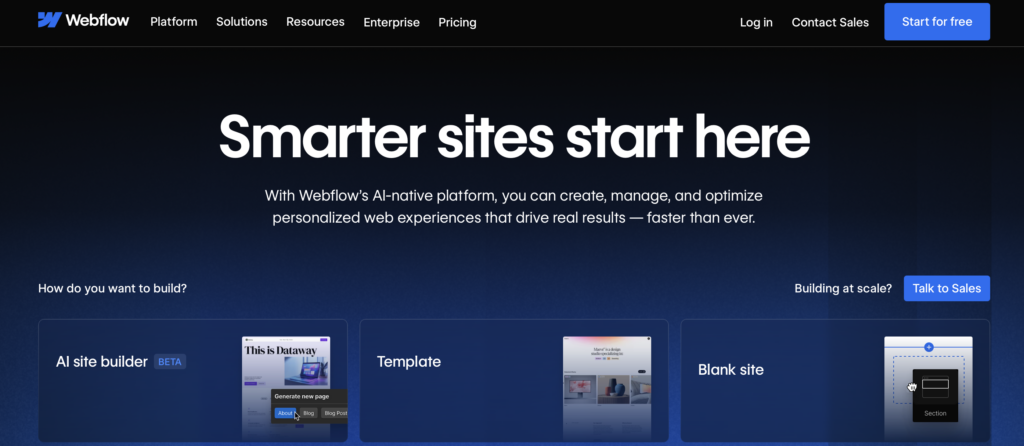
Services: Visual web design platform, CMS, hosting, e-commerce, responsive design
Advantages:
- Complete design freedom with visual development
- Professional-quality, pixel-perfect designs
- Powerful CMS for dynamic content
- Clean, semantic code generation
- Advanced animations and interactions
- Responsive design with full control
- SEO optimization built-in
- E-commerce capabilities included
- Designer-friendly interface
- Active community and extensive tutorials
- One-time design, easy content updates
Disadvantages:
- Steeper learning curve than drag-and-drop builders
- More expensive for beginners (starts $14/month, scales higher)
- Requires understanding of web design concepts
- Can be overwhelming for non-designers
- Time investment to learn properly
- Not as quick as AI generators
- May require custom code for advanced features
- Overkill for simple landing pages
Analysis: Webflow bridges the gap between no-code builders and custom development, offering designers full creative control without coding. The learning curve is significant but worthwhile for those building multiple sites or needing design flexibility. Best for agencies, designers, and businesses valuing design quality over speed.
5. Framer
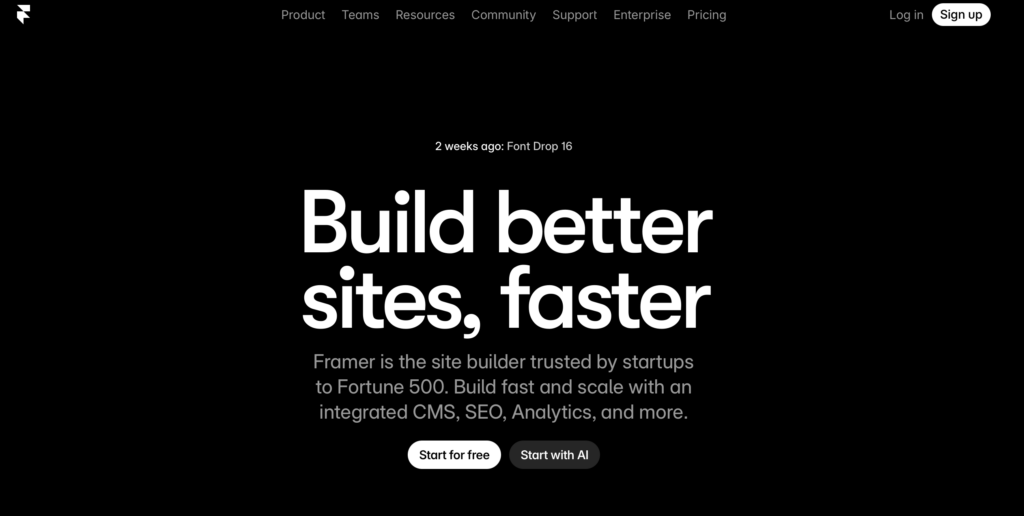
Services: Design-to-code platform, interactive prototyping, CMS, AI page generation
Advantages:
- Seamless Figma integration for designers
- AI generates page layouts and components instantly
- Advanced animations and interactions
- Real-time collaboration on canvas
- Built-in CMS for content management
- A/B testing and analytics included
- Masonry grids and modern layouts
- Code components when needed
- Fast, optimized hosting
- Designer-centric workflow
- Rapid prototyping capabilities
Disadvantages:
- Requires design knowledge to maximize value
- Learning curve for non-designers
- Template customization can be challenging
- More expensive than basic builders
- Primarily for design-focused teams
- May require custom components for unique needs
- Not ideal for non-technical marketers
- Browser compatibility considerations
Analysis: Framer excels for design teams who live in Figma and need their designs to become functional websites without handoff friction. The AI features accelerate layout creation, while the platform maintains design fidelity. Best for startups and agencies with design expertise who demand beautiful, interactive landing pages.
Essential Features That Separate Basic From Advanced Builders
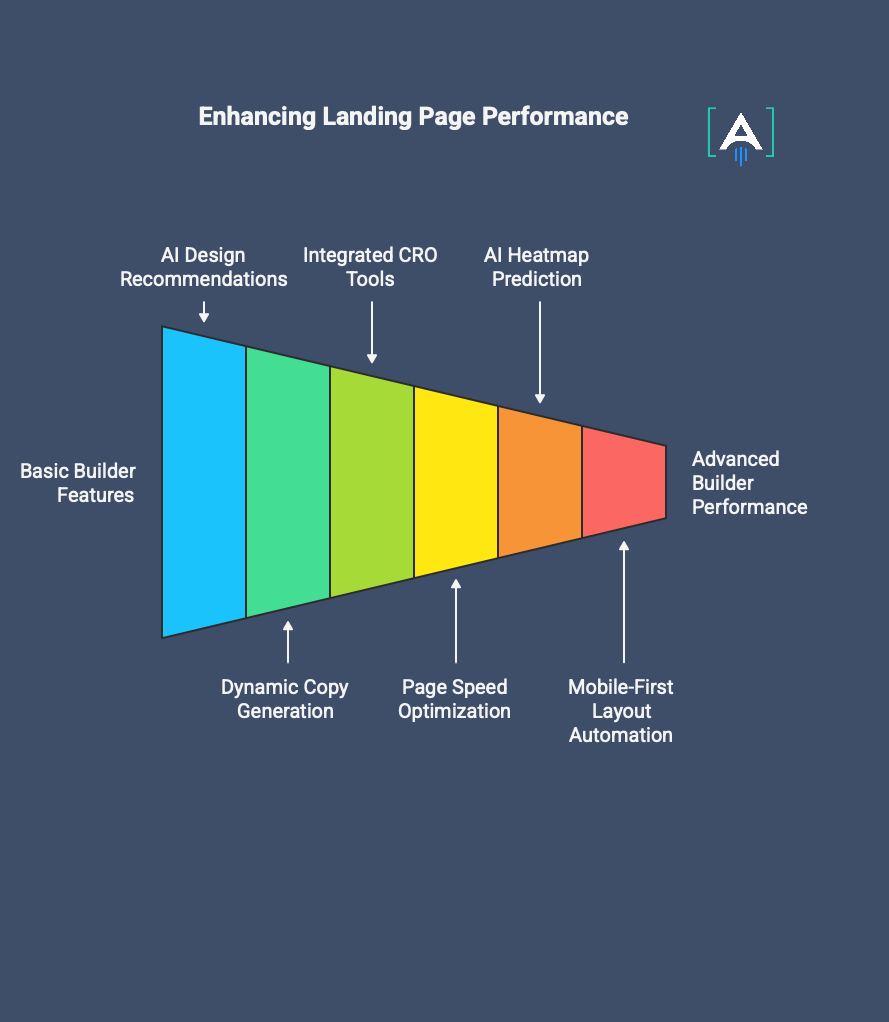
Evaluating AI landing page builders requires understanding which features drive measurable results. AI design recommendations should adapt to your industry and target audience. The system should analyze your goals and suggest layouts proven to convert in similar contexts.
Dynamic copy generation must create variations that maintain brand voice while testing different psychological triggers. Integrated conversion rate optimization tools eliminate the need for third-party software. Look for built-in heatmap generation, session recording, and funnel visualization.
Page speed optimization should happen automatically through image compression, code minification, and content delivery network integration. Landing pages that load in under 2 seconds enjoy a 30% higher conversion rate compared to slower pages Firework, making this feature non-negotiable for serious performance.
AI heatmap prediction capabilities estimate attention patterns before launch. This enables layout optimization during the design phase rather than after traffic arrives. Multivariate testing functionality lets you test multiple elements simultaneously rather than sequentially, dramatically accelerating optimization cycles.
Mobile-first layout automation ensures responsive design across all devices without manual adjustment. Premium builders include all these features in their core offering. Free tools typically provide only basic design and publishing functionality without sophisticated optimization features.
What AI Automates in Landing Page Testing
Traditional A/B testing requires manual hypothesis formation, variant creation, traffic allocation, and statistical analysis. AI automation transforms this entire workflow into a continuous optimization engine.
AI-generated A/B test variants automatically create multiple versions of headlines, calls-to-action, and layouts. The system identifies which elements most likely impact conversion, then generates alternatives based on proven psychological principles. Heatmap prediction occurs before publishing using trained models.
Real-time CTA optimization continuously monitors which call-to-action variants perform best. The system automatically increases traffic to winning versions while continuing to test new alternatives. Dynamic personalization based on visitor segments delivers different content to different audiences automatically.
For founders, this automation means faster testing cycles that directly accelerate revenue growth. Instead of running 2-week tests sequentially, AI tests dozens of variations simultaneously. Optimization happens continuously rather than in discrete campaigns, compounding improvements over time.
Market Data: Growth Statistics and Industry Trends
Understanding market dynamics helps CEOs evaluate long-term platform viability and future feature development. The landing page builders market is forecast to expand from USD 715.5 million in 2025 to USD 2.72 billion by 2035, Future Market Insights (https://www.futuremarketinsights.com/reports/landing-page-builders-market). This robust 14.3% CAGR reflects accelerating adoption across business sizes and industries.
The global AI-powered website builder market is projected to reach USD 31.5 billion by 2033, up from USD 3.17 billion in 2023, growing at a CAGR of 25.80% Market.us (https://market.us/report/ai-powered-website-builder-market/). The AI-specific segment grows faster than general landing page tools, indicating a clear market preference for intelligent automation.
The average conversion rate for a landing page is around 6.6% across all industries as of Q4 2024, Unbounce(https://unbounce.com/average-conversion-rates-landing-pages/). This baseline helps businesses evaluate their own performance. Top performers achieve conversion rates exceeding 11%, demonstrating significant optimization opportunities.
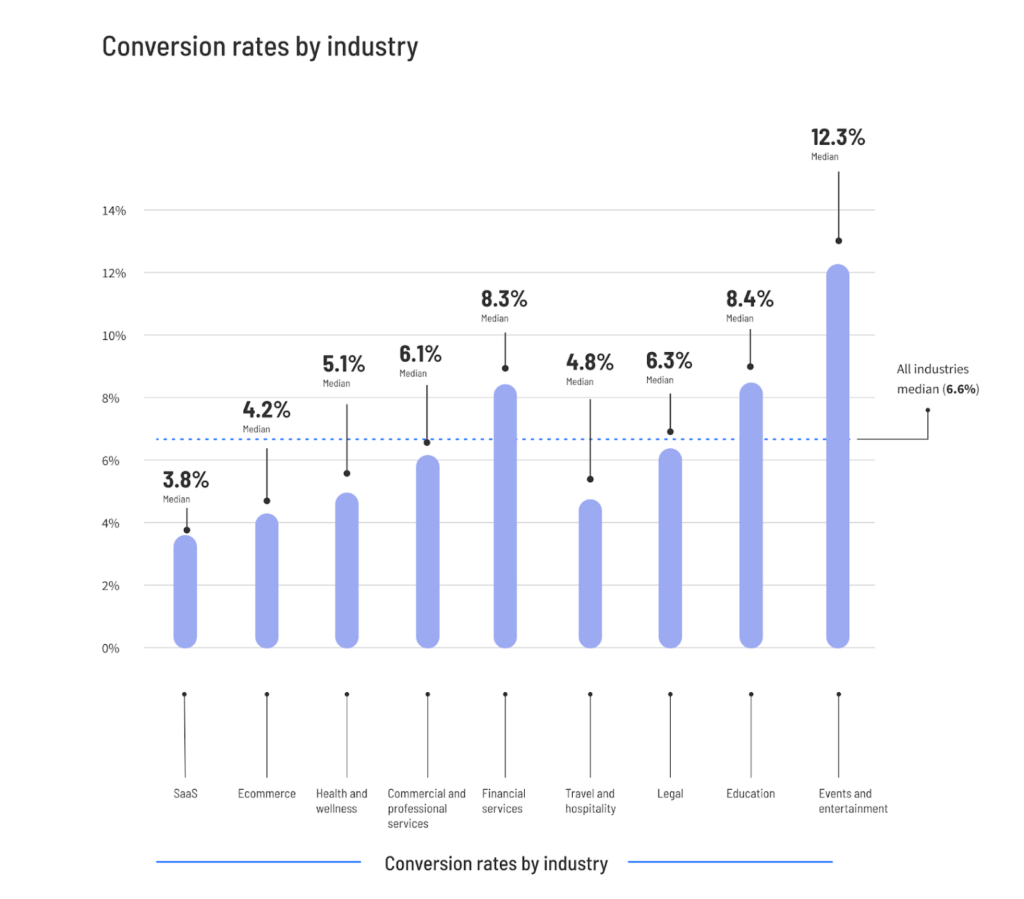
Conversion improvements from AI optimization deliver measurable ROI. Small and medium-sized enterprises drive the majority of landing page builder adoption due to cost-effectiveness and ease of use. E-commerce, SaaS companies, and education technology lead adoption rates.
Comparing Free vs Paid: Direct Feature Analysis
A structured comparison clarifies exactly what each tier delivers and helps justify budget allocation decisions.
Cost Structure: Free builders charge nothing but impose branding and usage limits. Paid platforms range from $50 to $400 monthly based on traffic volume. Custom development requires $10,000 to $100,000+ initial investment.
Speed to Market: Free tools enable same-day publishing with templates. Paid platforms support launch within hours with more design freedom. Custom development spans weeks to months before initial deployment.
Customization Depth: Free builders restrict you to preset templates with limited modification. Paid platforms offer extensive template libraries plus custom design flexibility. Custom development provides unlimited creative possibilities.
Testing Capabilities: Free tools provide basic split testing between two variants. Paid builders enable multivariate testing with AI-powered variant generation. Custom solutions support sophisticated testing frameworks with complete control.
Integration Options: Free platforms connect to basic email services. Paid tools integrate with major CRM systems, advertising platforms, and analytics suites. Custom development allows any integration through API connections.
Scalability Potential: Free builders struggle with high traffic volumes on shared infrastructure. Paid platforms scale automatically with guaranteed uptime and performance. Custom solutions scale infinitely with proper architecture.
The comparison reveals clear use cases. Free builders’ suit idea validation with minimal traffic expectations. Paid platforms deliver optimal value for growing businesses running serious campaigns. Custom development serves established brands requiring unique experiences.
Real Marketing Examples That Demonstrate ROI
A SaaS startup needed to validate product-market fit before investing heavily in development. They used Unbounce’s free trial to build a landing page collecting email signups.
The founder wrote copy positioning the solution and generated a simple design using AI recommendations. Within 48 hours, they published the page and directed paid search traffic to it. In just two weeks, they collected 200 qualified leads, validating strong market demand.
An ecommerce brand selling premium outdoor gear used Instapage’s paid platform to optimize a major product launch. They created a main landing page with six AI-generated variants, testing different headlines, images, and social proof placements. After 30 days and 10,000 visitors, the brand identified a winning combination that delivered a 29 percent conversion lift, resulting in revenue far exceeding the platform cost.
A global software company such as HubSpot used AI-powered A/B testing and predictive analytics to optimize email marketing campaigns. By segmenting audiences and predicting the best send times, open rates increased by 30%, while click-through rates improved by 50%, directly impacting pipeline growth.
These examples illustrate that tool selection should align with business stage, budget, and strategic goals. Early-stage companies may start with AI platforms for rapid testing, while established brands benefit from paid, full-feature platforms to scale efficiently. Combining fast experimentation with long-term strategic investment balances speed, cost, and growth potential.
Understanding AI Conversion Psychology Features
Advanced AI landing page builders incorporate psychological principles that improve conversion rates without requiring marketing expertise. Emotion-based layouts position elements to trigger specific psychological responses. The AI understands that certain color combinations evoke urgency while others build trust.
Placement intelligence determines optimal locations for testimonials, guarantees, and risk reducers. These elements appear exactly where visitor attention naturally flows, maximizing their persuasive impact. Social proof algorithms automatically highlight the most compelling testimonials or user numbers.
Attention heat zones map where visitors focus during their page journey. The AI places your most important conversion elements within these high-attention areas. This ensures critical messages receive maximum visibility without competing for attention.
These psychological optimization features distinguish premium AI builders from basic template tools. Professional content marketing agencies leverage these psychological principles when crafting landing page copy that works synergistically with AI design recommendations.
Decision Framework: Choosing Your Optimal Solution
Strategic tool selection requires evaluating five critical factors that align platforms with business objectives. Budget availability constrains options but shouldn’t be the sole decision criterion. Calculate total cost of ownership including subscription fees, integration costs, and team training time.
Timeline urgency determines whether you need deployment in hours, days, or weeks. Urgent campaigns favor no-code AI platforms that publish immediately. Brand building initiatives with longer horizons may justify custom development timelines.
Traffic volume expectations affect infrastructure requirements. Pages expecting thousands of daily visitors need enterprise-grade hosting and performance optimization. Low-traffic validation pages function adequately on free platforms.
Conversion goals define required optimization sophistication. Simple email collection needs basic functionality. Complex sales funnels with multiple decision points benefit from advanced testing and personalization capabilities.
Team skillset determines how much technical complexity you can manage effectively. Non-technical teams succeed with drag-and-drop builders featuring AI assistance. Technical teams may prefer platforms offering code access for advanced customization.
Apply this framework systematically. A pre-revenue startup testing product-market fit should choose free AI builders prioritizing speed over sophistication. A scaling SaaS company running paid acquisition campaigns benefits from paid platforms with advanced testing.
Most businesses find that tool needs evolve with growth stages. Starting with accessible AI platforms for testing, then graduating to more sophisticated solutions as revenue scales, creates an efficient optimization path employed by results-driven branding agencies.
Making the Right Choice for Your Business Growth
AI landing page builders have fundamentally transformed how businesses create high-converting pages. The technology eliminates weeks of manual design work while applying proven conversion principles automatically. For companies prioritizing speed to market and data-driven optimization, these platforms deliver measurable ROI.
Azarian Growth Agency specializes in building, testing, and optimizing AI-powered landing pages engineered specifically for conversions. Our team combines advanced AI tools with strategic marketing expertise to deliver pages that perform significantly above industry benchmarks. We help businesses navigate the complexity of platform selection while implementing sophisticated optimization strategies.
Our integrated approach connects landing page performance with broader marketing initiatives. We leverage social media marketing to drive qualified traffic, data analytics to identify optimization opportunities, and AI content optimization to ensure messaging resonates with target audiences.
Whether you’re launching your first campaign or scaling proven winners, strategic guidance makes the difference between mediocre and exceptional results.
Partner with us to transform your landing pages into high-performing revenue engines that consistently exceed your growth objectives.