

Most general contractors and subcontractors hit the same ceiling: one estimator can only do so much work. There are only so many hours in a week. At some point, the choice looks binary — hire another estimator or leave bids on the table.
That math is changing. A segment of contractors has figured out how to bid two to three times as many projects with the same headcount, using AI-powered takeoff tools that cut the most time-consuming part of the bid cycle from hours to minutes.
This is not about replacing estimators. It is about removing the bottleneck that keeps good estimators from doing more of the work that actually requires their judgment.
Manual quantity takeoffs consume an estimated 40 to 60 percent of total bid cycle time. AI tools are cutting that time by 60 to 80 percent. The math on estimator capacity changes dramatically.
Why Estimating Capacity Is the Core Growth Lever
In commercial construction, bid volume determines pipeline. Pipeline determines revenue. The problem is that estimating capacity — specifically, the time required to complete a manual quantity takeoff — has been a fixed constraint for most firms.
According to Construction Dive, material takeoffs still consume up to 50 percent of the bid cycle for most commercial contractors. One estimator quoted in the piece described a situation most GCs will recognize: “We used to have one estimator doing takeoffs for only a few trades, taking nearly a week.” When deadline stacks up, contractors either rush or pass.
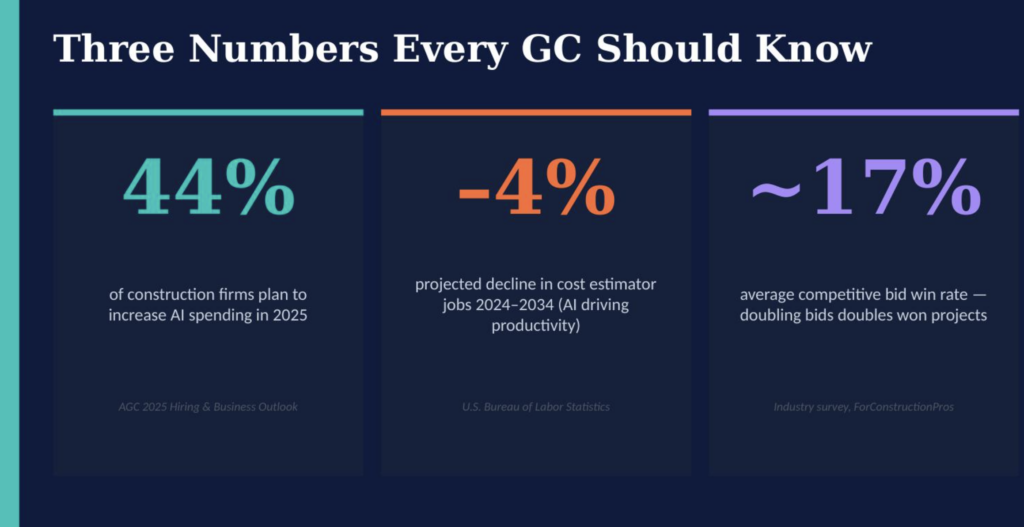
The industry is responding. The Associated General Contractors of America reported in their 2025 Construction Hiring and Business Outlook that 44 percent of firms plan to increase AI spending this year, and 35 percent plan to increase investment specifically in estimating software. The reason is straightforward: the demand for bids is growing, but the supply of qualified estimators is not.
The Bureau of Labor Statistics projects cost estimator employment to decline 4 percent from 2024 to 2034 — not because the work is going away, but because AI is making each estimator capable of doing more of it. The firms that capture that productivity gain first will have a structural cost and capacity advantage.
The Bid Volume Math
Start with baseline numbers. The average commercial construction bid requires roughly 28 hours of estimating labor using traditional methods. At approximately 160 working hours per month, one estimator can realistically complete 5 to 6 commercial bids per month. At an industry-average competitive win rate of around 17 percent, that produces roughly one awarded project per month.
Now run the same math with AI-assisted takeoffs, cutting per-bid time by 60 to 80 percent, reducing the per-bid time to 8 to 12 hours. Monthly capacity for that same estimator rises to 13 to 20 bids. At the same 17 percent win rate, that is 2 to 3 awarded projects per month instead of 1.
One estimator. Same salary. Two to three times the awarded project pipeline. No new hire required.
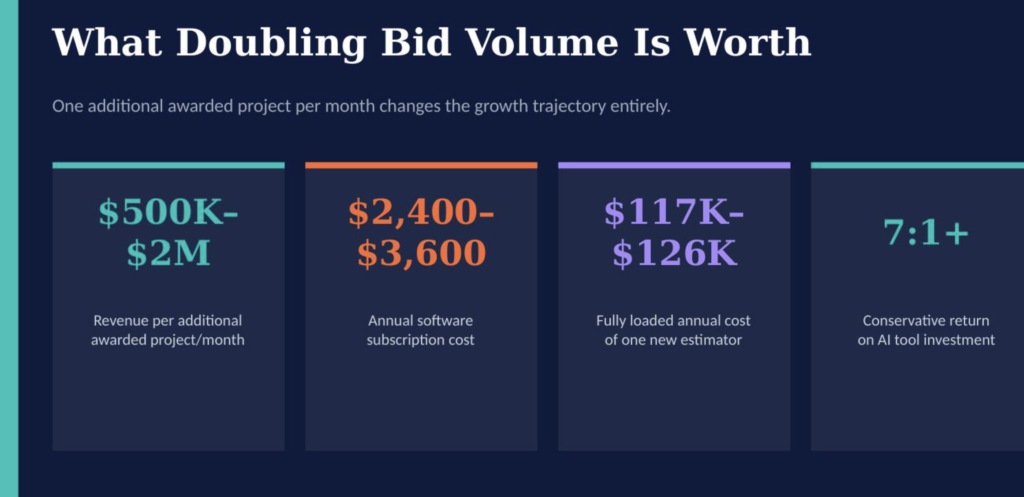
For a GC where the average awarded project generates $500,000 to $2,000,000 in revenue, one additional win per month is worth $500,000 to $2,000,000 in annual revenue at zero additional headcount cost. The math on the return against a $2,400 to $3,600 annual software subscription speaks for itself.
The math also works from a labor cost perspective. A senior construction estimator carries a fully loaded annual cost of $117,000 to $126,000 when salary, benefits, and overhead are included. If AI tools double the effective estimator output, a two-person estimating department using AI tools can match the output of a four-person department — saving $234,000 to $252,000 annually in headcount that was never added.
The Tools GCs Are Using
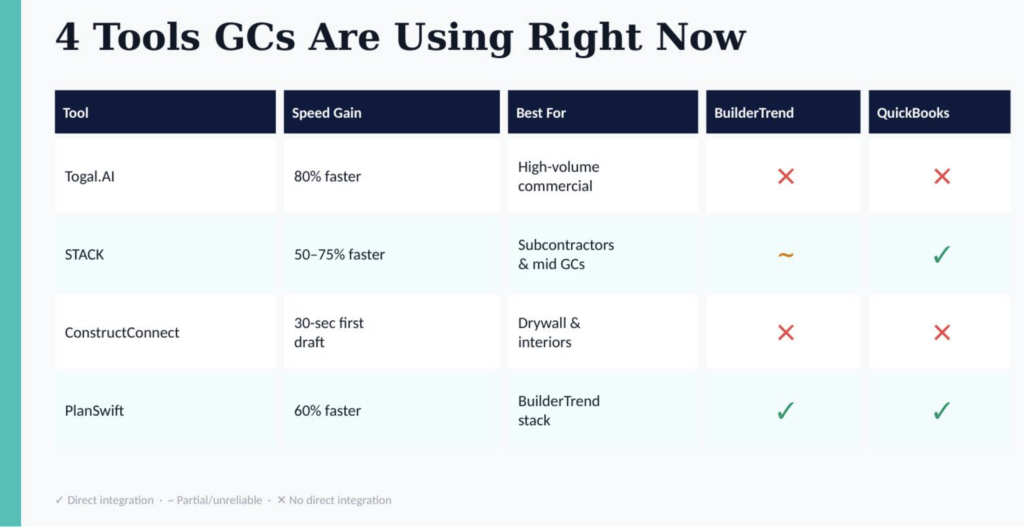
The AI construction estimating software market has matured significantly since 2022. Here is an honest breakdown of the tools that are producing real results, along with where each fits in a typical GC workflow.
Togal.AI
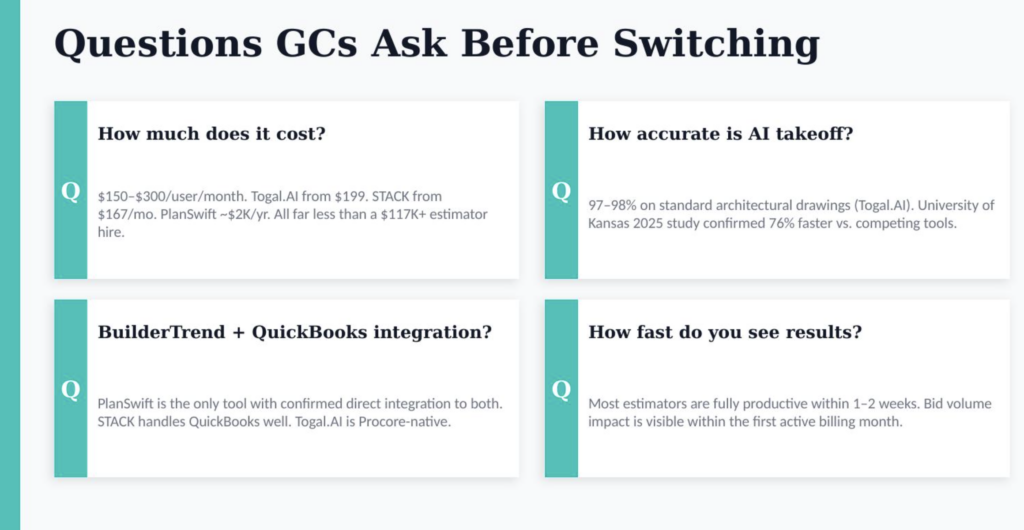
Togal.AI uses deep-learning computer vision to automatically detect, measure, label, and compare building elements on architectural drawings. The headline number: up to 80 percent faster takeoffs, with 97 to 98 percent accuracy on floor plans following AIA measurement standards. A 2025 study by the University of Kansas found Togal to be 76 percent faster than competing takeoff software in head-to-head testing — the strongest third-party benchmark currently available for any tool in this category.
Processing time runs 3 to 10 seconds per sheet. For a complex commercial project with 50 pages of architectural drawings, that is under 10 minutes for an initial takeoff that would otherwise take hours. A newer natural language feature called TogalCHAT lets estimators ask questions like “What is the total drywall area for Level 3?” and receive instant answers from the drawing data.
Togal works well for firms with dedicated estimating teams doing high volumes of commercial or multi-family work. It integrates with Procore, Bluebeam, and DESTINI Estimator. If your firm runs BuilderTrend, Togal does not have a direct integration — output requires an Excel export and manual import. Pricing runs $199 to $299 per user per month.
STACK Construction Technologies
STACK is a cloud-based takeoff and estimating platform that has found its strongest adoption among subcontractors and mid-size GCs. It combines AI-powered auto-count and measurement tools with integrated estimating, regional cost data, and proposal generation. Approximately 70 percent of STACK reviewers work at companies with 11 to 200 employees, which aligns well with the small-to-mid-size contractor segment.
STACK has a confirmed native integration with QuickBooks Online and QuickBooks Desktop, which matters for firms where job costing flows into QuickBooks. Its BuilderTrend integration has become less reliable in recent versions. Pricing starts at $1,999 per year for one full-access user. A free tier is available for basic evaluation.
ConstructConnect Takeoff Boost
ConstructConnect’s Takeoff Boost generates initial takeoff data in as little as 30 seconds by automatically identifying wall types and creating conditions in the platform. Estimator Sheri Winslow at AKS Interior Systems described the results directly: “I did three projects in 20 minutes. That probably would have taken me a couple of days.” She now uses Takeoff Boost on approximately 80 percent of her projects.
ConstructConnect is particularly strong for drywall, interiors, and ceiling work, with expansion to additional trade types underway. It integrates with ConstructConnect’s broader bid management ecosystem, which is a significant advantage for firms already on the platform.
PlanSwift
PlanSwift is the longest-established tool in the category and the only one with confirmed direct integrations to both BuilderTrend and QuickBooks (via a paid plugin). For GCs running that specific tech stack, PlanSwift is the path of least resistance from takeoff to project management to accounting — no manual data re-entry required. It is desktop-only (Windows), and its AI features are less advanced than Togal or ConstructConnect. Pricing runs approximately $2,000 per year per license.
The Integration Question GCs Should Ask Before Buying
The single most practical question to ask before selecting an AI estimating tool is: where does the data need to go after the takeoff?
Most GCs are running some combination of takeoff software, project management (BuilderTrend, Procore, CoConstruct), and accounting (QuickBooks). If the takeoff data does not flow cleanly into those systems, the time saved on the takeoff gets partially eaten up by manual data re-entry.
Here is the honest integration picture:
- PlanSwift connects directly to both BuilderTrend and QuickBooks. It is the most connected option for that specific stack.
- STACK connects natively to QuickBooks Online and Desktop. BuilderTrend connectivity has been inconsistent in recent versions.
- Togal.AI integrates with Procore and Bluebeam, not BuilderTrend or QuickBooks. Output requires Excel export and manual import.
- BuilderTrend itself connects to QuickBooks through a strong two-way sync covering invoices, payments, purchase orders, job costs, and vendors — so any tool that connects to BuilderTrend automatically benefits from that link to QuickBooks.
The practical takeaway: if your firm runs BuilderTrend as its project management core, PlanSwift is the best-integrated AI estimating option available today. If you run Procore, Togal.AI is the stronger fit. If QuickBooks integration is the only hard requirement, STACK delivers it reliably.
What the Firms Doing This Look Like
The companies getting the most out of AI estimating tools share a few characteristics. They are not the largest firms — the enterprise GCs have their own challenges with change management and legacy systems. The firms moving fastest are typically mid-size GCs and subcontractors with between 10 and 200 employees, where one or two estimators are responsible for the entire bid function.
UrbanCore Construction uses Togal.AI to produce estimates during live client meetings — a capability that was simply not possible when takeoffs took hours. Total Flooring Contractors reports completing 90 percent of their takeoff in minutes instead of hours. AKS Interior Systems, a drywall and ceilings subcontractor, does three projects in 20 minutes that previously took two days.
The pattern is consistent: firms where the estimating bottleneck was the binding constraint on bid volume are seeing the most dramatic results. For a GC where one superintendent, one coordinator, and one PM can take on $5 to $6 million in subcontracted revenue — the kind of equation where the limiting factor is simply how many jobs you can price — AI takeoff tools are directly converting to pipeline and revenue.
The firms that benefit most are those where estimating capacity, not sales capacity or field capacity, is what limits bid volume. Remove the estimating bottleneck, and the rest of the growth machine can run.
What AI Estimating Tools Do Not Fix
A realistic picture of these tools requires acknowledging what they do not solve.
AI takeoffs still require human verification. The tools are accurate on well-labeled drawings following standard conventions — 97 to 98 percent accuracy is the published figure for Togal on architectural plans. On poorly labeled drawings, non-standard abbreviations, or complex MEP and civil work, performance drops, and manual review becomes more time-consuming. Experienced estimators who understand this use AI to handle the repetitive measurement work and apply their judgment to the output.
AI tools do not eliminate the need for estimating expertise. They eliminate repetitive measurement and calculation tasks. The judgment layer — assessing risk, evaluating subcontractor relationships, reading a client, deciding which jobs to pursue — still belongs to the estimator. The best framing for these tools is that they free estimators to spend more of their time on the parts of the job that require them.
The integration gaps are real. If your takeoff tool does not connect directly to your project management and accounting systems, someone is re-entering data manually. That is a cost that offsets some of the time savings, and it is worth understanding clearly before committing to a platform.
The Bottom Line
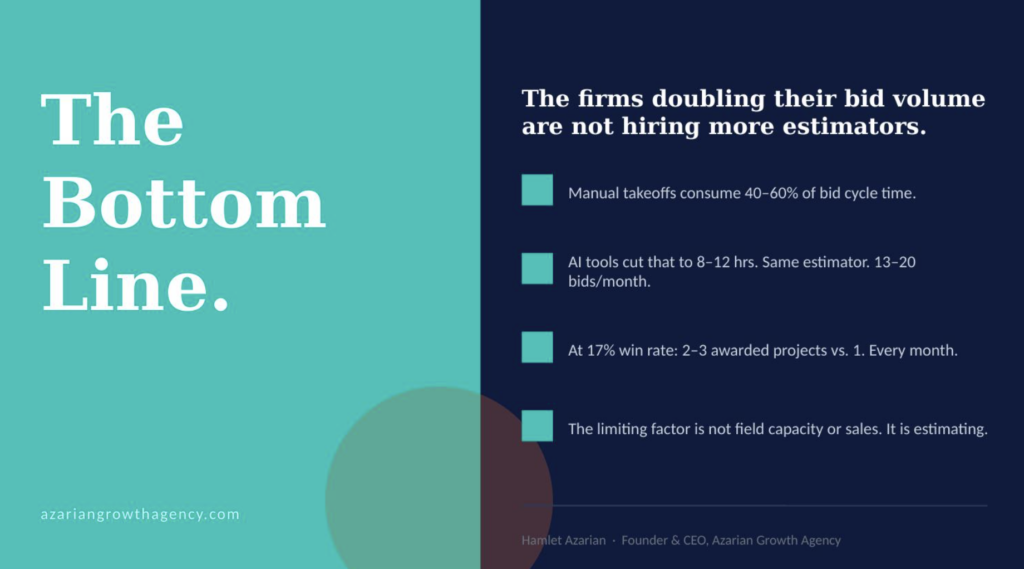
The firms doubling their bid volume are not doing it by hiring more estimators. They are doing it by removing the bottleneck that was limiting their existing estimators to 5 or 6 commercial bids per month.
AI takeoff tools do not replace estimating expertise. They eliminate the repetitive measurement work that consumes 40 to 60 percent of bid cycle time, freeing estimators to cover two to three times the volume with the same headcount.
For a GC where the limiting factor is how many projects the estimating team can price — not how many they can build or sell — that is a direct path to more pipeline, more revenue, and a structural cost advantage over competitors that have not made the shift yet.
The question is not whether these tools work. The data on that is clear. The question is how long a GC can afford to bid 5 jobs a month while a competitor bids 15.