
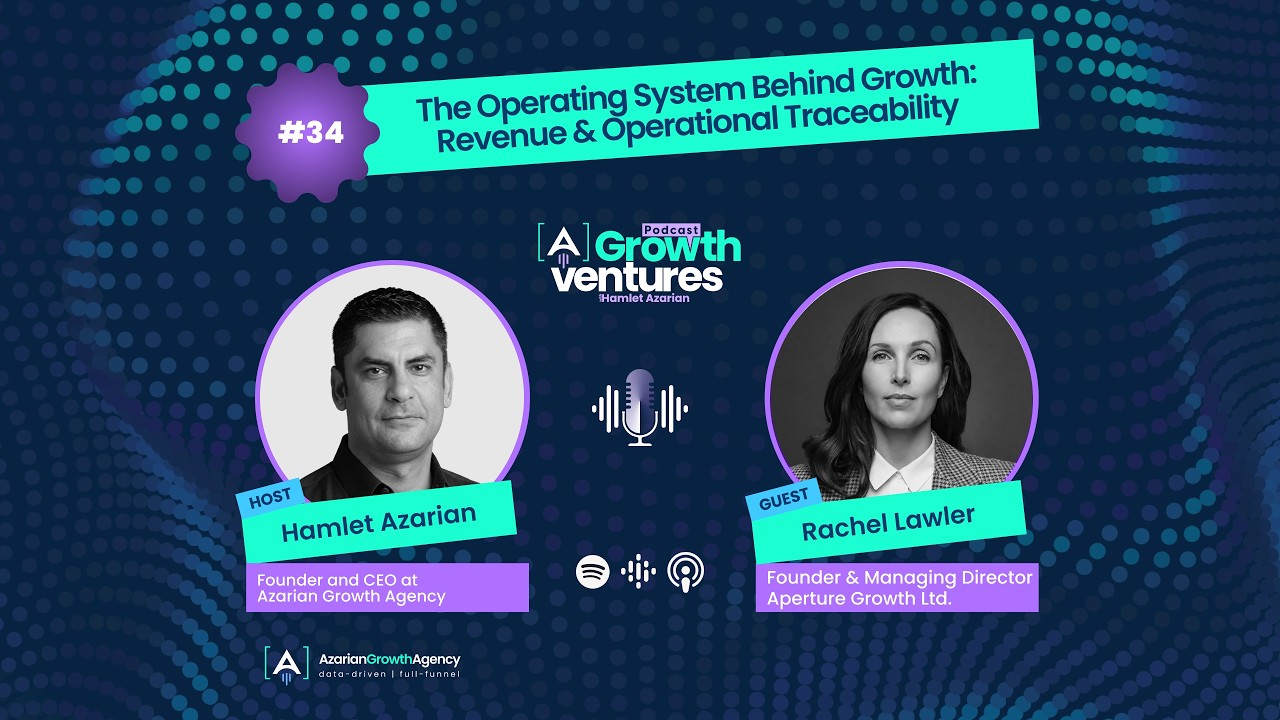
In this episode of the [A] Growth Ventures Podcast, Hamlet Azarian sits down with Rachel Lawler, Founder and Managing Director of Aperture Growth. Rachel is a growth operating partner who designs and builds commercial operating models for mid-market businesses.
With more than 20 years as a founder, operating investor, and advisor, Rachel has assessed hundreds of businesses for investment and worked alongside deal teams deploying more than $3 billion in capital. Her career spans startups, big law, M&A, private equity, and hands-on operating work.
This conversation explores why so many companies can report their revenue but can’t explain how they produced it. It also covers what that gap costs them in diligence, integration, and exit value.
Her central insight: a company’s operating model is now a strategic asset. It’s no longer about which apps you use. It’s about how your people, processes, technology, and judgment work together to move a dollar through the business.
What We Discussed with Rachel
1. Four Seats at the Same Table
Rachel explains how her background gives her four lenses on every business. The transaction lens shows what investors believe will create value. The operator lens shows how work and decisions actually move. The builder lens turns strategy into firm-owned workflows. The human lens preserves expert judgment while freeing people from acting as the glue between systems.
2. Why Deals Underperform After Close
From her time in deal development at Herbert Smith Freehills, Rachel saw the same pattern again and again: the underwriting case never matches what’s inside the business. Databases turn out to be incomplete, and new tech stacks and leadership changes pile up in the first 12 months. The buyers who win focus on how revenue moves and fix one or two blockers first instead of transforming everything at once.
3. Revenue Operational Traceability
Rachel’s biggest piece of advice for founders preparing to raise or sell: make every step from first lead to cash collection transparent. Just as FedEx tracks packages and finance teams keep ledgers, businesses need a revenue ledger. If moving a deal forward requires someone to manually jump between CRM, PowerPoint, and finance, the business carries key person risk and tech debt that buyers will discount.
4. The Signs That the “How” Is Missing
Rachel walks through the tells she looks for: revenue relationships that sit with the founder, reporting that shows outcomes but not the path to them, and handoffs that only exist in a slide deck. Others include wildly inconsistent close rates between tenured and new reps, and growth that creates more coordination cost instead of leverage.
5. Building a Blueprint of Your Business
Just like a house has electrical, plumbing, and structural plans, a business needs a map of its tech stack and every spreadsheet, call, or person holding it together. Rachel’s simple test: if a key person is unavailable, can the business still decide what happens next? If not, that capability belongs to the individual, not the company. She also argues that target market research should be owned by the business, not pushed onto reps chasing call quotas.
6. What Buyers See in Diligence
The fastest red flag is technical debt expressed as human coordination, like the one person in accounting who is the only one who can build bids. Rachel explains why there’s no universal valuation haircut and why sophisticated buyers quantify the cost of fixing infrastructure. She also shares why founders should stay on as close advisors after a deal. A rollup only becomes a platform when it shares one operating spine with the same systems, clean data, and no manual CRM updates.
7. Where AI Actually Delivers Today
Rachel separates probabilistic AI from rules-based automation and explains why the most effective wins come from building decision logic. She walks through a builder that could only produce one or two bids a week, and how an LLM plus automation layer can cut 75 to 80 percent of that manual work. Hamlet shares how AGA helped a contractor cut 500-page government RFP responses from one to two months down to a 15 to 20 minute first draft.
8. The Future: An Auditable Revenue Line
Rachel predicts that over the next 5 to 10 years, every major business will build a digital net of its operating model. Every human decision, automation, AI action, and system event will be timestamped in a ledger. That record becomes quality of earnings proof at exit and removes much of the founder risk and tech debt that drag down mid-market valuations.
Key Takeaways
- 01:40 – The four lenses Rachel brings to every business, and why the operating model is now a strategic asset
- 04:01 – Why the underwriting case never matches reality after close
- 06:29 – Revenue operational traceability: building a ledger from first lead to cash collected
- 08:59 – The signals that a company can report revenue but can’t explain it
- 12:16 – How to get knowledge out of the founder’s head and into company-owned systems
- 15:01 – Why target market research belongs to the business, not the rep
- 19:14 – Technical debt expressed as human coordination: the fastest red flag in diligence
- 22:49 – What turns a rollup into a platform: a shared operating spine
- 26:47 – Automation vs. probabilistic AI, and the bid process that got 75 to 80 percent faster
- 30:04 – Turning 500-page RFP responses from months into minutes
- 33:08 – The auditable revenue ledger and why it will earn a premium at exit
- 34:39 – Aperture’s 22-question go-to-market diagnostic
Final Takeaway
Rachel Lawler’s framework reframes what drives enterprise value. How much revenue a company generates is an outcome that shows up on the P&L. How it generates that revenue is an asset that shows up in the multiple, and most companies only manage the first one.
Whether you’re a founder preparing for an exit, a PE operating partner planning day zero, or a leader deciding where AI investment will actually compound, this episode makes one thing clear. Diligence, integration, and AI adoption are all the same question asked in a different room: can your business explain how it makes money without relying on one person?
Connect with Rachel Lawler


![[A] Growth Ventures - podcasts](https://src.azariangrowthagency.com/wp-content/uploads/2023/09/A-Growth-Ventures_logo.png)