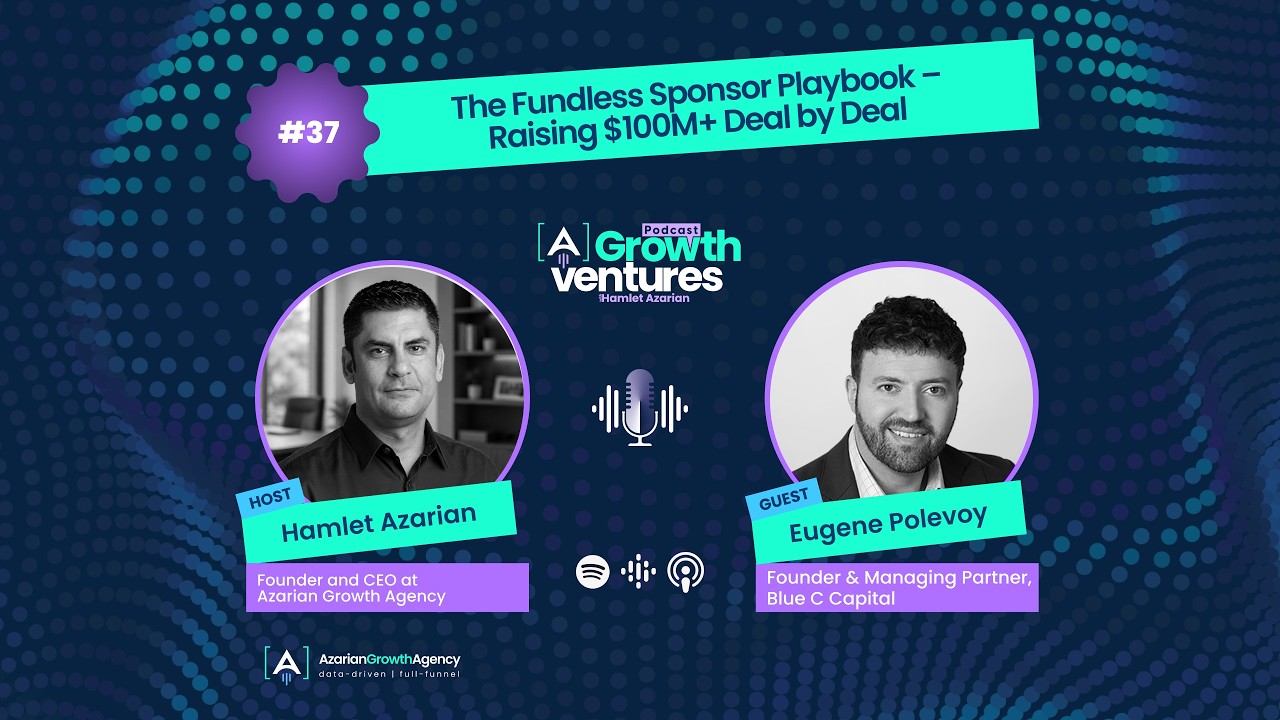
In this episode of the [A] Growth Ventures Podcast, Hamlet Azarian sits down with Eugene Polevoy, Founder and Managing Partner of Blue C Capital, an independent sponsor firm based in Toronto.
Eugene grew up working in his family’s auto repair shop, went to law school, spent three and a half years as an M&A banker at BMO Capital Markets, and then six and a half years at OnCap, Onex’s lower mid-market fund. Before launching Blue C, as a Principal at Imperial Capital, he built Frontier Service Partners, a Midwest residential HVAC platform, through three acquisitions in Ann Arbor, Fort Wayne and Kansas City, grew it organically from about $80 million to roughly $110 million in revenue, and sold it to Apex in 2024 after a hold of about two and a half years. Blue C’s first platform deal, Genset Holdings, a commercial generator services business, required raising more than $100 million and closed in 2025. Eugene sits on its board.
The conversation covers how the fundless model works in practice: why a sponsor needs their own capital both to survive until the first close and to co-invest for alignment, and why Blue C chose a de minimis management fee with carry above 20% so the firm plays for the exit. Eugene explains why he is skeptical of adjusted EBITDA, from add-backs for failed marketing campaigns to replaced employees and projected ERP savings, and how at 12 to 15 times, every $1 million of adjustments becomes $12 to $15 million of enterprise value with no cash behind it. He gives direct advice to founders preparing to sell, and walks through how Blue C loads its general ledger and customer invoices into an enterprise version of Claude to answer questions like last month’s retention in about ten seconds.
His central insight: the sponsor’s most important job is choosing the operator. Blue C walks away from more deals over the operator than for any other reason, and Eugene argues that a PE firm claiming credit for a portfolio company’s growth is “taking the wrong credit.” Data and AI help an operator make better decisions, but only someone who lives the business every day turns those insights into results.
What We Discussed with Eugene
1. From the Auto Shop to the Deal Table
Eugene grew up working in his family’s auto repair shop and worked as a mechanic before moving into law and finance. He finds that the operator background earns him more trust with sellers and management teams than it does with LPs.
2. How a Fundless Sponsor Works
Without a committed fund, an independent sponsor raises capital one deal at a time. Eugene explains why a sponsor needs their own capital, both to survive until the first close and to co-invest for alignment. Blue C charges a de minimis management fee and takes carry above 20%, so the firm earns its return at the exit. Its first platform, Genset Holdings, a commercial generator services business, required raising more than $100 million and closed in 2025.
3. The Add-Back Problem
Eugene is skeptical of adjusted EBITDA. He has seen add-backs for failed marketing campaigns, for employees who were replaced and for ERP savings that are only projected. At a 12 to 15 times multiple, every $1 million of adjustments becomes $12 to $15 million of enterprise value with no cash behind it.
4. Advice for Founders Preparing to Sell
Price almost always wins, so founders should prepare to earn it. Eugene’s advice is to clean up the financials early, including a proper cash flow statement, and to plan succession well before the sale process starts.
5. AI as a Data Cube
Blue C loads its general ledger and customer invoices into an enterprise version of Claude. Questions such as last month’s retention now take about ten seconds instead of hours in Excel. Eugene sees AI as a way to help an operator make better decisions, not as a replacement for one.
6. It’s a Company, Not an Asset
For Eugene, the sponsor’s most important job is choosing the operator. Blue C walks away from more deals over the operator than for any other reason, and he argues that a PE firm claiming credit for a portfolio company’s growth is “taking the wrong credit.” Only someone who lives the business every day turns data into results.
Key Takeaways
- 01:13 – From auto mechanic to sponsor: why an operator background earns more trust with sellers and management teams than with LPs
- 04:28 – Running a fundless firm: funding the search yourself, co-investing for alignment, and choosing carry over management fees
- 12:37 – The add-back problem: how adjusted EBITDA became aggressive, and why a 12–15x multiple turns $1M of adjustments into $12–15M of value from thin air
- 18:23 – Advice for founders preparing to sell: price almost always wins, so clean up the financials (including a cash flow statement) and plan succession early
- 28:59 – AI as a “data cube”: using enterprise Claude on the general ledger and invoices to get answers in seconds instead of hours in Excel
- 34:06 – Operator first: why Blue C turns down most deals over the operator, and why sponsors should not take credit for a company’s growth
Final Takeaway
Eugene Polevoy’s story shows how an independent sponsor competes without a committed fund. He puts his own capital at risk, ties the firm’s return to the exit rather than to fees, and underwrites the cash a business produces instead of its adjusted EBITDA. He uses AI to get answers from the books in seconds, and he treats the choice of operator as the decision that matters most.
Whether you are a founder preparing to sell, an operator weighing a sponsor partner, or an investor looking at the independent sponsor model, this episode makes one point plain: a business is a company run by people, not an asset on a spreadsheet, and its value comes from the operator who runs it every day.