
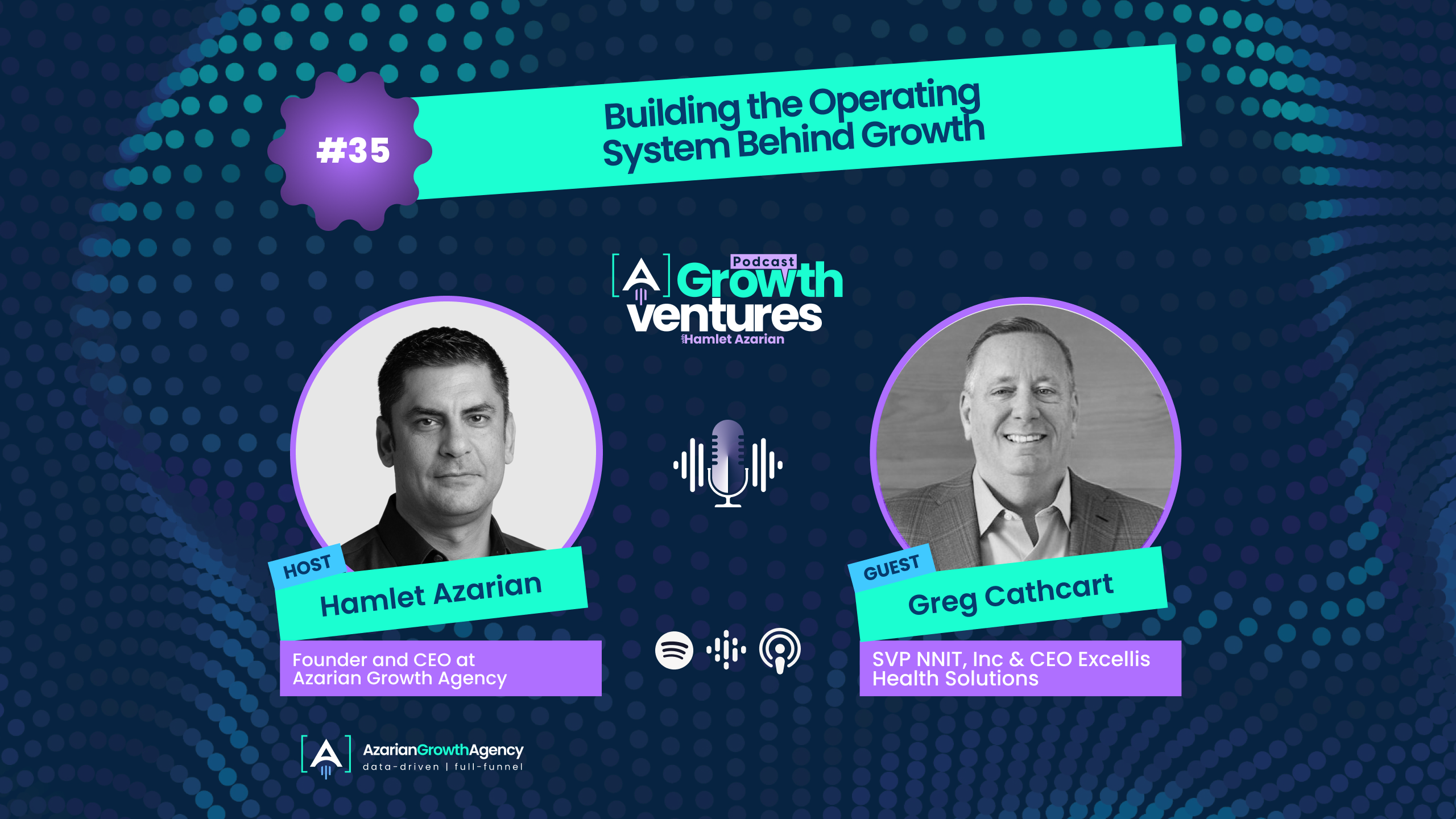
In this episode of the [A] Growth Ventures Podcast, Hamlet Azarian sits down with Greg Cathcart, founder of Excellis Health Solutions and now SVP and Head of NNIT US.
Greg founded Excellis in 2008 with a team he had already worked with for more than 20 years. The company focused on a problem the pharmaceutical industry hadn’t fully reckoned with yet: serialization, or tracking every unit of medicine through a global supply chain. He built the business ahead of the Drug Supply Chain Security Act, expanded into Europe and India, and sold to NNIT, a Danish IT services company. Then he stayed on, not for a short handoff, but as an operator leading the acquirer’s entire US business.
This conversation explores what building to sell actually looks like, why Greg walked away from a PE deal at the closing table, and what life looks like inside a strategic acquirer.
His central insight: the biggest opportunities come from spotting an industry shift early, earning credibility before the wave hits, and then leading it when everyone else is scrambling to catch up.
What We Discussed with Greg
1. Starting a Company with People You Already Trust
Greg and his co-founders had worked together at Johnson & Johnson and QAD, which went public in 1999. That history meant they knew each other’s strengths and weaknesses from day one, and none of them needed the next paycheck. Around year two, they formalized an operating agreement with two share classes: voting stock for the majority investor and phantom stock for the other founders, who received the same value per share at exit without the decision-making rights.
2. The Problem That Created a Market
Greg explains how counterfeit drugs, including fake anti-rejection medication that led to patient deaths, pushed the industry to ask the FDA for real enforcement. In some developing countries, counterfeits made up 25 to 35 percent of the drug supply. The DSCSA became law in 2013 with a 10-year rollout, and large manufacturers faced years of work and hundreds of millions of dollars in investment to comply.
3. Owning the Program, Not All the Work
Excellis competed against the biggest consulting firms in the world. Its edge was domain depth. Rather than doing all the heavy lifting, the team ran the compliance programs and brought in partners where needed. The stakes were clear: a site that wasn’t compliant couldn’t ship product. As regulations spread globally, Excellis acquired a two-person team in Europe that led that market and grew it into a group of more than 20.
4. Building the Business to Be Bought
Around year six or seven, at $10 to 12 million in revenue with no debt, Greg brought in a former colleague with a CPA and private equity background. His advice: restate the financials on an accrual basis, invest in the brand, and put operational processes in place. As Greg puts it, the team had been “a bunch of cowboys,” and buyers needed something of substance to take over.
5. Walking Away at the Closing Table
By 2019, Excellis had about 120 people and revenue in the low $20 millions. After a PE bake-off, the final bidder tried to change terms at closing. Greg walked away because the business didn’t need the deal. Then COVID hit. PE firms came back looking for a discount, and Greg said no again, confident the business would recover.
6. Why a Strategic Buyer Was the Right Fit
NNIT approached Excellis through KPMG in 2020. Greg asked them to honor the pre-COVID term sheet, and PPP support meant no one had been laid off. The PE earnout would have tied 30 percent of his future payout to tuck-in acquisitions he didn’t control. NNIT’s three-year earnout was based on clear top-line and bottom-line goals, and Greg kept full control of the business. He created a secondary option pool so every employee shared in any overperformance. His take: strategics often pay more because they’re buying to keep you, not to flip you in three to seven years.
7. Advice for Founders Preparing to Sell
Greg’s first recommendation is to get support from a mid-market investment bank, since bankers know the game and usually work on success fees. He shares how a neighbor who used the same bankers ended up with about 20 percent more. Beyond that: keep your books perfect, build a management structure that can scale, and invest in young talent. Excellis hires 8 to 10 college grads every year, and one former country club caddie now runs a 30-person group that’s going global.
8. The Next Wave: NDC Codes and 2D Data Matrix
COVID used up so many National Drug Codes that the industry must move from 10 digits to 12. UPC barcodes will be replaced by 2D data matrix codes, which affects every packaging line, ERP system, and scanner in the supply chain by 2033. Companies like Teva have 6,000 products to relabel, and Greg estimates the industry will spend billions. NNIT has already run pilots with about 20 customers and presented the findings alongside the FDA.
Key Takeaways
- 01:21 – Why Greg’s founding team had worked together for more than 20 years before launching Excellis
- 04:24 – Structuring founder ownership with voting stock and phantom stock
- 05:43 – What the DSCSA is and how counterfeit drugs pushed the industry to regulate
- 09:29 – How Excellis helped manufacturers interpret and execute compliance programs
- 10:41 – Competing with global consulting firms by going deeper on domain expertise
- 12:23 – Acquiring a two-person European team to follow customers into new markets
- 13:36 – Preparing to sell: accrual accounting, brand building, and operational processes
- 16:00 – Walking away from a PE deal at the closing table, right before COVID
- 17:13 – How NNIT came in as a strategic buyer and honored the pre-COVID terms
- 18:47 – Structuring the earnout and sharing upside with every employee
- 22:30 – Strategic vs. PE: why the right partner matters more than the type of buyer
- 25:21 – The three things founders should do before selling
- 29:46 – The NDC code change and the shift from UPC to 2D data matrix
- 33:17 – The playbook: find the disruption early, win the pilots, and lead the wave
Final Takeaway
Greg Cathcart’s story is a playbook for building a company with an exit in mind without losing sight of the people who built it. He formalized ownership early, cleaned up the books before buyers asked, walked away from a deal that wasn’t right, and chose a partner that let his team keep running the business.
Whether you’re a founder weighing PE against a strategic buyer, an operator preparing for diligence, or a leader in a regulated industry watching the next mandate take shape, this episode makes one thing clear. The best exits come from patience, preparation, and being early to the problem everyone else will eventually have to solve.


![[A] Growth Ventures - podcasts](https://src.azariangrowthagency.com/wp-content/uploads/2023/09/A-Growth-Ventures_logo.png)